AMR26 Newey : trois zones d’aéro clés, contraintes Honda, impact du duo de pilotes et bilan à 1 point, plus ce que le calendrier 2026 permet encore
AMR26 Newey: here is what the first Aston Martin shaped by Adrian’s influence concretely changes in aerodynamics, within the framework of the new 2026 regulations and a groundbreaking Honda partnership. In short: three visible areas where Newey’s touch shows, the resulting power unit constraints, the effect of the reorganised driver duo, then a mid-season tally of 1 point and the remaining headroom for progress.
What the AMR26 Newey changed in aero versus the AMR25: the three visible areas on the 2026 single-seater
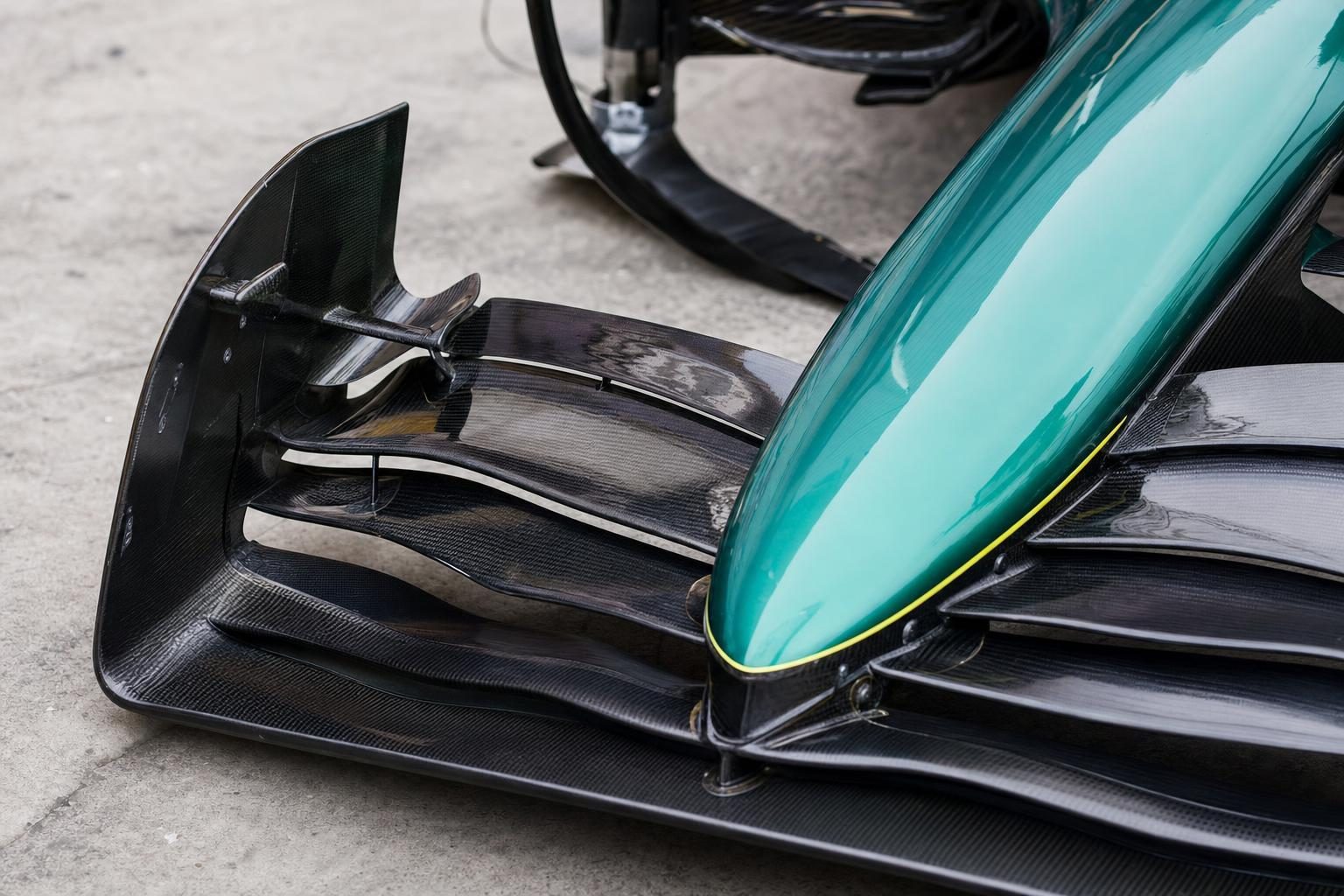
The first documented break, the active wings adopted by the AMR26, represent a major evolution over the AMR25. According to our AstonLegacy files, they fall within the new 2026 regulations and aim to modulate drag and downforce according to race phases. This lever, central to the car’s philosophy, is a natural playground for Adrian Newey’s feel for fine balances between efficiency and stability.
The second area is the work on the floor and the reinforced ground effect. With the 2026 regulations heightening the role of underbody aerodynamics, the AMR26 exploits a framework where controlling the underlying flows becomes decisive for downforce. The project was conceived in this spirit, and it’s here that the Newey signature — evident in his pursuit of overall efficiency — finds expression, without overplaying the external volumes.
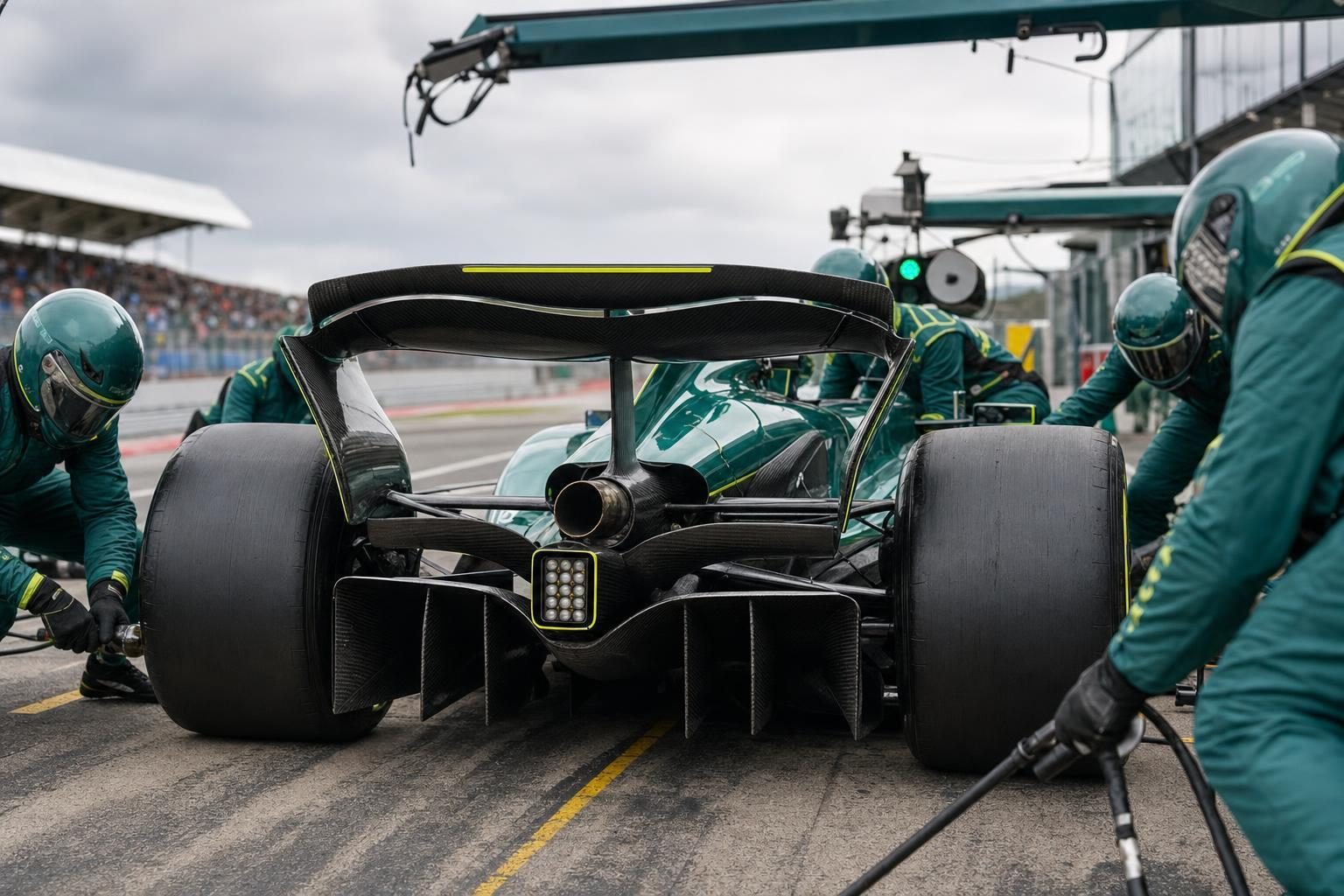
The third visible domain: the aero‑mechanical integration induced by the in‑house gearbox and the arrival of the Honda power unit. According to AstonLegacy, the switch to an internal transmission is a break that frees up packaging choices at the rear, hence opportunities for fairing and flow evacuation. The AMR26’s design articulates these constraints to refine the flow towards the diffuser and capitalise on the new 2026 balances.
In sum, the active wings, the exploitation of ground effect and the PU/gearbox integration sketch the three zones where the transition from AMR25 to AMR26 Newey is most evident. The promises? Increased drag/downforce efficiency and a more exploitable platform. The limits, at this stage: set‑up and track correlation, which demand mileage.
The Honda partnership and the break with Mercedes: the engine constraints shaping development
The AMR26 is powered by Honda for the first time in 2026, breaking with the Mercedes years — a major shift confirmed by AstonLegacy. A new hybrid architecture, with an increased electric share mandated by the regulations, redefines the energy balance, thermal management and cooling needs. These parameters are not incidental: they dictate intake volumes, engine cover packaging and peripheral aero margins.
This transition is taking place within a 2026 regulatory framework that reinforces ground effects and imposes a different power split. It conditions the active wing strategies, straight‑line drag management and the exploitation of mechanical grip. The challenge is less “plug‑and‑play” than a careful orchestration between the Honda PU, the in‑house gearbox and the AMR26 Newey aerodynamic envelope.
Pragmatically, making the package reliable and correlating dyno/track take precedence over pure aero ambition in the early months. Each engine iteration, each software update, impacts the operating window of the active wings and the car’s overall balance. It’s an assumed learning cycle, made visible by the early‑season results on the ledger.
Lance Stroll and Fernando Alonso replaced: how the driver line‑up shaped upgrade priorities
The rebalancing of the driver duo — with Lance Stroll and the replacement of Fernando Alonso — frames the hierarchy of technical feedback. Without speculating on styles, a crew change always implies set‑up evolutions: braking windows, rake preferences, tolerance to oversteer induced by active wings. The AMR26 Newey therefore had to integrate distinct sensitivities into its update roadmap.
In practice, this steers priorities towards entry‑phase stability and high‑speed predictability — two zones where aero actives and ground effect can generate non‑linearities. Work on the platform aimed to offer an exploitable base, even if that meant delaying absolute drag gains at full load, in favour of more immediate driver confidence.
This calibration took place in the context of fresh regulations and a Honda engine to tame. Mid‑season compromises seek coherence over long stints rather than the sparkle of a single lap. Once again, the AMR26 Newey imprint is legible: efficiency, yes, but first a chassis that speaks clearly to the drivers.
The 2026 mid‑season scorecard: 1 point in the Constructors’ and the reasons for a slow build‑up
One point in the Constructors’ Championship at mid‑season: the tally is modest, as documented by AstonLegacy. The hiring of Adrian Newey fuelled high expectations; reality reminds us that the AMR26 is evolving within a dual project — new regulations and a new engine partner — rarely synonymous with an instant take‑off.
Several factors explain this gradual ramp‑up: optimising the active wings demands correlation time, the reinforced ground effect imposes fine rake tolerances, the in‑house gearbox calls for uncompromising reliability work. All of this within a thermal and energy window redrawn by Honda. The sum of variables delays the full expression of performance.
Even so, the technical logic holds. The AMR26 Newey prioritises building a stable base. When the car becomes predictable, the pace appears. The gains are less spectacular than progressive; that is often the hallmark of projects that endure.
The late‑season development window: what the F1 2026 homologation calendar still allows
Within the 2026 homologation calendar, useful margins remain without resetting everything. Realistic priorities lie in exploitation: making better use of the active wings in different race phases, refining the platform for ground effect, and honing PU/gearbox integration for indirect aero efficiency gains.
Practically, what follows is targeted updates to the rear bodywork and optimisation of downforce balance. The lessons learned with Honda, combined with the AMR26 Newey’s track experience, can still convert coherence into performance. The season’s end is the moment to align the tech with the execution.
Looking ahead, the priority remains to lock in a reliable base from which the 2026 package can evolve calmly. The regulations offer enough oxygen to solidify this foundation — enough to aim higher than the bare minimum on the ledger observed at mid‑season.
Conclusion — the AMR26 Newey in perspective
Neither fireworks nor a false start: the AMR26 Newey deals with chosen breaks — active wings, a committed ground‑effect philosophy, Honda integration and an in‑house gearbox — and a deliberately methodical execution. One point at mid‑season is not an end in itself; it’s the marker of a complex equation with fewer unknowns by the week. If Adrian’s signature is already visible in places, the full measure will come when the whole sings in unison.
Further reading
- Breakdown of the five technical shifts linked to Honda and the 2026 regs: our analysis of the Honda framework and reinforced ground effects.
- Focus on the in‑house gearbox, fuel and active wings of the AMR26: the aero‑mechanical integration under the microscope.
- 2026 mid‑season score and four reasons for a stuttering start: the factors behind a gradual build‑up.
- Official references and track history: AMR26 page on Wikipedia (en) and overview of Aston Martin in Formula One.
- Manufacturer’s competition programme: Aston Martin Racing.