V12 Vantage 2009 : comment un pari d’ingénieurs a contourné la logique de gamme et inspiré l’esprit AMR jusqu’en 2022. Trois clés, sans fard.
The V12 Vantage was born in 2009 from as much an engineers’ wager as enthusiasts’ conviction: transplant the naturally aspirated 6.0-litre V12 from the DB9 into the Vantage’s compact chassis, then turn it into a viable limited series. Here, in three acts with a few nuances, is why this technical counter-move came before range logic and how its spirit flowed into the S and AMR versions right through to the 2022 Roadster.
Dropping a V12 into a Vantage: the chassis compromises the engineering team accepted
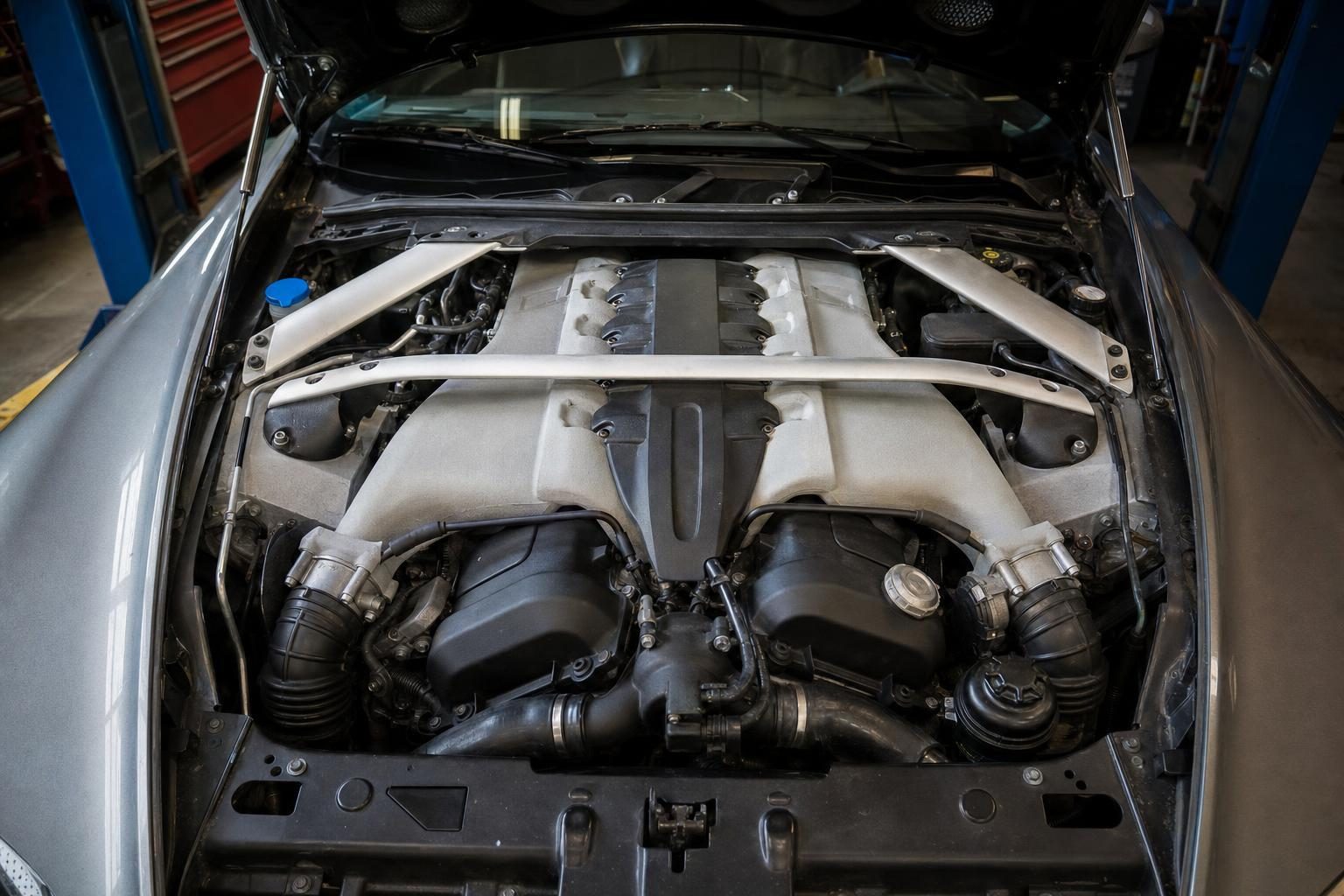
From the outset, the challenge was clear: marry a 6.0-litre 510 PS V12 from the DB9 to a more compact shell. According to our reference file, the team adapted the Vantage’s aluminium VH platform via substantial modifications to the bulkhead and transmission tunnel. This was no simple swap: we’re talking structural adjustments to package the layout and dissipate the thermal loads of a naturally aspirated twelve-cylinder.
These compromises sit within a long industrial story: the VH platform underpinned the DB9, DBS, Rapide and Vantage for nearly two decades. Adapting this modular backbone to a larger mechanical heart owed as much to sound engineering sense as to the tenacity of a few believers. Here, product logic yielded to workshop spirit.
The result rests on a deliberate balance: more mass and inertia up front, offset by exploiting a short wheelbase and a sharpened chassis. The V12 Vantage didn’t try to hide its genes; it harmonised them like tuning a baby grand in a compact room: methodically, with a dash of audacity.
The decision to build a limited series: why the programme could have remained a Nürburgring prototype
At Gaydon scale, this project could have remained a demonstrator, somewhere between a development mule and a Ring toy. According to our internal archives, the shift to limited production came once the thermal and structural viability of the installation had been proven. Interest from an informed audience did the rest: the car found its crowd before portfolio logic caught up with it.
Building in small numbers preserved the allure of the coup while avoiding collisions with other VH-based models. The limited series here acts like a safety valve: it permits the exception without upending the internal hierarchy. Implicitly, you read a simple strategy: validate the idea on the road and, if the alchemy works, extend it without dilution.
Thus the V12 Vantage shed its UFO status to become a gateway to a more radical signature, future inspiration for the AMR approach. It wasn’t a concession to marketing so much as prudence capitulating to mechanical self-evidence.
The internal comparison with the DBS: what the V12 Vantage gains in handling and what it gives up in comfort
Sharing VH DNA with the DB9 and DBS, the V12 Vantage still stakes out different ground. Against the DBS, it gains a sense of immediacy: shorter wheelbase, greater density, the V12 closer to the driver. That’s the stance of a compact sports car, not a long-haul GT. The short body, reinforced to house the twelve-cylinder, promotes direct steering and a more expressive front end.
Conversely, it gives up plushness and isolation, a contrast made plain in-house. The DBS capitalises on stretch and calm; the V12 Vantage on engagement and response. Two interpretations of the same mechanical theme, separated by tempo: andante on one side, allegro on the other.
This win–lose decoupling isn’t a flaw but a signature. It explains why the V12 Vantage first attracted drivers who want to feel the engine working within the shell, not floating above it.
The S and AMR versions (2011–2018): 4 changes that extended the model’s life without diluting the original idea
Continuity rests on one principle: don’t touch the architecture, heighten the intensity. From our files, the V12 Vantage S arrived in 2011 with an increase to 565 PS, while the AMR peaked in 2018 at 595 PS. Between the two, the recipe didn’t change: same platform, same format, same spirit. Here are four axes that extended the model’s life without watering it down.
- Power and breathing: the incremental rise in output stayed faithful to the naturally aspirated V12, with no hybridisation or forced induction.
- Cooling and flow: intake tweaks and thermal management supported the power hike, always within the VH envelope.
- Chassis tuning: damping and calibration refined to contain added inertia while keeping the bite of the short footprint.
- AMR signature: a more committed reading of the same theme, conceived as an extension — not a rewrite — of the original idea.
In practice, neither the S nor the AMR betrays the 2009 promise. They amplify its contrasts and, in doing so, set the tone that would inspire the rest of the range loyal to the AMR badge.
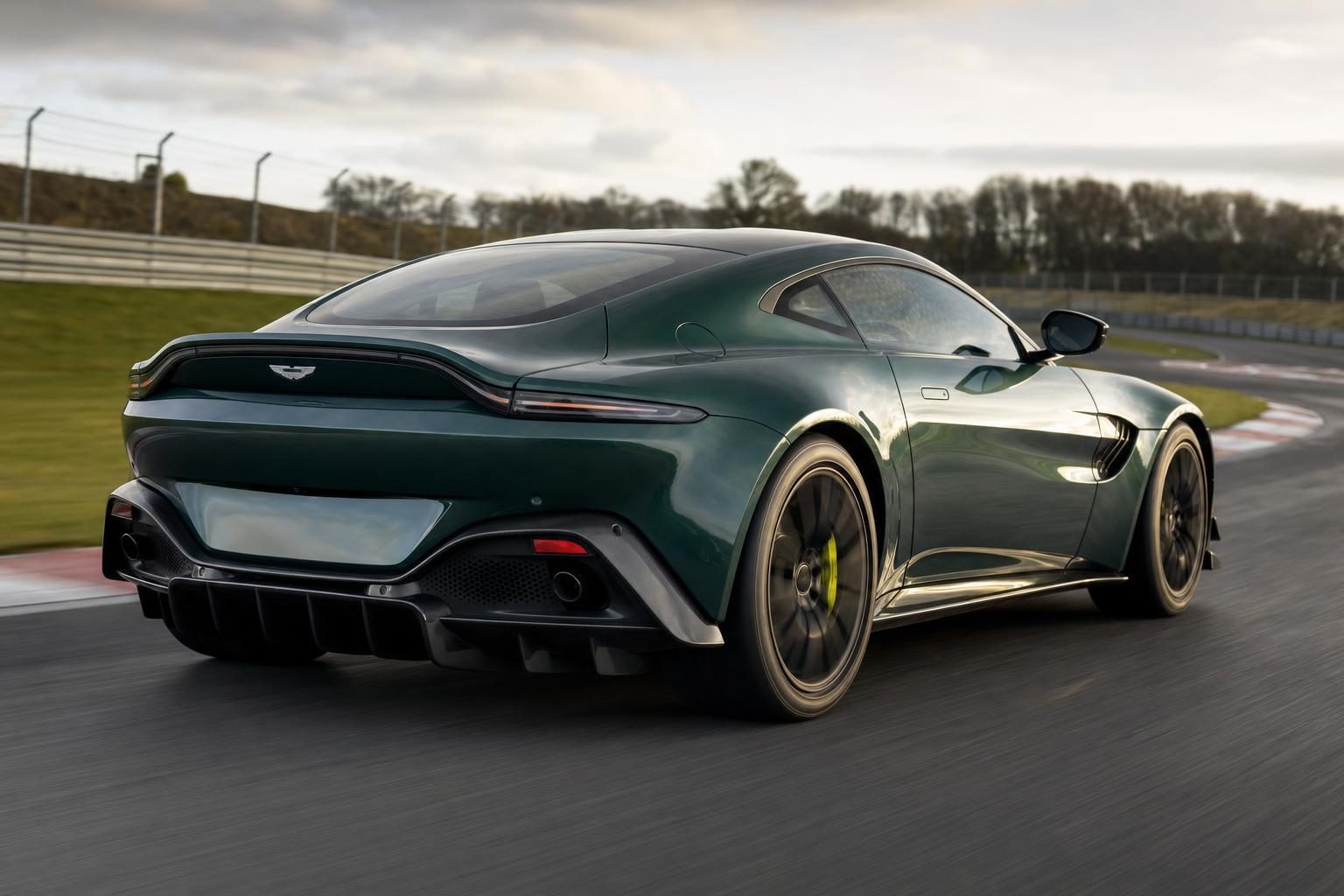
The 2022 V12 Vantage Roadster and auctions: the end of the naturally aspirated V12 cycle at Aston Martin
The 2022 V12 Vantage Roadster closes the loop for naturally aspirated V12s at Gaydon. Built in limited series, it immediately commanded values above list, a sign of appetite fed by rarity and by the story the bloodline has written since 2009. According to our range recap, it’s the full stop of a cycle, not a comma.
What matters here isn’t just the final open body: it’s the culmination of a path begun by a bold transplant. The market understood it, and so did the auctions. In this final reading, the V12 Vantage retains the purity that made it desirable: a naturally aspirated engine, compact format, and that sense of mechanical closeness numbers only half convey.
Within a VH family shared by DB9, DBS, Rapide and Vantage, this model’s trajectory draws a diagonal: from opportunistic engineering to an assumed signature. A parenthesis, yes, but written in indelible ink.
Conclusion — V12 Vantage, when logic bows to self-evidence
Three simple lessons define the V12 Vantage: dropping a V12 into a short chassis demands owned structural compromises; a limited series can be a full-scale validation strategy; and the continuity through S then AMR extended the idea without dilution, up to the 2022 Roadster that signs off a naturally aspirated cycle. The V12 Vantage got ahead of range logic because it first convinced where everything begins: at the wheel.
To place this model in context, explore our guide to the genealogy of the V12 Vantage and its major evolutions, our analysis of five reasons that gave birth to the 2009 project and the file on the aluminium VH platform shared for twenty years.
To go further: see the detailed entry on the history and variants of the V12 Vantage, browse Aston Martin’s past-generation models, and visit the official media hub dedicated to the V12 Vantage.