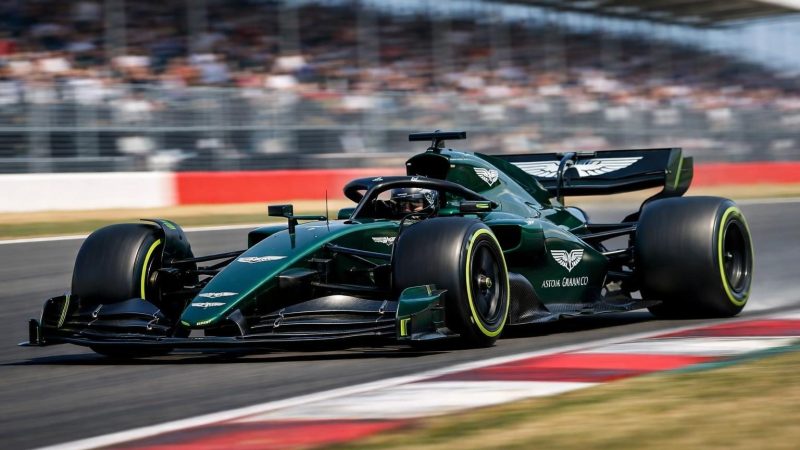
AMR26 Honda 2026, focus on in-house gearbox, active aero, expanded MGU-K, Aramco sustainable fuel and Honda RA626H power unit, from the Silverstone side.
The AMR26 Honda is Aston Martin’s first car of the 2026 era conceived around the new rules, with five ruptures that redefine both design and on-track operation. We review these technical pivots — in-house gearbox, active aerodynamics, reinforced MGU-K, 100% sustainable fuel and Honda power unit — through the very concrete lens of what the Silverstone team is changing, learning and risking.
The first gearbox developed in-house since 2004: why it matters
According to Aston Martin, the AMR26 debuts an eight-speed semi-automatic gearbox designed in-house, a first at Silverstone since 2004. This choice breaks with the era of purchased, locked components and restores control over a unit that dictates chassis–engine integration and energy management. The aim is clear: optimise mass, packaging and rigidity for a more compact, more electric 2026 architecture.
The impact goes beyond packaging. By taking responsibility for kinematics and materials, the team can synchronise shift maps, torque dampers and electric torque strategies with the needs of the Honda RA626H. System coherence comes first: aligning mechanics, calibration and software creates performance margins that an external component often limits.
Finally, mastering the gearbox reshapes maintenance and upgradability. Iteration cycles, from track to dyno, shorten. In a regulatory framework where active aero and hybridisation stress the transmission differently, this internal control is as much a defensive as an offensive advantage, as the AMR26 spec sheet published by Aston Martin reminds us.
Active aerodynamics in 2026: Corner Mode, Straight Mode and what it changes on track
The 2026 regulations mandate fully active front and rear wings operating in two states: Corner Mode (maximum angle of attack) and Straight Mode (drag reduction), not relying solely on DRS, according to the official AMR26 presentation. The objective is twofold: restore downforce in corners and unlock top speed on the straights, via real-time orchestration of incidences.
For a team, this transforms both the driver’s tool and the engineer’s tool. The interaction between aero modes, rake and brake balance becomes a living triptych. Braking grip, mid-corner stability and re-acceleration are tuned as much by the actuation logic of the flaps as by springs and bars. In practice, mode mapping must anticipate wind, traffic and tyre state.
The flip side is software. Ensuring watertight Corner/Straight transitions, preventing oscillations and anticipating destabilisation in gusts require predictive control. It is a new craft that brings aerodynamics closer to energy strategy and the transmission, a topic we detail below. The foundations are set out in Aston Martin Racing’s technical content.
The next-generation MGU-K and bidirectional torques in the transmission
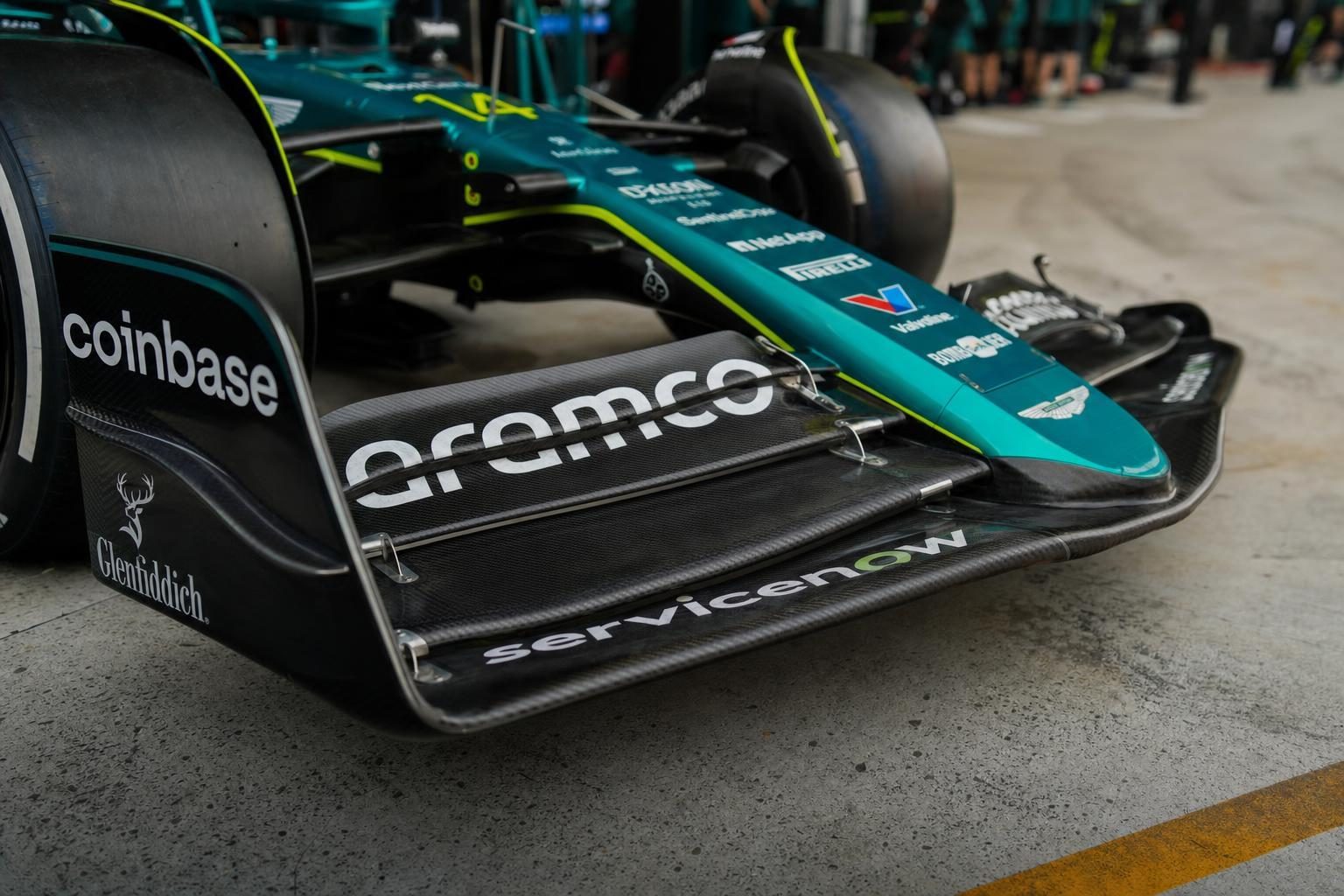
Per Aston Martin, the 2026 MGU-K delivers and harvests significantly more energy than before. For the transmission, that means handling high torques in both directions: propulsion when deploying, resistance when regenerating. Gears, shafts, bearings and torsional damping are sized to withstand more frequent, more intense shocks.
The novelty is as much mechanical as software-based. Clutch and engine torque maps must smooth the switch between traction and regeneration without unsettling the chassis at the apex. The longitudinal balance perceived by the driver depends on this smoothing, synchronised with active aero transitions. Here, the in-house gearbox becomes an asset: the alignment of torque ramps, phasing and synchronisations is managed to a tenth of a second.
On track, expect crisper low-end launches and more aggressive regeneration strategies approaching braking zones. At Silverstone and elsewhere, this forces a rewrite of differential and traction-control maps, for a homogeneous chassis–propulsion package, as described in the AMR26 documentation.
Aramco ProForce+: 100% sustainable fuel as constraint and technical opportunity
Aston Martin specifies that Aramco exclusively supplies ProForce+, a 100% sustainable FIA-compliant fuel derived from non-food biomass or municipal waste. This chemistry changes calibration fundamentals: volatility, flame speed, latent heat and lubricity dictate ignition timing, injection pressure and thermal strategy.
The constraint can become an opportunity if the engine and intake are designed around this profile. Tumble and swirl targeting in the chamber, injector geometry and intake air temperature management are tailored to the ProForce+ window. On track, performance repeatability between batches is essential; direct engine–fuel collaboration reduces variables.
For the team, integration extends to electrical recovery. Higher-efficiency combustion improves the thermal/electric energy balance, hence the MGU-K deployment strategy. The AMR26 page at Aston Martin makes it a pillar of the 2026 package.
Honda RA626H: what the return of a Japanese power unit supplier brings to Silverstone
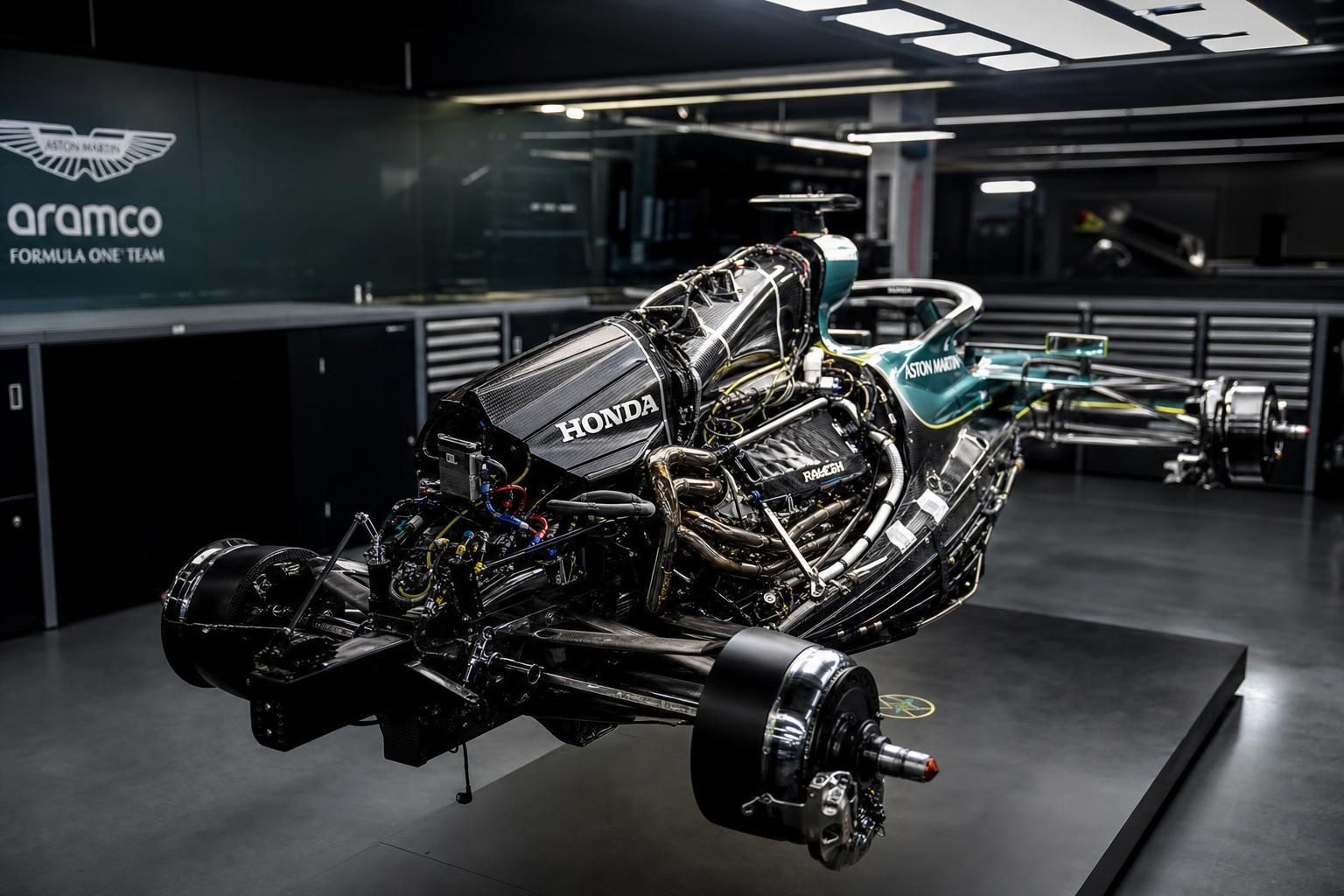
According to Wikipedia, the AMR26 is powered by the Honda RA626H, the first Honda engine to power an Aston Martin in F1, and the first non-Mercedes engine on a Silverstone-based single-seater since Force India’s Ferrari in 2008. This change goes beyond the badge: architecture, hybridisation philosophy and integration tools differ.
The collaboration imposes a new technical interface: electrical systems, cooling, mounting and accessory inertias are aligned to Honda specifications. For aerodynamics, the packaging of the power unit and heat exchangers redefines the side volumes and rear profiling. The freedom gained with the in-house gearbox eases this junction.
Operationally, Honda brings testing methods and dyno/track correlation. The iteration loop between the RA626H, the reinforced MGU-K and active aero runs through coordinated map sets. It is a measured yet profound cultural shift: the team adjusts its procedures, and the drivers tune their style to the torque delivery and regenerative braking associated with the Honda package.
Conclusion — AMR26 Honda, five ruptures that rewrite integration
With AMR26 Honda, the 2026 edition is no mere facelift. An in-house gearbox, two-faced aerodynamics, a more powerful, reversible MGU-K, 100% sustainable fuel and an all-new RA626H engine form a coherent whole. Performance will hinge on the fine integration of these building blocks, as much as on trackside execution.
For further context, readers can revisit our analysis of the AMR26’s debut and the Honda partnership, place these choices within Aston Martin’s long history and, on the road-car side, explore the DB9’s evolution and architecture. The factual elements detailed by Aston Martin and summarised by Wikipedia frame these ruptures; the season will tell how Silverstone turns them into lap time.