AMV8 Aston Martin, 17 ans de production, Vantage 1977 et Volante : six anecdotes sourcées sur la survivante des années 1970-1980 et ses marchés clés.
AMV8 Aston Martin, or the art of enduring when everything around it changes: this piece gathers six sourced anecdotes on the coupé born in 1972, its standout variants — the 1977 Vantage and the Volante — and the markets that kept it afloat until 1989. On the menu: atypical industrial longevity, disputed top-speed figures, the crucial role of the United States and the Middle East, sometimes forgotten projects, and a useful read on the traceability of a model shaped over four successive managements.
17 years and 4 owners: the production longevity that defies industrial standards
From May 1972, the designation “Aston Martin V8” replaced the DBS V8 when the car adopted a single-headlamp front end, according to reference data on Wikipedia. This name change marked the start of an unusually long cycle for a V8 grand tourer: production stretched to 1989 — seventeen years of continuous evolution on the same base, a singular case in the industry.
Over this period, the company passed through the hands of at least four owners, among them the Gauntlett family and Ford, which took control in 1987 according to the marque’s history. And yet, despite these major transitions, the coupé remained in the catalogue, reconfigured to suit the priorities of the moment. The most notable fact is not so much the raw longevity as its ability to stay relevant amid shifting industrial and financial contexts.
Introducing strategic variants proved decisive. According to official and encyclopaedic histories, the new owners launched the V8 Vantage in 1977, then the Volante in 1978, before the Bulldog concept in 1980. In other words, longevity was not simple conservatism: it was a methodical adaptation, with the Aston evolving just enough to remain coveted without betraying its character.
The 1977 Vantage: the era’s most powerful version and its disputed figures
The V8 Vantage announced in 1977 stands out as the sharpest iteration of the programme. In the specialist press of the time, there is a documented divergence on its top speed: some sources claim an official figure beyond 170 mph, or 273 km/h, while others place the maximum at 168 mph. This ambiguity — rare today — recalls a time when test protocols, conditions and exact configurations could move the needle.
Beyond the number, the essence lies elsewhere: the Vantage repositioned the GT as a credible British alternative to top-tier sports cars. This role, attributed by the marque’s histories, helped maintain the programme’s appeal and gave a technical backbone to the entire V8 range in the late 1970s.
This debate over v-max still fuels insider conversations. Above all, it illustrates a reality: the 1977 Vantage’s performance, in a demanding across-the-Channel context, contributed to the endurance reputation of the whole lineage, including the more civilised versions.
The Volante and the markets that saved the marque: United States and Middle East
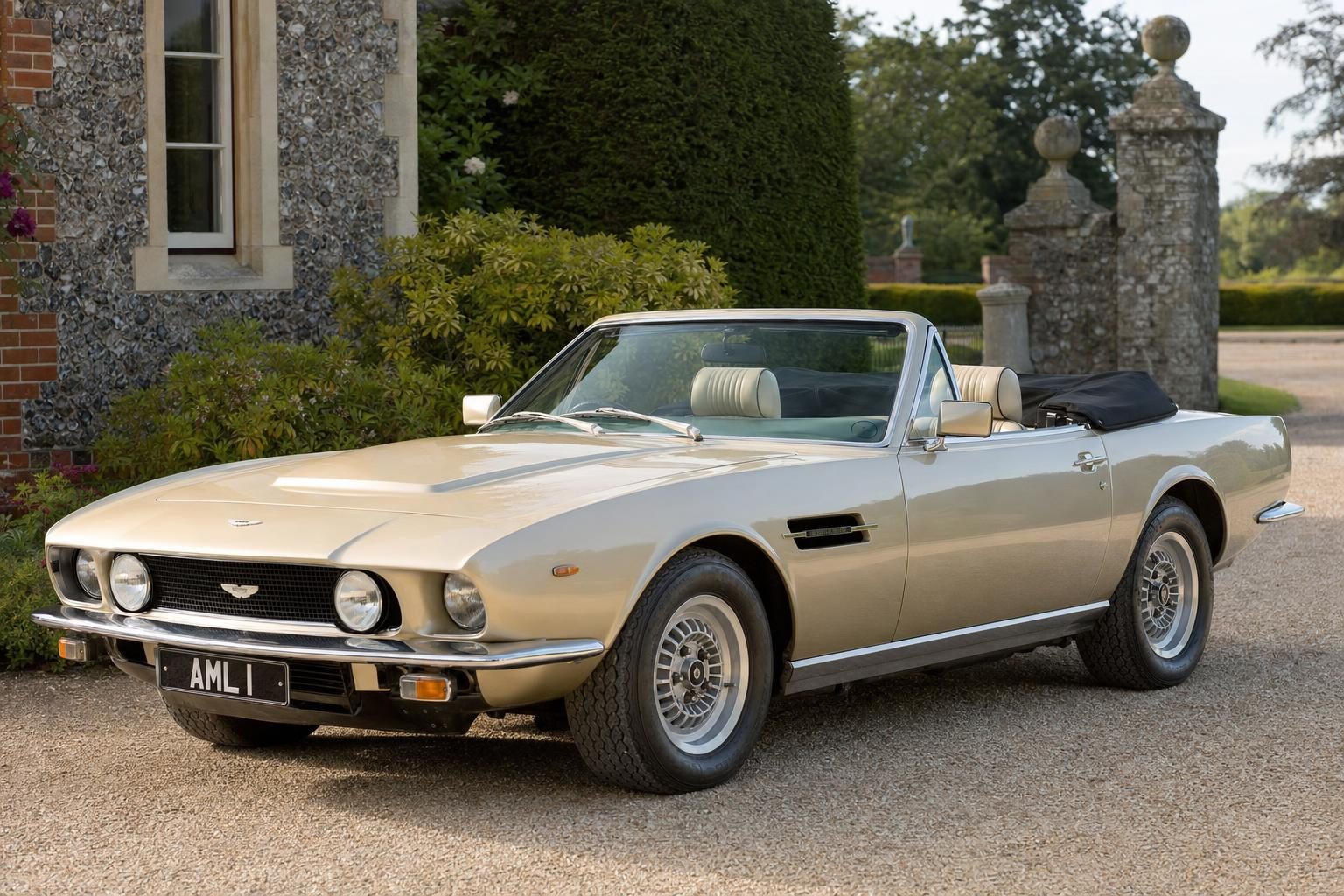
Launched in 1978, the Volante proved a sound bet. According to general histories, the convertible became an essential commercial tool in the 1980s, particularly in the United States and the Middle East. These markets, receptive to characterful GTs and open body styles, provided the volume and margin vital to the financial survival of a still-fragile company.
The Volante’s merit was not merely aesthetic. In these strategic destinations, the open silhouette reinforced the marque’s identity and established the idea of a long-distance grand tourer, elegant yet capable. In return, international demand consolidated the industrial viability of a car built at a measured pace.
To explore the broader context, our dossier on the marque’s DNA offers a useful framing of cycles of crisis and rebound. Read here: histoire de la marque et culture de légende.
Forgotten variants: Nimrod, Bulldog and the abandoned projects of the 1980s
The 1980s saw some bold avenues take shape. In 1980, the Bulldog concept — mentioned in encyclopaedic sources — embodied an experimental, near-manifesto vision that spoke to a desire for stylistic and technical rupture. It never made production, but its existence says much about the ambition of the moment.
In a more sporting register, the Nimrod C2 programme, derived from the V8 engine, entered Group C. According to Wikipedia, the car placed 7th at the 1982 24 Hours of Le Mans. Modest in absolute terms but significant given the resources, this result fed the V8’s aura in endurance racing.
These parallel paths — spectacular concept on one side, endurance on the other — enriched the V8’s technical genealogy. They help explain why, beyond the road coupé alone, the engine and architecture retained a firm place in enthusiasts’ imaginations.
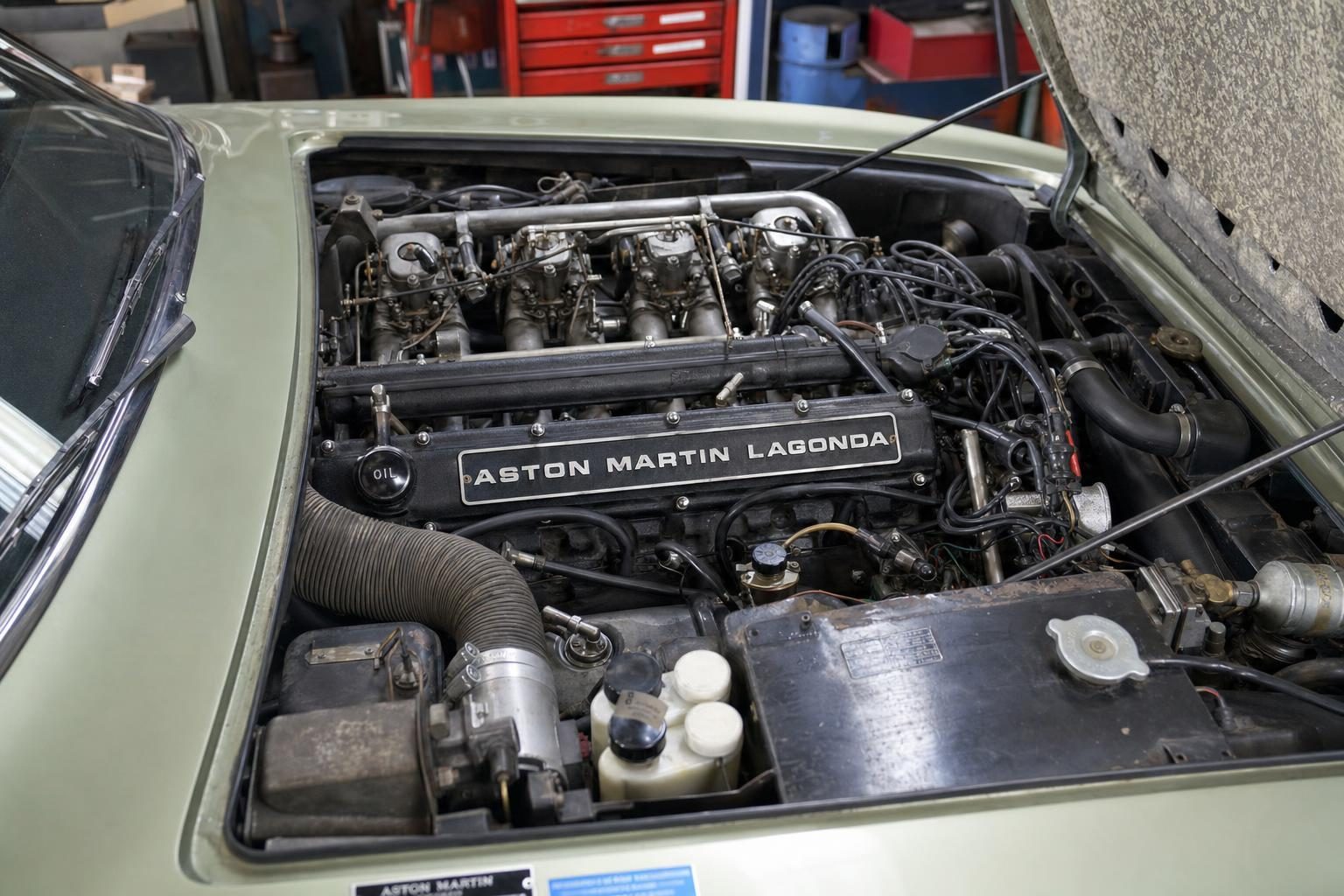
Chassis numbers and traceability: why every AM V8 differs from its neighbour on the line
For a model produced from 1972 to 1989, under several managements and with successive evolutions, traceability takes on particular importance. Without entering into an inventory, keeping track of the succession of model years and variants (1977 Vantage, 1978 Volante, 1980 Bulldog concept) already helps explain why two examples close in appearance may reflect different technical priorities.
This diversity, the consequence of a history of relaunches and adjustments, strengthens the case for precisely documenting a given car: its milestones, its original market (notably when it comes to the United States or the Middle East, pivotal in the 1980s), and any updates. For an enthusiast, it is the best way to read the car through the marque’s chronology as attested by official and encyclopaedic histories.
To delve deeper into the thread between the DBS V8 and the Aston Martin V8, our dossier dedicated to the first road-going V8 offers useful context: histoire et genèse de la DBS V8. As for the model studied here, its overview page appears in our models section: Aston Martin V8 (1972-1989).
AM V8 in 2026: current values, clubs and restoration specifics
In 2026, interest in the line remains driven by what recent history has validated: rare longevity, a 1977 Vantage with performance striking enough to keep debates alive, and a Volante that mattered to the financial balance of the 1980s. All points to bear in mind when assessing an example or considering a period-correct restoration.
The official and encyclopaedic reference sources — starting with the manufacturer’s heritage page and the model summaries — offer a solid factual basis for situating a chassis in the chronology and appreciating the importance of export markets. Two useful entry points:
The rest is a matter of method: cross-checking the available information, placing the example within the sequence marked by 1972, 1977, 1978 and 1980, and drawing on known archives. For an overall panorama of the marque and its cycles, see also the page dedicated to the model in English, a useful complement to the marque’s histories.
Conclusion — AMV8 Aston Martin, six milestones to understand a survivor
From 1972 to 1989, the AMV8 Aston Martin spanned seventeen years, at least four managements and several repositionings without leaving the stage. The 1977 Vantage — with a top speed still in dispute — and the 1978 Volante structured this resilience, while Bulldog and Nimrod added contour to the 1980s. When evaluating an example, remembering these milestones and the markets that mattered is already to restore the essentials: the context that gives an Aston V8 its value.