One-77 beyond myth and price: carbon, Cosworth V12, dedicated workshop, deposits and Q‑Series. A precise review of the real manufacturing choices.
The One-77 may have been born under the spotlights and a Savile Row–style striped cloth, but its interest goes far beyond its roughly £1.15 million price tag and the magic of the number 77. Here, factually, is what truly dictated its design and manufacture: a carbon-fibre monocoque, a 7.3‑litre V12 developed with Cosworth, dedicated off-line teams, a meticulously timed development schedule and a final flourish with the Q‑Series. The aim: to understand the industrial decisions that made this Aston a case study rather than merely a collector’s trophy.
Carbon as a monocoque: why Aston Martin broke with aluminium for the first time
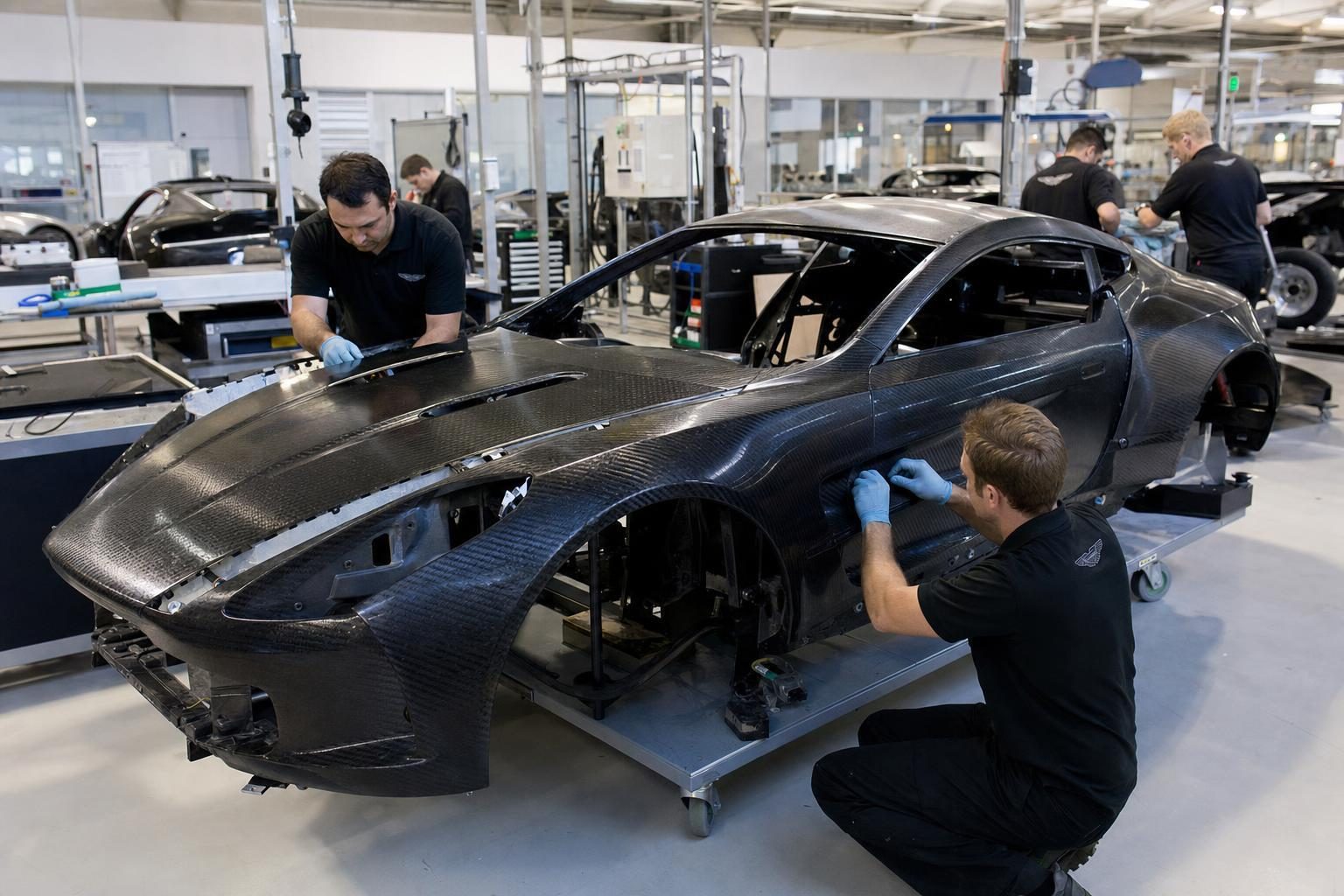
The car’s appearance at the 2008 Paris Motor Show and its full reveal at Geneva in 2009 confirmed a rare technical shift for the marque: a carbon-fibre monocoque at the heart of the architecture. According to the official media.astonmartin.com brief, the One‑77 departs from the aluminium structures that long served as a signature for Gaydon’s GTs. The break is not cosmetic: it reorganises mass, rigidity and safety, and demands a distinct tooling chain and skill set.
Why this choice? For a hypercar limited to 77 units, the pursuit of lightness and torsional rigidity calls for a material that accepts complex forms without multiplying joints. Carbon answers that brief precisely: lighter than a metallic shell at equal stiffness, and less penalised by welding points. It is nonetheless costly to industrialise, especially at such a low rate of production.
This technical shift places the One‑77 in the select club of period sports cars with a full composite chassis. It also quietly explains part of the final bill: beyond materials, it’s the tooling, specialist labour and quality control that weigh in. Realities of manufacturing that a simple list price does not tell.
The 7.3‑litre V12 and Cosworth: what the collaboration brought that Newport Pagnell could not do alone
The heart of the One‑77 is a naturally aspirated 7.3‑litre V12 developed in partnership with Cosworth. According to Wikipedia, it delivers 750 PS (559 kW) at 7,500 rpm and 750 N·m at 5,000 rpm. This spec places the unit among the most demanding naturally aspirated engines of its time. Cosworth’s contribution, from a powertrain specialist with a rich record, lies as much in precision machining as in high‑rev development and validation processes that a conventional GT production does not mobilise in the same way.
This partnership explains the car’s ability to rev and the confidence to announce, then exceed, the targeted top speed. Again per Wikipedia, the measured top speed reached 354.067 km/h in December 2009, beyond the initially estimated 349 km/h. That delta illustrates the role of a development partner able to unlock high outputs without forced induction, with drivability and durability suited to an exceptional road car.
Turning to Cosworth is also a very British admission of pragmatism: surround yourself with the best when the level of specialisation requires it. A kind of technical understatement, far from badge engineering, that lends credibility to the One‑77’s mechanical ambition.
The mini‑factory within the factory: the dedicated team build method
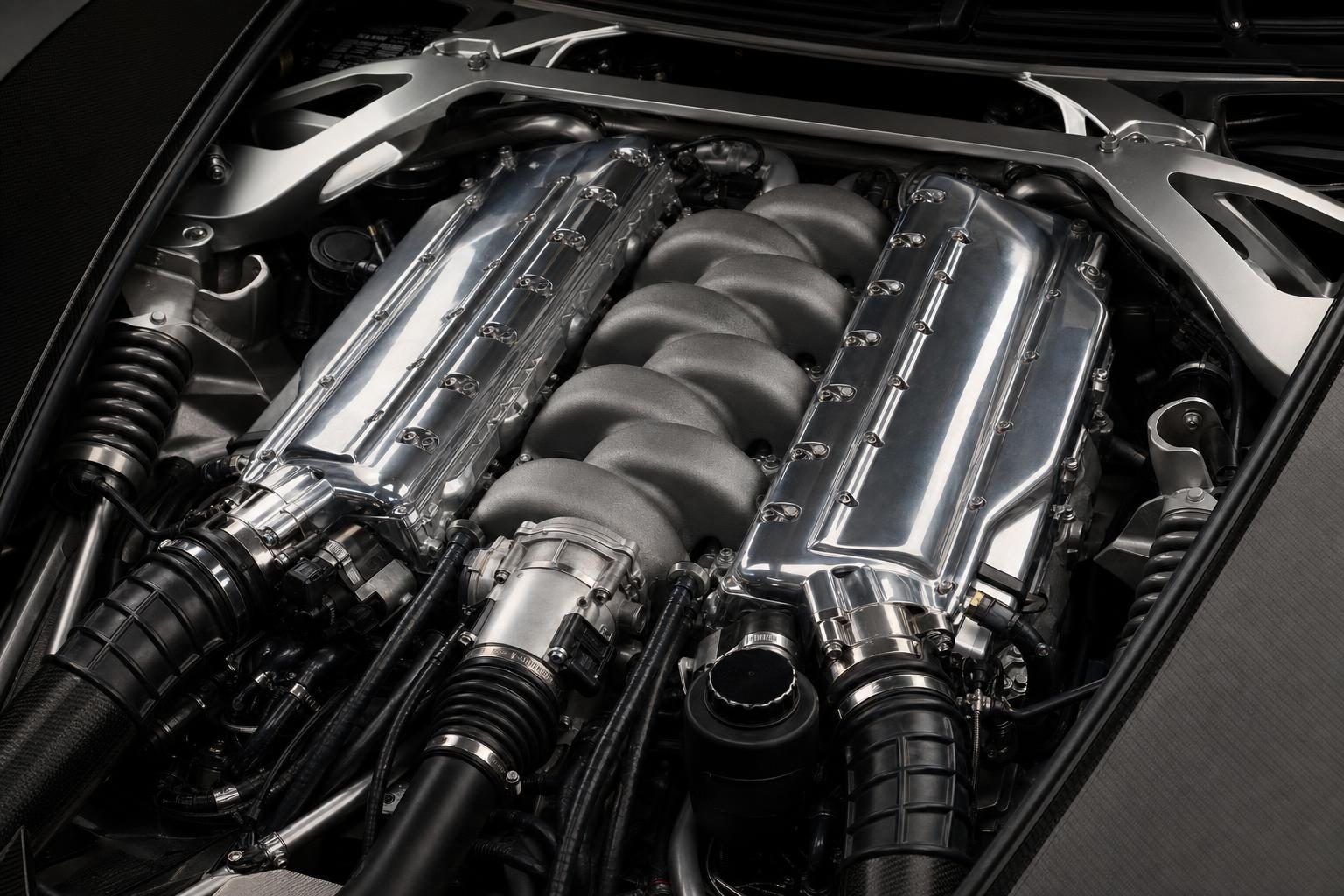
Rather than integrate this model on a flow line with the rest of the range, Aston Martin set up dedicated teams to build each car. As specialist nicholasmee.co.uk notes, every example was assembled off a conventional production line. In practice, that means near‑craft work zones, operation times tailored to each chassis’s specifics, and case‑by‑case quality control.
This “mini‑factory” within the factory has several virtues: first, it avoids disrupting series‑production rhythms. Next, it allows fine traceability of operations and responsiveness to the contingencies of a 77‑unit project. Finally, it showcases skilled labour around a process closer to watchmaking than automotive flow. The corollary, of course, is a higher hourly cost and inherently compressed timelines.
For enthusiasts, this operating mode reinforces the dimension of a “living collector’s piece”. For the marque, it’s a showcase of know‑how, comparable to what would later be the Vulcan. On that subject, our technical analysis of the track car and its manufacture can be found via this presentation of the Vulcan, focused on its customer programme.
From the 2008 Paris show to first delivery in 2011: three years and a £200,000 deposit
The One‑77’s public timeline is clear. A first appearance at the 2008 Paris Motor Show, largely veiled under a grey striped cloth, then a full reveal at Geneva in 2009: the sequence formalised by media.astonmartin.com. Meanwhile, development continued, and first customers waited until the initial deliveries in 2011, with production completed in 2012 and all 77 units sold according to astonmartin.com.
This long tempo is easily explained: composite materials, homologation processes, validation of performance and chassis tuning, not to mention coordination with Cosworth. To reserve a slot, a £200,000 deposit was required, per media.astonmartin.com, signalling early customer commitment to a progressively maturing project.
To place this sequence within the marque’s history, readers will find a dedicated technical and historical summary in our feature on the genesis and engineering of the One‑77, useful for gauging the learning effect on later programmes.
The Q‑Series at the end of production: 7 variants and today’s value question
At the tail end of the run, Aston Martin offered 7 special “Q‑Series” cars with distinct liveries and technical specifications identical to standard production, according to Wikipedia. A way to close the industrial cycle with a visual signature, without muddying the shared technical value across the 77 units. The message is clear: rarity remains first and foremost mechanical and structural.
As for current values, official sources confine themselves to confirming the sale of all 77 examples and the end of production in 2012. The limited Q‑Series, identifiable by their colour combinations, naturally fuel collector interest. Still, absent consolidated public data in the cited sources, restraint is wise: the engineering singularity argues for enduring appeal more than for a numbers arms race.
To delve deeper and situate this model among the marque’s key pieces, explore our dedicated One‑77 model page, which compiles useful markers without getting lost in mythology.
Conclusion — why the One‑77 remains, first and foremost, a manufacturing story
In the end, the One‑77 is not read solely through its price or its confidential production run. Carbon monocoque, 7.3‑litre V12 developed with Cosworth, dedicated teams, a controlled timeline from Paris 2008 to 2012, and a Q‑Series finale: each decision targets the technical coherence of a singular project. That is why the One‑77 continues to fascinate engineers as much as collectors: because its value begins in the workshop.
For official and historical references, it is useful to cross‑check the One‑77 dossier published by Aston Martin and the marque’s past models One‑77 page, which complement this article’s insights without altering its conclusion: the One‑77 is a manufacturing lesson before it is a number.