Lagonda Série 2, la berline en coin de 1976 qui sauve Aston Martin : design radical, électronique tactile, V8 de 280 ch et une mise au point hors norme.
The Lagonda Series 2 is not a mere style manifesto: it is Aston Martin’s answer to an existential crisis. From its October 1976 debut at Earls Court, it flaunted a wedge design carved by William Towns, digital instruments with touch-sensitive controls, and a clear ambition to reposition the marque. Here’s why these technical choices — and the time it took to make them reliable — go far beyond a simple redesign.
The 1975 backdrop: why Aston Martin needed a bold signal after the factory shutdown
In December 1974, the factory closed. In 1975, a group of new shareholders took over Aston Martin. The message had to be audible, visible and credible: show that the marque could still innovate while selling high-margin cars. Conceived as a technological luxury saloon, the Lagonda Series 2 became that signal.
Its first public act came at the Earls Court Motor Show in October 1976. The London stage suited the ambition: to demonstrate, before exacting clients, that the Newport Pagnell house could combine audacity and tradition. The goal was clear: create demand quickly and restore confidence after a period of uncertainty.
The choice of a completely new body and a digital cockpit was part of this strategy. The Lagonda Series 2 did not rely on a prestigious badge alone: it promised an interface and on-road presence that stood apart from the period’s offer. A risky bet, but a necessary one for a rebuilding constructor.
In this context, the in-house V8 architecture remained an anchor. It tied the Lagonda Series 2 to Aston Martin’s mechanical expertise, while the rest — electronics, ergonomics, positioning — signalled a confident entry into a new era.
William Towns’ wedge design: what the Lagonda shares with the Countach and the Esprit
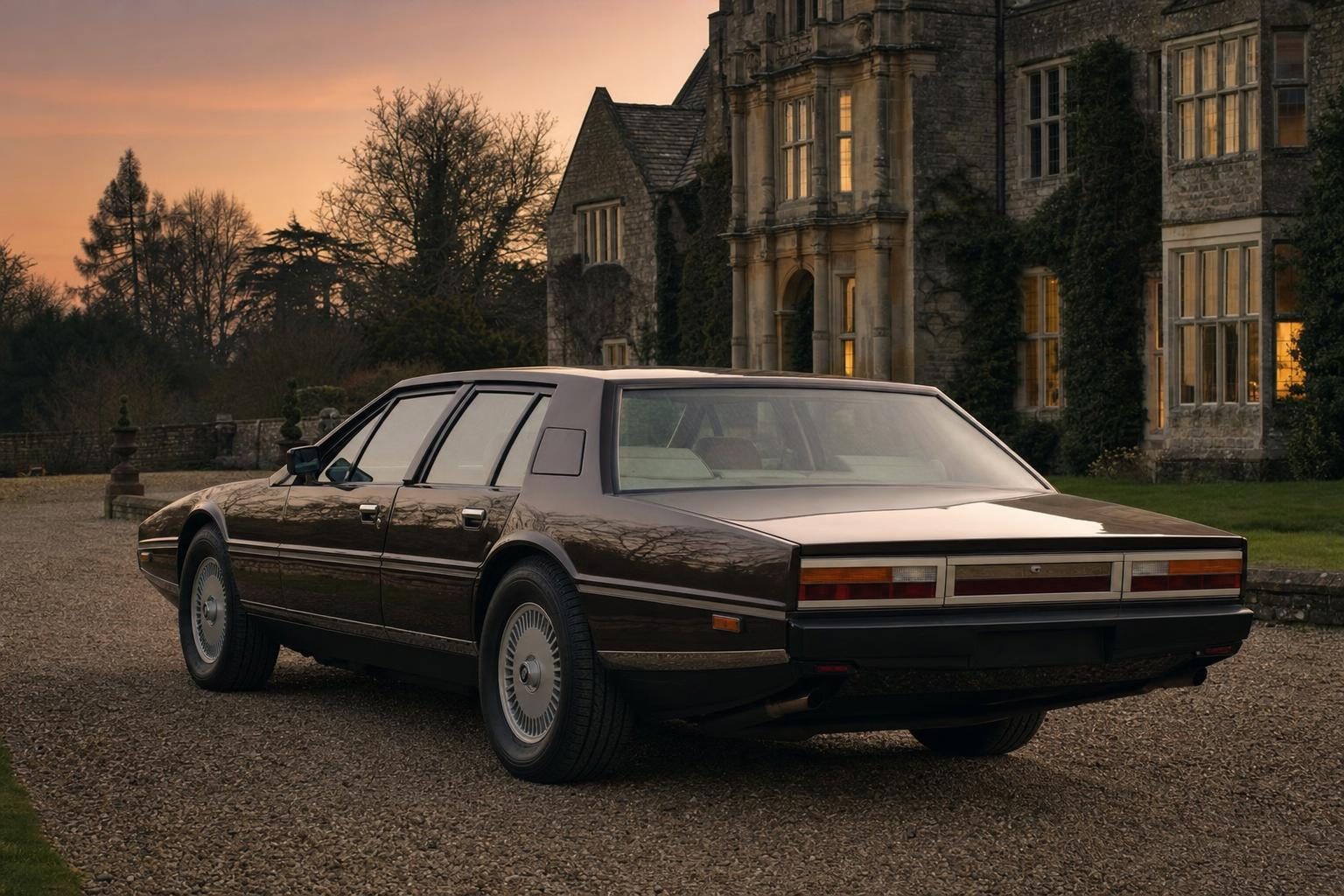
William Towns designed the Lagonda Series 2’s wedge body from the ground up. According to Wikipedia (Aston Martin Lagonda), it shared only the 5.3‑litre V8 with the earlier Series 1 — limited to seven examples between 1974 and 1976. Everything else was a blank page, cut with a set square.
With its taut profile, sharp edges and endless bonnet, the Series 2 sits among the wedge silhouettes that marked the 1970s. What does it share with the Countach and the Esprit? A refusal of visual compromise and the will to make the line a technical as much as an aesthetic argument: a deliberate visual gearbox that tells modernity at a glance.
The difference lies in the mission. Where some mid-engined sports cars speak of attack, this grande saloon evokes quiet authority. Towns’ wedge is not a stylistic whim: it is a user architecture that installs the Lagonda Series 2 as a rolling lounge with spectacular proportions.
This choice had a useful side effect: it captured attention just as Aston Martin needed to remind the world of its know-how. Beneath those emphatic angles, the Lagonda Series 2 calmly repeats that innovation can be a heritage value.
The digital instruments with touch-sensitive controls: the engineer inspired by a Californian lift
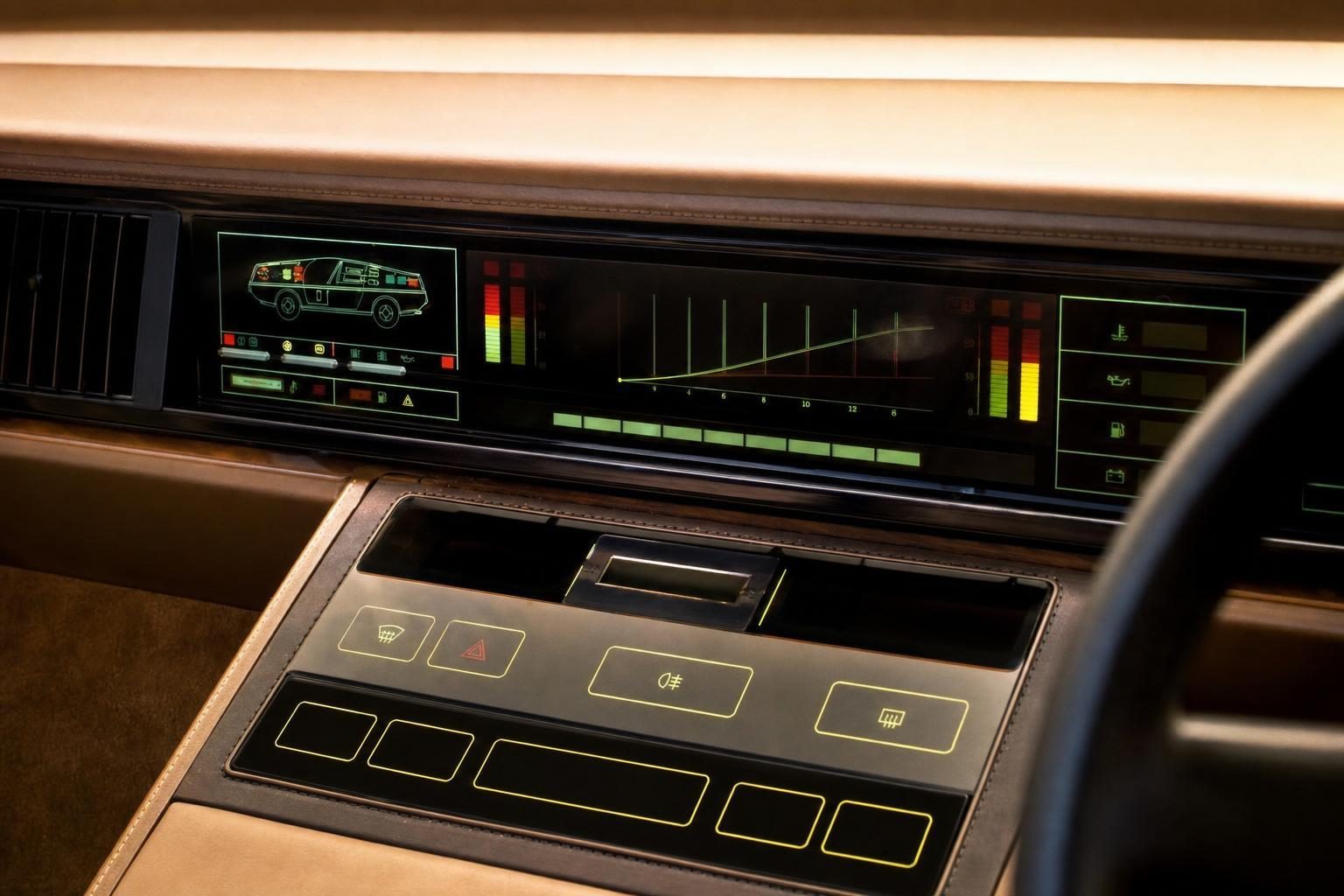
The Lagonda Series 2’s digital dashboard still stuns with its audacity. According to media.astonmartin.com, engineer Mike Loasby found inspiration for the touch-sensitive switches while visiting the lift buttons at National Semiconductor’s headquarters in California. The idea is simple to state, less simple to execute: transpose an electronics language to a luxury car.
The result is an LCD display and touch controls. Inside, that changes everything: the Lagonda Series 2 tells its technology through gesture, swapping conventional switches for a flat interface. In the market, it was a signature, almost a provocation.
This bet came at a cost. The Lagonda Series 2’s onboard electronics proved complex to develop. The promise of a futuristic experience demanded long iterations, painstaking validation, and compatibility with a thermal and vibratory environment far removed from a Californian clean room.
This grafting of the semiconductor world into a 1970s British car was no gimmick. It placed the Lagonda Series 2 on the leading edge — at the price of a lengthening timetable.
From the October 1976 reveal to first delivery in 1979: three years of development
Shown in October 1976 at Earls Court, the Lagonda Series 2 was not delivered for the first time until 1979. According to Aston Martin and Wikipedia (Aston Martin Lagonda), those three years were explained by the complexity of the electronics. Between intention and daily use, a spectacular prototype had to become a liveable saloon.
The mechanicals leaned on known quantities: a double overhead cam 5,340 cm³ V8, rated at 280 PS at 5,000 rpm (source: Wikipedia Aston Martin Lagonda). The human–machine interface took the lion’s share of the effort. Time worked against the finances, but also for the technical reputation: the Lagonda Series 2 became synonymous with serious ambition, not stand gimmickry.
This gap between unveiling and first keys reflected rapid learning. The constructor shaved off gratuitous spectacle and made reliable what needed to be. By 1979, the Lagonda Series 2 kept its promise: a luxury saloon that spoke electronics without denying its V8.
Meanwhile, the image improved. The Lagonda Series 2 established itself as a singular proposition capable of challenging price benchmarks. In 1980, the list price reached £49,933, more than a Ferrari 400, less than a Rolls‑Royce Corniche (source: Wikipedia Aston Martin Lagonda). The alignment was deliberate.
645 chassis in fourteen years: four series and today’s values for a saloon that still divides opinion
The career ran until 1989, with a total of 645 chassis produced (source: Wikipedia Aston Martin Lagonda). The range evolved through successive series. The Series 3, limited to a single model year, totalled 75 units with injection, marking a distinct technical step in the line.
This measured production, coupled with William Towns’ wedge and the touch interface, explains values that are likewise… angular. The Lagonda Series 2 gathers believers and intrigues the rest. Its appeal lies in that mix of visual radicalism and mechanical classicism.
To reset the markers, the Series 1 had been built in only seven examples and shared only the 5.3‑litre V8 with the Lagonda Series 2 (source: Wikipedia Aston Martin Lagonda). The 1976–1989 saloon thus stands as the true modern Lagonda project made real, in both duration and volume.
The model remains a marker of engineering culture. You have to enjoy the conversation between LCDs and a big naturally aspirated V8. Those who hear dissonance pass; the others savour the contrast — the Lagonda Series 2’s deliberate signature.
Conclusion: why the Lagonda Series 2 remains a winning bet, in its own way
In retrospect, the Lagonda Series 2 ticked the boxes that the situation demanded: unforgettable styling, a cutting-edge interface, and a proven mechanical core. Shown in 1976, delivered in 1979, produced to 645 chassis through 1989, it gave Aston Martin the strong signal sought after the 1974 shutdown.
William Towns’ design, Mike Loasby’s Californian inspiration for the touch-sensitive instruments and the 280 PS V8 make a rare equation. That is the Lagonda Series 2’s interest: it does not freeze its era; it embraces it — seriously, with a dash of British impertinence.
To delve deeper, explore the model presentation on the official Aston Martin site and the marque’s context on Wikipedia. Our dedicated feature on the 1976 Lagonda models and our analysis history, design and technique of the 1976 Lagonda Series 2 add perspective, as does the portrait of William Towns and his self‑taught designer’s method.
Today, the Lagonda Series 2 remains one of the clearest expressions of what an Aston Martin can do in times of doubt: dare — and hold the note.