Vantage GT3 Imola, récit embarqué des 6 Heures 2026 avec le numéro 27 de The Heart of Racing, contexte WEC, technique et perspectives de saison.
Vantage GT3 Imola on onboard camera for six hours: the exercise speaks volumes about what a modern GT3 hides under full load and what Imola represents when it comes to opening a WEC season under tension. From the official feed of car No.27, you read the car, the team and the track — without fuss, but with everything that matters to understand a 2026 campaign that promises to be dense for Aston Martin and The Heart of Racing.
This feature places No.27 in context over the duration, from traffic to restarts, via grip management and steering-wheel tools. And as always at Imola, pace isn’t enough: you need the discipline of a Vantage GT3 perfectly driven, set up and operated.
No.27, a car and a team at the heart of the Aston Martin WEC project
No.27 is entered by The Heart of Racing (THOR), with a sharp trio: Ian James, Zach Robichon and Mattia Drudi. According to fiawec.com, Drudi set the best LMGT3 reference in FP3 with 1:41.973, a snapshot revealing the potential of this Vantage against the field. Set at Imola during the 6 Hours 2026, that marker sets the scene: the car has resources, and the team knows how to exploit them.
For 2026, THOR expanded to two Vantage GT3s in the WEC, taking over the No.23 previously operated by Racing Spirit of Leman. This step up is no trifle: it anchors the outfit as spearhead of Aston Martin’s customer programme at the highest level, while offering strategic levers on track — offset pace, data sharing, undercut coverage.
Note that Kobe Pauwels, winner of the Aston Martin Racing Driver Academy, made his WEC debut at Imola at the wheel of No.23, replacing Rubens Barrichello. A very clear signal: the pathway aligns talent development and factory-customer commitment, with the Vantage GT3 as technical and sporting pivot.
Imola 2026, default season opener: the context of a pressure-cooker race
Imola opened the 2026 FIA World Endurance Championship from 17 to 19 April, with Qatar postponed for geopolitical reasons, according to Wikipedia. Fourth running of the event and third consecutive on the WEC calendar, the Enzo e Dino Ferrari circuit thus became a first full-scale exam: spring temperatures, abrasive asphalt, close walls and heavy traffic. The whole immediately puts each Vantage GT3 to the test of “realistic” endurance.
Starting at Imola means accepting a reduced margin for error. In LMGT3, the slightest approximation in Tamburello or Variante Alta costs you dearly in rotation and tyre life. For No.27, the opener was therefore a revealer: pit-driver coordination, stint windows, calibration of the aids. The issue is not only the day’s result, but the set-up of a working base for the entire season.
To this sporting pressure is added the media magnifying glass effect of a season start without a Qatari prelude: weak signals — top speed, braking stability, lap-time consistency — take on outsized importance. The No.27 onboard then becomes an analytical instrument as valuable as the official timing.
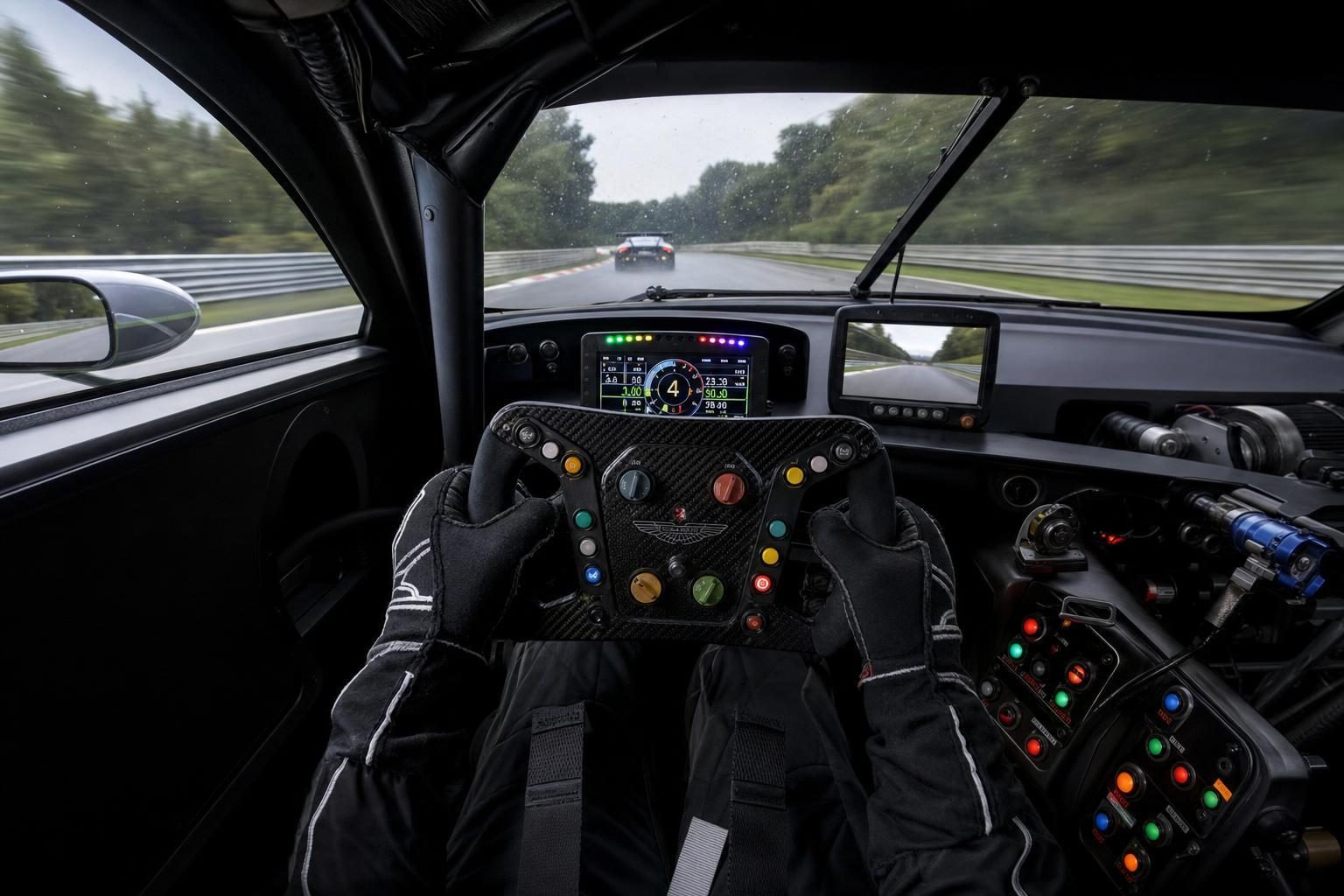
No.27’s cockpit: what the onboard reveals
The official onboard feed published on 18 June 2026 by Aston Martin offers a fine reading of the fundamentals of a Vantage GT3 Imola in real conditions. You see a very alive steering wheel but never twitchy, a sign of a locked-in front end and steering that delivers information without over-amplifying it. Hands stay calm through rapid sequences, then tighten the angle over the kerbs, indicating a rear end free enough to rotate without stepping out.
The switches come to life as stints unfold: engine map tweaks, traction control and ABS settings adjusted to tyre state and track evolution. The redefined electronics for LMGT3 make the difference here, not to mask but to exploit: better managing traction out of Acque Minerali, securing degraded brakings into Tosa, or containing oscillations on throttle over kerbs that are more aggressive than they look.
Traffic management appears in filigree as one of the keys at Imola. Overtaking in LMGT3 requires shaping the move one or two corners earlier to present cleanly at the end of the straight. Discipline into the chicanes avoids “breaking” the flow, preserving temperature and balance. Again, the No.27 onboard illustrates this discreet art, where usable speed outweighs needless swagger.
The Vantage GT3, anatomy of a front-running GT3 born from a road car
The Vantage GT3 is based on the road car’s bonded-riveted aluminium chassis and a 4.0-litre twin-turbo V8, with aerodynamics, suspension and electronics entirely reworked for LMGT3. This road-to-race genetics, embraced by Aston Martin, places the car at the intersection of durable engineering and exploitable performance. It also explains the behaviour signature noted at Imola: a precise front, traction built more by balance than by electronic constraint.
The aerodynamic package, optimised within the regulations, targets stability in long loaded corners and tolerance over compressions. On an old-school circuit like Imola, the rear wing and diffuser work in concert to hold the platform, while suspension settings absorb kerbs without triggering parasitic yaw. On screen, that translates to a “planted” car, few late corrections and crisp exits.
The engine architecture contributes to managing base rhythm: available torque, linear response, controlled cooling over the stint. In this context, the Aston Martin technical universe claims continuity from a Vantage platform that has performed for over a decade. Since 2012, the marque has moreover amassed 11 WEC titles, a benchmark that places the Vantage as Gaydon’s most titled racing car over the period.
From FP3 to the chequered flag: race takeaways and season outlook
The lap-time high point came early: in FP3, Mattia Drudi put No.27 on top of LMGT3 in 1:41.973, as reported by fiawec.com. A useful indication of the performance window, but not an end in itself. The onboard reminds us of endurance’s essence: sustain that level over time, deal with neutralisations, and execute cleanly in the pits. In that logic, the first rendezvous at Imola chiefly served to stress-test methods and tools.
THOR’s 2026 trajectory sits within a broader frame. With two Vantages entered, feedback accelerates, and the lessons from an LMGT3 podium at Le Mans for No.23 — the Vantage’s eleventh at Le Mans — naturally feed into No.27’s work. The common thread remains the same: baseline reliability, consistent pace, and the ability to convert good track position into a class result.
For readers following the lineage, the Imola Vantage GT3 extends the latest-generation road Vantage. In that respect, it’s useful to refer to the Vantage MKII and its chassis and engine evolutions, which form the DNA of this coupé refined through the LMGT3 sieve. On the competition side, programme coherence is also visible across the Atlantic, with the 2026 IMSA campaign and its four podiums, a valuable technical and sporting mirror for the WEC.
There remains the human dimension, glimpsed in the cockpit: measured breathing, economical gestures, clear voices on the radio. At this level, the difference is often made in the quality of decision-making. And we circle back to Imola: a circuit that demands restraint. The Vantage GT3 Imola doesn’t reward emphasis, but accuracy — exactly what this onboard feed highlights.
Conclusion — Vantage GT3 Imola, what six hours teach us
From the official feed of No.27’s onboard camera, Imola 2026 delivers a clear synthesis: the Vantage GT3 Imola is a machine of pace and consistency, built to turn a strong road base into a honed endurance tool. THOR laid the markers — FP3 reference, diligent execution — in a shifted season opener where every detail counts.
What comes next will hinge on capitalising: tyre-fuel management, clean overtakes and fine calibration of the aids. For those who want to extend this perspective, our feature Road to Race, from the Imola opener to Spa and Valkyrie provides useful bearings. The message is crystal clear: with this Vantage GT3 Imola, method rules, and endurance rewards those who hold their line — for the long haul.