Virage 1989: why the first Aston Martin fully conceived at Gaydon split opinion and how it laid the groundwork for the modern era.
Virage, more hinge than totem, this coupé launched in the late 1980s distils Aston Martin’s in-between: a well-known V8 under an all-new suit, production still at Newport Pagnell while the horizon already read Bloxham then Gaydon. Here, in four very concrete angles, is how this model blurred the lines while laying decisive markers — and why it deserves a closer look today than period clichés allowed.
A familiar engine in a wholly new suit: what the 5.3-litre V8 hid
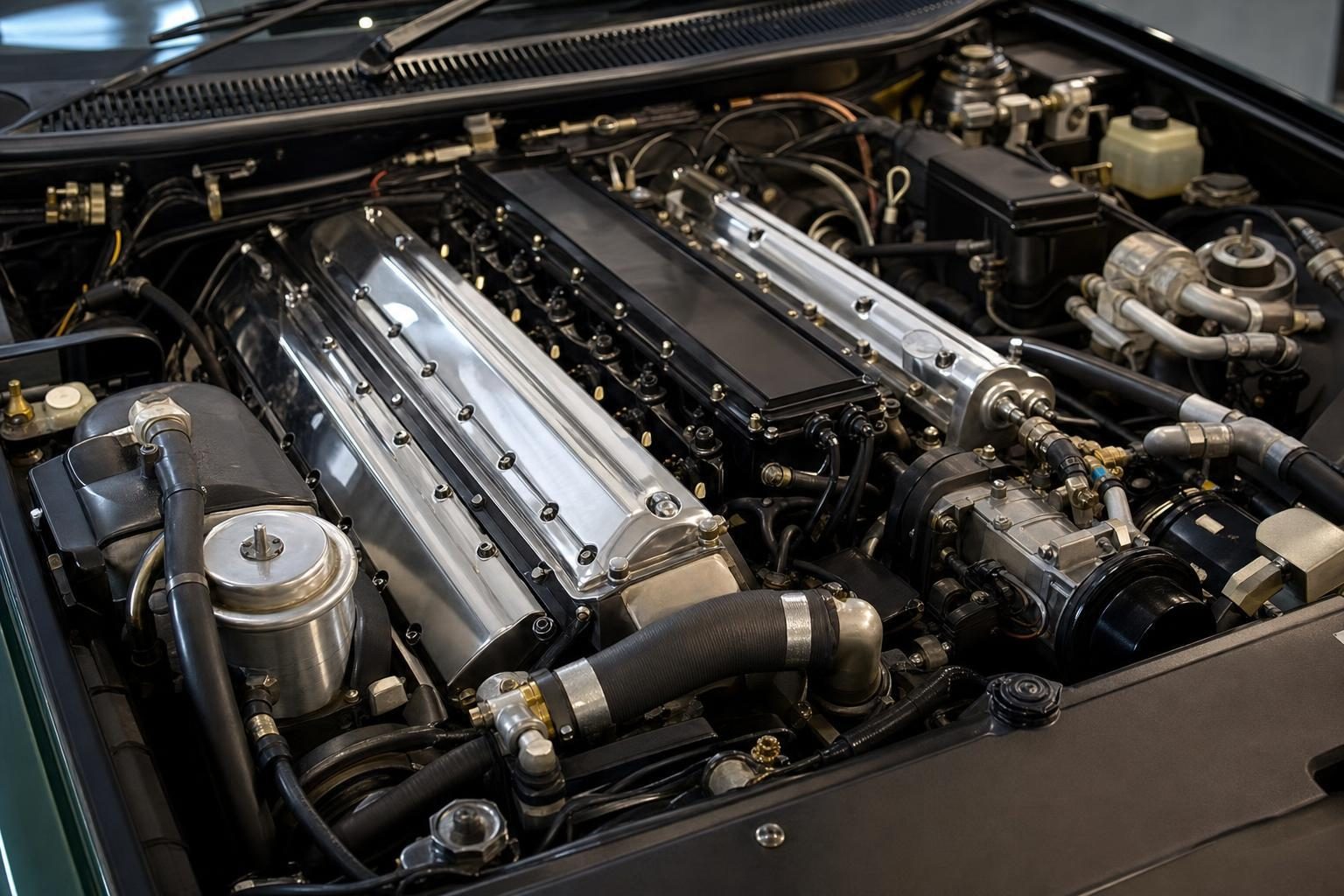
Beneath the refreshed lines lies the 5.3-litre Tadek Marek V8, a historic Aston Martin unit bored out and sharpened for the 1989 context. Depending on sources, the base version develops around 306 PS, while the future Vantage variant will peak at 550 PS. This deliberate mechanical continuity gave the coupé a soundtrack and torque signature familiar to brand loyalists, but also a hint of ambiguity: the tech reassured, the positioning was already reaching for something else.
The decision to retain this V8, rather than introduce an entirely new architecture, reflects the pragmatism of a small manufacturer in the late 1980s. According to the dedicated reference page, the Virage was unveiled at the Birmingham Motor Show in October 1988 and entered production in 1989, with specifications evolving rapidly as the range took shape. The industrial and stylistic transition had begun; the mechanical break would wait.
The Vantage variant presented in 1992 pushed the ambition further, with two Eaton superchargers and a quoted 550 PS according to Aston Martin Works, making this evolution one of the most powerful sports cars of its era in the UK. Between restraint and excess, the Virage thus embodied the two faces of Aston Martin at the dawn of the 1990s.
John Heffernan’s design: rupture or continuity with the DBS line?
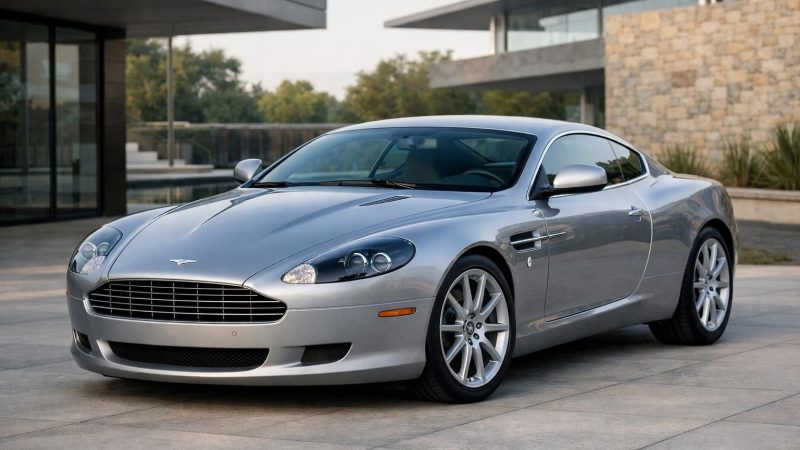
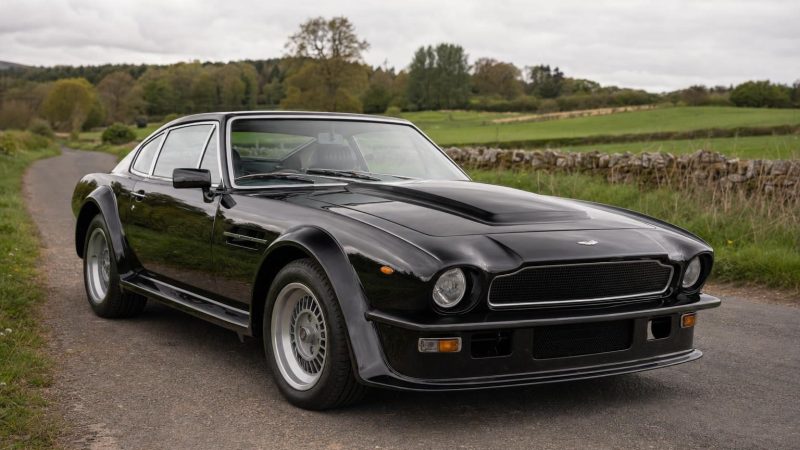
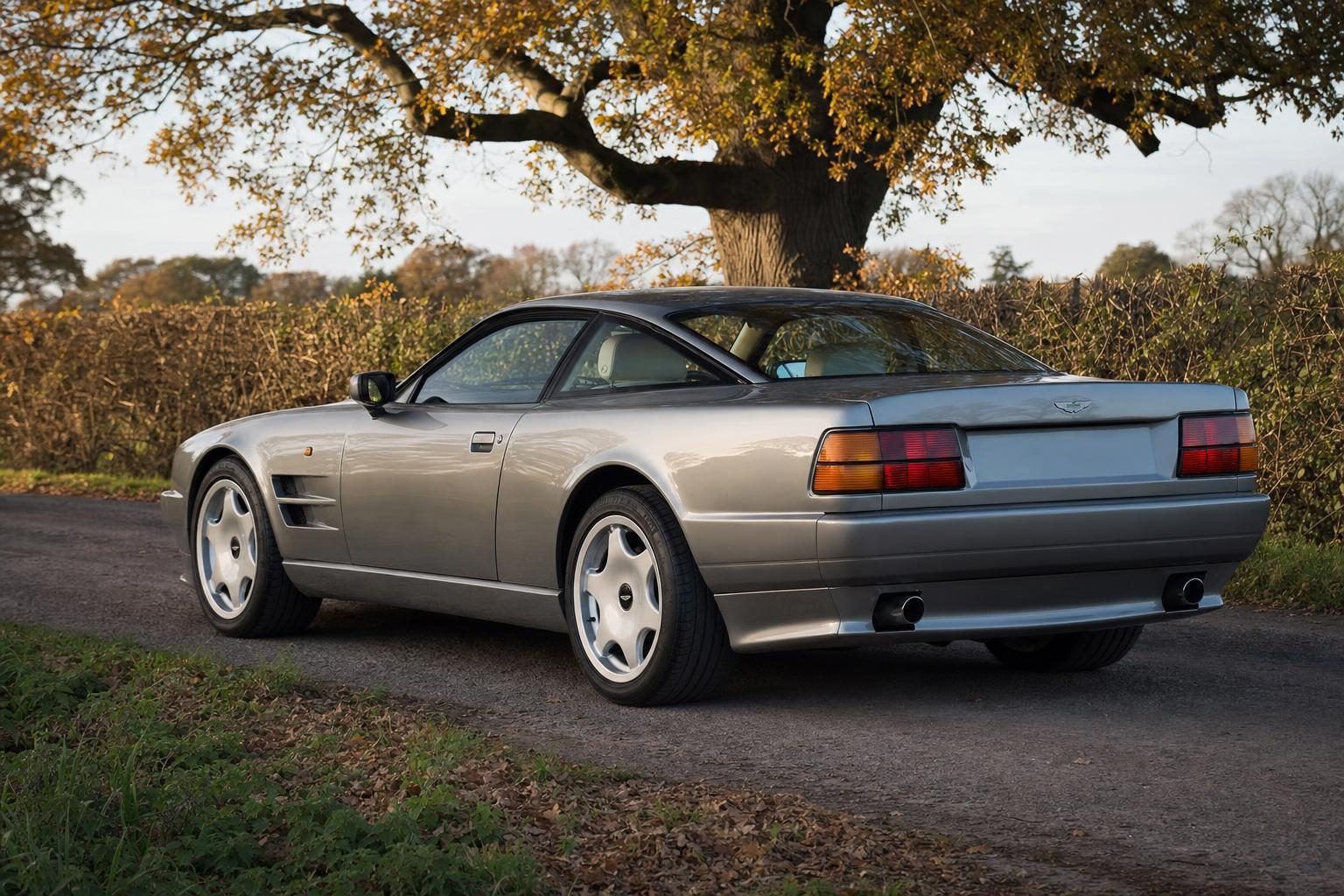
Styled by John Heffernan and Ken Greenley (Heffernan Greenley), the Virage’s bodywork breaks with the volumes of the AM V8s descended from the DBS lineage. More angular, more pared-back, it steps away from 1970s muscle aesthetics in favour of sober modernism. This choice was no accident: it repositioned the marque between British elegance and the visual efficiency of a grand tourer, without denying a very “Aston” stance.
That said, this is no disconnected manifesto. The long-bonnet/rearward-cabin proportions continue the DBS/AM V8 grammar, while fuller surfaces and more integrated lights close the chapter on American references. The Virage carries out an elegant transition rather than a coup de théâtre. Again, a fruitful tension: brand continuity on one side, a desire to turn the page on the other.
This stance explains its mixed reception. Too square for some, subtly timeless for others, the Heffernan/Greenley design can now be appreciated on its own terms: a coherent update of Aston DNA, without easy effects. The marque’s archives also place this model as the last great Aston assembled at Newport Pagnell before the DB7 marked a true industrial turning point.
Volante and Vantage variants: when the Virage searched for an identity
The multiplication of variants quickly revealed the programme’s ambition — and hesitations. The Volante offers the open-air grand touring experience, while the supercharged Vantage claims 550 PS according to Aston Martin Works. Between these poles, the array of special bodies based on the Virage (including a “Lagonda Vignale” shooting brake) highlights the chassis’s versatility and the appetite of a connoisseur clientele.
This diversity has two readings. On the one hand, it gives the model a rare breadth, capable of spanning hushed luxury and spectacular performance. On the other, it sustains a certain image indecision, each iteration pulling the coupé in a different direction. The Virage thus emerges as a laboratory more than a perfectly canonical product.
In numbers, total family production remains limited. According to tallies, around 1,000 units are cited overall, with a range often quoted between 891 and 1,050 depending on which variants are included. Noting this discrepancy is essential: beyond the singular icon that is the Vantage, the entire lineage is confidential by nature.
Current values and market: is the Virage still the forgotten Aston Martin at auction?
Neither the definitive culmination of Newport Pagnell nor the true starting point of the Gaydon era, the Virage sometimes pays for its in-between status. Up against very clearly identified references such as the AM V8 “DBS series” on one side and the DB7 on the other, it attracts a knowledgeable but narrower audience. Proven rarity — roughly a thousand units across all versions — fuels interest without mechanically exploding hammer prices.
Several factors nonetheless work in its favour. First, the appeal of its Tadek Marek V8 in a late and carefully honed interpretation. Next, the Heffernan/Greenley signature, which has gained perceived elegance over time. Finally, the variety of the range, from grand touring Volante to supercharged Vantage, broadens the base of potential collectors — with differing sensibilities according to body styles and specifications.
To place this model in the Aston Martin timeline, our dedicated files help illuminate the industrial and stylistic pivot. The Virage and variants file sets the whole programme in perspective, the AM V8 line descended from the DBS explains the run-up, and the DB7, the Bloxham/Gaydon-era turning point sets the downstream. In this weave, the 1989 coupé appears less “forgotten” than in need of fine recontextualisation.
Conclusion: putting the Virage back at the centre of the board
At the end of this tour, the Virage reveals itself for what it is: a clear-sighted hinge between tradition and renewal. Familiar yet sharpened powertrain, modernist design without denial, strong-personality variants, limited production and a persistent debate over its positioning: the sum makes a discreet classic. Neither the epilogue of Newport Pagnell nor the prologue of Gaydon, it occupies a place apart — that of a milestone which allowed Aston Martin to navigate the 1990s with consistency and suppleness.
To delve deeper, see the reference page dedicated to the Virage, Aston Martin’s official information bank on the transition towards DB7, as well as the index of past Aston Martin models. Enough to put the Virage back at the centre of the board, where a fair reading — sober, precise, well-documented — finally does it justice.