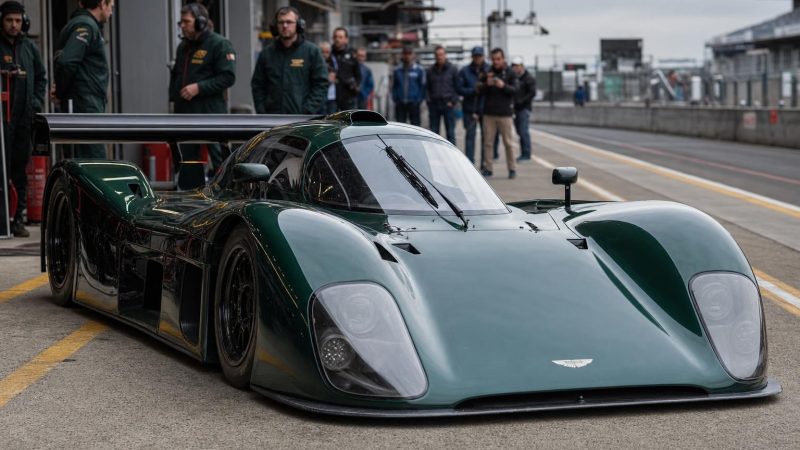
AMR1 Group C, a technical venture cut short: Protech, kevlar-carbon monocoque, Le Mans 1989 and the aborted AMR2, the facts and where to see the chassis.
The AMR1 Group C is not a tale of failure, but of a serious technical gamble, abruptly halted by a regulatory change of course. Here, without embellishment, is what you need to know about the 1989 programme: its engineering structure, its kevlar-carbon and V8 architecture, its Le Mans weekend, the unfinished AMR2 and the fate of the chassis. The aim: to put facts at the centre, based on what Aston Martin’s archives and the dedicated Wikipedia page establish.
Protech: the secret structure created to design the programme
To rejoin the World Sports Prototype Championship scene in 1989, Aston Martin relied on an ad hoc entity: Protech, for Proteus Technology Ltd. According to the page devoted to the AMR1, this structure brought together Peter Livanos, Victor Gauntlett, Richard Williams and Ray Mallock, via Ecurie Ecosse. Conceived as an engineering accelerator, the set-up avoided overloading the factory and concentrated talent around the Group C project.
Protech acted as an agile laboratory. The era demanded clear-cut technical choices and rapid development. By creating a British-style “skunkworks”, Aston Martin gave itself a rare degree of leeway in an environment still dominated by heavyweights such as Sauber-Mercedes, Jaguar and Porsche. The programme’s foundations were solid, the ambition measured, the method pragmatic.
People sometimes remember the brevity of the programme and forget its rigour. The formation of Protech, described by Wikipedia as a harness uniting industrialists, executives and tuners, explains the technical coherence that followed. It is also what enabled rapid iteration between AMR1 and the future AMR2, alas caught out by regulation.
Kevlar-carbon monocoque and a developed road-car V8: the project’s architecture
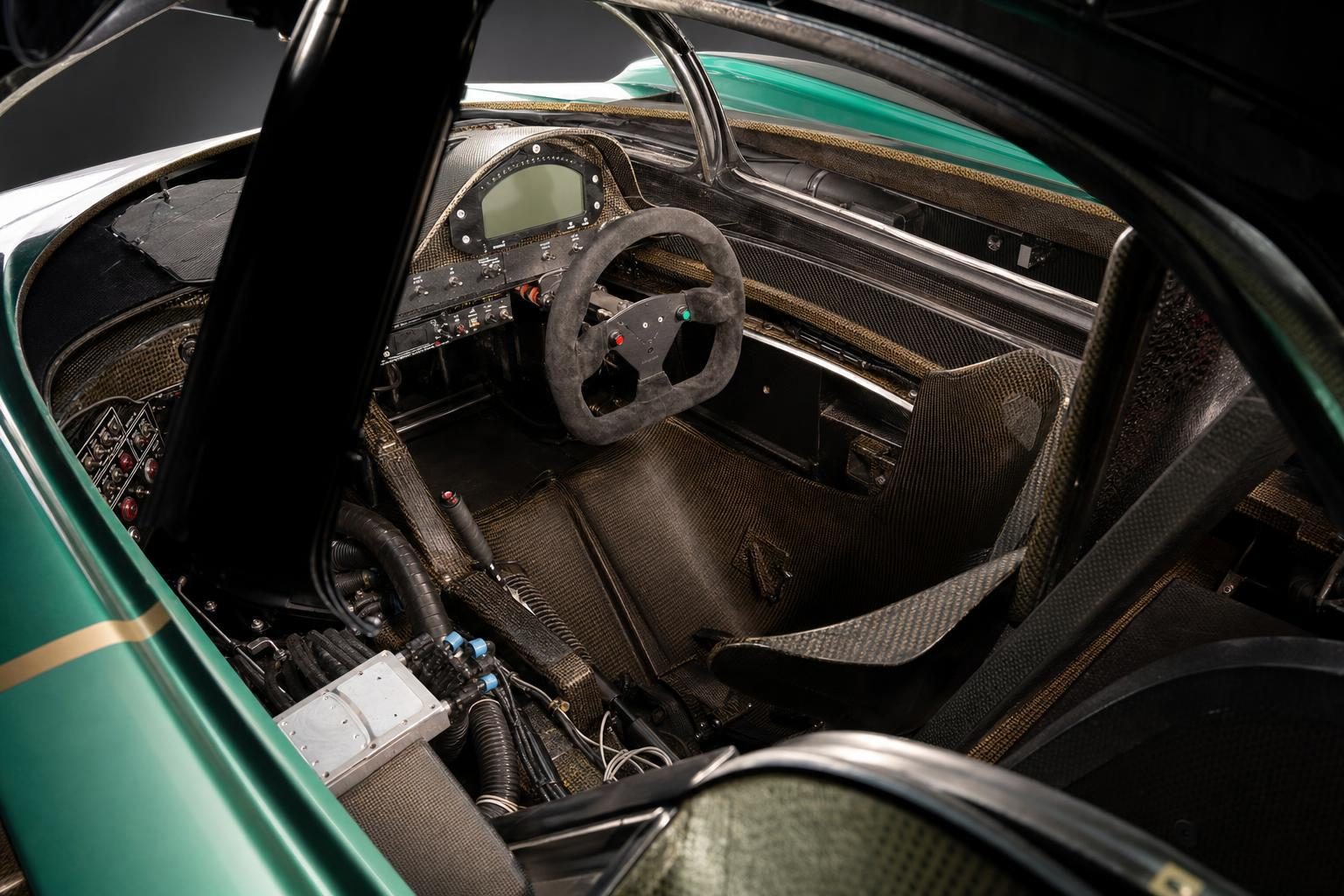
The AMR1’s technical basis centred on a kevlar/carbon monocoque, highlighted by Aston Martin as a radical technology in 1989. The goal was clear: rigidity, safety and weight control, in the service of efficient long-duration aerodynamics. For a tradition-steeped constructor, this choice signalled an assumed generational leap.
On the powertrain side, the programme relied on a large-displacement V8. Publicly available elements focus chiefly on chassis structure and materials, but the 1989 context logically places this V8 at the heart of a performance/endurance balance. This composite monocoque and V8 duo reflects the spirit of Group C: aerodynamic efficiency, mechanical robustness and fine management of endurance constraints.
The technical stance was no mere affectation. It aimed to bridge the gap to the benchmark teams on the grid, while preserving what the marque does best: an expressive, long-legged engine encased in a modern shell. In Aston Martin’s documents, the kevlar-carbon monocoque is indeed presented as the most disruptive element of the package.
Le Mans 1989: 32nd and 40th on the grid, then an early retirement for one of the two chassis
At the 1989 24 Hours of Le Mans, the competitive snapshot is precise. According to Wikipedia, the two AMR1 chassis qualified 32nd and 40th out of 56 cars. A modest grid position, but logical against top-tier opposition. More than anywhere else, Le Mans remains a technical and methodological filter: the slightest approximation is punished on the spot.
The race was cut short for chassis #03, forced to retire in the first half of the event due to electrical problems. The other car continued, though little more can be inferred than this lesson: sorting an endurance prototype requires mileage, and 1989 did not really offer a second chance.
It helps to place that Le Mans in the brand’s perspective. Between the foundational DBR1 victory in 1959 and more recent GT campaigns, the AMR1 embodied a return via the toughest route, the top tier of sports-prototypes. The learning curve there is implacable, yet it structures what follows.
The unfinished AMR2: how an FIA regulation killed the programme in six weeks
At the end of 1989, the FIA announced the switch to naturally aspirated 3.5-litre engines for 1991. According to Wikipedia, this decision sealed the programme’s fate: Protech closed in February 1990, even before the AMR2/06 chassis was completed. Six weeks between decision and execution, and a project stopped dead.
The irony is brutal. The Version III 6.3-litre V8 planned for AMR2 is indicated as more powerful, with a promised top speed of over 230 mph on the straight, where the AMR1 had been limited. The technical iteration was under way, and the answers to identified weaknesses were ready to test. The regulatory framework shut the door just as maturation began.
This regulatory shift, a major one, is no mere footnote. It redrew the entire endurance ecosystem and pushed players to rethink their approach. At Aston Martin, it left an interrupted project, immobilised investment and an incomplete learning curve. It reads less as a defeat than as an exogenously induced “missed opportunity”.

Where the AMR1 chassis are today: collections, auctions and historic circuits
The fate of the chassis sheds light on the programme’s heritage value. According to Wikipedia, AMR1/01 belongs to the Aston Martin Heritage Trust. AMR1/03 went under the hammer in 2004 for 294,250 euros. And AMR1/04 was the first to be sold at auction in 2000 for 133,500 pounds sterling. These markers state something simple: history attracts interest, especially when it is rare.
These prototypes appear periodically at historic events, witnesses to a period of technical transition. To grasp the wider arc of competition at Aston Martin, this chapter can be set alongside the marque’s subsequent GT successes, embodied by the DBR9 entered in GT1, and a Sarthe centenary full of twists, summarised in our Le Mans and World Championship dossier.
Beyond the sums, it is the AMR1’s place in the collection that intrigues. It illustrates a “composite + big V8” path that the AMR2 was meant to elevate. In a marque where racing feeds identity, these chassis are technical milestones more than trophies. They are judged by the lessons they left behind.
Conclusion – AMR1 Group C, a technical venture halted yet coherent
The AMR1 Group C did not deliver its full potential, not through any lack of ambition, but because of a sudden regulatory scissor effect. Protech enabled a swift, well-executed assembly of a solid base, the kevlar-carbon monocoque returned Aston Martin to the material standard expected in 1989, and the AMR2 promised to address top-speed limitations. The Le Mans results remain modest, the facts are stubborn; but the trajectory itself was coherent.
To extend your reading on the manufacturer and historical context, see the official Aston Martin site and the reference page on Wikipedia about Aston Martin. The AMR1 Group C deserves neither oblivion nor flagellation: it simply deserves to be put in its place, that of a serious attempt cut down by regulation.