Virage Volante: 4 facts on the 1992 convertible that Newport Pagnell built in just 36 units, between boardroom hesitation and the rigidity challenge.
The Virage Volante occupies a discreet place in Aston Martin’s history, and that is precisely what makes it interesting. Through four factual anecdotes, we revisit this convertible assembled at Newport Pagnell between 1992 and 1995, less well known than the coupé unveiled in 1988, but rich in lessons at the close of an era. On the agenda: rigidity, volumes, unchanged mechanics and value, with sourced markers and a little context to shed light on this singular model.
Why the shift from coupé to convertible posed a rigidity problem that the Gaydon team did not anticipate
Any convertible derived from a coupé naturally loses some torsional rigidity. On the Virage, the equation is familiar: removing the roof requires structural reinforcements and specific chassis tuning. However, the available sources do not at any point indicate that “a Gaydon team” failed to anticipate this. Indeed, at the turn of the 1990s, production and engineering of the model were handled at Newport Pagnell, while the Gaydon site came later.
The challenge itself is undisputed: moving from the Virage coupé (revealed at the Birmingham Motor Show in October 1988, according to Wikipedia, Aston Martin Virage page) to an open body calls for precise compromises. Adding reinforcements affects mass and weight distribution, while suspension calibration must absorb the absence of a roof without degrading comfort. The Volante thus fits into a classic but demanding exercise: preserving character while opening up the sky.
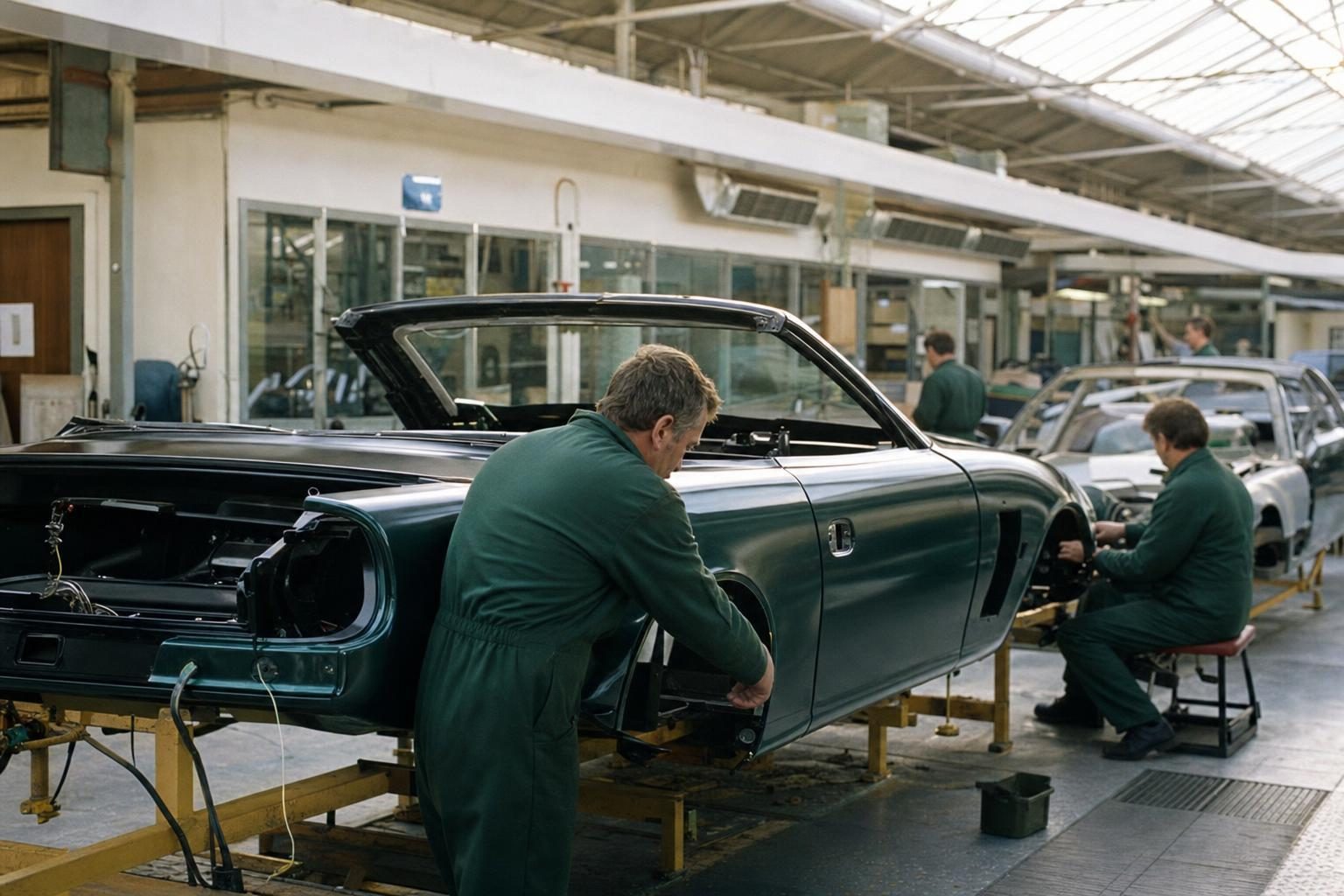
This rigidity constraint partly explains why an “old-school” convertible remains a goldsmith’s project for an artisanal manufacturer. The development pace matches Newport Pagnell’s attention to detail rather than the cadence of a large group: a singularity that contributes to the rarity of the Virage Volante — and to its understated charm.
36 units: the production constraints that limited the run
The figure sets the tone: around 36 units of the Virage Volante are thought to have been produced between 1992 and 1995, according to AMOC registers reported by specialist Nicholas Mee. Measured against the total output of the line, this handful of cars places the Volante among the most confidential variants of the Newport Pagnell era.
Why so few? The answer lies in the capacity of an artisanal site and the coexistence of several projects. The end of the Virage’s career coincides, from 1993, with the arrival of the supercharged Vantage version, a priority in image and resources (again according to Wikipedia). In this context, the convertible, remaining naturally aspirated, was not the technological standard-bearer; it moved at its own tempo, that of a workshop accustomed to short runs and meticulous finishes.
Registers kept by enthusiasts, such as those relayed by Nicholas Mee, confirm this rare-bird status. At Newport Pagnell, production was divided between specific orders, personalisation and supply constraints: plenty of good reasons to stick to a limited series, whose low diffusion today fuels collectors’ interest.
The 5.3‑litre 330 PS engine shared with the coupé: the decision to change nothing mechanically
Another telling anecdote: the Virage Volante retains the naturally aspirated 5.3‑litre V8 with 330 PS, identical to the coupé, paired with a 5‑speed ZF gearbox (source: Wikipedia). No specific mapping, no engine settings dedicated to the convertible: a deliberate decision for continuity.
In 1993, the family welcomed a supercharged Vantage boasting 550 PS, while the Volante remained in standard naturally aspirated form. This parallel offer illustrates the convertible’s positioning: an open GT, faithful to the Virage spirit, without chasing one‑upmanship; an open‑air Aston rather than a record‑breaker.
This technical choice has the merit of coherence. It simplifies production at Newport Pagnell, favours the proven reliability of the 5.3 V8 and aligns the Volante with the grand touring DNA of the model. For the driver, the message is clear: enjoy a classic convertible, with a familiar engine character, without a learning curve or surprises.
Launch price and current values: what rarity does to a Virage Volante’s worth
The sources available here document neither the launch price of the Virage Volante nor a current value in figures. However, the key datum — around 36 cars — helps illuminate the value dynamic. Such a short run from Newport Pagnell acts as a catalyst for connoisseurs’ interest, all the more so when it shares its mechanical base with the 1988 coupé and precedes the move to the V8 Coupé in 1996.
In the landscape of 1990s Astons, the Volante stands out through three classic collector factors: limited production, direct kinship with a landmark launch model (the Virage presented at Birmingham in 1988) and a pivotal position before the rise of the Vantage variants and the range’s evolution. In the absence of figures, these elements carry weight — and lastingly.
For those wishing to explore the lineage and place the Volante in its time, the manufacturer’s “past models” pages offer a useful overview; there you can track the transition to the V8 Coupé mentioned by Aston Martin – Past Models. In parallel, community documentation, including guides by Nicholas Mee, highlights volumes and rarity. Two complementary views, one conclusion: rarity breeds appetite — especially when it is discreet.
To delve further into the Virage line
To position the convertible against the original coupé, our analysis of the four design decisions of the 1988 Virage puts the car back in its industrial and stylistic context. There you can gauge what the Volante preserved, and what it had to adapt.
Fancy a family overview? Our Virage model guide summarises the milestones: Birmingham 1988, Volante launch in 1992, Vantage in 1993, then the move to the V8 Coupé in 1996. A useful backbone for reading the Newport Pagnell years without getting lost.
And to understand the subsequent ramp‑up, our feature on the 1998 V8 Vantage V600 shows how supercharging and the pursuit of performance redefined the decade — while the Virage Volante itself remained faithful to natural aspiration.
Conclusion — Virage Volante, assumed rarity and unshowy elegance
The Virage Volante remains a discreet milestone, and therein lies its singularity. Rigidity to master, around 36 units according to AMOC registers relayed by specialists, unchanged mechanics in the face of the Vantage wave: Newport Pagnell’s convertible plays the card of continuity, with a distinctly English charm. When weighing its value, rarity and kinship with the original Virage count for more than undocumented numbers.
For the Aston aficionado, the Virage Volante is less a firework than a discreet wink: an open, artisanal sports car that has traversed the years with quietly spoken elegance. And perhaps that is how you recognise a true Aston: when the facts suffice, without drumrolls or fanfare.
Also worth a look: the Virage family page on Wikipedia and the “past models” overview on the official Aston Martin site, to place the Virage Volante within the brand’s map.