Cygnet, l’expérience urbaine d’Aston Martin entre pari raté et pièce de collection, jusqu’au spectaculaire Cygnet V8 dévoilé à Goodwood en 2018.
Cygnet, the most improbable city car ever to leave Gaydon, compressed in three years an environmental ambition, a positioning gamble and, ultimately, a curious insiders’ prestige. Based on a Toyota iQ carried over wholesale technically, Aston Martin aimed to offer an urban entry key to its clientele, before closing the experiment in 2013. Here, in four paradoxes, is why the venture failed in the numbers while living on in conversation — crowned by a Cygnet V8 as serious as a Goodwood stopwatch.
A Toyota iQ under Aston styling: the Gaydon decision Ulrich Bez alone championed
Between 2011 and 2013, the Cygnet was assembled at the Gaydon headquarters. The base is familiar: a Toyota iQ, whose technical specifications were adopted unchanged, from the 1.3-litre 97 PS four-cylinder to emissions of 110 g CO₂/km. The promise, however, was different: to offer an urban solution to clients accustomed to GTs, with presentation and brand signature in keeping with the rest of the garage.
Ulrich Bez, then at the helm of Aston Martin, announced a target of 4,000 deliveries per year, for a price of around £30,000. The bold wager was to transpose the brand’s aesthetic DNA and service onto an ultra-compact platform. The bodywork, finish and brand experience were to make one forget the mechanical obviousness of the iQ, in favour of a very specific use: the city, historic centres, short trips.
The Cygnet therefore embraced its mismatch: a pocket Aston Martin, conceived from the top down and driven from Gaydon as a tool of urban compliance and practical elegance. On paper, the package is coherent. On the street, the kinship with Toyota, technically acknowledged, proved harder to sell.
Fewer than 600 in Europe instead of the 4,000 a year promised: reasons for a commercial failure
The figures speak for themselves. According to Wikipedia, fewer than 150 units found buyers in the UK and fewer than 600 in Europe in total, before production ended in September 2013. The gap with the 4,000 units per year initially announced by Ulrich Bez is considerable. Nicholas Mee & Co, for its part, cites around 800 units delivered worldwide, which confirms the extent of the shortfall, whichever source you choose.
Why the setback? First, overlapping identities: a 100% Toyota iQ heart, including its specifications, wrapped in Aston Martin presentation. For a savvy audience, the cost/performance trade-off versus the original iQ became tricky. Next, the restricted use case — designed for the city and little else — mechanically limited the buyer pool. Finally, the brand’s imagery, shaped by sporting GTs and charismatic V12s, married poorly, at the time, with a 97 PS urban mite.
Still, the experience was brief but clear-cut: production at Gaydon from 2011 to 2013 tested the real appetite for an everyday Aston. Clients, however, mostly continued to enter the brand via traditional coupés and roadsters. A few years on, the Cygnet’s story is read less as a faux pas than as an endearing curiosity, precisely because it failed to find its market.
To place the project within the historical range, the official past models page soberly sums up the initiative and its place at Aston Martin. There you’ll find the dedicated sheet for the Cygnet on Aston Martin’s site, useful for gauging the original intent.
The interior that cost three times an iQ: what Q personalisation really added
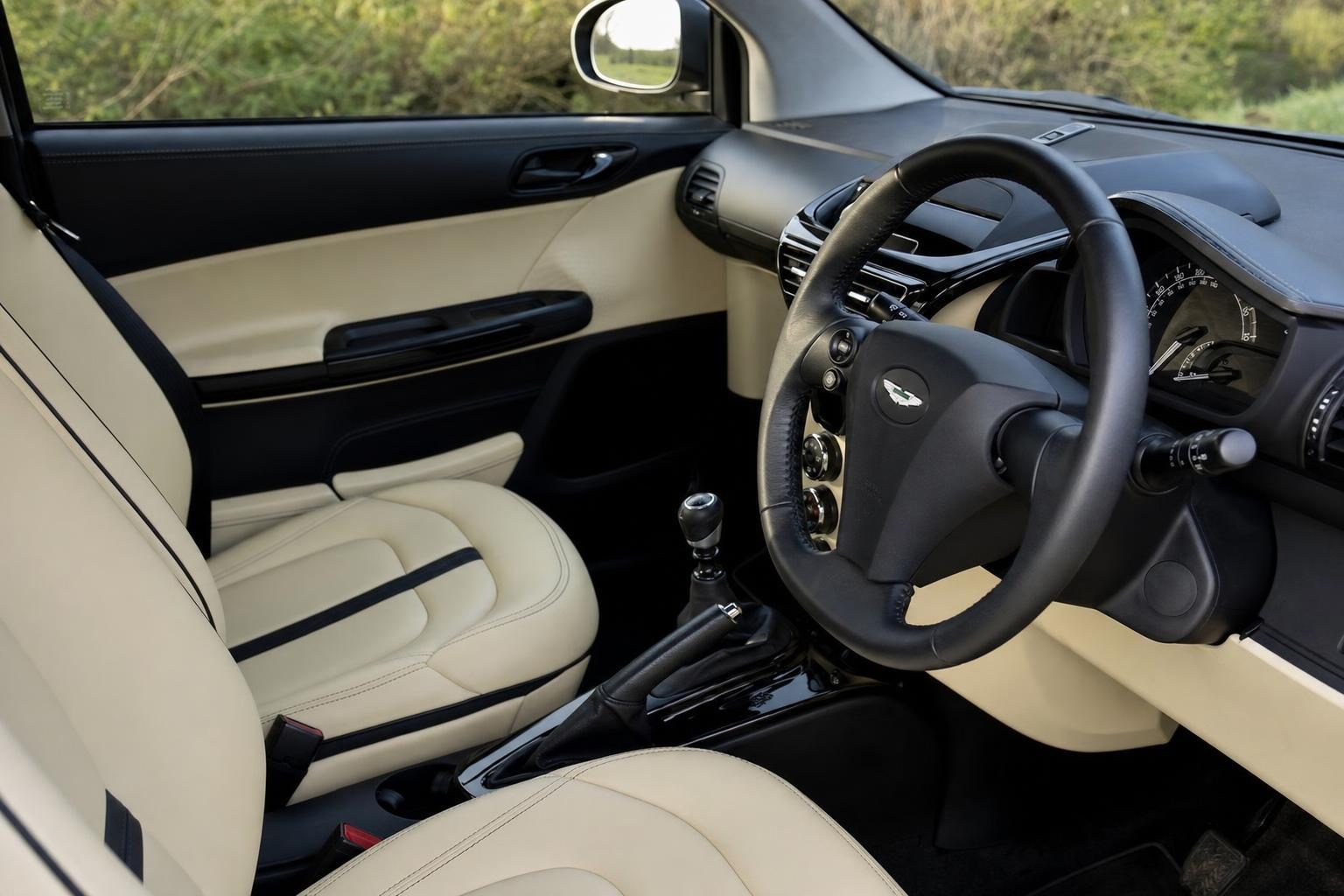
The refrain often returns when discussing the Cygnet: a bespoke interior and presentation worthy of the house. Lacking consolidated figures from available sources, let’s stick to fundamentals. The difference from the iQ lay in the overall treatment: revised bodywork, richer execution and integration into the Aston Martin ecosystem, from point of sale to aftercare.
What personalisation really added was, first and foremost, brand coherence. Even on a technical base shared with Toyota, the goal was a specific experience, with a level of detail Gaydon knows how to orchestrate. Strictly technically, nothing changed: 1.3 litres, 97 PS, 110 g CO₂/km. So it was in perception, tactility and urban use that the little Aston was meant to score points.
The role of Q by Aston Martin is crystal clear, however, on the one-off of 2018 (see below). It’s also an opportunity to recall, for anyone wishing to understand the in-house personalisation logic, how special commissions work and what’s possible. For more, our dedicated guide to bespoke options details what to expect from a personalised commission with the Q by Aston Martin programme, from initial brief to delivery.
To position the Cygnet from a buying and collecting perspective, our feature answers the key questions around a first investment in the brand, helpful to situate this singular city car among other lineage models: six questions before starting an Aston Martin collection.
The 2018 Cygnet V8: 430 PS, 4.7 litres and one car for one client
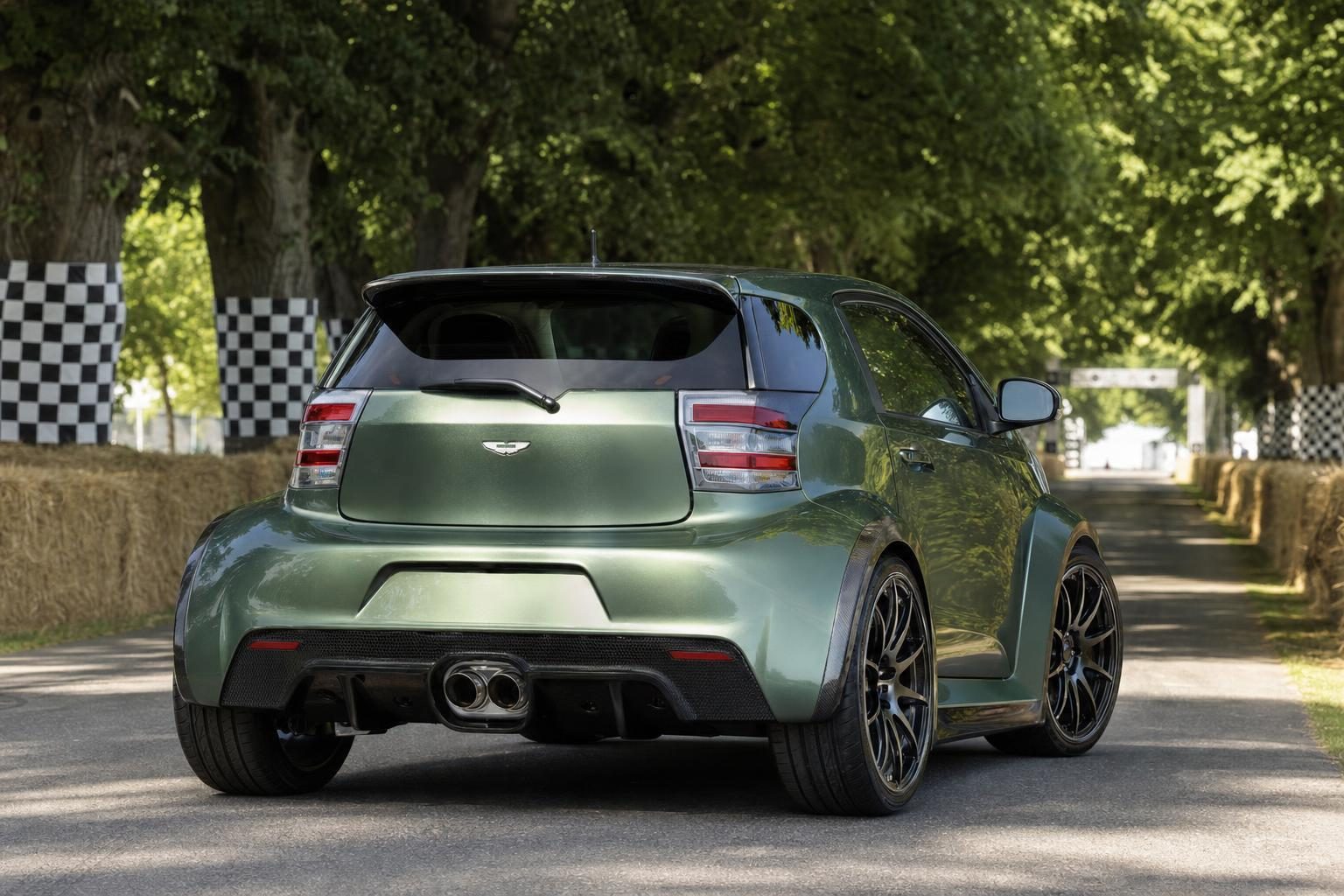
In 2018, the Cygnet returned… by the smallest of doors and the loudest of engines. Commissioned via Q by Aston Martin, this one-off received the V8 4.7-litre from the Vantage S, tuned to 430 PS. The official sheet quotes 0–60 mph in 4.2 seconds, a top speed of 170 mph and a power-to-weight ratio of 313 PS/tonne. Shown at the 2018 Goodwood Festival of Speed, this Cygnet V8 turned an urban curiosity into an engineering demonstration.
This coup does not erase the city car’s commercial history, but rewrites it in the margins: one car, for one client, serving a simple idea — to show that a pocket wrapper can, if need be, digest a serious drivetrain. The object raises a smile, certainly, but delivers on the Goodwood hill. A kind of wink ready for the start line.
For details and specifications released by the marque, the press pack devotes several sections to this singular creation: all the official information on the Cygnet V8. As for the core context of the production model, the dedicated page gathers the elements on the 2011–2013 period and its characteristics: the reference article on the Aston Martin Cygnet.
For those wanting to return to the original model, our feature retraces the full story of this urban experiment and its specifics within the range: everything about the Cygnet at AstonLegacy.
Conclusion — what the Cygnet still says about Aston Martin
In the end, the Cygnet remains an endearing paradox. Conceived and built at Gaydon from 2011 to 2013, technically identical to the Toyota iQ (1.3 litres, 97 PS, 110 g CO₂/km), it aimed for 4,000 annual sales and stopped at fewer than 600 in Europe according to Wikipedia, or around 800 in total according to Nicholas Mee & Co. A commercial failure, yes, but an unexpected cultural success: the object continues to intrigue for what it reveals about Aston Martin — the desire to clothe use with style and to probe the brand’s frontiers.
The 2018 one-off, the Cygnet V8, closes the loop with humour and seriousness: 430 PS under a tiny cap, Goodwood as theatre, and Q by Aston Martin at the controls. If the Cygnet didn’t change the city, it changed the conversation. And that may be how an urban experiment becomes, with time, a discreet collector’s piece.