Vulcan 10 ans, bilan d’une hypercar de piste rare : 24 unités, V12 7,0 l atmosphérique, kit AMR Pro, un exemplaire routier et un futur à déchiffrer.
Vulcan 10 years: the perfect moment to revisit what this track hypercar, limited to 24 examples and delivered in 2016, changed in Aston Martin’s recent history. Beyond the headline number, a naturally aspirated 7.0‑litre V12 pushed to 820 PS, a highly exclusive client programme and an AMR Pro evolution that reset the markers. Underneath, a simple question: why does this model remain, a decade on, such a one‑off?
Why exactly 24: the Vulcan’s number and its nod to Le Mans
Why 24 examples? Because the allusion to the 24 Hours of Le Mans is no accident. According to Aston Martin’s pressroom and Wikipedia, Vulcan production was strictly limited to 24 units, delivered throughout 2016. This short run, conceived as a pointed nod to endurance racing, immediately frames the Vulcan 10 years as an insider’s object: rare enough to create tension, visible enough to influence the brand image.
This micro‑series strategy curbed speculation and validated a precisely run track support programme. By setting the gauge at 24, the marque could ensure intensive technical follow‑up and a coherent calendar of private events, while each owner became, in a way, the ambassador of an experimental chapter. The Vulcan 10 years thus sits within the lineage of modern track‑only machines, but with an avowed cultural anchor.
The number also has a concrete consequence: fleet homogeneity. With 24 cars, technical evolution (notably the subsequently offered AMR Pro kit) remained controlled, easing updates and preserving on‑track use value. In practice, the Vulcan 10 years owes as much to this calculated rationing as to its spec sheet.
The naturally aspirated 7.0‑litre V12: an engine philosophy in decline
At the heart of the package, a naturally aspirated 7.0‑litre V12 delivering 820 PS (source: Wikipedia Aston Martin Vulcan). In a world already won over by turbocharging and now hybridisation, this architecture champions a mechanical purity grown rare. Throttle response, an unfiltered surge through the revs and the soundtrack gain what forced induction can sometimes subtract in character. The Vulcan 10 years is also this: a manifesto for high‑flow natural breathing.
The choice of NA here is no footnote. It dictates driving dynamics, traction management and the learning curve of torque delivery on track. It also recalls that the brand’s DNA can blend refinement with measured brutality. The whole, coupled to a 6‑speed gearbox that remains unchanged even with the AMR Pro kit, embodies a form of sporting orthodoxy seldom seen today. The Vulcan 10 years thus capitalises on a signature sound and long‑range progressivity, two qualities that age well.
On the aerodynamic front, the car already generates spectacular downforce: 1,362 kg at its maximum speed, thanks to the front splitter, rear diffuser and adjustable rear wing (source: Wikipedia). This technical bedrock, paired with the V12, explains why the Vulcan 10 years remains formidable on track, even against more recent GT3s.
The 2017 AMR Pro kit: when Goodwood rewrites the aero rulebook
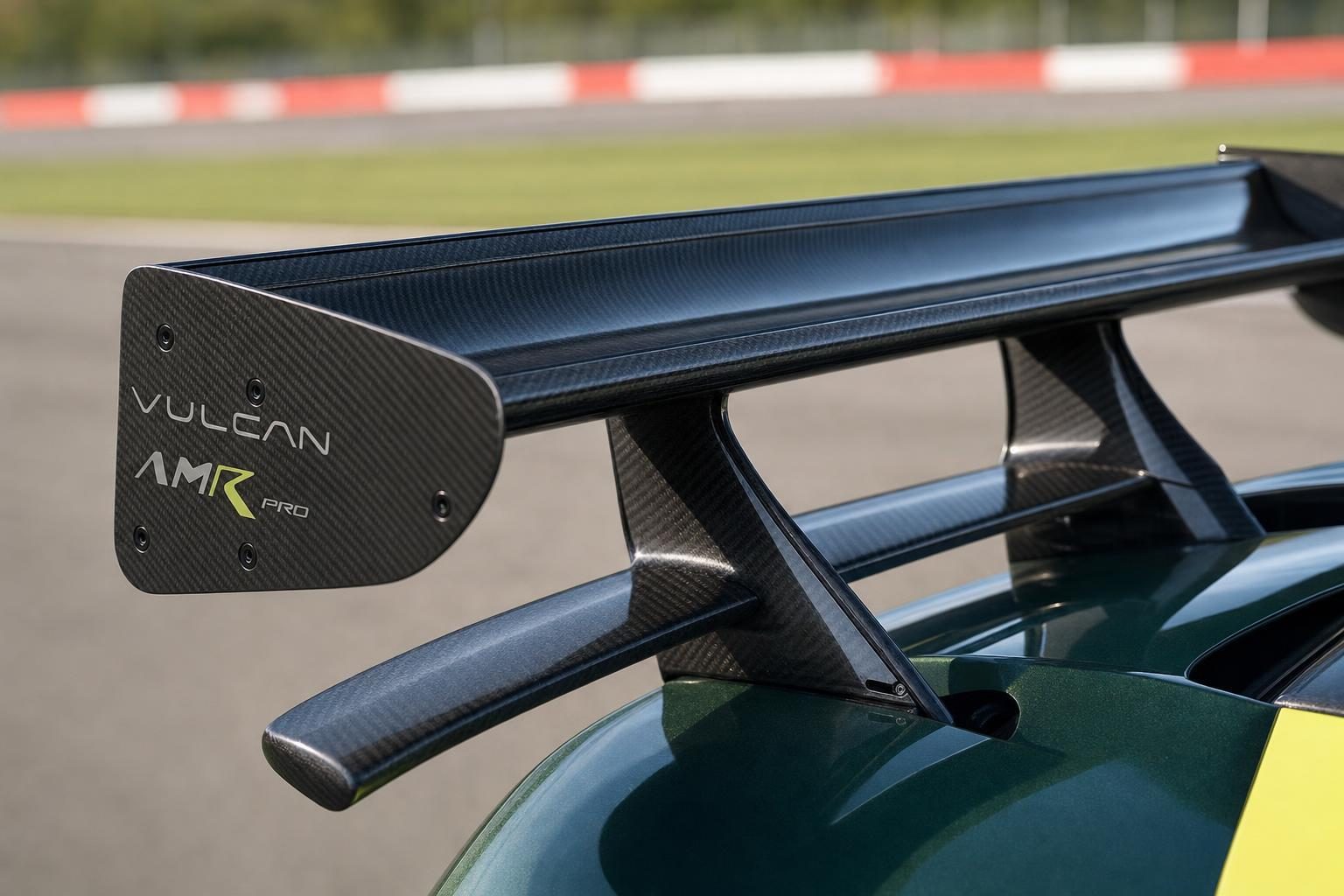
Unveiled on 29 June 2017 at the Goodwood Festival of Speed, the AMR Pro kit tipped the Vulcan into another aerodynamic dimension (source: media.astonmartin.com). Downforce rises by 27%, the load increasing from 3,150 N to 4,000 N at 160 km/h. Above all, aero balance shifts from 41.5% to 47% forwards, moving the centre of pressure closer to the middle of the car. In short: a more heavily “loaded” front axle, sharper turn‑in and a feeling of serenity at high speed. The Vulcan 10 years gains margin and, at the wheel, a granularity of feedback that matters.
The detail of the additions is eloquent and… simple: a bi‑plane rear wing topped by a 20 mm Gurney flap, large front dive planes, and channels carved into the wheel arches (sources: media.astonmartin.com / Wikipedia). No change to power or gearbox. Everything happens in the air, not the engine figures. The result, on a fast circuit, is felt immediately: more attack possible without waking surprises. Armed with its AMR Pro, the Vulcan 10 years receives a dynamic second youth without sacrificing its mechanical personality.
Important point: the AMR Pro kit is available on request via the Q department for the 24 owners (sources: media.astonmartin.com / Wikipedia). This measured retro‑compatibility has fostered unity across the Vulcan “grid” over the years. It also explains the consistency of performance seen during public demonstrations, as you can glean from an onboard track video.
A road‑legal one‑off, 18 months’ work, zero compromise
There is only one. A single Vulcan has been homologated for the road, converted by the very British RML Group after 18 months of work (source: Wikipedia). The feat owes as much to painstaking engineering as to regulatory negotiation. The Vulcan 10 years gains elements essential for road use, but yields nothing on intent: neither power nor the distilled “track‑only” spirit. A balancing act.
The paradox is deliberate: to bring a car conceived for extreme aerodynamics and track‑day logistics into common road law without betraying it. This textbook case remains isolated. To date, it is the only street‑legal example according to Wikipedia. And by contrast, it helps measure what the Vulcan 10 years represents for the marque: an experimental manifesto not to be diluted.
The fact that one owner pushed this logic to the end also says something about attachment to the object. For the rest of the fleet, the DNA remains that of a closed‑cockpit track barchetta, to be lived within the framework for which it was designed. A connoisseur’s luxury, owned as such.
Ten years on: where are the 24 Vulcans and what future for the track hypercar at Aston Martin
Ten years later, most of the 24 cars remain in active collections, often seen at private events or public demonstrations. One example was even entered in 2022 and 2023 in the British Endurance Championship in Class A against GT3s (source: Wikipedia). The Vulcan 10 years is therefore not just a boudoir piece: on track, it remains relevant, thanks to massive downforce and transparent dynamics.
The question of legacy naturally points to today’s road and track hypercars. Genetically, the cultural kinship can be read between the lines in the approach to aerodynamics and continuous updates via technical packs. To illuminate the lineage, our guide dedicated to the Vulcan model reviews its genesis and positioning, while the feature Aston Martin Vulcan, 820 PS track hypercar gathers key markers.
The discussion about the future of track‑only models at Aston Martin also feeds on the contrast with road‑going hypercar projects, more focused on hybridisation and stratospheric efficiency. For context, see our page on the Valkyrie and its radical approach. The Vulcan 10 years, with its big NA engine and aero fine‑tuning honed at Goodwood, maps a parallel path: pure pleasure, without road ties, where the stopwatch is not the only judge.
Finally, for those who want to go back to the source, the Wikipedia page dedicated to the Aston Martin Vulcan summarises the key data, and the official release Aston Martin Vulcan AMR Pro details the increased downforce, the bi‑plane wing and the shift in centre of pressure. All elements that explain why the Vulcan 10 years resists ageing: its technical coherence remains current.
Conclusion — Vulcan 10 years, a track manifesto that doesn’t age
In ten years, the Vulcan 10 years has kept the essentials: a symbolic run of 24, a naturally aspirated V12 at the top of its art, and an AMR Pro kit that magnifies aerodynamics without betraying the mechanics. Add the unique road conversion by RML and an occasional competition presence, and you have a singular milestone in the Aston Martin galaxy. The Vulcan 10 years is not a relic: it’s a performance grammar still spoken in the present tense.