Virage, genèse express, V8 32 soupapes et variantes 6.3 : découvrez comment le coupé de 1988 a assuré la transition Ford et façonné l’avenir d’Aston Martin.
Virage is the name of a wager met against the clock, of a design chosen by competition, and of a V8 brought up to date for the era of catalytic converters. Unveiled on 18 October 1988 at the British International Motor Show in Birmingham, the new Aston marked a measured break and a conscious continuity. We look back at its origins, its 5.3-litre 32-valve mechanics, the shift under Ford ownership and those lesser-known variants – 6.3-litre and Shooting Brake – that make it, today, a more subtle heritage pivot than many think.
A three-month design contest: the origins of the Virage
The model’s genesis was a creative sprint. According to Aston Martin’s official press pack, the design resulted from a competition won by two young British stylists, John Heffernan and Ken Greenley, tasked with delivering a proposal in just a few months. Their approach broke with the muscular angularity of the 1970s V8s while retaining a grand touring stance. The chosen line – high shoulder, clean surfaces, sharpened nose – established a restrained modernity, exactly what the marque was seeking at that pivotal moment.
Shown in Birmingham on 18 October 1988, the coupé was, by Aston Martin’s own admission, the first “truly” new model in nearly twenty years. The deliberately sober silhouette placed the Aston in a more international timeframe without denying Newport Pagnell. This choice of understatement, born of a competition rather than an internal evolution, fixed an immediately legible identity: a stately GT coupé, without unnecessary flamboyance.
This context explains the measured yet respectful reception the public gave the project. The car arrived at just the right time, with contemporary volumes and a crisp lighting signature, as an elegant transition between the old guard and the era to come.
The 5.3-litre 32-valve: a V8 reworked for the catalytic era
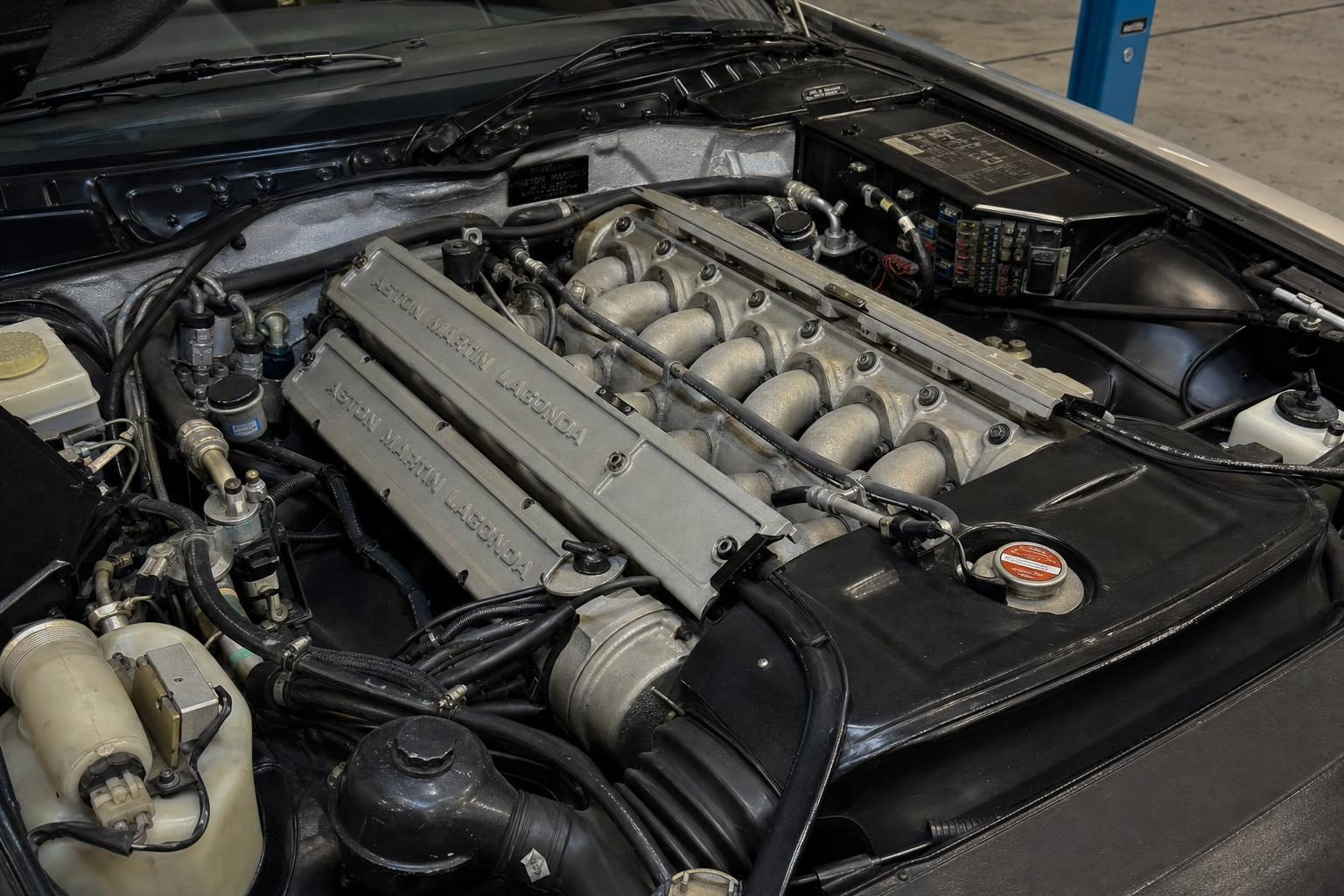
Under the bonnet, the Virage introduced a major evolution of the marque’s iconic V8. According to Aston Martin, the base engine is a 5.3-litre 32-valve developing 330 bhp. This configuration met tightening emissions constraints and the smoothness demands imposed by catalytic converters, while preserving the nobility of the British cross-plane. The output may not be thunderous, but the promise lay elsewhere: freer breathing, improved efficiency and availability at low and mid revs.
This V8 is more than a number. It signalled a return to in-depth development after a long period of iterations. The four-valve-per-cylinder layout brought a genuine gain in cylinder filling and better compatibility with regulations, without betraying character. The marque emphasised the importance of this base for the next, more muscular step, which would take the form of 6.3 evolutions and later supercharged Vantages.
In use, this 5.3-litre’s mission was chiefly to put Aston back into the long-distance GT conversation. Supple, broad-shouldered and sonorous, it put Newport Pagnell back in technical step with the late 1980s.
The Ford transition: what the new owner changed (and what it didn’t dare touch)
Shortly before this launch, Ford took control of Aston Martin. According to Wikipedia, the Virage was the first Aston presented under this new ownership. The message was clear: capital and industrial processes would evolve; British singularity must remain. In practice, the influence first showed in development rigour and range structuring, not in stylistic homogenisation.
What Ford changed was the scale of resources. The arrival of a major group supported measured industrialisation, quality control and access to a broader network. What Ford didn’t dare touch was the soul of the Newport Pagnell workshop: meticulous build, an artisanal cadence, and latitude for bespoke versions. The Virage embodied this balance: a cleaner, more coherent product, yet still crafted on a human scale.
This dosage, perceptible from 1988, prepared the technical evolutions of the early 1990s and the ramp-up of derivatives, without breaking the thread of a GT tradition unique to the marque.
The 6.3-litre variant and the Shooting Brake: two Newport Pagnell curiosities
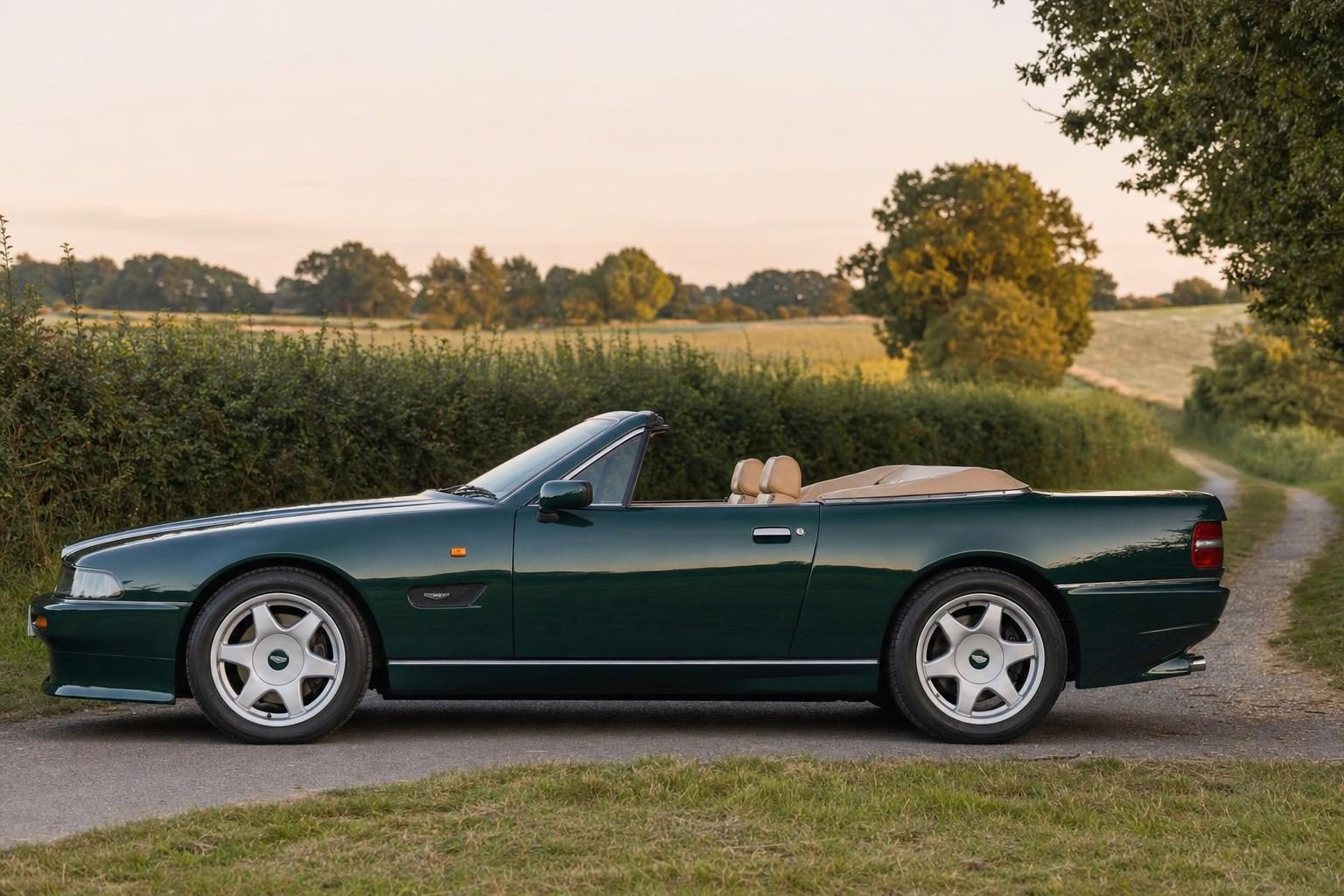
In January 1992, Aston Martin offered a 6.3-litre conversion derived from the AMR1’s engine. Figures vary by source: Wikipedia mentions between 456 and 500 hp, while Aston Martin Magazine places the distinct twin-supercharged Vantage at “around 550 bhp”. The key here is the philosophy: a workshop capable of extracting spectacular vigour from an in-house V8 and clothing it with a widened bodykit as required. The existence of only 19 Virage Volante in 6.3 wide-body specification, reported by Nicholas Mee, speaks to the rarity of these preparations.
In this vein of “curiosities” shaped to order, the Shooting Brake silhouette holds a special place in the Virage imagination. Without venturing into numbers, the guiding idea stands out: Newport Pagnell long cultivated a know-how in singular transformations, exploring other uses of grand touring. The shooting brake harks back to this living-room craftsmanship, typically British, that many associate with this generation.
Whether the 6.3-litre with racing lineage or the shooting brake styling exercise, the constant remains: personalisation, low volumes and technical coherence in service of a specific client. That’s also what makes the Virage so interesting to collect today.
Values and today’s market: why the Virage remains undervalued among classics
Modest production contributes to its singularity. According to Wikipedia, the Virage Coupé was assembled in only 224 or 233 examples – figures differ by source – for an overall production, all variants combined, of around 1,050 units. Such rarity could justify higher values. Yet the market has long favoured either earlier 1970s-charmer V8s or the more spectacular supercharged Vantages.
Why the relative discount? First, because the car sits in a transition: first under Ford, the first “truly” new model in nearly 20 years, it lacks both the retro nostalgia of the 1970s and the power shock of mid-1990s Vantages. Then because its design, born of a competition, chose restraint over showmanship. Good news in use, less effective for auction-room theatre.
For the informed enthusiast, this opens a window. The coupé combines Newport Pagnell construction, a 32-valve V8 adapted to catalysts, and the possibility – for a few examples – of an AMR1-inspired 6.3 pedigree. Tangible, verifiable, durable arguments. In the Aston hierarchy, the Virage asserts itself as a value to rediscover, with fundamentals that stand the test of time.
Conclusion: why the Virage deserves better than a mere “transition” label
As noted: the Virage was born of a competition, adopted a 5.3-litre 32-valve tailored to its era, and inaugurated the Ford period without denying Newport Pagnell. The 6.3 derivatives and workshop curiosities complete the picture of a coherent GT, technically grounded and culturally important for the marque. For those seeking measured poise, meticulous build and genuinely low production numbers, the Virage today offers a shrewd entry point into Aston Martin heritage.
To explore further, see the model’s official presentation on Aston Martin’s page dedicated to the V8 Virage and the historic Aston Martin media dossier on the Virage, as well as the encyclopaedic Wikipedia summary which lists production figures and variants.
Also on AstonLegacy.fr: the detailed portrait of the model on our Virage profile, the V8’s technical roots in the history of the 1969 DBS V8, and the contemporary V8 link with our feature on the AMV8.