collection Aston Martin ou comment bien débuter : budget global, pièces, Works Service, cote et assurance. Un guide concret pour un premier achat serein.
Aston Martin collection: before you commit a cheque and a dream, you need to frame the project. This practical guide reviews the total cost of ownership, parts availability — notably via the Newport Pagnell Works Service — values and resale, as well as documentary checks and insurance. The goal: to help you calmly choose your first example, from “classic” DBs to coupés of the VH era.
What total budget to plan: purchase price, insurance, maintenance and storage
The purchase price is only one chapter of a well‑thought‑out Aston Martin collection. You must add insurance (often on an “agreed value” basis), routine maintenance, time‑bound operations (clutch, running gear, cooling), and suitable storage. Spreading this envelope over 12 to 24 months avoids nasty surprises, especially with a car that has seen little recent use.
The “maintenance” line varies greatly by era. On a “classic” DB, the simpler but older mechanicals require regular attention and preventive refreshes. On VH‑era DB9s and V8 Vantages, access to extensive documentation and shared components eases routine work, but demands scrupulous adherence to service intervals. In all cases, a thorough initial service right after purchase is a wise move.
Storage is not optional. A dry, ventilated shelter, a maintained battery, periodic drives and fresh fluids protect value — and enjoyment. Failing a private garage, consider specialist storage. The quality of battery conditioning, tyres and fuel has more long‑term impact than many invoice lines.
Classic or modern era: DB Mark III/DB4 versus DB9/V8 Vantage, two different worlds
Two approaches coexist in an Aston Martin collection. The DB Mark III and DB4 embody the craftsmanship of Newport Pagnell: charm, vivid mechanical sensations, and a direct link to the brand’s origins. In return, they require an ongoing relationship with a competent workshop and driving that respects warm‑up times and mileages.
Opposite them, the 2005 to 2018 DB9 and V8 Vantage are built on the VH platform. According to factory documentation and specialist publications, this base is well known to workshops, and certain parts shared with Jaguar or AMG simplify routine servicing. As such, you’ll find coupés that are more usable day‑to‑day while remaining fully in the house spirit.
Finally, the DB7 (1994–2003) occupies a pivotal position. According to Wikipedia, more than 7,000 examples were produced, making it the most widely built model in Aston Martin’s history until the arrival of the DB11/DB12. Broad production eases access to wear parts and specialists, while offering a relevant entry point for a first purchase.
To place each generation and refine your shortlist, our panorama of the marque’s lineages remains a useful tool: comprehensive guide to Aston Martin models.
Parts availability: what the Newport Pagnell Works Service still offers
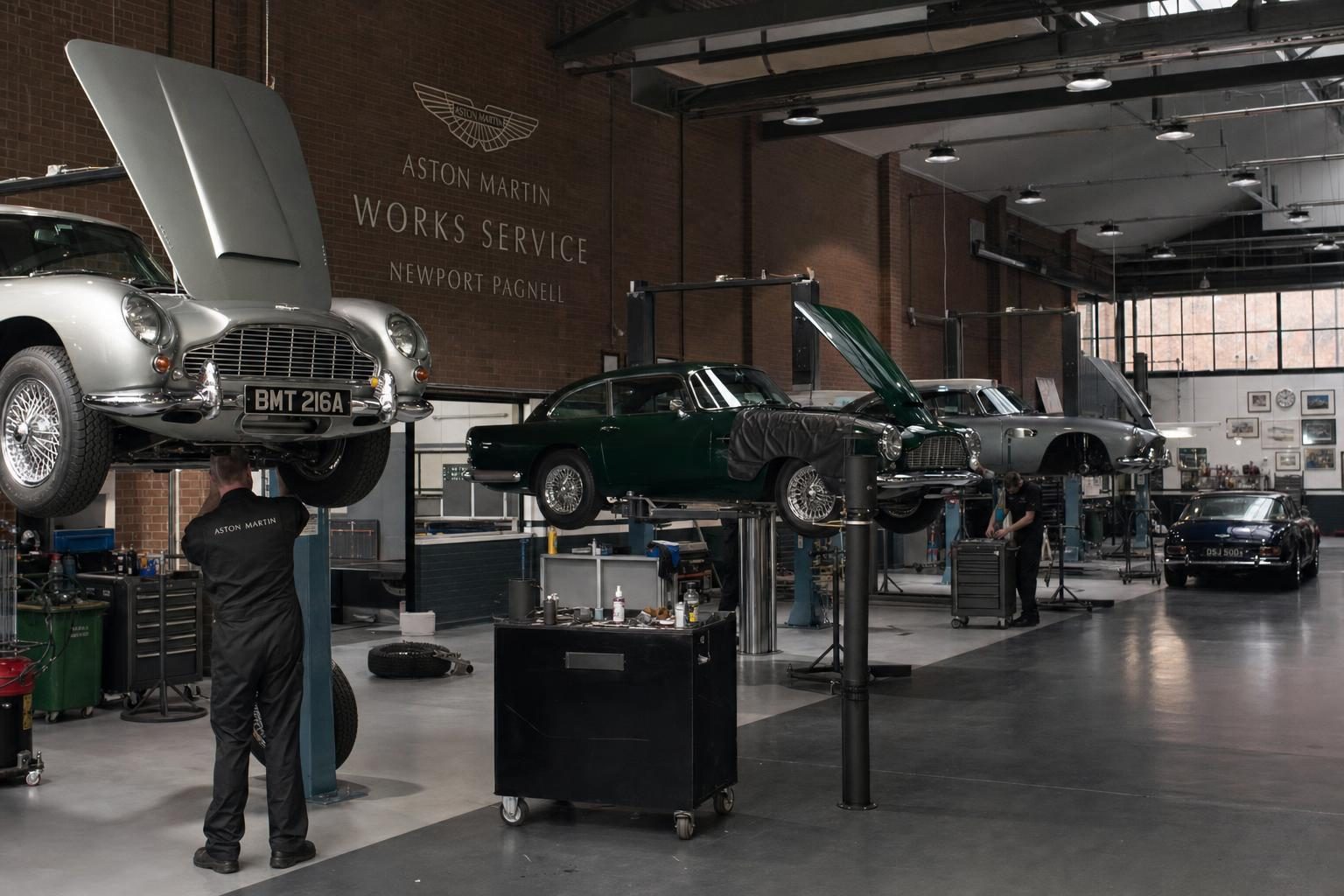
A key point for a successful Aston Martin collection: parts access. The Newport Pagnell Works Service still operates for classic models. According to Aston Martin, the entity provides restoration, maintenance and the supply of specific components, with the continuity of expertise implied by the historic address.
The Newport Pagnell programme was in fact revived in 2017, after a decade without production on the site, as Wikipedia notes. This return to activity came with renewed availability for certain references and an ability to remanufacture critical parts — an asset for DBs predating the VH era.
On DB9s and V8 Vantages, the VH platform and the use of shared components facilitate the supply chain for routine servicing. While not solving everything, it helps shorten lead times for consumables and certain peripheral assemblies — a welcome plus for regular driving.
To prepare a first purchase, take time to sound out the network: recognised independent workshops, delivery times for key parts, and the Works’ ability to document an intervention. The technical mesh is as reassuring as the best evaluation expertise.
Values and liquidity: which models resell most easily
The liquidity of an Aston Martin collection varies with model notoriety, production volume and current desirability. The DB7, with more than 7,000 units according to Wikipedia, offers a broad market and relatively fluid transactions, especially for examples with clean histories and sought‑after specifications.
The DB9 and V8 Vantage benefit from a solid base of buyers, driven by usability and the availability of technical information. Their wider diffusion than “classic” DBs generally enables reasonable resale times when the car is properly maintained and presented.
At the opposite end of the spectrum, the One‑77 hypercar, produced in 77 examples, targets a micro international market. According to the major auction houses cited by our editorial team, it regularly achieves several million euros. Such an icon changes hands within a restricted circle, but its ultra‑rare positioning creates captive demand quite unlike that of core‑range models.
To gauge trends and delve deeper into these cases, browse our technical feature on the Aston Martin One‑77 and its collecting trajectory as well as our page dedicated to the DB7, pivot of modernity.
Pre‑purchase checks: service book, Heritage Certificate and matching numbers
The seriousness of an Aston Martin collection is played out in the paperwork. Aim for a coherent service book, detailed invoices and, ideally, oversight by recognised specialists. A recent, by‑the‑book service is worth more than a stack of older work.
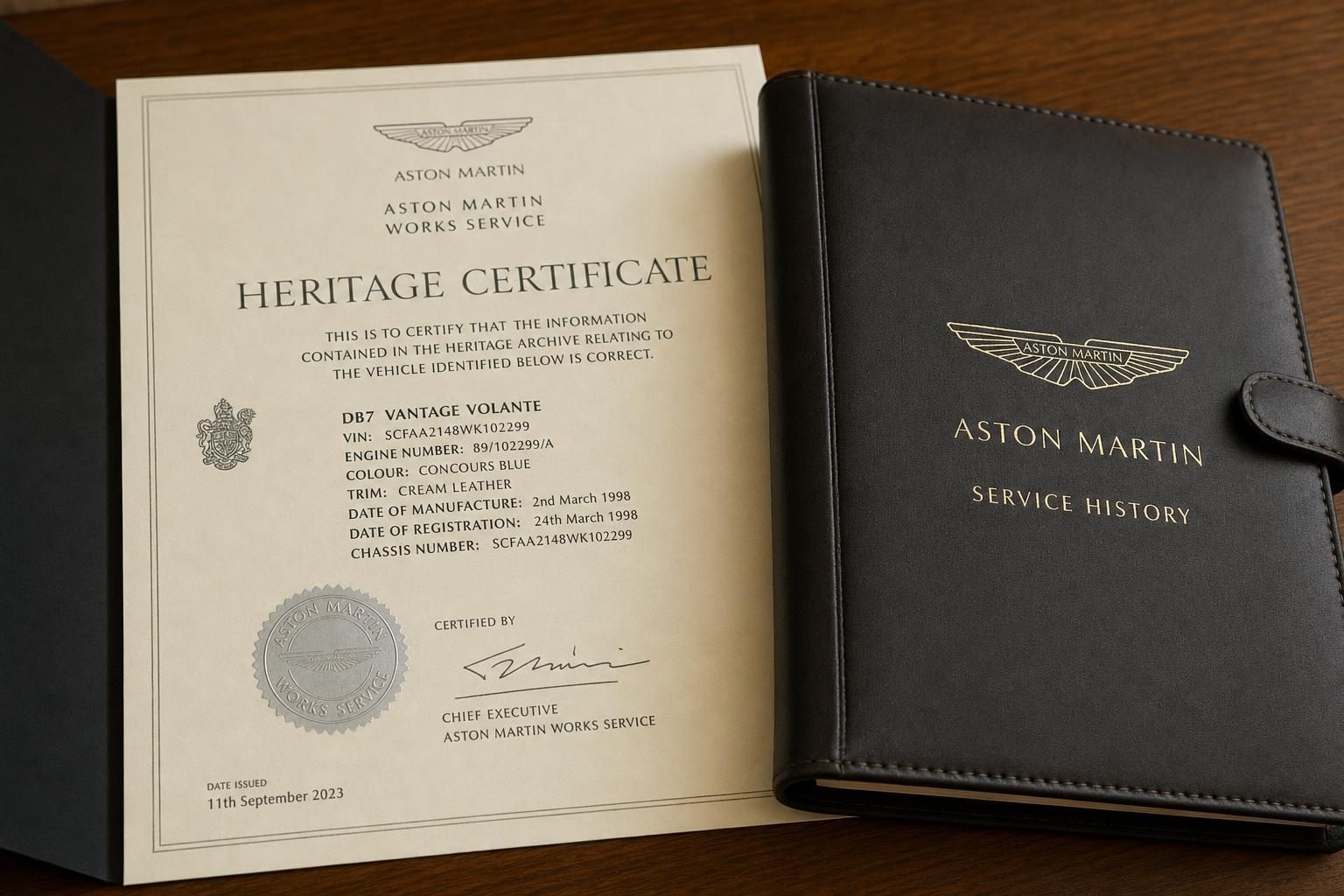
Heritage Certificates, issued by the Heritage Trust, are the authoritative tool to confirm matching numbers and original specification. They provide hard‑to‑dispute documentary proof, valuable for long‑term worth and liquidity. Verify the alignment between the certificate, manufacturer plates and stampings.
Inspect generation‑specific weak points. On classic DBs: structural corrosion, panel alignment, interior integrity and component correctness. On VH models: condition of running gear, electrical peripherals and update history. An independent inspection remains a rational investment.
Finally, cross‑check the road test against the documents: cold behaviour, oil pressure, braking stability and absence of parasitic vibrations. A sound car tells the same story on the road and on paper.
Insuring a classic Aston Martin: specifics of agreed value policies
The right policy protects an Aston Martin collection against uncertainty. “Agreed value” policies set, in advance, a compensation basis agreed between insurer and insured. This is the right tool for cars whose values change and whose uniqueness doesn’t always fit traditional schedules.
To obtain this value, prepare a file: inspection, detailed photos, a copy of the Heritage Certificate and service history. Update it periodically, especially after significant work or a market shift. Specialist insurers appreciate transparency and regular updates.
Match cover to real‑world use: limited annual mileage, events, occasional trips. The excess, breakdown cover and damage options specific to a collector vehicle should be calibrated as precisely as possible. Well‑designed insurance supports preservation and enjoyment of the car — not the reverse.
Conclusion — starting an Aston Martin collection without missteps
Entering an Aston Martin collection means combining desire and method. Frame the overall budget, choose your era with eyes open, secure parts supply via Works Service where relevant, and target models with liquidity aligned to your horizon. Heritage Certificates and a rigorous service file cement value, while an agreed value policy protects both investment and pleasure.
To continue your thinking, explore the official page of the Newport Pagnell Works Service, the encyclopaedic entry on the DB7 and its production, as well as the page dedicated to the DB9 and the VH platform. A reasoned first step, and your Aston Martin collection begins under the best auspices.