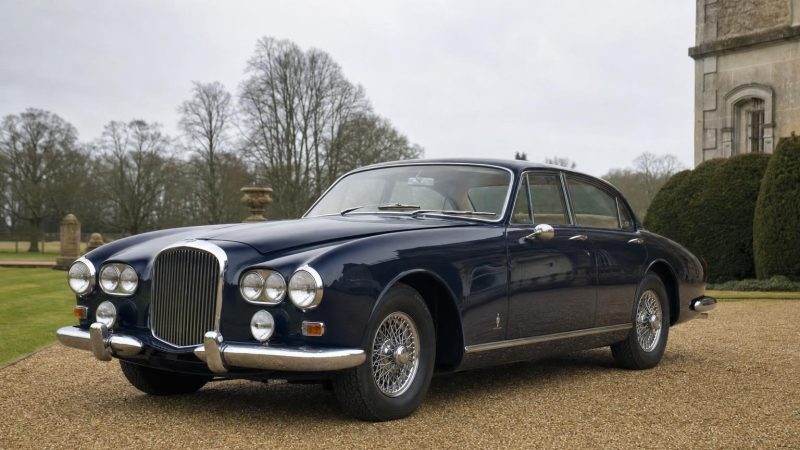
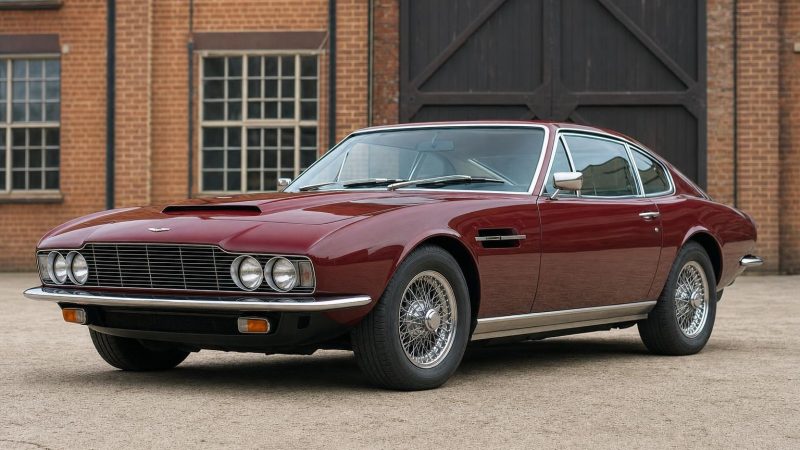
DB4 Newport Pagnell: why the DB4 is not a simple Mark III. Five technical breaks, from the platform to the 3.7 L, explained with sources.
DB4 Newport Pagnell marks the moment Aston Martin made a clean break with the DB Mark III and opened a new era. Far from a simple facelift, the DB4 rebuilt the house from the ground up: chassis, engine, body, production site and industrial logic. Here, point by point, are the five technical breaks that seal this change of generation and explain why the DB4 is not the direct heir to the Mark III, but its philosophical replacement.
On the menu: a new platform chassis, a completely rethought straight-six, Touring of Italy joining the workshop, the move to Newport Pagnell and production in five series. Enough to recontextualise this DB4 Newport Pagnell, unveiled at the 1958 London Motor Show, where its silhouette and modernity caused a sensation, according to the page dedicated to the DB4.
To place the subject, recall that the DB Mark III was still leaving Feltham, from what was already a classic mechanical era. The DB4 Newport Pagnell, by contrast, redefined the brand’s grammar. The reference sources, notably Wikipedia, clearly establish this technological shift.
A new platform chassis: the end of the Claude Hill tube-frame
The first break is structural. The DB Mark III still rested on the tubular architecture inspired by the work of Claude Hill. With the DB4, Aston Martin adopted a new platform chassis, turning the page on the tube-frame. This change is no detail: it redefined the mounting points, rigidity and the way the car was clothed.
According to the historical synthesis dedicated to the DB4, this move to a platform allowed better integration of the bodywork and a rationalisation of assemblies. The DB4 Newport Pagnell thus became more modern in its processes, less dependent on an artisanal tubular framework. It’s a different production language, aligned with the rest of the project.
In practice, this chassis facilitated the adoption of the Superleggera body and laid the foundations for sharper variants. The architecture would serve as the base for the future DB4 GT and, by extension, the famous DB4 GT Zagato, two sporting derivatives we detail in our dedicated feature.
To gauge the gap with the old school, a look at the period presentation of the DB Mark III illustrates what the DB4 deliberately abandoned: the persistence of tubular construction and post-war solutions.
The Tadek Marek 3.7-litre engine: clean slate over the Lagonda straight-six
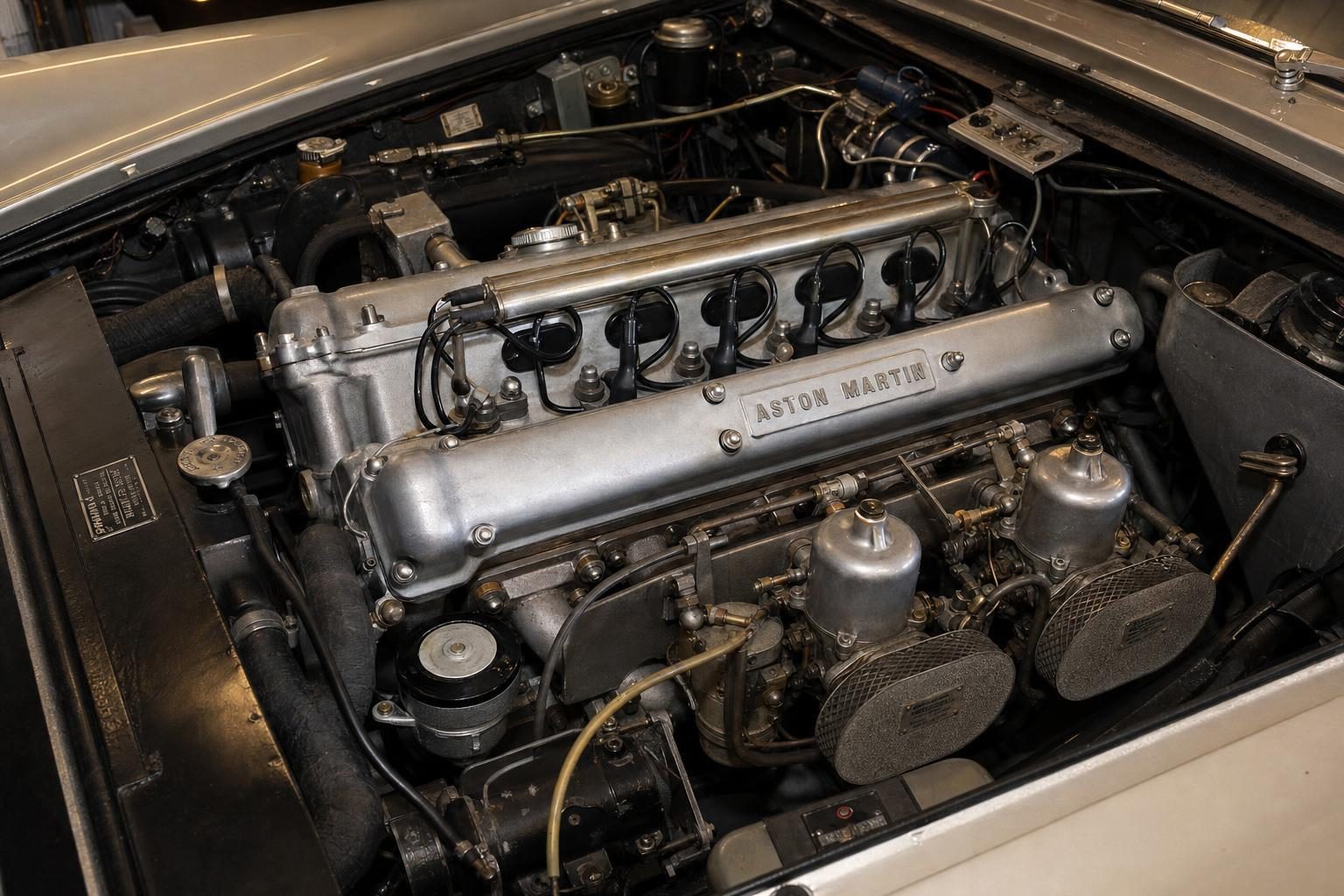
Second line of fracture: the mechanical heart. The DB4 inaugurated a 3.7-litre DOHC straight-six designed by Tadek Marek. Block and head in R.R.50 aluminium alloy, twin-cam valvegear, markedly improved breathing and efficiency: everything opposed it to the Lagonda six of the Mark II/III. This was not an evolution; it was a new chapter.
The technical literature on the DB4 underlines this strategic choice: modernise the power unit and reduce mass, thanks to the light alloy. The DB4 Newport Pagnell thus ushered the engine into the Marek era, a name that would leave a lasting mark on Aston Martin’s straight-six dynasty.
This more ambitious design also prepared the sporting versions. The potential of the 3.7-litre would be exploited in the DB4 GT, then pushed further still with the sleeker GT Zagato body. Proof that the mechanical break was no engineer’s whim, but the bedrock of a range.
Compared with the Mark III, whose engine remained an evolution of the Lagonda six, the DB4 stood out through its materials approach and valvegear kinematics. A deliberate clean slate, and rarely better executed in British industry at the turn of the 1950s and 1960s.
Carrozzeria Touring’s Superleggera body: Italy arrives at Newport Pagnell
Third break: the clothing. The DB4 introduced at Aston Martin the Superleggera method by Carrozzeria Touring, Milan. Fine tubes, aluminium panels, and that line both pure and muscular, which made an impression at the 1958 London Motor Show, according to the DB4’s dedicated notice. The coupé imposed a new aesthetic as much as an unprecedented manufacturing process at Feltham… then at Newport Pagnell.
The DB4 Newport Pagnell owes much to this transalpine collaboration. Superleggera dictated the curves, the visual balance and the management of masses. It also strengthened the industrial proposition, as the Italian method dovetailed perfectly with the platform chassis, ensuring a more coherent whole than the old tubular frame.
The result is a silhouette that would become a template for the following decade. The Series V, lengthened, prefigures the DB5, attesting to the initial rightness of the volumes. Italy didn’t just draw a pretty coupé; it defined Aston Martin’s formal language for years.
To reposition the Mark III in this picture, its bodywork retained classic proportions and less lightweight assembly solutions. The DB4, by contrast, shifted to a more international approach, where technique and style advanced together.
Newport Pagnell: why the DB4 inaugurates the site that still builds Astons today
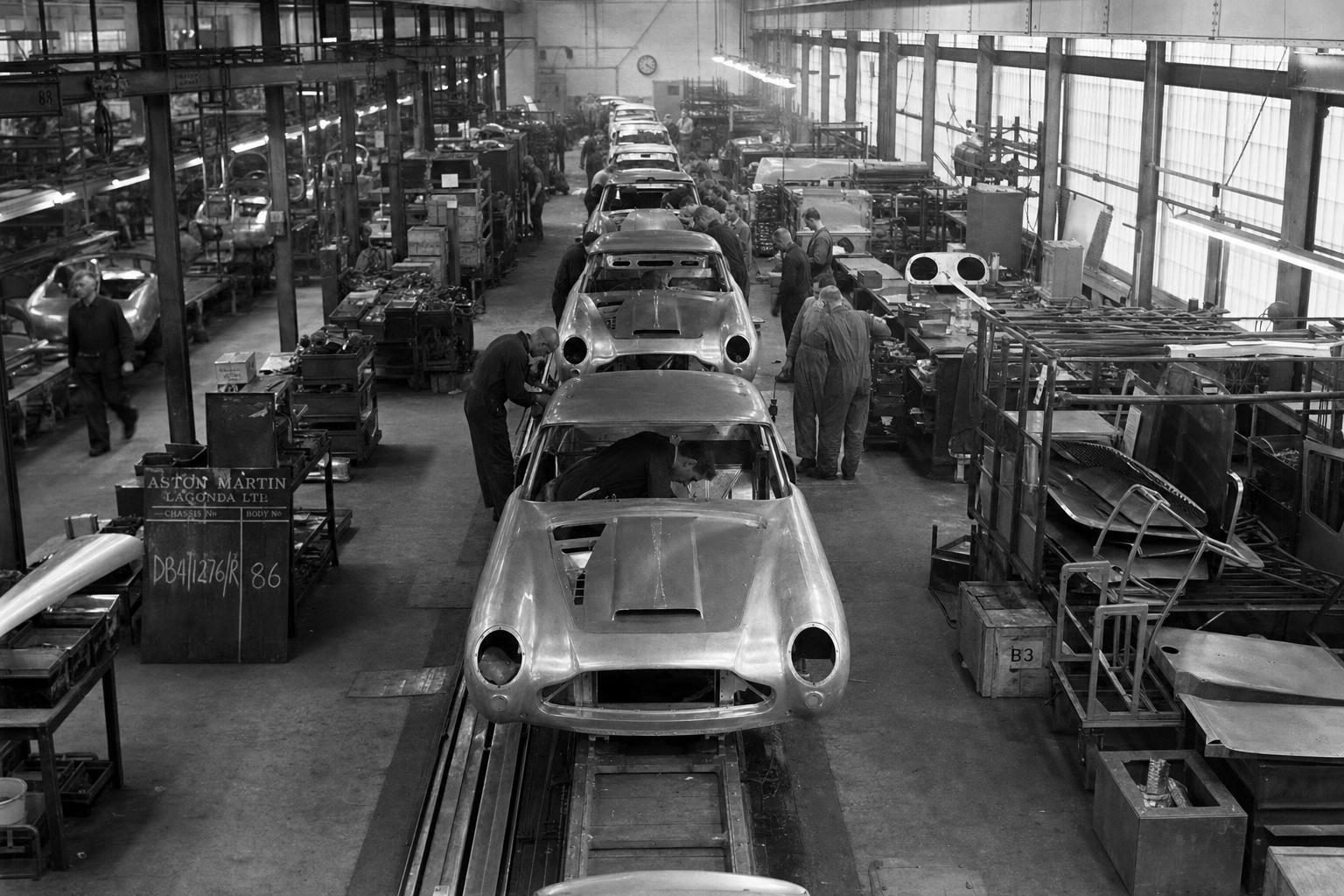
Fourth break, geographical and strategic. The DB4 was the first model assembled at Newport Pagnell while the DB Mark III was still produced at Feltham. This move was no anecdote: it accompanied a rise in industrial maturity. At Newport Pagnell, the marque anchored a production organisation that would shape its identity for decades.
The DB4 Newport Pagnell crystallised this transfer. It linked Milanese-inspired bodywork, a modern chassis and a Marek engine to a site capable of marrying them properly. The address became a symbol; it would remain so, right up to the heritage programmes run today.
In practice, moving production allowed know-how to be internalised, flows to be optimised and quality control to be introduced in line with the model’s ambition. It was also the condition for industrialising sharper derivatives, whether future GTs or evolutionary series.
It becomes clearer, then, why the DB4 is not the unofficial “Mark IV”. It is the starting point of a cycle, and Newport Pagnell is its instrument. This combination of place and technique explains the symbolic power of the name DB4 Newport Pagnell in the marque’s history.
Five series, 1,110 examples: anatomy of production from 1958 to 1963
Final break: the product logic. The DB4 was offered in five series between 1958 and 1963, totalling “around 1,110 examples” according to the reference page. Other secondary sources vary on the precise figure; what matters is the order of magnitude and cadence, signalling controlled output for a hand-built grand tourer.
Each series brought targeted evolutions, culminating with Series V, longer, which traced the line of the DB5. This series-led management speaks to more rigorous industrial steering than in the past, aligned with feedback and continuous improvement. Here the DB4 Newport Pagnell shows its maturity: even the lifecycle reflects the break.
On this base, Aston Martin developed the sportiest pieces of the puzzle: the DB4 GT, then the DB4 GT Zagato. These derivatives exploited the chassis base, the Marek engine and the Superleggera lightness to aim at competition and image. A performance-led demonstration, entirely born of the logic introduced by the DB4.
To delve deeper into the genealogy, our model guide places the DB4 among its contemporaries and direct descendants, while the Mark III profile reminds us where we came from. The overall coherence confirms the thesis: the DB4 is not an evolution; it’s a restart.
Conclusion – DB4 Newport Pagnell, five breaks for a new era
At the end of this journey, the case is clear: DB4 Newport Pagnell marks a methodical break with the DB Mark III. New platform chassis, light-alloy Marek engine, Superleggera body, the shift to Newport Pagnell, and production in five series – five keys that close the door on the old world and open that of the Astons of the sixties.
This coupé changed the way an Aston Martin was conceived, built and clothed. The DB4 Newport Pagnell is thus the matrix from which the DB4 GT, GT Zagato and, in filigree, the DB5 would be born. A measured revolution, perhaps; but a revolution all the same.
For enthusiasts, placing DB4 Newport Pagnell in this context is to better understand the brand’s evolution: not a simple continuity of the Mark III, but a carefully orchestrated generational leap, the traces of which are still visible today.
- Discover the model file and detailed specifications of the DB4 in our guide: Aston Martin DB4 – fiche modèle.
- Compare with the previous generation thanks to our feature: Aston Martin DB Mark III – historique.
- Explore the sporting lineage and its examples: DB4 GT Zagato – histoire et exemplaires.
Useful and complementary sources: