DB5 Goldfinger Continuation, 25 voitures assemblées à Newport Pagnell avec gadgets de film et 4 500 heures d’ouvrage, vendues 2,75 M£. Que dit vraiment ce programme ?
The DB5 Goldfinger Continuation embodies a beguiling paradox: building, in 2020 at Newport Pagnell, a 1963 icon for just 25 clients, with gadgets devised by Chris Corbould OBE, at £2.75 million before taxes. This DB5 Goldfinger Continuation is neither a restoration nor a simple replica: according to Aston Martin, it is the resumption of a production halted since 1965, conducted in association with EON Productions. Four questions arise: what does it mean to “resume” manufacture after 55 years? Which gadgets actually work? What do the stated 4,500 hours represent? And how should we position the status and value of these 25 cars against period DB5s?
Newport Pagnell in 2020: what it means to ‘resume’ a production stopped in 1965
The first DB5 Goldfinger Continuation left Aston Martin Works in July 2020, “the first in a strictly limited series of 25 customer cars”, after a 55-year gap since production ended in 1965 (sources: Aston Martin and media.astonmartin.com). Resuming is therefore no metaphor: the historic Newport Pagnell workshop reprises the methods and specifications of a DB5, but for a numbered series, with contemporary suppliers and today’s quality control. In other words, the DB5 Goldfinger Continuation reactivates an artisanal chain rather than an industrial line.
This revival forms part of a deliberate Continuation strategy: producing ex nihilo cars conceived more than half a century ago. According to Aston Martin, the project is run with EON Productions, keeper of the Bond universe, which frames the lineage: this is a cinematic DB5, acknowledged as such, and not a technical evolution. The DB5 Goldfinger Continuation thus stands apart from restorations: it does not reuse an existing chassis, it does not update an old car; it builds anew an icon discontinued since 1965.
For the collector, the nuance is decisive. A restoration sustains the continuous authenticity of a unique vehicle. Here, the DB5 Goldfinger Continuation claims factory and contextual authenticity (Newport Pagnell, association with EON, gadgets), but not historical continuity of chassis. The intent is clear, almost museal: to revive a DB5 as we imagine it, in the spirit and attributes of Goldfinger.
In this respect, the initiative places Newport Pagnell back at the heart of the story. It is indeed where the original DB5s were assembled, and it is where, in 2020, bodies and chassis are made to the model’s standard. Defined thus, the DB5 Goldfinger Continuation cultivates the aura of the place as much as that of the object.
Chris Corbould OBE’s gadgets: which ones actually work, and within what limits
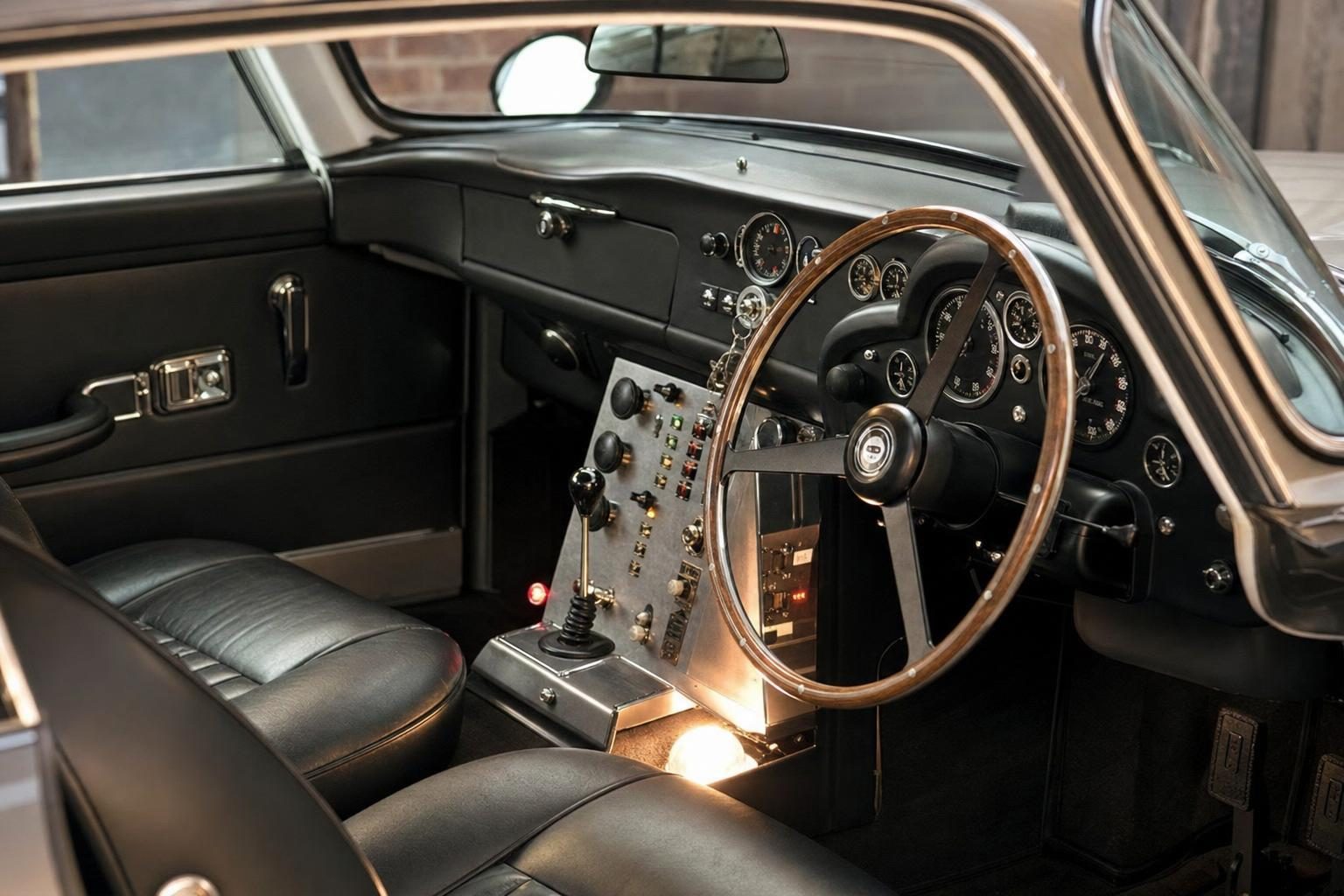
The specification lists equipment developed by Chris Corbould OBE, special effects supervisor for the Bond saga (source: media.astonmartin.com). The DB5 Goldfinger Continuation notably receives a retractable “bullet-resistant” screen, a rotating number plate, a smoke screen simulator and an oil jet simulator (source: astonmartin.com, May 2020). The word “simulator” is central here: we are talking about effects, not armaments. The car reprises the film’s imagery with devices designed to produce sensations and demonstrations, not to confer policing capabilities.
Within this framework, the DB5 Goldfinger Continuation embraces on-set realism: some gadgets are active, but within a controlled perimeter. The revolving plate operates mechanically, the smoke screen and the “oil jet” are explicitly simulations, and the rear shield or retractable screen follow a logic of demonstrative accessories. These are special effects devised by a film professional and integrated by the factory.
Beyond the anecdote, Chris Corbould’s involvement ties the DB5 Goldfinger Continuation to its cultural source. The anchoring is not merely cosmetic: it guarantees coherent execution with the Bond universe as validated by EON Productions. We are not speaking of an aftermarket kit, but of elements conceived and installed within the official programme.
Usage remains the question. By nature, these functions call for private demonstrations or appropriate venues. The DB5 Goldfinger Continuation thus sits at the balance point between collectors’ car and stage object: operational, but in the spirit of a cinematic prop designed to astound without encroaching on reality.
4,500 hours per car: what this figure means in a modern factory
According to media.astonmartin.com, building each DB5 Goldfinger Continuation requires around 4,500 hours. At workshop scale, that represents more than six man-months full-time, or, more concretely, an accumulation of highly craft-driven operations: metalwork, panel fitting, bespoke wiring for the effects, interior trimming, commissioning and inspection.
This time burden illustrates the fundamental difference between a DB5 Goldfinger Continuation and a current high-volume model. Whereas a modern car is born in a few dozen hours on an automated line, the English barchetta of 2020 — for it is indeed an “old-school” car in its construction logic — demands successive sequences, rework and manual validations, notably to integrate Chris Corbould OBE’s gadgets and the specific “Goldfinger” features.
The 4,500 hours also include orchestration of partners. Recreating period components entails dedicated supply chains, tooling and jigs, and therefore quality back-and-forth. The DB5 Goldfinger Continuation derives its value from this stacking of rare hours, carried out at Newport Pagnell, under factory stewardship and not within the freer economy of independent restoration.
This extended timescale is not just a cost; it is an implicit promise of consistency. Each DB5 Goldfinger Continuation leaves with a homogeneous level of finish and integration, which distinguishes a factory programme from a more heterogeneous series of reconstructions.
The legal status of a non-road-legal car at £2.75 million
Each DB5 Goldfinger Continuation is priced at £2.75 million before taxes (source: Aston Martin). The legal status question then naturally follows: how does a car of historic design, built in 2020, sit against today’s road regulations? Official releases focus on manufacture, the association with EON and the gadgets; they do not set out road homologation.
We are left with an obvious point: a DB5 Goldfinger Continuation reprises the architecture of a 1963 model, with “Goldfinger” devices explicitly conceived as special effects. In most markets, safety and emissions rules have evolved dramatically since 1965. Consequently, the typical use envisaged for this kind of programme is collection, events and private demonstrations, within the legal limits applicable in each country.
For the buyer, the issue is practical rather than philosophical: determining where and how to use the DB5 Goldfinger Continuation. Road use, registration, insurance and transport follow national frameworks, and demonstrations of the gadgets in any case require controlled environments. At this price, clarity over the scope of use matters as much as the spec sheet.
The moral contract is clear: the factory delivers a DB5 Goldfinger Continuation faithful to the film’s spirit, assembled at Newport Pagnell, and the buyer organises their experience in an appropriate setting. The links with EON Productions and the object’s cultural patina weigh more heavily than utilitarian considerations.
The original and the copy: what the market value of 1963 DB5s says about these 25 new cars
Comparing a DB5 Goldfinger Continuation to a 1963 DB5 is to illuminate two value regimes. The former anchors itself in an official narrative: 25 units, Newport Pagnell, EON association, gadgets by Chris Corbould OBE, 4,500 hours, £2.75m before tax. The latter rests on historical authenticity, a chassis’s traceability and its individual pedigree — dimensions the Continuation programme does not claim by definition.
In the market, this distinction rarely creates confusion: a period DB5 remains a singular automobile, sometimes restored, sometimes patinated, speaking to lovers of both engineering and history. Conversely, the DB5 Goldfinger Continuation assumes the value of a factory project, limited and culturally stamped, which its rarity (25 examples) and narrative coherence reinforce. The two objects converse without substituting for one another.
This dialogue has a virtue: it protects the perimeters. The DB5 Goldfinger Continuation does not dilute the aura of the 1963 cars; it stages it, literally, via effects and a symbolic geography (Newport Pagnell, EON). In return, the original DB5s lend depth to this series of 25, which finds its natural audience here: collectors drawn to the idea of a “film” DB5, produced by the factory, within an official framework.
Ultimately, the value of these 25 cars is not a firebreak against the original’s market, but a parallel chapter. The DB5 Goldfinger Continuation is an object of cultural authority more than performance, a concentrate of hours, craft and effects that proudly owns its identity.
Conclusion: where the DB5 Goldfinger Continuation sits in history and collecting
By resuming, 55 years on, the manufacture of an icon, the DB5 Goldfinger Continuation clarifies its intent: new-build at Newport Pagnell, 25 units, gadgets developed by Chris Corbould OBE, 4,500 hours per car, £2.75m before tax, association with EON Productions. Neither restoration nor opportunistic replica, it reactivates a specific craft and imagination — those of a cinematic DB5 — and offers collectors a factory object, rare and coherent.
This DB5 Goldfinger Continuation is not here to compete with 1963 chassis, but to converse with them. And that is perhaps the best compass: letting history and its official reissue coexist, in quintessential British elegance, with the faint wry smile that befits well-oiled gadgets.
- To delve into the model’s history, see our dedicated feature on the Aston Martin DB5, its versions and specificities.
- Also worth reading: DB5: history, context and key evolutions to position the Continuation against the originals.
- And for the inseparable link with 007: Aston Martin and James Bond: 60 years of shared history.
Sources and further reading:
Official announcement of the programme and specifications;
media.astonmartin.com release on the first car completed;
historical overview of the DB5.