Lagonda Serie 2: unveiled at the London Motor Show in 1976, this wedge-shaped saloon by William Towns shocked with its onboard electronics and radical style.
Lagonda Serie 2: from its debut, this wedge-shaped saloon imposed a radical vision of what an Aston Martin could be, blending an angular style by William Towns, an entirely digital dashboard, and a V8 engine that is both noble and unique. Unveiled at the London Motor Show at Earls Court in 1976, the Lagonda Serie 2 still stands today as the most audacious UFO ever to emerge from Newport Pagnell, a proposition that marries formal boldness with technological experimentation at a pivotal time for the brand.
1975-1976: The Renaissance of Aston Martin and the Bold Bet of the Lagonda Serie 2
The Lagonda Serie 2 was unveiled in 1976 at the London Motor Show at Earls Court, with the ambition of embodying a stylistic and technical renewal for Aston Martin. This London presentation formalised a rare industrial gamble: to turn a large luxury saloon into a futuristic manifesto, both through its ultra-angular silhouette and its fully digital cockpit. The Lagonda Serie 2 reflects a strong desire to challenge established codes and project the brand towards a new horizon.
This move is part of a sequence where Aston Martin seeks to redefine its trajectory. The previous Lagonda, known as Serie 1 and launched in 1974, had found only 7 buyers (source: Wikipedia), proving that the name Lagonda needed to regain meaning and a distinct identity. The Lagonda Serie 2 precisely addresses this challenge: to embrace a sharp stylistic line and claim an unprecedented driving experience, in line with the high-tech aspirations of the decade.
The technical positioning follows the same logic of affirmation. Under the bonnet, the saloon adopts a 5,341 cc DOHC V8, a mechanical heart that is both prestigious and refined. As for the industrial rollout, it would not commence until the end of 1978, confirming the scale of the challenge taken on by the Lagonda Serie 2 and the care taken in developing such a disruptive ensemble in the landscape of prestige saloons.
William Towns and the Wedge Design: A Total Break with the Past
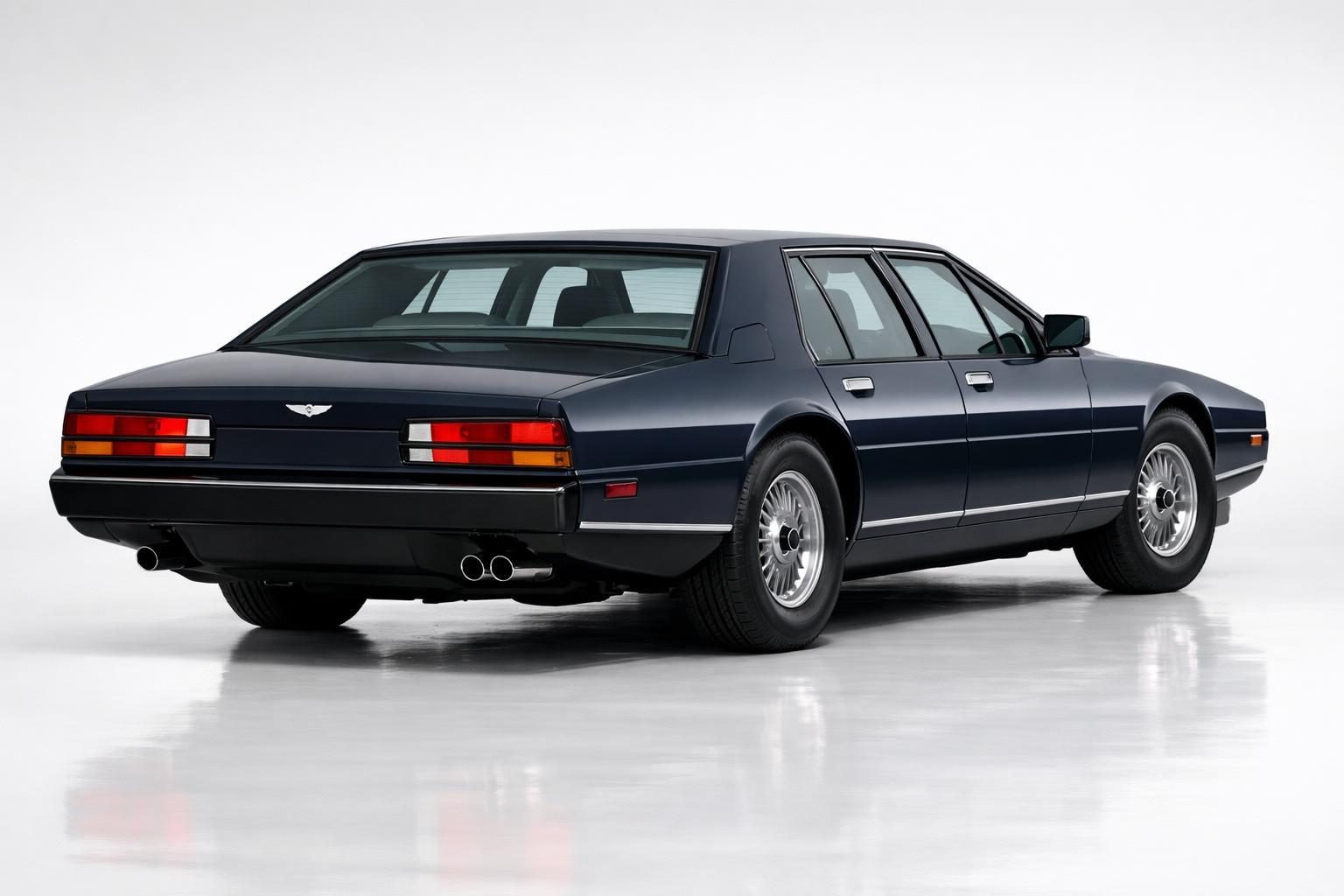
The visual signature of the Lagonda Serie 2 is the work of William Towns, who was also the designer of the Serie 1 from 1974 (source: Wikipedia). With this wedge-shaped, taut, and low body, Towns makes a clear break from the heritage of rounded and classic lines. The volumes are stripped to the extreme, the surfaces appear knife-edged, and the profile stretches forward in a deliberate geometric continuity. This approach gives the Lagonda Serie 2 an unstoppable stage presence.
The graphic purity of the whole serves a clear purpose: to make the Lagonda Serie 2 a rolling sculpture that embodies an era of precision and boldness. This design reflects a desire to align the exterior style with the interior revolution that accompanies it, notably the digital instrumentation and touch-sensitive interfaces. The immediately identifiable wedge architecture transforms every appearance into a visual statement.
This creative gesture can be rediscovered in our dedicated file, which details the genesis, silhouette, and specifics of the 1976 version: the Lagonda 1976 file. To extend the historical and official perspective, the Aston Martin press kit dedicated to the Lagonda Series 2 documents the role of William Towns and the significance of this unique stylistic choice.
Onboard Electronics: A Dashboard of the Future That Malfunctions
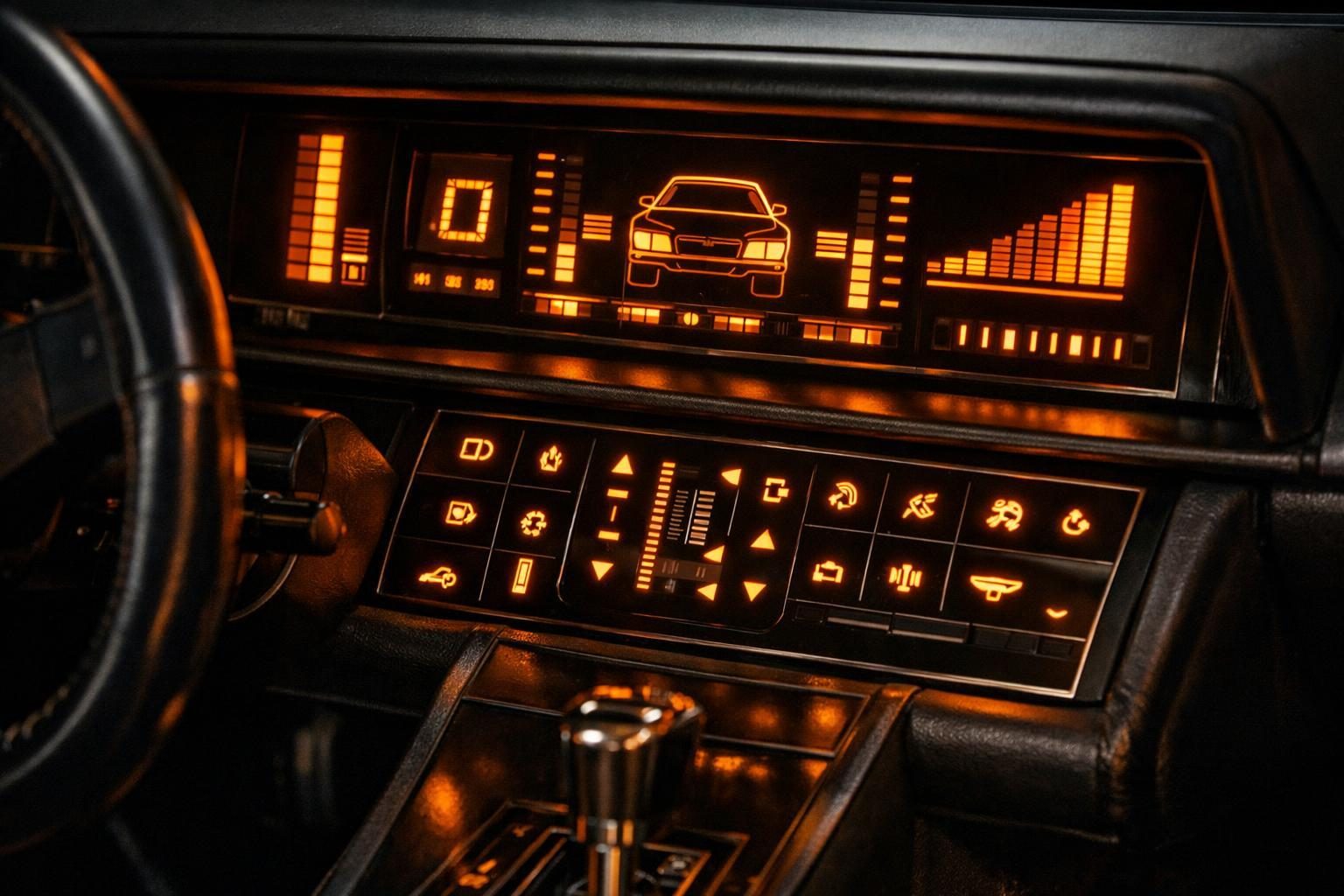
Inside, the Lagonda Serie 2 explores another frontier: a fully digital dashboard and touch-sensitive controls, developed under the influence of Peter Sprague, then director of Aston Martin and also involved with National Semiconductor (source: media.astonmartin.com). This ambition places the saloon at the forefront of automotive interfaces of its time and echoes the wedge aesthetic: technology as the heart of the project.
However, the implementation of a fully digital display and touch controls on a production car was a perilous undertaking. The sophistication of the systems, their pioneering nature, and the hardware/software integration made development particularly demanding. In this context, the Lagonda Serie 2 gained a reputation as a rolling laboratory: visionary in its intent, demanding due to the complexity it introduced into daily life.
This avant-garde vein remains one of the essential reasons why the Lagonda Serie 2 continues to fascinate: it materialises the moment when luxury automobiles attempt a significant technological leap. The synthesis of official and historical sources, notably the Aston Martin summary and the Wikipedia page (in English) dedicated to the Aston Martin Lagonda, sheds light on the catalytic role played by Peter Sprague and the spirit of experimentation of the time.
Difficult Production: 16 Cars in Two Years, Then an Increase in Cadence
Although the Lagonda Serie 2 was presented in 1976, actual production did not begin until the end of 1978 (sources: motorsdb.com; astonmartins.com). This delay illustrates the complexity of such a disruptive project, both in terms of electronics and in manufacturing an extraordinary body and interior. The result, during the first two years of production, reached only 16 units, a figure that reflects the scale of the industrial challenges faced.
Beyond this timid start, the pace subsequently increased, without ever diluting the uniqueness of the proposition. The total number of Lagonda series produced between 1974 and 1990 amounts to 645 units (source: Wikipedia), highlighting the rarity status attached to the model. In this context, the Lagonda Serie 2 occupies a central place: a showcase of craftsmanship, but also of a boldness that far exceeds the usual practices of the category.
For enthusiasts, the milestones of this ramp-up and the associated variants are detailed on the AstonMartins.com detailed file dedicated to the Lagonda Series 2. Here, one can measure how the Lagonda Serie 2 has structured the identity of the modern Lagonda lineage, between innovation and highly specialised craftsmanship.
Heritage and Current Value: From Beautiful Fixer to Retro-Futuristic Icon
The trajectory of the Lagonda Serie 2 illustrates a curious paradox: initially perceived as an offbeat proposition, it now stands as a retro-futuristic icon. Its rarity, radical design, and digital cockpit have transformed it, in the collective imagination, from an ambitious curiosity to a centrepiece of an era. This interpretation is corroborated by the total heritage of 645 units produced across all series (1974-1990, source: Wikipedia), an indication of lasting exclusivity.
On the mechanical side, the 5,341 cc DOHC V8 provides the Lagonda Serie 2 with the breath and nobility expected of an Aston Martin. In terms of power, sources diverge: guide-automobiles-anciennes.com mentions around 309 hp, while Wikipedia states 320 hp (324 PS). This difference is explained by the measurement method, but it also reminds us that the Lagonda Serie 2 combines electronic avant-garde with great engine tradition. To delve deeper into this mechanical aspect of the lineage, our page dedicated to the AM V8 of Aston Martin offers useful additional information.
Over the decades, the cultural footprint of the Lagonda Serie 2 has strengthened. Its alliance between an absolute wedge line and digital instrumentation makes it instantly recognisable, and its history reads like a manifesto of boldness. To place this adventure in the long timeline of the brand, consult our retrospective on the history of Aston Martin, which sheds light on how bets like the Lagonda Serie 2 have shaped the image of the manufacturer.
Conclusion – Lagonda Serie 2, a Vision That Transcends Eras
From its revelation at the London Motor Show in 1976 to its production launched at the end of 1978, the Lagonda Serie 2 synthesises the best of Aston Martin when the brand chooses boldness: wedge design by William Towns, digital cockpit with touch controls under the impetus of Peter Sprague, and a 5,341 cc DOHC V8 for the mechanical soul. The Lagonda Serie 2 embodies this rare articulation between experimentation and exclusivity, captured by limited production volumes and an aura that has continued to grow.
At a time when the founding visions of prestige automobiles are being rediscovered, the Lagonda Serie 2 remains a landmark. It proves that a saloon can be a work of engineering and style, a page turned towards the future. For a documented overview, combine our Lagonda 1976 file with external reference resources, including the official Aston Martin media site on the Series 2 and the encyclopaedic summary dedicated to the Lagonda – all points of reference to measure the lasting impact of this vision.