Aston Martin DB5: history, design and legend of the 1963 British GT immortalised by James Bond. Production, engine and figures.
The Aston Martin DB5 embodies British sporting elegance and serves as a thread to trace the history of a car that has become an icon. This article outlines the industrial and stylistic genesis of the Aston Martin DB5, its mechanics, its connection with James Bond, and the spectacular rise in its value on the collector’s market.
Aston Martin DB5: Birth of an Icon (1963)
The production of the Aston Martin DB5 took place between 1963 and 1965 at the Newport Pagnell factory. David Brown, who had owned Aston Martin since 1947, saw in this sports saloon the continuation of a prestige strategy begun after his acquisition.
The iconic status of the Aston Martin DB5 is due as much to its quality of construction as to its exclusivity: the exact number of units varies according to sources. Aston Martin mentions fewer than 900 saloons (coupes), while the specialist Supercar Nostalgia counts 1,021 units (898 coupes and 123 convertibles), and Wikipedia suggests around 1,059 cars. Presenting these figures side by side highlights the rarity and enduring appeal of the Aston Martin DB5.
The Aston Martin DB5 was designed to combine refinement and performance, positioning the brand in the continuity of David Brown’s models inspired by the demand for quality and the selection of high-end components.
A Design by Carrozzeria Touring
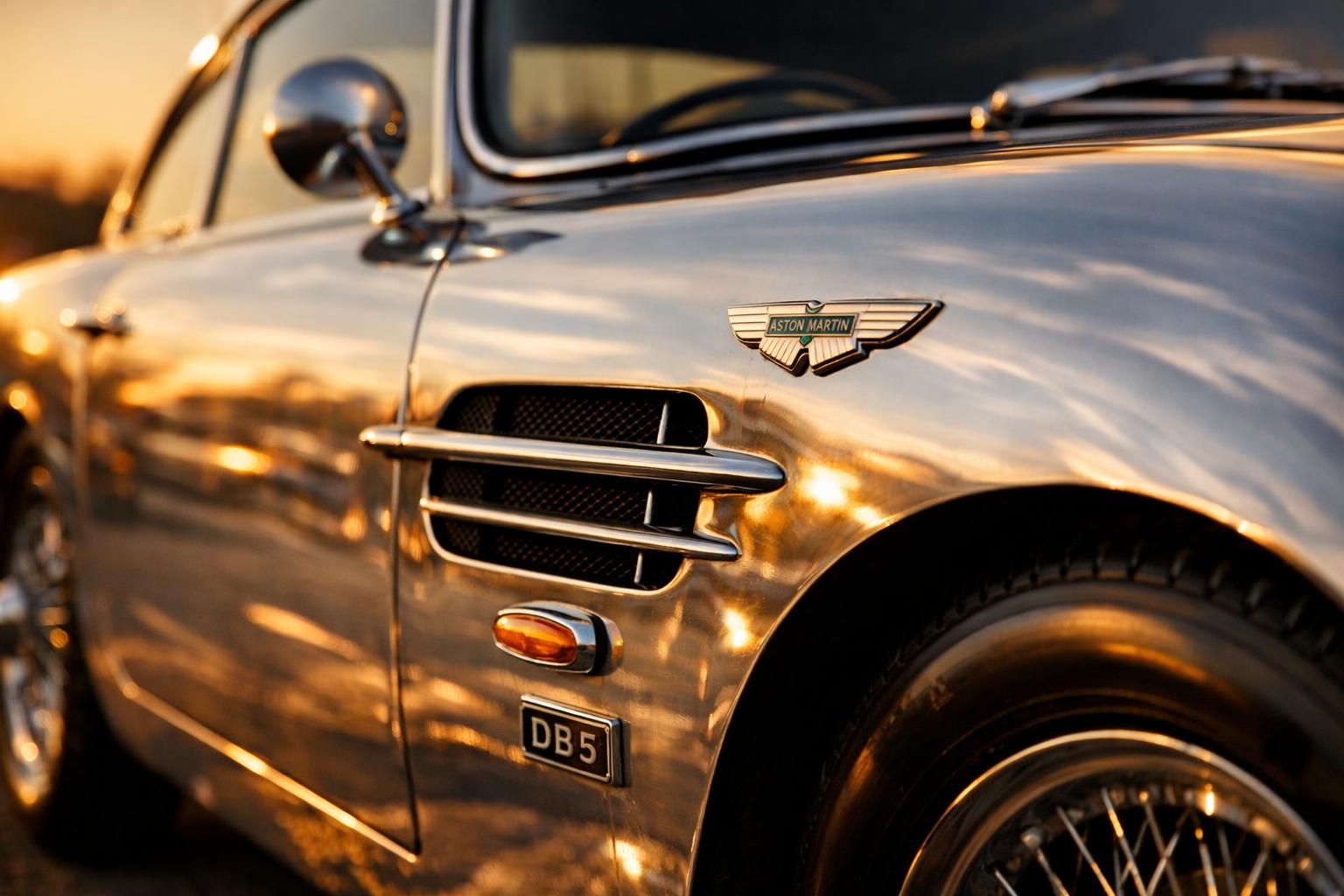
The body design of the Aston Martin DB5 is the work of Federico Formenti from Carrozzeria Touring Superleggera. The construction adopts the Superleggera technique, which means a tubular frame clad in aluminium, giving lightness and elegance to the lines.
This marriage of Italian design and British mechanics has given the Aston Martin DB5 an immediately recognisable silhouette, slender and proportioned, which has traversed decades without losing its charm.
To delve deeper into the model, check out the detailed profile of the DB5 model on AstonLegacy: Aston Martin DB5 model profile.
The 4.0-Litre Six-Cylinder Engine
The mechanics of the Aston Martin DB5 are based on a 4.0-litre (3,995 cm3) DOHC inline six-cylinder engine. This engine delivers around 282 PS in standard configuration and can reach up to 325 PS in the Vantage variant.
The transmission is provided by a ZF 5-speed gearbox, a modern solution for the time and suited to the road and sporting vocation of the Aston Martin DB5. The engine-gearbox combination offered a refined and high-performing compromise, a key contributor to the model’s road reputation.
The precision of the chassis and the lightness provided by the Superleggera construction made the Aston Martin DB5 a pleasure to drive while maintaining an image of a very high-end grand tourer.
James Bond and the Goldfinger Legend
The first cinematic appearance of the Aston Martin DB5 occurs in Goldfinger (1964), a foundational moment of its legend. The DB5 of 007 later reappears in eight films of the series: Goldfinger (1964), Thunderball (1965), GoldenEye (1995), Tomorrow Never Dies (1997), Casino Royale (2006), Skyfall (2012), Spectre (2015), and No Time to Die (2020).
This repeated exposure has transformed the Aston Martin DB5 into a cultural symbol, associating its image with that of James Bond and a world of sophistication and adventure. The link between the brand and Agent 007 is now inseparable in the collective imagination.
For a dossier on the history of Aston Martin and James Bond, find our summary: Aston Martin and James Bond – 60 Years of History. Furthermore, the recent revival of special series shows how the Aston Martin DB5 retains a living status in contemporary production: Aston Martin has relaunched a Goldfinger Continuation series of 25 units starting from 2020 (Aston Martin Works press release).
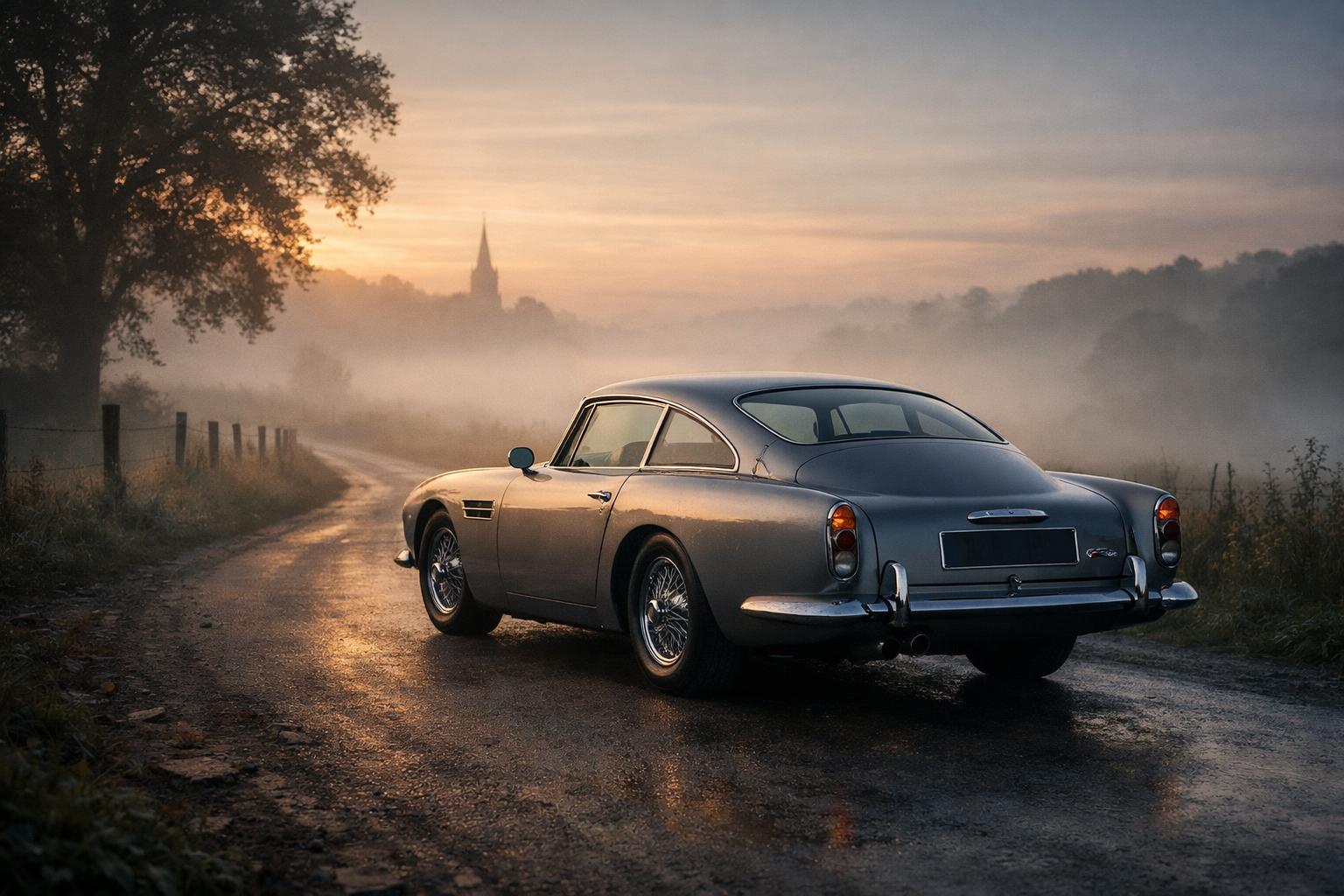
A Soaring Value — Aston Martin DB5
The association with James Bond and rarity largely explain why the value of the Aston Martin DB5 is soaring in the collector car market. The divergent production figures accentuate the aura of rarity: fewer than 900 according to Aston Martin, 1,021 according to Supercar Nostalgia (with 898 coupes and 123 convertibles), and around 1,059 according to Wikipedia, which gives each unit a sought-after status.
Certified examples, Vantage versions, convertibles, and cars with a particular history (screen appearances, provenance, restorations) see their prices skyrocket, reinforcing the idea that the Aston Martin DB5 is both a work of art and a heritage asset.
For additional technical and historical documentation, consult the dedicated Wikipedia page for the Aston Martin DB5: Aston Martin DB5 — Wikipedia EN, and the numerical dossier from Supercar Nostalgia that lists the units: Supercar Nostalgia listing.
Conclusion
The Aston Martin DB5 remains an emblem: design by Carrozzeria Touring, Superleggera construction, a 4.0-litre six-cylinder engine, and a history linked to James Bond explain why it has become the most famous car in the world. Its limited production between 1963 and 1965 at Newport Pagnell, and the revival in limited Goldfinger Continuation series, further cement its status.
Whether a coupe or a convertible, each Aston Martin DB5 carries a part of automotive and cultural history, continuing to fuel the passion of collectors and enthusiasts of British grand touring.
To explore the history of the brand and its models further, also read our summary on Aston Martin: History of the Aston Martin Brand.