Road to Race WEC 2026 dévoile l’entrée en matière de THOR : Imola chahuté, Spa en progrès, coulisses, enjeux LMGT3 et perspectives avant Le Mans.
Road to Race WEC 2026, the documentary series following Aston Martin THOR at the heart of the paddock, opens its Season 2 with two contrasting acts: Imola, first promoted to opening round by a shaken-up calendar, then Spa, the stage for a clear step forward. On the menu: sporting context, technical choices and team dynamics, to understand what these six weeks really changed in the build-up to Le Mans.
We decode what Road to Race WEC 2026 shows — and what it doesn’t — linking the footage to established facts: a season opener switched to Europe, a Valkyrie stringing together points finishes before sealing its best WEC result at Spa, and a doubled LMGT3 entry on THOR’s side. All with the subtext of a unique road-derived hypercar racing on two continents.
A reshuffled calendar: why WEC 2026 started at Imola
Season 2 of Road to Race WEC 2026 opens at Imola for a simple reason: the initially scheduled Qatar opener (1812 km) was postponed to October 2026 due to the war in Iran, making Imola the first round of the year. According to the Wikipedia page dedicated to WEC 2026, this rearrangement reshuffled the deck from the outset, forcing teams to adjust their logistical and technical plans.
This shift weighed on preparation: Europe replacing the Middle East at short notice meant teams had to reconfigure test windows and freight flows. In this fluid context THOR launches its campaign, the cameras of Road to Race WEC 2026 trained on the workshops and the pit wall, between caution and the opportunities offered by a demanding circuit.
Imola, with its succession of chicanes and loaded braking zones, is hardly a “warm-up lap”. The documentary shows the team settling into this new tempo, while the WEC formalises its results and sporting narrative. For an overview of the Imola round, it’s worth consulting the series’ report via the FIA WEC news page dedicated to the race.
The Valkyrie at Imola: ninth place and a third consecutive points finish
At Imola, Road to Race WEC 2026 captures the essentials: THOR’s #007 Valkyrie, entrusted to Harry Tincknell and Tom Gamble, finishes the race in ninth position. According to astonmartin.com (5 May 2026), this marked the third consecutive points finish for the Valkyrie in the WEC, after two top 10s recorded in Japan and Bahrain at the end of 2025.
This ninth place is worth more than a simple statistic. On the one hand, it extends a run of consistency that underpins the programme’s progression. On the other, it comes in the context of a reconfigured calendar, with no margin for error on a circuit that punishes imprecision. The documentary, for its part, stages set-up work under pressure and traffic management — the lifeblood of a hypercar in accelerated learning.
Another salient point recalled by astonmartin.com: the Valkyrie entered by THOR is the only hypercar derived from a road-homologated car to race simultaneously in the WEC and the IMSA WeatherTech SportsCar Championship. This double life imposes technical and operational choices that are hinted at throughout Road to Race WEC 2026 — and which would help explain, in part, the ramp-up seen at Spa.

Spa-Francorchamps: the Valkyrie’s best WEC result before Le Mans
At Spa, Road to Race WEC 2026 documents a genuine step: the #007 Valkyrie completed the 6 Hours in fourth place, the programme’s best WEC result to date, before an eighth place at Le Mans. The progression is clear and, according to astonmartin.com (14 June 2026), it crowned a run of points finishes with an overall performance finally reflected on the results sheet.
The interest of Spa, in this story, also lies in Aston Martin’s history with the Ardennes: the brand took the first GTE win of the WEC era there in 2012, and the Vantage had, before 2026, six class victories and fourteen further podiums. The documentary doesn’t dwell on it, but the backdrop matters: it illuminates internal expectations at a circuit that has often smiled on Gaydon’s cars.
To place these images and results in their official context, the documentary can be cross-checked with the factory communication by consulting Aston Martin’s Spa recap — useful for gauging what Road to Race WEC 2026 shows… and what it merely hints at.
THOR expands to two Vantage GT3s: the stakes of doubling the LMGT3 effort
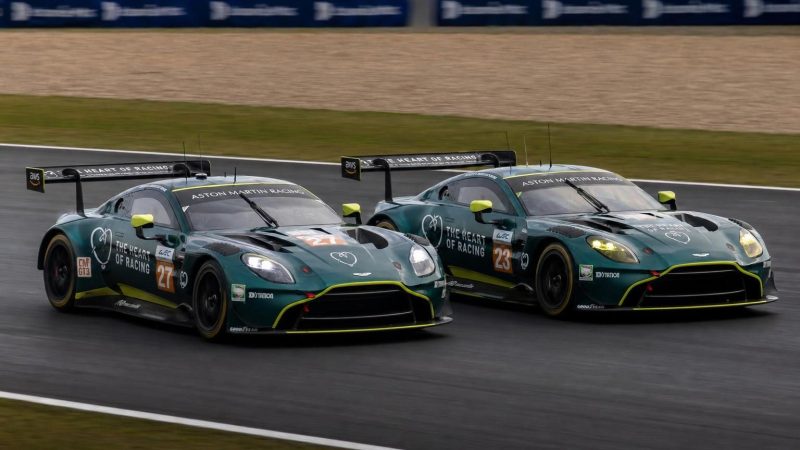
In 2026, THOR expands its LMGT3 footprint to two Vantage GT3s, absorbing the entry previously run by Racing Spirit of Léman. The FIA WEC specifies that Ian James combines the roles of Team Principal and driver of the #27. This structural step up, perceptible in the background of Road to Race WEC 2026, changes the weekend economy: more data, more operational obligations, and a beneficial scale effect if coordination follows.
The Vantage GT3 is built around an in-house bonded aluminium chassis and a 4.0-litre twin-turbo V8, carrying over the mechanical architecture of the road-going Vantage. These technical fundamentals — recalled by astonmartin.com — help explain the coherence of Aston Martin’s LMGT3 roster: a solid industrial base, built around a modern road platform refined for endurance.
At Imola, the #23 Vantage GT3 brought in Kobe Pauwels, a graduate of the Aston Martin Academy, replacing Eduardo Barrichello who was unavailable due to an IMSA scheduling clash (source: Wikipedia for the 6 Hours of Imola 2026). A timely adjustment, and an example of the flexibility required in a season defined by adaptation. For readers wanting to locate the product base, find the road lineage via our page dedicated to the production Vantage (MKII) and its evolution, as well as the spec sheet for the Valkyrie, road side and competition DNA.
What Road to Race doesn’t show: headroom for progress up to Le Mans
Road to Race WEC 2026 suggests the trend without opening every folder. First, the Valkyrie’s regulatory and technical uniqueness — a road-derived hypercar, racing in both the WEC and IMSA — demands careful management of operational correspondences. The documentary shows logistics and pit stop rhythm, but the crux lies in invisible engineering: track-to-simulator correlation, refreshing damper sets, aerodynamic operating windows.
Next, the impact of the modified calendar doesn’t end at Imola. Bringing Spa forward before Le Mans, for THOR, means validating set-up choices on a high-speed, high-elevation track, then extrapolating to a 24-hour circuit where efficiency and stability are paramount. The documentary captures the momentum, but leaves off-camera the granularity of technical decisions that Aston Martin’s official releases confirm.
On the LMGT3 side, moving to two cars creates its own challenge: turning the volume of data into a sporting advantage without diluting human resources. Road to Race WEC 2026 shows the beginnings — synchronising briefings, sharing tyre trends — while the results will reveal whether the scale effect pays dividends at Le Mans.
To watch or rewatch these two episodes, the official video is available on YouTube; and for an editorial step aside, our in-house feature gathers key elements, analysis and useful links, including the page dedicated to the Road to Race documentary at Imola and Spa. Complement with the full Season 2 Road to Race episode and the Aston Martin Spa recap before Le Mans.
Conclusion — Road to Race WEC 2026, a clear foundation before La Sarthe
Between Imola and Spa, Road to Race WEC 2026 tells a measured progression: consistency in the points, then the best WEC finish to date, while the THOR structure broadens its LMGT3 footprint. Nothing overblown, but concrete milestones before Le Mans.
What next? Capitalise on what Road to Race WEC 2026 hints at: a hypercar unique for its road DNA and dual-championship campaign, a more capable Vantage GT3 duo, and a team learning fast in a disrupted calendar. The facts are there; the season is still being written, and that’s precisely what makes it compelling.