V8 Vantage GTE, GT return in 2012, WEC podium from year one, 2014 LMGTE Am titles, key drivers and GTE Pro withdrawal in 2020.
V8 Vantage GTE: here is how the WEC programme, launched in 2012 after the abandonment of the AMR-One in LMP1, gave Aston Martin Racing a clear sporting direction once more. The common thread: a deliberate return to GTs, a championship podium from the very first year, robust LMGTE Am titles in 2014, and a gallery of drivers who defined the “British” aesthetic of endurance performance right up to the announcement of the GTE Pro withdrawal at the end of 2020.
Birth of GTE in 2012: LMP1 abandoned and a return to GT after the AMR-One fiasco
In spring 2012, Aston Martin Racing refocused its sporting strategy and fielded the V8 Vantage GTE in the FIA World Endurance Championship. The context was clear: the team drew a line under the LMP1 programme with the AMR-One, officially scrapped, to return to the brand’s natural arena, GT racing. This shift immediately put the Gaydon outfit back in a technical framework better aligned with its road product and its racing DNA.
According to the dedicated Aston Martin Racing page on Wikipedia, the debut came in 2012, under GTE regulations. This recentring had the virtue of coherence: capitalising on a Vantage base familiar to the workshops and legible to the public, without the complexity of a prototype. In the short term, it was also the quickest way to reconnect with performance at the highest level of endurance racing.
The V8 Vantage GTE then became the flagship of the factory GT programme. In the shadow of the withdrawn LMP1 prototype, this V8-engined coupé set out to write another story: less spectacular in absolute terms, but more effective for building a durable racing identity.
Inaugural WEC season 2012: second in the LMGTE Pro championship in year one (V8 Vantage GTE)
From 2012, the V8 Vantage GTE put Aston Martin Racing at the heart of the action in LMGTE Pro. Again according to Wikipedia, the team finished second in the LMGTE Pro championship in its debut WEC season. The statistic speaks for itself: return, settle in, score in the championship. In one campaign, the essentials were in place.
This result validated the technical and strategic choice. By restarting from a familiar GT base, the team shortened the learning curve and regained immediate competitiveness. For brand loyalists, the V8 Vantage GTE became “the car” that put Aston Martin back into a credible narrative of consistency and world championship podiums.
In image terms, the 2012 season also anchored a distinctly English driving and engineering signature: consistency, finesse in exploitation and a composed calm. The V8 Vantage GTE established itself as the factory GT that could perform without excessive noise, very much in the Aston Martin manner.
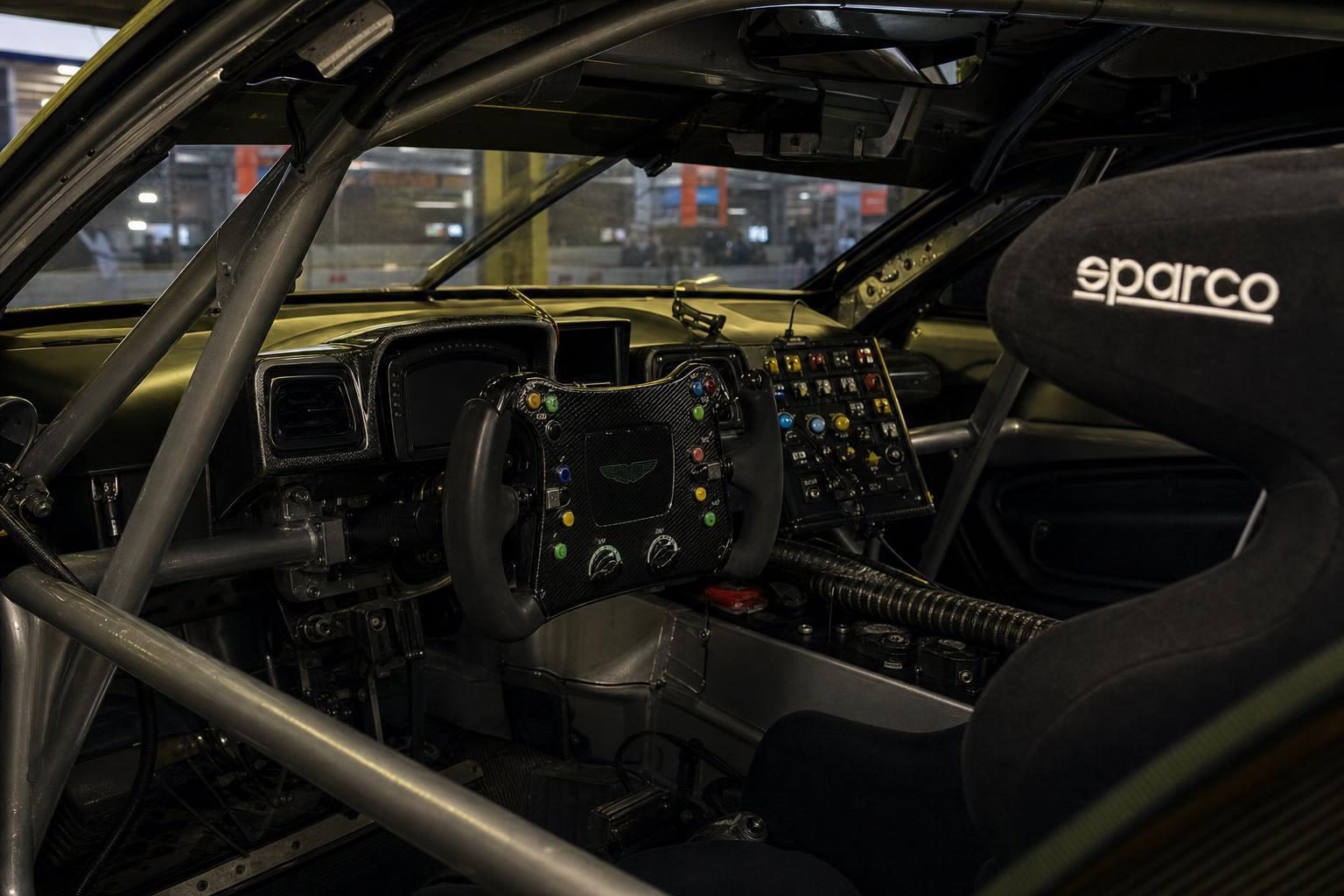
LMGTE Am: 2014 team and drivers’ titles with Poulsen and Heinemeier Hansson
The Am side of the V8 Vantage GTE programme delivered its most tangible harvest. In 2014, Aston Martin won the FIA WEC Endurance Trophy for LMGTE Am teams and drivers with Kristian Poulsen and David Heinemeier Hansson, again referenced by Wikipedia. A double crown underlining the seriousness of the commitment in the Pro-Am category, the backbone of the GTE grid.
This LMGTE Am success showcased the solidity of the technical package and factory backing around the V8 Vantage GTE. It also validated the effectiveness of an environment where team rigour allows mixed crews to convert consistency into titles. The 2014 honours weigh heavily in Aston Martin’s modern endurance image.
For readers wishing to delve deeper into the recent GT heritage, our feature on the Vantage GTE’s history and victories in the WEC and at Le Mans puts this 2014 result into the car’s timeline.
Bruno Senna, Darren Turner, Stefan Mücke: the faces of a decade in GTE Pro
Beyond results, a car is embodied by its drivers. In 2013, Bruno Senna joined the GTE Pro crew, alongside Frédéric Makowiecki and Rob Bell (source: Wikipedia Aston Martin Racing). The Brazilian brought a nuanced reading of endurance pace and useful media credibility to the V8 Vantage GTE as it gathered momentum.
The beating heart of the GTE Pro programme, however, remained the duo Darren Turner – Stefan Mücke, identified as the main axis, joined by Peter Dumbreck at Le Mans 2013 (source: Wikipedia). Turner, a house stalwart, and Mücke, sharp and effective, established technical and human continuity aboard the V8 Vantage GTE.
The brand’s centenary in 2013 provided the setting for this ensemble. For the occasion, two 2013-spec Vantage GTEs were entered in GTE Pro, and two 2012-spec Vantages in GTE Am (source: Wikipedia). A way to celebrate history by fielding both the latest evolution and the initial base, while consolidating presence in Pro and Am.
To slot these figures into Aston Martin’s GT lineage, revisit our overview of the DBR9 and its 2007–2008 Le Mans victories, and, on the road-car side, the genealogy begun by the 2005 V8 Vantage, whose spirit the V8 Vantage GTE translates to the track.

December 2020: withdrawal from GTE Pro and switch to the Hypercar programme
On 23 December 2020, withdrawal from the GTE Pro programme was announced (source: Wikipedia Aston Martin Racing). This marker closed the chapter opened in 2012 and sealed the V8 Vantage GTE’s arc in the World Endurance Championship. Eight seasons of continuous presence, with structuring milestones: a category podium from 2012, LMGTE Am titles in 2014, and a sporting identity refined by reference crews.
Beyond the date, the essence lies in the legacy. The V8 Vantage GTE re-established Aston Martin in a coherent, credible and sustained global GT narrative. It also prepared the public and the team to envisage the next stage of endurance racing, in a technical universe in flux.
For the broader WEC and class context, the championship’s official site offers clarity: see the presentation of the series and classes on fiawec.com. For the brand’s historic racing anchor, see the official Aston Martin racing timeline.
Conclusion: what the V8 Vantage GTE fixed in the racing DNA
In eight years, the V8 Vantage GTE did more than fill timing sheets: it set out a method. Return to GT fundamentals in 2012; target efficiency over showiness; turn consistency into a LMGTE Pro podium in the very first season; and finally inscribe a line of titles in LMGTE Am in 2014. Add drivers of high practical value — Senna, Turner, Mücke — and you get a clear, durable imprint.
The V8 Vantage GTE remains Aston Martin’s answer to a simple question: how to build a modern racing identity, faithful to the brand’s spirit, in a global, exacting championship? In GT, with measure and return. That is precisely what the V8 Vantage GTE delivered.
To continue reading, our recap feature on the Vantage GTE’s sporting legacy and the historical summary on Aston Martin Racing complete this assessment.