Valkyrie AMR Pro au Paul Ricard, entre V12 sans hybride, appuis extrêmes et ADN LMH : voici 5 clés pour lire l’onboard et la philosophie “sans règles”.
The Valkyrie AMR Pro, in onboard footage from Circuit Paul Ricard, reveals what it means to push a “no-rules” hypercar on a benchmark track. From the images and facts published by Aston Martin and public sources, we decode five key takeaways: the choice of layout, the KERS-free Cosworth V12, the aerodynamic and production fundamentals, the direct lineage to the Valkyrie AMR-LMH and, above all, what the onboard says about dynamics that flirt with modern F1 standards.
The Valkyrie AMR Pro and Circuit Paul Ricard: why this choice matters
Seeing the Valkyrie AMR Pro at Paul Ricard is no coincidence. The Aston Martin UNLEASHED programme runs track days there, where owners drive their own cars before riding as passengers in the AMR Pro with a test driver at the wheel. According to Aston Martin, this format blends education, safety and technical demonstration on a modular, perfectly resurfaced circuit, ideal for probing the limits of downforce and braking over long, fast sequences (official presentation of the UNLEASHED days at Paul Ricard).
Paul Ricard is an open-air laboratory: long straights, technical sequences, generous run-offs and consistent tarmac. For an extreme-downforce machine, the readability of lines and the quality of grip determine the driver’s confidence… and the passenger’s. That is precisely what this track-only model seeks, born to lap fast and for long stints, without the filter of road homologation.
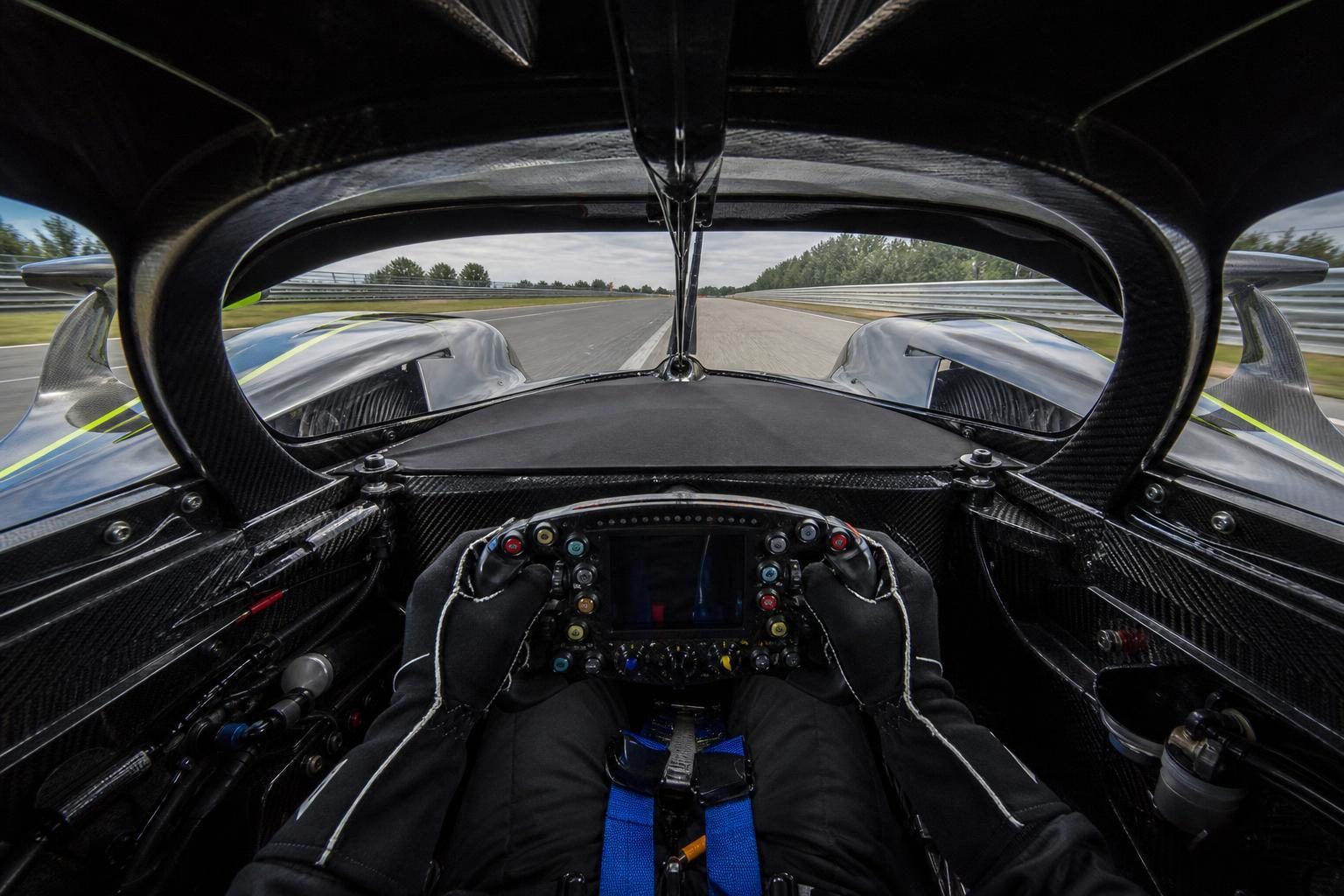
The onboard angle adds another layer of analysis. The in-car camera, particularly on the Mistral straight and through Signes, highlights high-speed stability and how the aero “pins” the car to the ground. Where many road-legal hypercars show movement, this radical barchetta remains unruffled. A signature trait.
Cosworth V12 1,000 PS with no hybrid: what dropping KERS changes on track
The cardinal point of this radical coupé is the 6.5-litre naturally aspirated Cosworth V12, delivering around 1,000 PS, with public estimates ranging from 820 kW to 1,100 PS. It revs to 11,000 rpm and, crucially, does so without KERS hybrid assistance. Based on information released by Aston Martin and compiled by Wikipedia, this choice lightens the system, simplifies thermal management and gives throttle response a rare clarity at this performance level.
In the onboard, the lack of hybridisation shows in the linear shove and consistent braking. No variable regen at the pedal, no deployment strategy on throttle: the mechanical communication is direct. The driver can place the apex and pick up the throttle without the “step” in torque typical of aggressive hybrid systems. It’s less spectacular in raw numbers, but often more consistent over a clean lap.
The corollary is more demanding management of gears and mechanical grip, especially on exit from medium-speed corners. The very responsive V12 requires fine work on throttle opening to avoid “unsettling” the rear before the aero takes over. On screen, this translates into very progressive pick-up, then an acceleration that stretches to the limiter, almost “British” in style: precise, determined, without bombast.
One body, one aero, 40 built: the numbers that define the AMR Pro
Initially presented at the 2018 Geneva Motor Show, then revealed in production form in 2021, the Valkyrie AMR Pro adopts a specific body, more aggressive than the road-going Valkyrie. It notably features a bi-element rear wing and an LMP1-inspired diffuser, highlighted by Wikipedia and Aston Martin press material. The goal is clear: maximise downforce beyond regulatory constraints.
The spec sheet confirms this intent: wheelbase extended by 380 mm, track widened by 96 mm at the front and 115 mm at the rear versus the standard Valkyrie, according to the maker’s dedicated page. This geometry promotes high-speed stability and allows more committed aero settings, which at trackside translate into a car that’s “planted” in fast sweepers and surprisingly docile under trail braking.
On production, 40 examples were built plus two prototypes, all left-hand drive. The run is both exclusive and coherent, centred on a single brief: circuit performance without road compromise. Aston Martin even announced a 3 min 20 s target lap at Le Mans, indicative of aerodynamic efficiency that exceeds Le Mans Hypercar frameworks (references from the Aston Martin pressroom).
From Paul Ricard UNLEASHED to Valkyrie AMR-LMH: same DNA, two destinies
The Valkyrie AMR Pro forms a bridge to the competition-entered Valkyrie AMR-LMH: according to Wikipedia, the latter is the only LMH hypercar derived from an existing production car. Seeing the AMR Pro at work at Paul Ricard clarifies what this implies: the core aero-mechanical balance, the hunt for downforce efficiency and the confidence it gives the driver are shared.
The UNLEASHED programme, by exposing owners to passenger laps with the test driver, acts as the “experiential chapter” of this kinship. The technical link is visible in the big themes (architecture, downforce philosophy, absence of KERS on the AMR Pro) as much as in behavioural details seen on the onboard: stability under braking, precise turn-in and energy carried through fast corners.
The story unfolds over time. The AMR Pro’s dynamic world debut, in March 2022 at the Bahrain Grand Prix with Dirk Müller for two demonstration laps, set the model’s public grammar (source: Aston Martin pressroom). Overall Valkyrie production concluded in December 2024 (150 coupés, 85 Spiders and 40 AMR Pro, per Wikipedia), closing a rare chapter where track and road faced the same aerodynamic mirror.
What an onboard lap teaches about hypercar dynamics edging towards F1
A strong onboard can be worth a long debrief. At Paul Ricard, three key zones let the AMR Pro “speak”: the Mistral straight, Signes and the double-right Beausset. The footage shows a car with a very stable rake, seemingly “nailed down” approaching Vmax; at Signes, entry comes with a very slight lift, then firm commitment and throttle back on with no visible correction. Aero does the heavy lifting; the chassis gives the confidence to push beyond the usual psychological threshold of road-legal hypercars.
At Beausset, you can read the differential between mechanical and aerodynamic grip: the AMR Pro carries mid-corner speed and accepts a progressive load-up to the exit point, where a heavier or less downforce-rich car would tend to smooth its line more. The lack of KERS removes residual torque variables: the throttle becomes a load variator, not a switch for electric boost.
Finally, deceleration illustrates the relationship between widened geometry and stability. The increased tracks and stretched wheelbase translate to a straight, stable brake entry, followed by a slight rotation at apex, without notable “pogoing”. Here you understand the ambition of Aston Martin’s stated 3 min 20 s at Le Mans: not a number tossed in the air, but the consequence of a package conceived outside regulatory constraint. To cross-check these impressions, the Paul Ricard onboard available online is a solid visual reference (Valkyrie AMR Pro onboard at Paul Ricard).
Conclusion — Valkyrie AMR Pro, the track as a revealer of philosophy
At Paul Ricard, the Valkyrie AMR Pro lays its cards on the table: textbook aerodynamics, a naturally aspirated Cosworth V12 with exemplary response and a design freed from road constraints. The onboard isn’t just another flashy clip: it’s a direct reading of the “no-rules” philosophy that fed the Valkyrie AMR-LMH. In brief, this model shows how Aston Martin translated the intuition of a concept shown at Geneva in 2018 into a 40-unit machine capable, in its own way, of brushing reference lap times.
For those wanting to gauge the gap between road and race, the family tree is clear and documented. The official pages dedicated to the track model and UNLEASHED experiences set the technical context as much as the sporting intent (media presentation of the AMR Pro and Paul Ricard UNLEASHED programme). And to place this line within the range and its racing heir, explore our feature on the Valkyrie AMR-LMH entered at Le Mans, the page dedicated to the Valkyrie models and their recent history, as well as our analysis of the hybrid Valhalla and its technical ruptures. The Valkyrie AMR Pro will stand as the frankest distillation of what Aston Martin aerodynamics can do when given the track to express itself.