Valkyrie LMH 2025, bilan chifré WEC/IMSA : fiabilité, premiers points au Mans, podium à Road Atlanta, V12 Cosworth bridé et programme 2026
Valkyrie LMH 2025: here are five figures that tell, without embellishment, Aston Martin’s first international campaign across WEC and IMSA. From pure endurance to managing the Balance of Performance, we put the British prototype’s progress in perspective, its contrasts between championships, and what these data say about the brand’s strategy.
22,000 race miles: what an inaugural WEC season covers
Why start with distance? Because more than 22,000 miles covered in the WEC in 2025 by the two cars — a total published in December 2025 by astonmartin.com — demonstrate the real reliability of a nascent programme. The tally is impressionistic: stints completed, procedures repeated, neutralisations managed. Above all, it doesn’t deny the early-season hiccups; it puts them in context.
In Qatar (1812 km), the #007 retired with a transmission issue while the #009 finished 23 laps down, a bruising start noted by Wikipedia. In other words, the mechanical base stood up over the year despite a rough opening. It’s this logistical and technical endurance that then enables consolidation at Fuji and Le Mans.
From Aston Martin’s perspective, this metric has another merit: it feeds data transfer to the eponymous road car, around a V12 sharing the same philosophy. The road-to-track lineage of the Valkyrie isn’t a slogan; it’s a set of correlations made tangible by massive mileage.
Le Mans 2025: 12th and 14th, and the first Constructors’ points in history – Valkyrie LMH
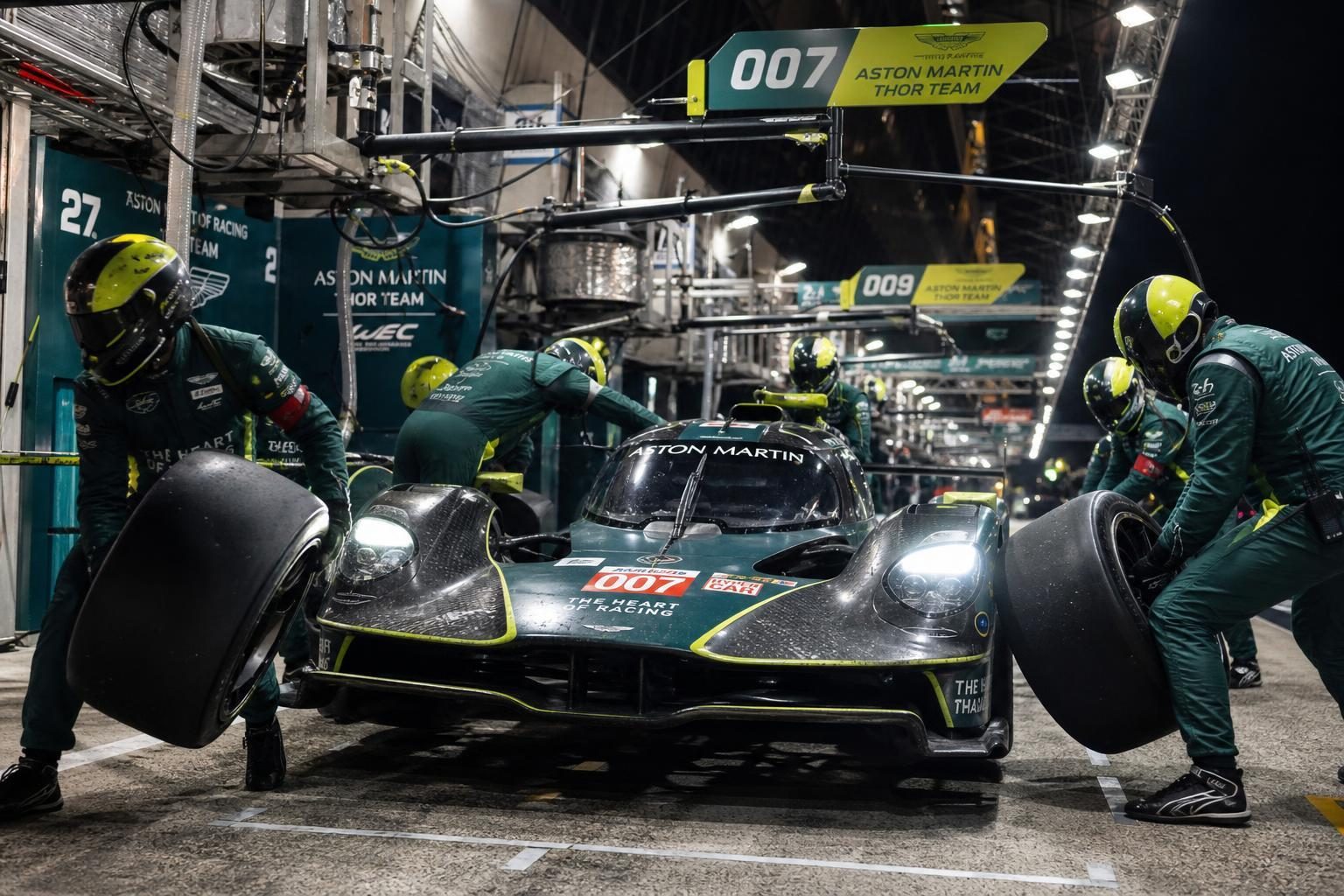
At Le Mans, the mission was twofold: reach the finish and matter in the classification. Objective achieved with a 12th place for the #009 and 14th for the #007, accompanied by the first Constructors’ points in Aston Martin’s history in WEC Hypercar, confirmed by media.astonmartin.com and astonmartin.com. For a first participation of this model in the Sarthe classic, the essentials were laid down: reliability, discipline and a pace aligned with the BoP window.
The 2025 hierarchy was dense, but the green prototype kept the tempo by night and by day. The double finish provides a valuable snapshot of stints, fuel usage and tyre windows. Above all, it validates a method: make the 24 Hours a controlled laboratory more than a sprint, to better build the remainder of the season.
For a detailed chronological breakdown of the race and the stints of the #007 and #009, see our dedicated focus on the Valkyrie at Le Mans 2025. Between hard facts and strategic resets, the analysis confirms the growing command as the hours ticked by.
Petit Le Mans 2025: the first podium, five seconds from victory
The WEC/IMSA contrast played out at Road Atlanta. At Petit Le Mans 2025, the Valkyrie claimed its first podium in any competition, finishing 2nd, five seconds behind the winning Cadillac, a result highlighted by Wikipedia and astonmartin.com. The margin is slim, but it carries weight: it validates the chassis potential and the team’s ability to exploit a performance window different from that encountered in the WEC.
This podium fits into an American trajectory already under way: the Valkyrie is the first LMH to score points in IMSA (from Sebring 2025, according to astonmartin.com). In a field dominated by LMDh, Aston’s LMH homologation found a stage, proof that beyond equivalence settings, on-track execution and tyre model choices make the difference.
The pendulum is instructive: Fuji delivered the best WEC result of the season (5th) with Marco Sørensen and Alex Riberas — who became the first Aston drivers to score points in the WEC’s top class, according to astonmartin.com. In IMSA, Road Atlanta converted that momentum into a podium. Two championships, two contexts, one conclusion: the ramp-up is measurable.
A Cosworth V12 capped at 500 kW: why Aston eschewed hybrid
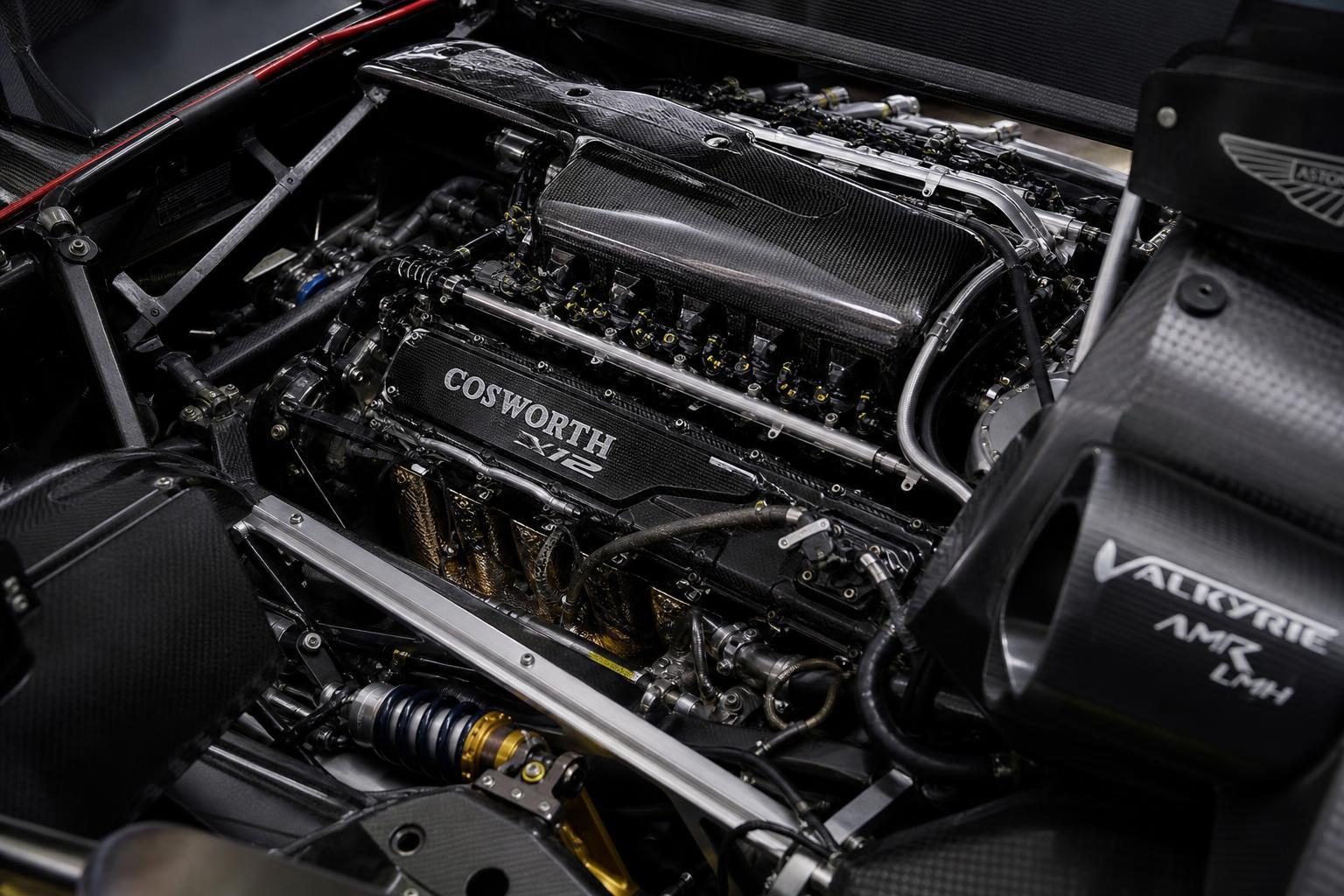
At the heart of the project, the 6.5-litre naturally aspirated Cosworth V12 serves as a signature. In competition, it is limited to 500 kW (680 PS) while the road version exceeds 1,000 PS and nears 11,000 rpm, a technical reminder detailed by astonmartin.com in its race briefings. This mechanical choice, fully owned, accompanies another decision: to race without a hybrid system.
Why forgo hybrid? Because coherence comes first. In LMH, hybridisation isn’t mandatory, and the chosen architecture simplifies thermal management, packaging and integration risks for a first year. It also trims weight and accelerates development. The sporting consequence is clear: everything hinges on the V12’s efficiency, aero and tyre exploitation, with a narrower adjustment margin than an electrified system would allow.
The WEC/IMSA reading nuances this approach. In the WEC, hybrid rivals compel compromise with BoP and varied circuit profiles. In IMSA, on bumpier tracks with more broken-up stints, the V12’s response and mechanical stability translate more readily into race pace. The Road Atlanta 2025 result is the concrete illustration for the Valkyrie LMH.
2026 season: unchanged line-up and two Vantage LMGT3 as reinforcements
What’s next? It plays out in continuity. For 2026, an unchanged line-up on both numbers: #007 Gamble/Tincknell and #009 Riberas/Sørensen, confirmed by astonmartin.com in December 2025. Crew stability is a rational choice after a learning year in which fine knowledge of stints, maps and tyre windows was hard-won.
In parallel, the THOR entity strengthens the WEC package with two Vantage LMGT3. The benefit goes beyond image: it’s an economy of scale in data and process, from tyre management to pit operations. More cars mean more information, hence more robust correlations for Valkyrie LMH set-up work.
Preparation for 2026 is already under way. Our “road to race” dossier, from Imola to Spa, details the improvement axes identified after 2025 and the update programmes. A must-read to follow, step by step, the factory car’s ramp-up: the Valkyrie’s WEC 2026 programme.
Conclusion – what these 5 figures really say about the Valkyrie LMH
Five markers, one underlying trend. The 22,000 miles validate the package’s robustness, Le Mans 2025 yielded the first Constructors’ points, Road Atlanta delivered the first podium five seconds off the winner, and the Cosworth V12 capped at 500 kW explains part of the WEC/IMSA differential. It all converges towards a consolidating 2026, with stable crews and Vantage LMGT3 support.
Nothing exuberant: steady progress, at times thankless, but tangible. For a Year 1, the learning curve was continuous and, above all, quantifiable. The Valkyrie LMH has settled, without fuss, into the Hypercar landscape. What follows will be decided in the same place as 2025’s truth: on the track, lap after lap.