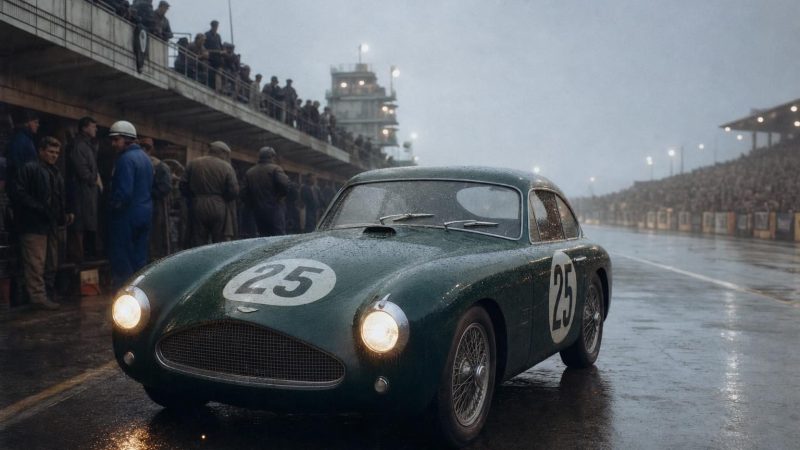
DB Mark III, four founding choices in 1957 that defined Aston Martin’s style, engineering and legacy. A precise, sourced, no‑nonsense analysis.
DB Mark III: here is the pivotal model which, in 1957, set Aston Martin’s stylistic and technical sights with clinical precision. We revisit four design decisions — a grille signed by Bert Thickpenny, Girling disc brakes, an engine reworked by Tadek Marek and a crystal‑clear power range — which together mapped out the road for the DBs to come. Launched simultaneously in Geneva and the United States in March 1957, 551 examples in total, with a literary James Bond to boot: the subject is well charted, the facts sourced, and the influence enduring.
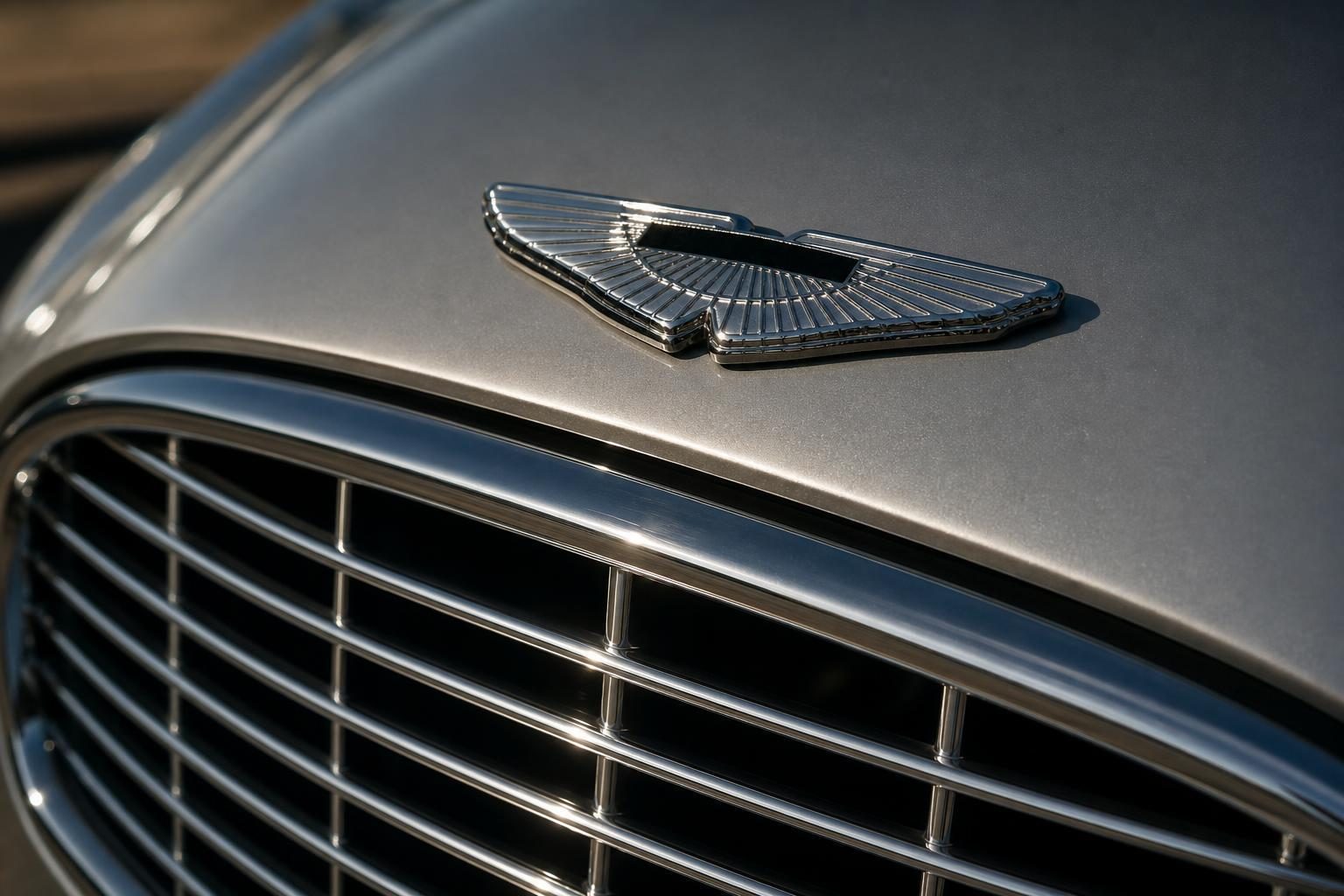
The Bert Thickpenny grille: birth of a brand face
You can recognise an Aston at first glance since 1957, and that’s no accident. According to Aston Martin’s official press kit, the coupé’s front grille was designed by Bert Thickpenny, first glimpsed on the DB3S, then adopted by the DB Mark III. This centre‑pinched, base‑widened design establishes a clear physiognomy: a brand face that would carry across the following range.
The gesture is simple, almost austere, yet decisive. By fixing a mesh and recognisable proportions, the grille organises the front end around a strong visual signature while allowing the radiator and ancillary components to breathe. The balance between expression and function, rare at the time, becomes a sort of guiding line for Astons of the 1960s.
The legacy is direct: the future DB4 would reinterpret this theme with greater confidence, but the Thickpenny axis remains. To gauge the continuities and breaks, compare the profiles and nose treatments with the production DB4: you can clearly read the foundational geometric intent defined by the DB Mark III.
Girling disc brakes: when racing shapes the road
The DB Mark III introduces Girling disc brakes, initially as an option, then as standard from the 101st example according to information cross‑checked between Aston Martin’s press kit and Wikipedia. This mid‑production shift illustrates a straight transfer of technology: racing experience accelerates the adoption of a system more durable and more consistent than drums.
On the open road, the difference is felt less on the first stop than the hundredth: resistance to fading, finer modulation, and greater confidence at high speed. The message was clear for 1957 customers: this Aston is not merely elegant, it keeps pace with the state of the mechanical art. And for the marque, it is a structuring step on the path of subsequent DBs, where active safety becomes as much an identifier as the sound of a straight‑six.
This alignment between racing and grand touring fits a precise calendar — 1957 — confirmed by both the dedicated Aston Martin press kit and the English‑language Wikipedia page. The DB Mark III sets the marker: a beautiful body never eclipses technical rigour.
The Tadek Marek engine: last Lagonda breath, first Polish signature
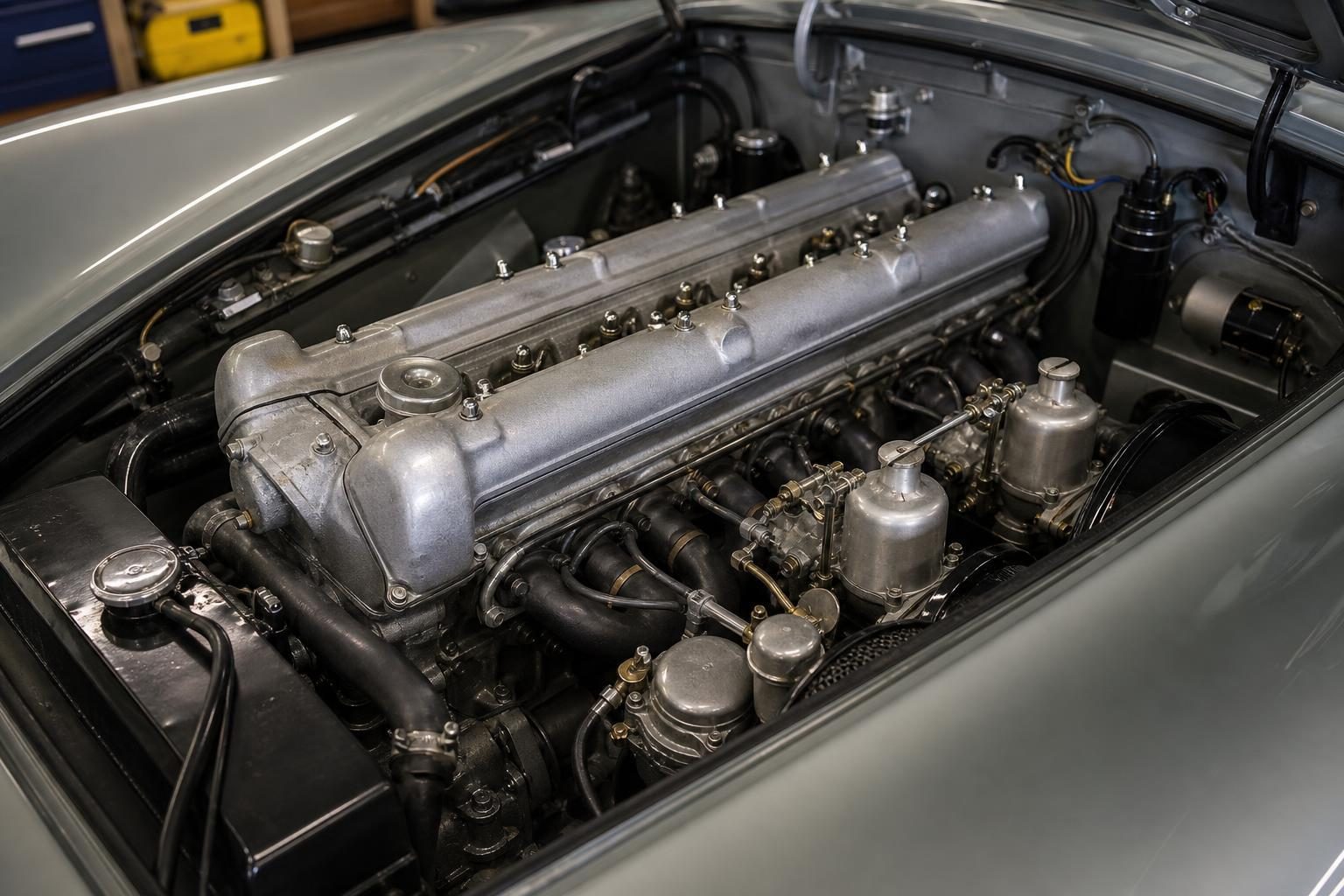
The last DB model to carry the Lagonda‑origin six designed under W.O. Bentley, the 1957 coupé also marks, according to Aston Martin, the decisive intervention of Tadek Marek. The Polish engineer reworked the whole to improve breathing and reliability, placing his stamp on a block at the end of its cycle while mentally preparing the future.
This dual status — swansong of a Lagonda engine and first Marek signature — explains the car’s personality: a classic grand touring character, but sharpened by a more systematic engineering approach. The cylinder heads, fuel system and cooling evolve towards greater overall coherence, without denying the original mechanical nobility.
In the marque’s internal history, the DB Mark III thus forms a bridge. It neatly closes one chapter — the Lagonda six — and opens the next — the Marek era — whose legacy would profoundly mark the following decade. For broader context, see also our analysis of the DB2 as a foundational technical template, which sheds light on the continuity of design choices.
551 examples, three power levels: understanding DBA, DBD and DBC
Total production stands at 551 examples, of which only 5 with automatic gearbox, according to Wikipedia. The engine range is clear and tiered: standard DBA version at 162 PS with twin SU carburettors; DBD option around 180 PS; and competition‑level DBC at about 214 PS thanks to triple Weber 45s, again per the Wikipedia synthesis for the model.
This no‑nonsense architecture serves three customer profiles. The DBA covers grand touring use, the DBD targets the regular sporting enthusiast, while the DBC frankly addresses those who frequent circuits. We are far from a sprawling catalogue: three steps of power, three ways to live the same body and chassis.
This calibration would anticipate the range logic of later DBs, with a pertinent core proposition and understandable performance tiers. For detailed specifications, our DB Mark III specification sheet compiles the figures and known variants, echoing available public data.
The DB Mark III in ‘Goldfinger’: the first Aston Bond no one cites
Before the cinematic icon DB5, James Bond drives, in Ian Fleming’s work, a “DB III” in the novel Goldfinger (1959). Aston Martin notes this in its official history: it is the first Aston Bond, but in literature. The detail amuses connoisseurs and puts the DB Mark III at the heart of popular culture, two years before the film that would transform the marque’s image.
This discreet yet precious literary nod reinforces the model’s aura without turning it into a prop. We are speaking of a truly marketed car, launched in Geneva and in the United States in March 1957, which ends up in the hands of the most famous fictional agent. A way, ultimately very British, to anchor a grand tourer in the collective imagination without drumrolls.
Note that this precedence informs readings of later Bond models. Rereading Fleming, then rewatching Goldfinger, is to measure how a shape and a presence — those of the DB Mark III — prepared the way. In this respect, the official Aston Martin news dedicated to the model offers a useful reminder of this lineage.
Conclusion — DB Mark III: what it truly changed
What the DB Mark III establishes in 1957 is a foundation. A face signed by Bert Thickpenny, Girling braking technology inherited from the circuits, a Lagonda engine refined by Tadek Marek, and a readable power range. According to official sources and Wikipedia’s synthesis, the 551 examples produced — including 5 automatics — mattered more for their influence than for their numbers.
Beyond the figures, the model fixes a method: priority to overall rightness rather than effect. This is the line that would be found, amplified, on the DB4 and its descendants. For those who like to understand Aston Martin’s coherence, the DB Mark III is less a parenthesis than a point of origin. And if you want to follow the thread, compare with the DB4 for style and upscaling, and return to the DB2 as foundational act to gauge continuity.
In short, the DB Mark III not only foreshadowed a face and a way of braking; it validated a technical philosophy that still flows through the marque’s DNA. Reason enough to restore its place — including when speaking of Bond — among the Astons that count.