Vanquish 25 years: three generations, from Geneva 2001 to 2024, V12, carbon and heritage. Technical comparison, brand culture and market in 2026
Vanquish 25 years, or how a name became a compass for Aston Martin: three generations, three V12s, and a single guiding idea of high-intensity grand touring. Marking the March 2026 announcement of the model’s 25th anniversary, we set the technique and culture of this lineage in perspective without repeating monographs, to illuminate the continuity of a constructive philosophy — from Newport Pagnell to Gaydon, from aluminium chassis to carbon skins, from naturally aspirated to twin-turbo.
March 2001, Geneva: why this name and architecture changed Newport Pagnell
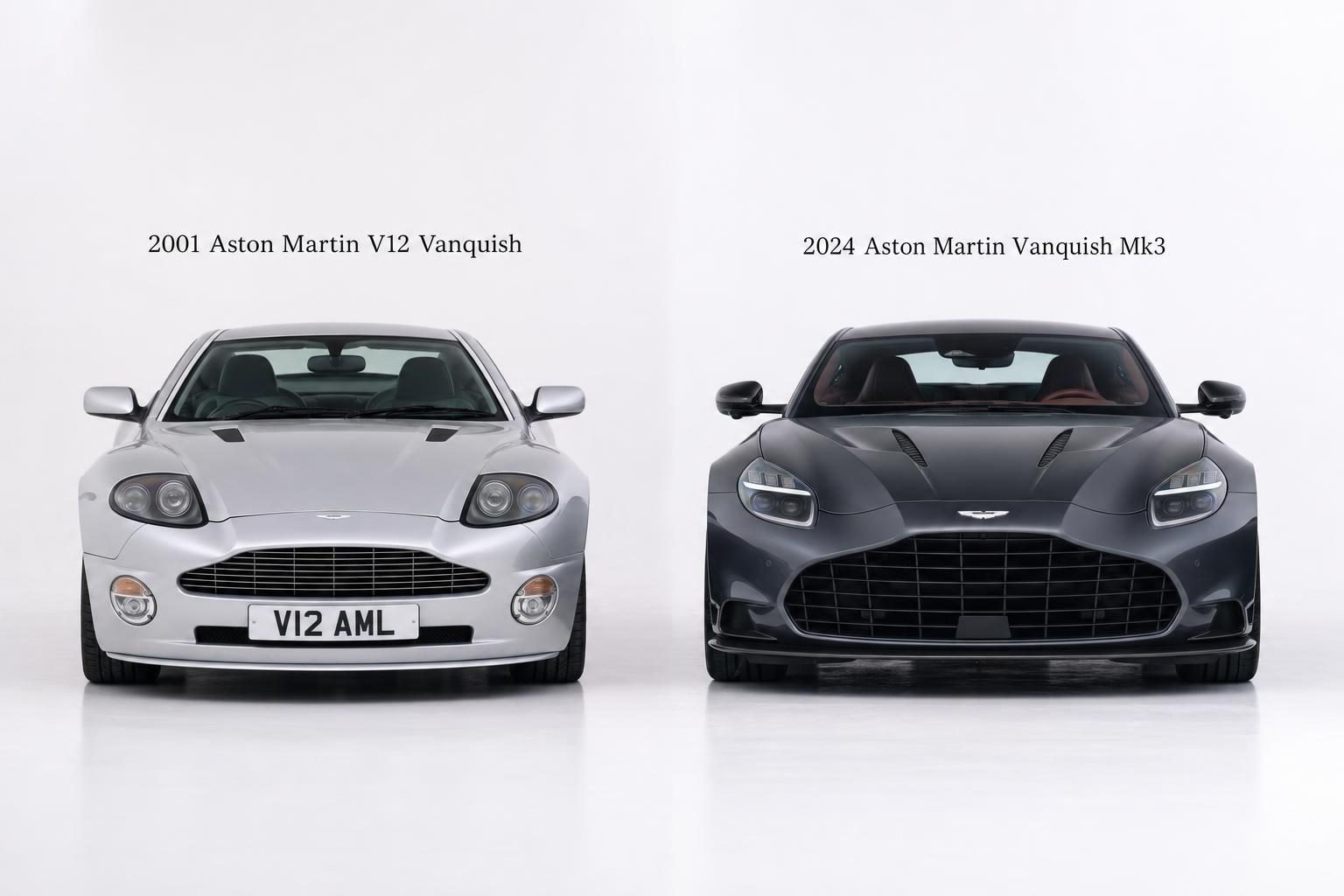
The first V12 Vanquish was unveiled at the Geneva Motor Show in March 2001. The name “Vanquish” — to defeat, to dominate — sets the tone, but it is the architecture that fixes the trajectory. According to Aston Martin’s official communications in March 2026, this coupé designed by Ian Callum is the last model built at Newport Pagnell before the move to Gaydon, a major industrial and cultural handover. The choice of an aluminium structure and composite bodywork heralds a modern way to make an Aston: controlled craftsmanship, tooled by engineering.
At its heart, a 6.0-litre V12 with 460 PS, lifted to 520 PS on the Vanquish S. This engine, initially naturally aspirated, sets the ambition: to deliver high speed with ample torque in reserve and a muted, long-legged surge, while keeping a line both muscular and restrained. The architecture mattered as much as the power: increased rigidity, proportions tailored for the long bonnet, and a driver-oriented cockpit, almost classical in spirit, contemporary in execution.
This original Vanquish also propelled Aston Martin into the popular imagination: painted Tungsten Silver, it took a role in Die Another Day (2002), with a few Q-Branch options. A nod that didn’t make the car, but sealed its silhouette in the memory of a whole generation.
For a deeper look at the specifics of this first opus, see our complete Vanquish Mk1 feature, a useful complement to this transgenerational perspective.
2,589 first-generation cars: production figures and place in time
The numbers tell a story of controlled production. According to media.astonmartin.com (Aston Martin Works), the first generation (Vanquish and Vanquish S) totals 2,589 units. The astonmartin.com site states 1,489 units for the 460 PS Vanquish before the arrival of the S, which continued until 2007. This dual reading neatly illuminates the reality: a relatively limited base of “460” Vanquish, then a qualitative ramp-up with the S, in a tightly managed lifecycle.
In time, the Mk1 sits at a crossroads: the last “great” Aston from Newport Pagnell, the first truly modern Aston conceived for the Gaydon era. Its reach targeted connoisseurs rather than volumes which, 25 years later, underpins its cultural value. It is the starting point of a lineage defined less by horsepower than by the way it is served: precise chassis, long wheelbase, endless bonnet, and a V12 at the core of the promise.
Our selection of reference sources on this anniversary corroborates this trajectory, beginning with Aston Martin’s Vanquish at 25 article, complemented by the Aston Martin Works media dossier on the 25 years and the dedicated Wikipedia page for the Vanquish, useful for framing chronology and volumes.
Second generation 2012: the Vanquish Mk2 and the One-77’s influence on its carbon bodywork
In 2012, the name returns, the era changes. Under Marek Reichman’s direction, the new Vanquish adopts 100% carbon-fibre body panels — aerospace grade — and draws on the One-77’s sculptural DNA. Surfaces gain tension, the shoulders are more deeply carved, the tail is sharpened: aerodynamics becomes a language. This bodywork is not a styling trick; it is a method. It allows more exact forms and precise mass control, in keeping with the lineage’s logic.
The ideological framework remains the same: a GT with a V12 placed at the heart of the experience. Industrialisation at Gaydon refines perceived quality and repeatability without smothering singularity. The Vanquish Mk2 is not a revolution in philosophy; it is a consolidation: better use of materials, aerodynamic integration, modernised ergonomics. The name endures because it describes less a number than a brief.
On the market, this Mk2 marks Aston Martin’s alignment with contemporary standards of “visible carbon” and assembly rigour, while retaining a grand touring stance. Again, continuity: stance, proportions and mission remain, the material changes — to the benefit of precision and expression.
For a numerical overview and our analysis of the most recent generation, the Vanquish Mk3 spec sheet offers a useful techno-historical counterpoint.
Third generation 2024: 835 PS, 1,000 Nm and the announced end of the naturally aspirated V12
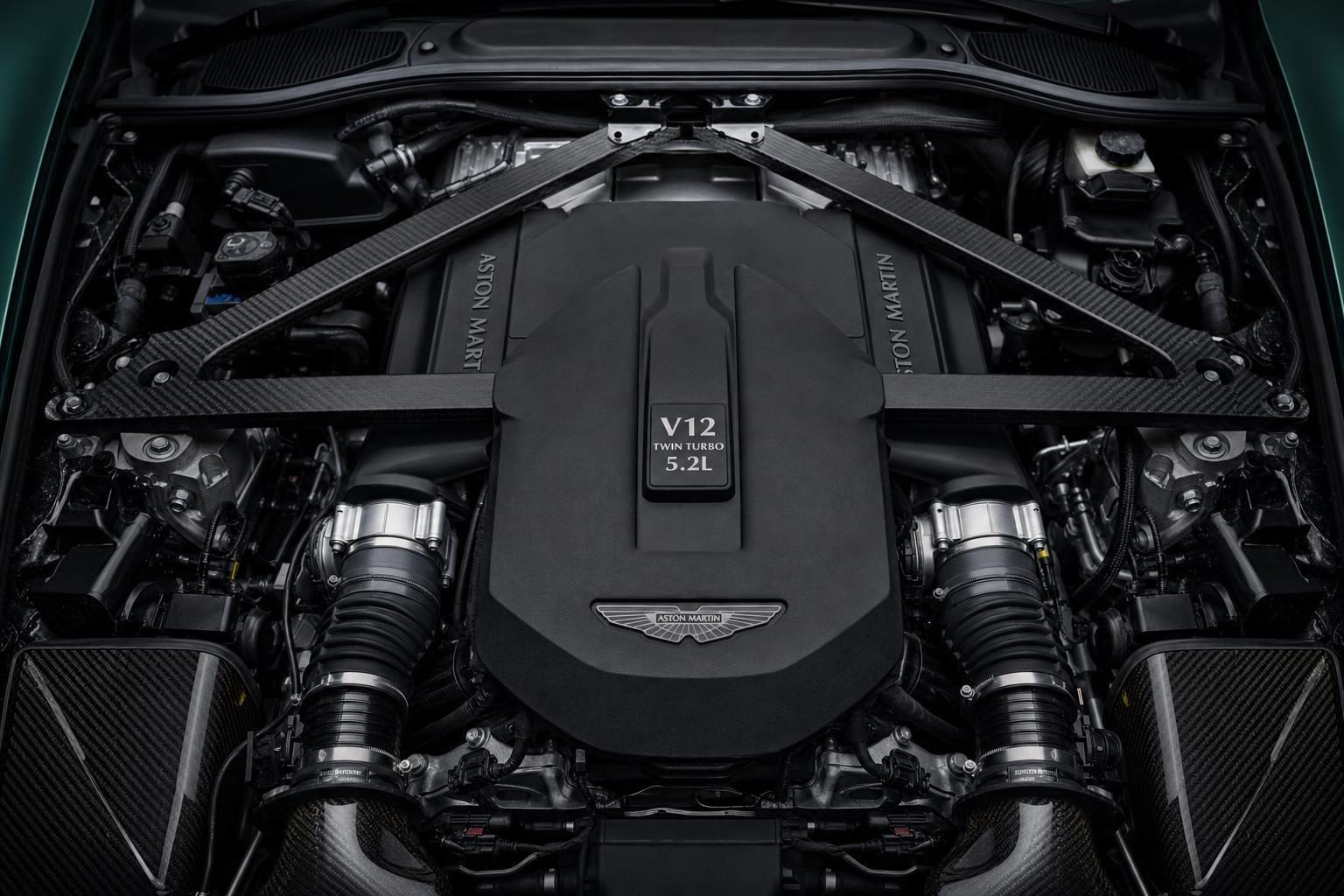
In 2024, the third iteration brings the mechanical argument to its numerical peak: 835 PS, 1,000 Nm, a 5.2-litre twin-turbo V12, 0–60 mph in 3.3 s and 214 mph flat out (figures supplied by Aston Martin, March 2026). The engine’s temperament changes — forced induction replaces the infinite smoothness of natural aspiration — but the spirit persists: to provide abundant, immediate thrust in a crisply sculpted envelope.
Aesthetically and structurally, Marek Reichman’s signature continues: athletic volumes, clean surfaces, mastery of airflow. Carbon is no longer a discourse; it is the daily grammar. The 2024 Vanquish illustrates maturity: the industrial tool has absorbed artisanal exacting standards and puts them at the service of performance, without a stylistic rupture from its forebears.
Culturally, this third generation chiefly confirms the end of the naturally aspirated V12 era in the Vanquish line. It is a page turned with elegance: forced induction does not deny the heritage; it reinterprets it. For purists, the song changes; for the philosophy, the essence remains — a cutting-edge GT, centred on a twelve-cylinder as the backbone of the experience.
For targeted technical reading, see our 5 technical innovations of the 2024 V12, to gauge what twin-turbocharging brings in efficiency, packaging and character.
Collecting a Vanquish in 2026: what the three generations exchange on the market
In collecting, a Vanquish’s value is not judged by the odometer alone. The Mk1 concentrates the charm of the Newport Pagnell–Gaydon transition and the popular aura of cinema. Early examples, the Tungsten Silver “Bond echo” configuration and well-kept S versions embody this measured rarity. Mechanical coherence (maintenance, history) carries weight, as often with a first-of-line whose total volume is contained.
The Mk2 (2012–2018) trades its collectible argument on material sophistication: carbon bodywork, series production build quality, and a style that has aged well thanks to the One-77’s influence. Buyers see in it a modern Aston “to wear every day” without denying the ritual, which supports demand for understated configurations and well-documented special series.
The 2024 Vanquish, for its part, mobilises the argument of absolute performance within a GT canvas. Its very powerful twin-turbo V12, canonical figures and status as witness to the end of natural aspiration already lay the foundations of a future classic. Markets value technical ruptures when stylistic continuity keeps them legible — and the Vanquish excels precisely at this exercise.
From generation to generation, it’s the same conversation between high performance, understated elegance and meticulous material execution. It is this dialogue — more than the chase for the last tenth — that forms the core of demand, yesterday as today.
Conclusion — Vanquish 25 years, or the constancy of a right idea
Twenty-five years after Geneva 2001, Vanquish 25 years boils down to fidelity: a GT coupé with a V12 at the centre of the experience, an evolving architecture serving precision, and a design that prefers rightness over noise. From Newport Pagnell to Gaydon, from aluminium to carbon, from naturally aspirated to twin-turbo, the lineage hasn’t changed its DNA: it has simply learned to express it better.
While the numbers evolve — 2,589 units for the Mk1 according to Aston Martin Works, 835 PS and 1,000 Nm for the 2024 — the promise endures. And it is this continuity that gives an emblematic Aston its strength: a grand tourer that yields nothing on elegance and that, three generations on, still speaks to the driver as much as to the collector.
To go further, Aston Martin’s reference content dedicated to this anniversary usefully illuminates the chronology and spirit of the lineage: the official 25 years article and the dedicated media dossier, complemented by an encyclopaedic summary.