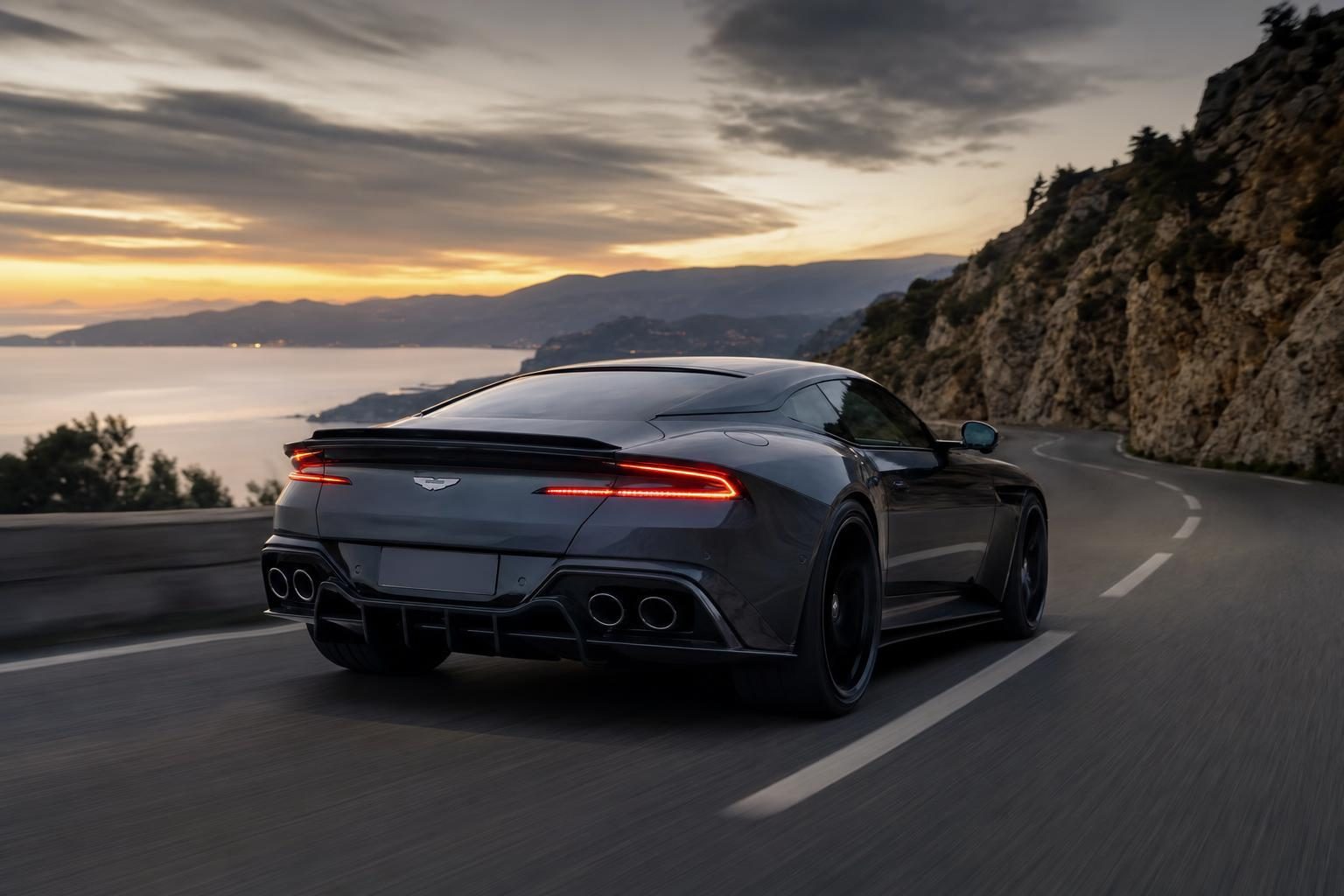
Super tourer: the DB12 debuts a category and a 680 PS V8. Specs, 690 PS S version and everything that sets it apart from the DB11.
Aston Martin’s take on the super tourer is the DB12: a grand touring coupé that the brand positions above the classic GT, with a twin‑turbo V8 that’s both more powerful and sharper, an electronic rear differential and in‑house‑developed infotainment. This buying guide clarifies power figures by market, sets the DB12 against the DB11 which it clearly eclipses, and explains what the new DB12 S brings.
Why does Aston Martin say super tourer rather than GT?
Aston Martin presents the DB12 as the world’s first super tourer, an official label embraced by the brand. The intent is clear: to go beyond the traditional GT brief, targeting top‑tier performance while retaining the versatility and refinement expected of a sporting touring car. According to Aston Martin, this positioning reflects a step up in power and dynamic engagement.
This super tourer designation signals a different balance: more power and response without sacrificing the ability to cover long distances serenely. The quoted top speed of 202 mph, or 325 km/h, and 0–60 mph in 3.5 s (sources: Aston Martin; auto123) back up this ambition. The DB12 thus aims to be more incisive than a traditional GT while remaining usable every day.
Versus the DB11, Aston Martin highlights a leap in performance. The power increase is around 34% compared with the DB11 (source: auto123), illustrating the conceptual shift. In other words, the super tourer addresses those who want an elegant long‑distance car, but with a clear surplus of punch and performance.
The 4.0‑litre twin‑turbo V8: 680 PS and market‑specific figures
At the heart of the super tourer is a 4.0‑litre twin‑turbo V8 rated at 680 PS and 800 Nm by Aston Martin. This output is expressed in metric horsepower (PS). Converted to North American usage, it comes to roughly 671 hp (SAE), an equivalence noted by Aston Martin and echoed by TopSpeed. This dual reading explains why different figures appear across documents and markets, without any technical contradiction.
The stated performance aligns with these values. The brand quotes a top speed of 202 mph (325 km/h) and 0–60 mph in 3.5 s (sources: Aston Martin; auto123), useful markers to place the DB12 among high‑performance coupés. In practice, the variations in homologation from one market to another (expressed in PS or hp) do not change the driving experience: the car delivers the same character, with peak torque of 800 Nm according to Aston Martin.
For buyers comparing spec sheets and international road tests, remembering the expression method is key: 680 PS in Europe, around 671 hp in the United States. Both figures describe the same engine. For an official overview, see the manufacturer’s DB12 page, which outlines this super tourer positioning and its core specifications.
Finally, the ZF 8‑speed automatic gearbox equips the DB12 (source: Aston Martin). It favours smoothness on the motorway while offering rapid shifts when the pace quickens. This engine‑gearbox pairing contributes to the versatility that defines a well‑rounded super tourer.
Chassis, suspension and e‑differential: what changes versus the DB11
The electronic rear differential is among the significant evolutions on this generation (source: Aston Martin). Compared with a more traditional layout, an e‑differential allows finely tuned locking to improve traction under acceleration and stability in loaded corners. On a high‑performance road car, the perceived gain comes as much from the ability to deploy torque as from the agility you feel.
Integrating the e‑differential, combined with the ZF 8‑speed gearbox, steers the DB12 towards a more connected drive without abandoning expected comfort. Aston Martin does not detail damping data or specific geometry here, but the gearbox‑differential package sets the framework for tuning that seeks to reconcile precision and progressiveness, two pillars of a true super tourer.
Versus the DB11, the emphasis on electronic traction control reflects the evolving brief. The roughly 34% power jump (source: auto123) demands more sophisticated torque management, especially on the open road. In this context, the e‑differential emerges as a key tool to put 800 Nm to the ground with greater consistency and confidence, whatever the conditions.
The DB12 S: 690 PS and heightened dynamic edge
The DB12 S pushes the super tourer concept further with 690 PS and 590 lb‑ft of torque, and a quoted 0–60 mph in 3.4 s (source: Aston Martin). This extra power and responsiveness offers headroom to those seeking a sharper version, while retaining the front‑V8, rear‑drive layout.
According to Aston Martin, the DB12 S is the most powerful non‑hybrid, front‑engined V8 in its class. This positioning makes the point: keep grand touring versatility, but with an extra slice of dynamic bite. On paper, the tenth shaved from the 0–60 mph time versus the DB12 and the increased output sketch a more incisive character without breaking with the spirit of the DB line.
From a buying perspective, the DB12 S targets those who want to maximise engagement while staying within the same super tourer philosophy. The technical fundamentals remain, with the ZF 8‑speed transmission and rear e‑differential, ensuring continuity in how performance is delivered.
Interior, in‑house infotainment and personalisation
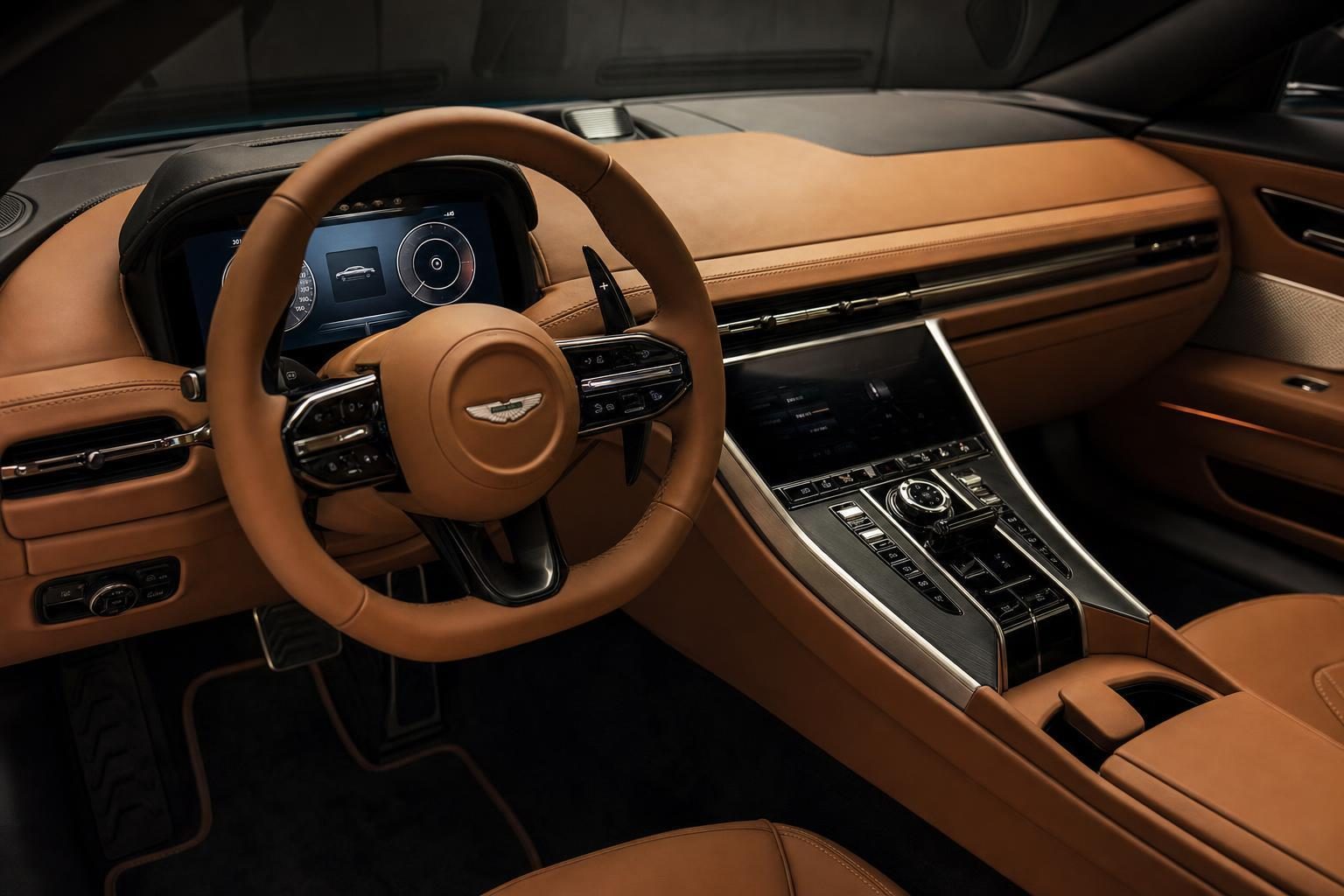
The DB12 debuts infotainment developed in‑house by Aston Martin, with dual 10.25‑inch screens (sources: Aston Martin; TopSpeed). This shift to a home‑grown solution is strategic: control of ergonomics, updates and vehicle‑function integration. For the buyer, the stakes are as much about the modernity of the interface as the coherence between physical and digital controls, an area where Aston Martin claims clear progress.
The adoption of two 10.25‑inch screens modernises presentation and navigation between functions, aiming to reduce latency and simplify access to key settings. Developed by the brand, the system reflects Aston Martin’s visual identity and fits the ambition of a contemporary super tourer that doesn’t sacrifice the on‑board experience.
On personalisation, while each market offers its own configurations, the essence is the ability to tailor the ambience to the intended use: hushed long‑distance cruiser or a more assertive coupé. The continuity of finish between DB12 and DB12 S lets buyers choose first on desired performance level, then on colours, materials and options.
Conclusion: how to choose your DB12 or DB12 S super tourer
To make your choice, first decide between the DB12’s power‑comfort balance and the DB12 S’s extra edge. Both share the super tourer DNA championed by Aston Martin, with the same technical basis — twin‑turbo V8, ZF 8‑speed gearbox, e‑differential — and performance that places the car above a traditional GT.
Next, clarify the numbers: 680 PS corresponds to around 671 hp in American measure (sources: Aston Martin; TopSpeed). The quoted performance — 202 mph and 0–60 mph in 3.5 s for the DB12, 3.4 s for the DB12 S (sources: Aston Martin; auto123) — sets the scale. Finally, validate the on‑board experience: the dual 10.25‑inch, in‑house‑developed infotainment is a differentiator on this generation.
To dig deeper, explore the official DB12 page on Aston Martin’s site via this model and super tourer presentation, or browse the DB12 summary page that aggregates known data. For internal comparisons, our model guide is a good starting point: complete DB12 overview. To situate the evolution versus its predecessor, see our DB11 reference. Finally, to place the DB12 within the brand’s recent strategy, the analysis Vantage and DB12, the return to the top provides context.