Vanquish S 2004: sequential gearbox, aluminium VH structure and 520 PS. Six technical points on the great Aston Martin of the Gaydon handover that the press skimmed over.
Between 2004 and 2007, the Vanquish S brought together a series of technical refinements too often filed under “final tweaks”. That’s a perspective error. Here we revisit, from an engineering and behind-the-scenes angle, six concrete points that make this evolution of the British coupé a discreet but decisive milestone.
Newport Pagnell to Gaydon: the Vanquish S as the pivot of transition
On one side, the historic Newport Pagnell works; on the other, the industrial era at Gaydon. Between the two, the Vanquish S acts as a bridge. According to Wikipedia (Aston Martin Vanquish), it is the last Aston Martin assembled at Newport Pagnell, while paving the way for the architecture and technical ambition of models to come. It’s not simply a sentimental “last of the line”: it’s a rolling prototype of the transition.
Produced from 2004 to 2007, the S version extends the lineage begun in 2001. Total production of the Mk1, all versions combined, hovers around 1,504 examples according to the same source — a number other publications vary, proof that Newport Pagnell’s discretion comes with occasionally fluid statistics. This context also explains why the 2004 evolutions sometimes slipped past the headlines.
The symbolism is twofold. On the one hand, the Vanquish S gracefully closes the historic workshop. On the other, it opens the road to the Gaydon-built generation, where tooling, assembly and validation scale up. The object is collectible; the engineering, transitional.
The 6-speed sequential gearbox: promises and reality of paddles in 2004
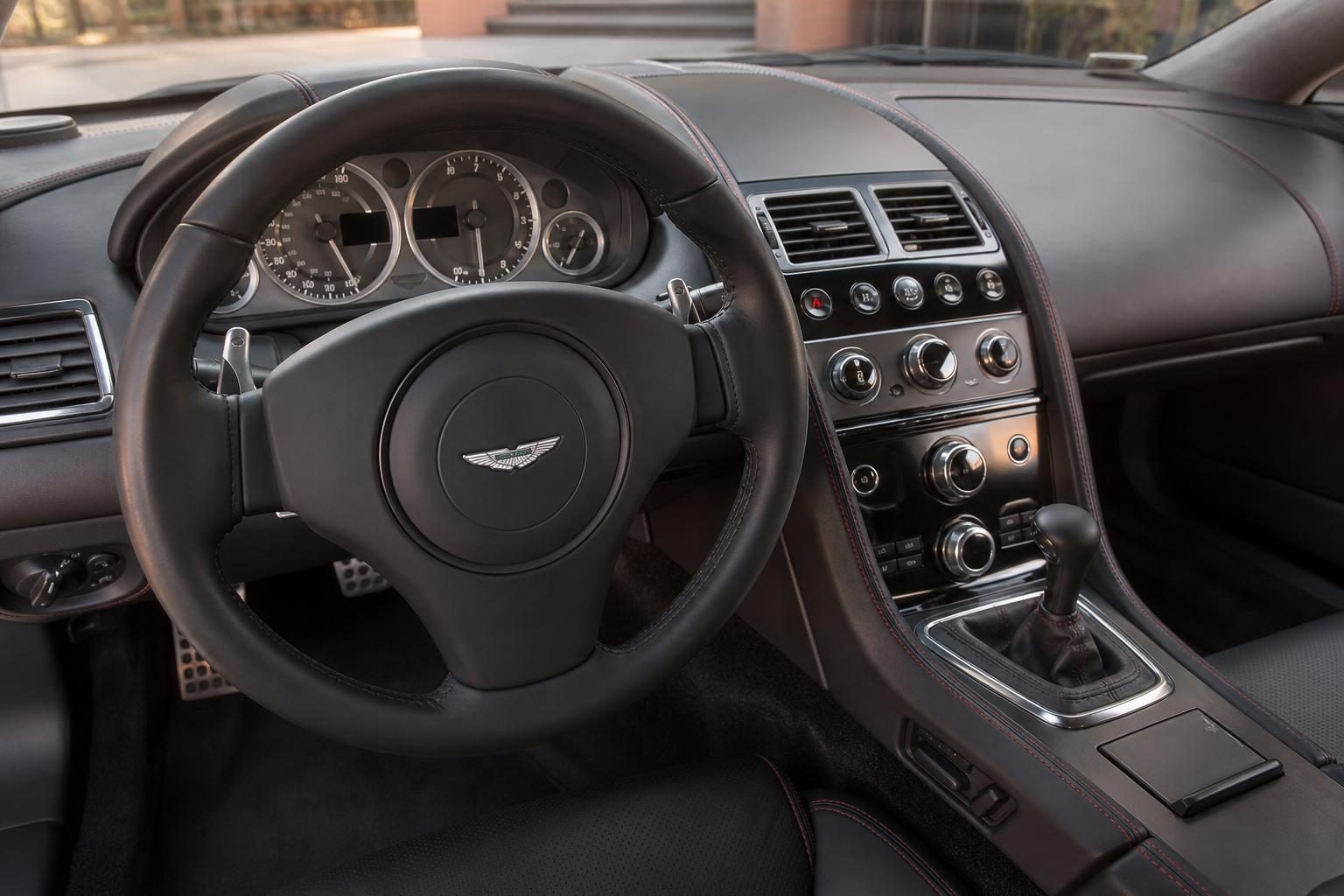
The Vanquish S transmission is a robotised 6-speed sequential gearbox, operated by steering wheel paddles (Wikipedia). In 2004, the idea was appealing: a whiff of motorsport, hands staying on the wheel, and the prestige of “on-the-fly” shifts. The promise then was perceived modernity, not yet the immediacy later attributed to dual-clutch systems.
In practice, the value of this layout is read in how it shapes the driving rhythm. Shifts follow a logic that compels you to drive “with” the machinery. It’s a language: learn its tempo, anticipate, and work the paddles to keep the V12 in its sweet spot. In 2004, this was no gimmick; it was a deliberate stance.
Nuance matters: beyond the “paddles” label, the chassis–engine–gearbox coherence defines the car’s personality. The Vanquish S doesn’t try to erase the mechanics, but to stage them. A philosophy the press of the time, charmed by the novelty of the controls, didn’t always dissect through to the logic of integration.
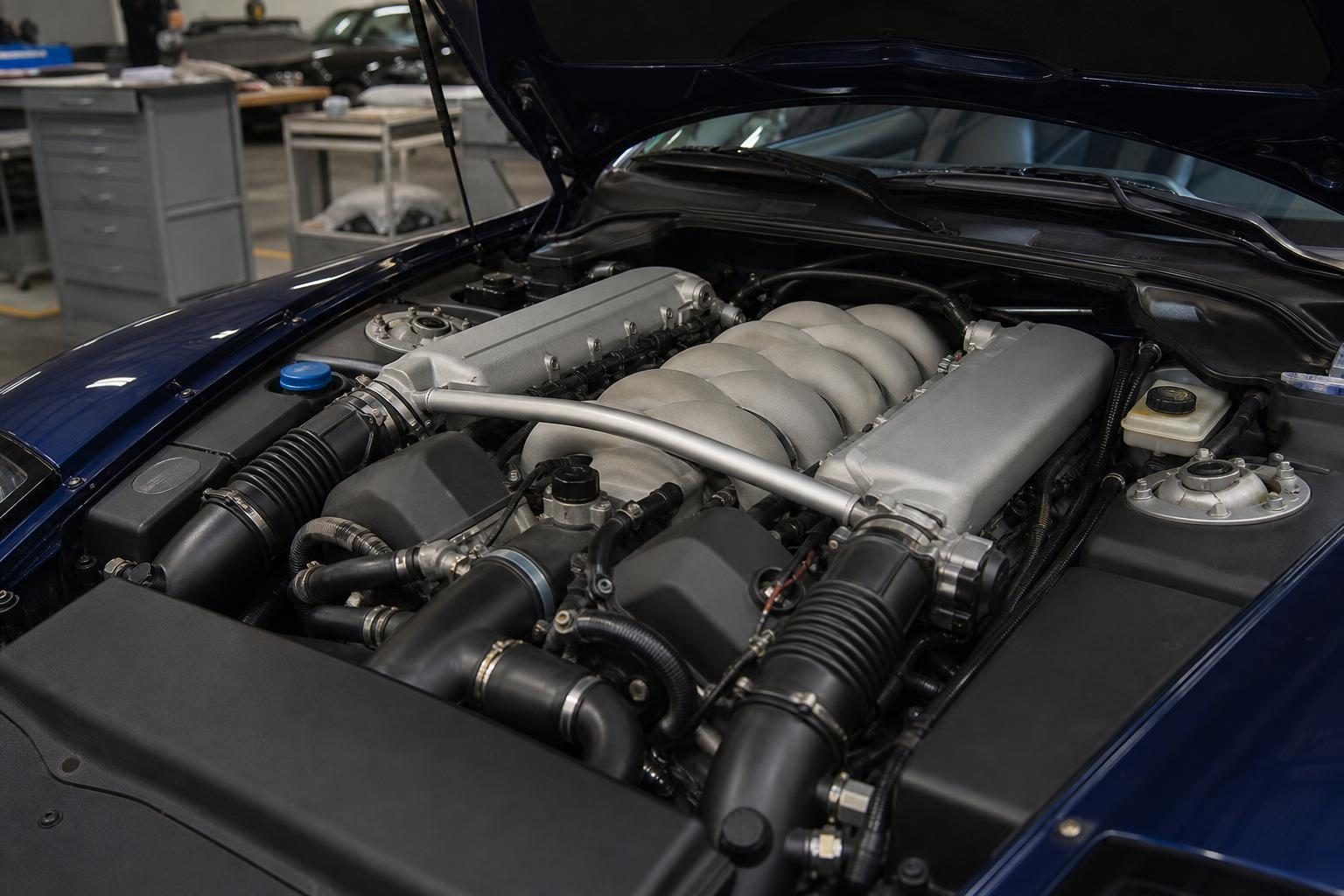
The 6.0-litre naturally aspirated V12: from 460 to 520 PS, how Aston Martin found 60 PS
The jump from 460 to 520 PS clearly distinguishes the Vanquish S from the first iteration (Wikipedia). The block remains a 6.0-litre naturally aspirated V12, emblematic of a mechanical school the brand masters. The figure itself isn’t cosmetic: 60 additional PS is a meaningful step and pushes top speed to 305 km/h according to the manufacturer (Wikipedia).
Crucially, this power gain should be seen in context. It isn’t just about extending the straight: the extra headroom transforms how the car uses each gear. It offers more ease at mid revs, more response in the intermediates, and shows that a well-honed naturally aspirated engine needs no special effects to convince.
Implicitly, the Vanquish S illustrates a philosophical transition. Before the turbo-everywhere era, this naturally aspirated V12 embodied machining precision and engine management. A stated output, a clear value, and an experience defined as much by the swell as by the texture of the climb to the red line.
Aluminium and composite body: a mass–rigidity balance rivals envied
The structure of the Vanquish Mk1, of which the S is the evolution, combines aluminium extrusions and composite panels, developed in cooperation with Ford, then owner of the group (Wikipedia). The approach is anything but anecdotal: it’s the backbone of handling, assembly precision and the car’s dimensional durability.
In practice, this material mix serves a dual objective. On one side, contain mass via structural aluminium; on the other, hone local rigidity and perceived aerodynamics with composite elements. The result is a platform with its own equilibrium, setting the accuracy of the contact patches and the car’s progression at a brisk pace.
The press often focused on power and the paddle gearbox. Yet it’s the architecture that defines the signature from behind the wheel. In the long term, the intelligence of this construction — conceived with a large group but executed with Newport Pagnell craftsmanship — explains the Vanquish S’s ability to stand the test of time without losing coherence.
Current values and watchpoints for a Vanquish S buyer
Before buying, approach the Vanquish S for what it is: a consummate evolution of an emblematic model, produced over a short period (2004–2007) and marking the end of the Newport Pagnell era. Overall Mk1 production is cited at around 1,504 examples by Wikipedia, a figure to treat with caution as other sources differ. Perceived rarity therefore owes as much to history as to volume.
On vigilance, prioritising a clear history is always wise. The robotised 6-speed sequential transmission warrants a careful test to understand its logic and ensure it operates as designed. Likewise, a close inspection of the aluminium/composite structure and assembly quality aligns with the architecture set out on the spec sheet.
A road test conducted at operating temperature and on varied routes allows you to gauge engine/gearbox harmony and high-speed stability, the car claiming 305 km/h flat out (manufacturer). Finally, weighing up how your own use matches the car’s character — a fast, technical and expressive gran turismo — remains the best filter before deciding.
Conclusion: why the Vanquish S deserves a fresh read in 2024
Reappraising the Vanquish S is to recognise the discreet yet essential role of a pivotal Aston Martin. Last from Newport Pagnell and already looking to Gaydon, it blends a sequential gearbox designed to engage the driver, a naturally aspirated V12 lifted to 520 PS and an intelligently executed aluminium–composite structure. Beneath the headlines, these choices are defining.
In an age of lightning shifts and turbos everywhere, the Vanquish S recalls another way to go fast, up to 305 km/h according to the manufacturer, with style and method. For those seeking the clear line between heritage and transition, this model deserves a place apart — and a long test drive, preferably, to let the engineering tell its story.
- To place the S within the lineage, see our dedicated page for the first-generation model on the Vanquish Mk1 in detail.
- From the “historic workshop” angle, our report from Newport Pagnell usefully complements this read: the last from Newport Pagnell, in selected anecdotes.
- To understand the generational shift in architecture, compare with the DB9, pillar of the Gaydon era.
Sources and useful resources:
- Wikipedia page for the Aston Martin Vanquish for production, powertrain and specification markers.
- Official Aston Martin Vanquish page (past models) for manufacturer context.
- Evo’s Vanquish S road test for media insight to compare with technical data.