AMR1 1989, un retour au Mans entre ambitions et réalités : moteur Callaway, programme Williams, échos du DBR1 et héritage discret des Sanction II.
AMR1: three letters and a number encapsulating Aston Martin’s gamble at Le Mans in 1989. This return to endurance prototypes, awaited since the 1960s, reveals bold technical choices, a tight schedule and an organisation where motorsport engineering met heritage restoration. Here are five facts to reassess the programme in light of what it says about the brand’s ambitions at the end of the Eighties, and what it quietly left in Newport Pagnell’s legacy.
Why Aston Martin decided to return to Le Mans thirty years after the 1959 victory
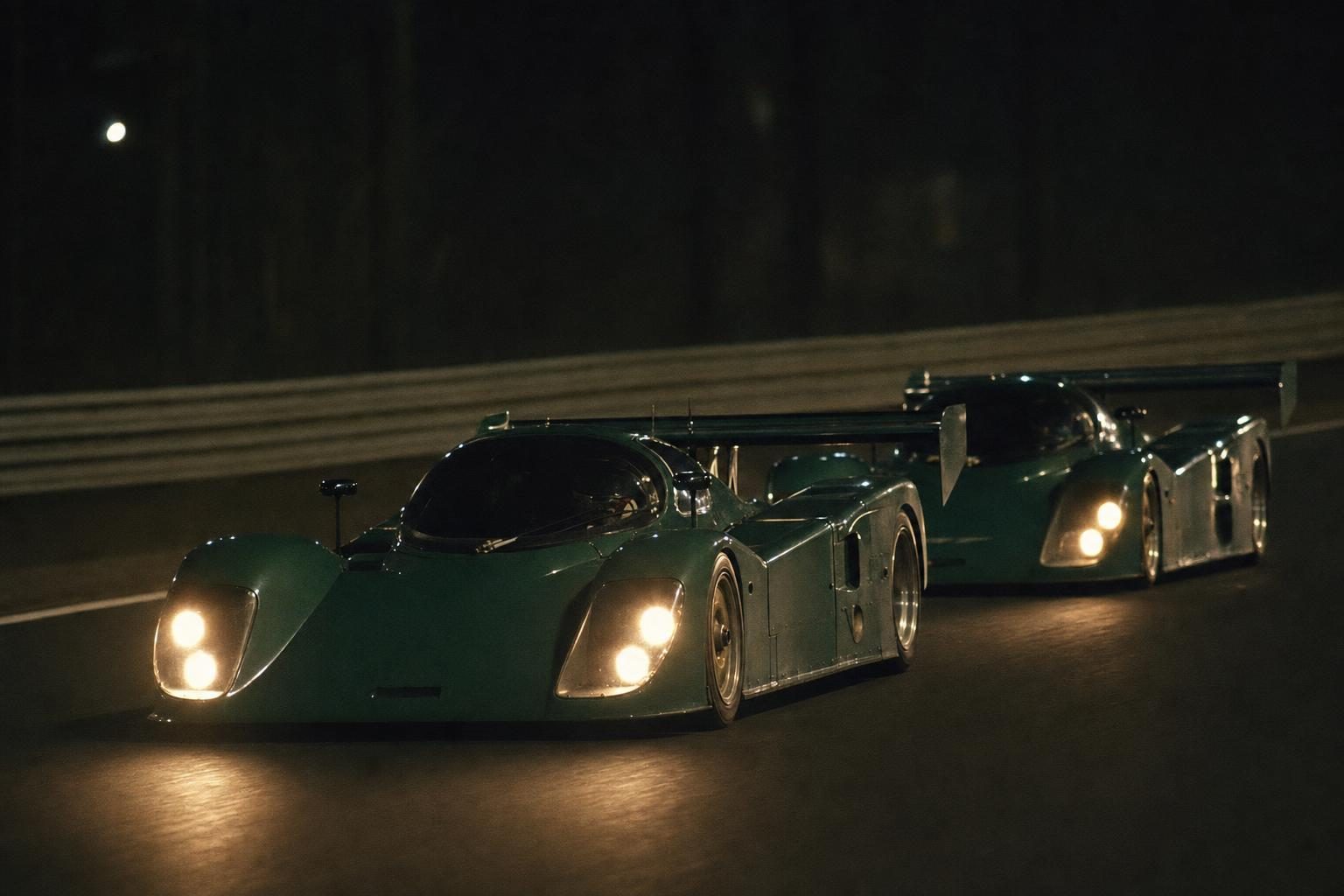
Thirty years after the DBR1’s triumph in 1959, Aston Martin returned to La Sarthe with the AMR1, its Group C racing car entered for the 1989 24 Hours of Le Mans. In the meantime, the marque had not contested Le Mans in endurance prototypes since the 1960s. Coming back therefore meant restating a sporting ambition in plain sight, at a time when endurance was attracting manufacturers and top-flight engineers.
This comeback sits within a brand culture shaped by historic successes and the persistence of a certain British grand touring ideal. The implicit comparison with the 1959 DBR1 hangs over the project: it evokes the demands of a works effort and the complexity of a dual challenge, technical and human. To revisit that foundational chapter, our feature on the 1959 victory sheds light on the context and period keys: the DBR1 victorious at Le Mans in 1959.
Reviving an official presence in Group C also meant reaffirming engineering capability. The AMR1 was born at a pivotal moment when Aston Martin aligned heritage and competition in-house, a sometimes delicate balance but one revealing the strategic priorities of the late 1980s.
The RDP87 V8 engine and programme management by Richard Williams
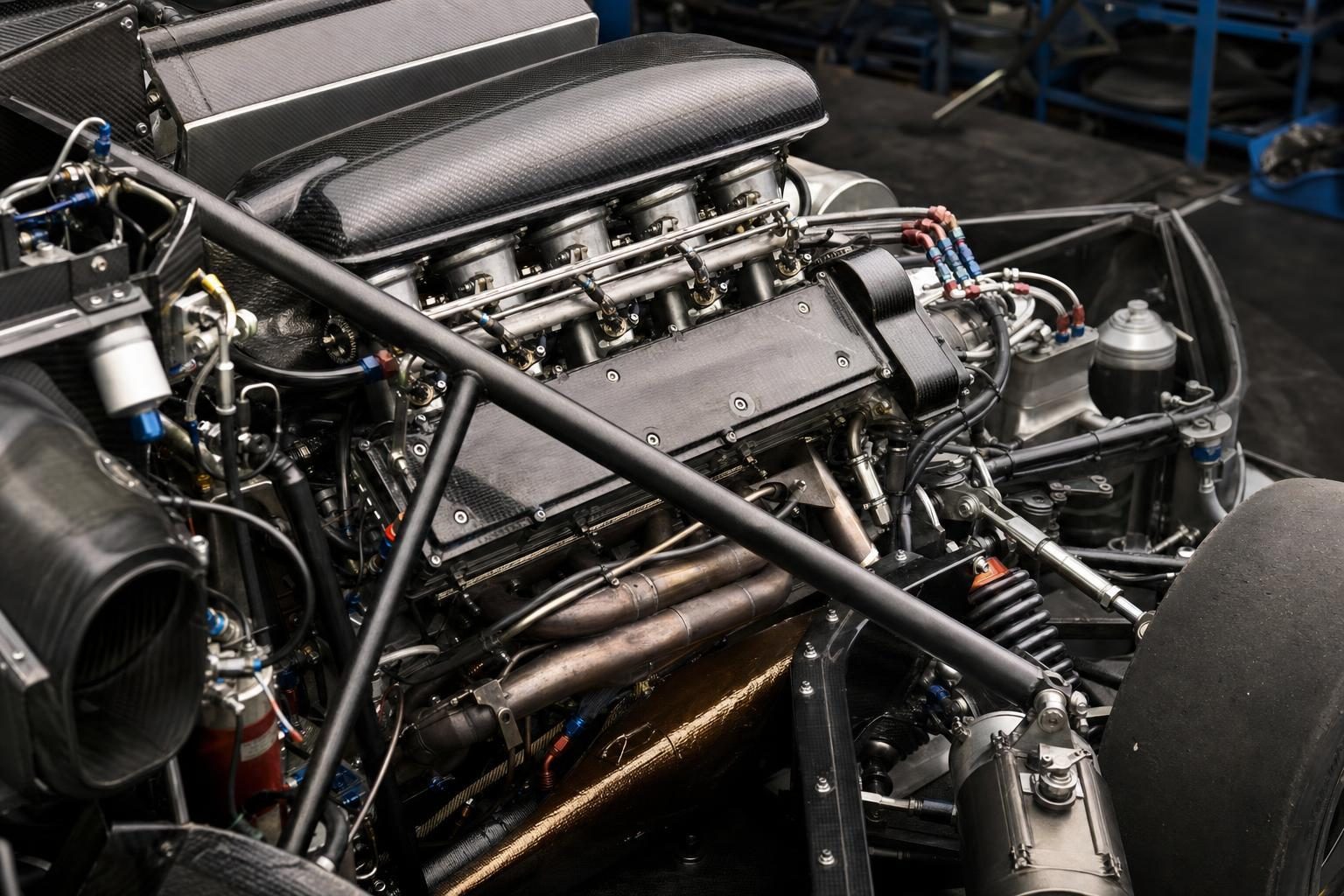
At the heart of the AMR1 was a V8 designed by Reeves Callaway, referenced RDP87. Specialist sources cite outputs between 550 and 600 PS depending on race specifications and chosen configurations. The range reflects the realities of development in endurance conditions, where mechanical longevity and peak output do not always coincide, especially under demanding Group C regulations.
Programme management was entrusted to Richard Williams, a key figure moving between the race shop and heritage projects. According to CarJager (March 2026), Williams had to produce four examples of the AMR1 for the 1989 endurance races, a workload that mechanically impacted other undertakings. This setup illustrates how Newport Pagnell simultaneously managed the sporting showcase and preservation of the myth.
This engine choice and governance say something about ambition: turning to Callaway meant seeking a partner able to deliver a competitive V8 quickly, while the in-house team, under Williams’ aegis, juggled time, resources and the development of a new car to a tight calendar.
Four chassis, only one at the finish: the outcome of the 1989 24 Hours of Le Mans
Four AMR1 chassis were built for 1989, a number confirmed by CarJager. The title of this section, often echoed in accounts, conveys the impression left by the race at La Sarthe. What can be stated with certainty is that the logistical and technical effort was substantial for a structure reacquainting itself with the top category.
As for the precise sporting verdict of the 1989 24 Hours of Le Mans, secondary sources take differing approaches. Our cited source focuses chiefly on the number of cars produced and the programme context, rather than a detailed classification. That relative silence is telling in itself: it underlines how endurance rewards continuity of experience as much as outright speed.
For Aston Martin, this campaign amounted to accelerated learning. It exposed the AMR1 to Le Mans’ harsh mechanical realities, and to the consumption and reliability trade-offs inherent to Group C. In short, a lesson in how to build a programme that lasts.
What the DB4 Zagato Sanction II owes to the AMR1 engineering team
CarJager highlights a direct link: the DB4 Zagato Sanction II project was delayed notably because Richard Williams first had to deliver the four AMR1s in 1989. This interweaving shows how, at the end of the 1980s, competition and heritage coexisted under one roof, with teams and resources moving from one project to another.
In practical terms, the expertise gained in design, assembly and chassis tolerances on the AMR1 filtered into heritage restorations and reconstructions. Without mixing genres, the methodologies, tooling and development discipline of a racing car tended to raise the bar on the Sanction II cars, and conversely, the attention to historical detail fostered a culture of precision benefiting the endurance machine.
This quiet back-and-forth is revealing: the workshop does not oppose the cult of icons to innovation; it makes them converse. In this respect, the DB4 Zagato Sanction II indirectly benefited from the skillsets consolidated on the AMR1, right down to build documentation and the management of projects with multiple dependencies.
The AMR1’s legacy in Aston Martin’s modern racing strategy
Though the AMR1 lacks the sporting afterglow of a DBR1, its legacy is read elsewhere: in an organisational understanding of a works programme and in the interplay between image, technology and endurance. Since then, the marque has built its modern competition presence on platforms closer to the road and on structured commitments in endurance championships.
The lineage is found in the learning. The AMR1 reopened a door: that of an official presence which would later blossom with notable GTs. To trace that path, remember the later campaigns and cars such as the DBR9, whose broad strokes we cover here: the DBR9 in competition. And for the most recent endurance chapter, the story of Vantage wins in the WEC and at the 24 Hours of Le Mans offers a telling counterpoint: history and victories of the Vantage GTE.
Rereading the AMR1 with hindsight is to accept the usefulness of trial and error. The structural lessons, from partner selection to programme governance, are evident in Aston Martin’s modern approach to motorsport.
Conclusion: what the AMR1 says about Aston Martin’s ambitions and priorities
Beyond the numbers, the AMR1 tells of ambition: returning to Le Mans with a Callaway-designed RDP87 V8, four chassis produced under Richard Williams’ leadership, and a team simultaneously delivering DB4 Zagato Sanction II cars. The AMR1 thus reveals a moment of truth at Newport Pagnell, when competition and heritage conversed daily.
Compared with the DBR1 and 1959, the 1989 car reminds us that winning demands more than a good idea: it takes time, resources and continuity. That may be the AMR1’s discreet legacy: preparing the ground for a more structured strategy, whose spirit is clear in Aston Martin’s modern racing commitments. To read further, see the page dedicated to the AMR1 and the marque’s official news: historical AMR1 profile, racing and brand news and institutional milestones. In short, the AMR1 was a step—imperfect yet necessary—on the road from one myth, the DBR1, to a contemporary era in which endurance is built to last.