Vanquish 25 ans, trois générations passées au crible : continuités techniques, vraies ruptures et le V12 comme fil rouge du flagship Aston Martin.
Vanquish 25 years old, or how a name establishes itself as the yardstick for a flagship V12 at Aston Martin, despite three very distinct chapters. We revisit the Geneva debut, pioneering aluminium–carbon engineering, the imprint of the One-77 and the contemporary redefinition of the super-GT with 835 PS. On the agenda: clear continuities, decisive breaks, and that mechanical throughline that keeps the promise.
Geneva 2001: the first Vanquish and the break with Newport Pagnell
The first Vanquish V12 appeared at the 2001 Geneva Motor Show. According to Aston Martin, it marked a major turning point as the last model assembled at Newport Pagnell before production shifted to Gaydon. This move was more than a new address: it sealed an era and prepared the brand’s modern industrialisation.
In the marque’s history, the sports car ushered in a resolutely contemporary technical approach while honouring the noble V12 architecture. This coexistence between traditional powertrain and modern structure set the tone. From the outset, the Vanquish asserted itself as the flagship, a role it would retain—albeit in different forms—across generations.
Twenty-five years on, the evocation of Geneva 2001 remains foundational. The initial promise — a big-breathing coupé, stately yet sharp — still runs through the lineage. That is precisely the focus of our Vanquish 25 years angle: what held firm, and what evolved, without needless folklore.
Aluminium–carbon structure and F1-inspired paddle-shift: first-generation innovations
The first generation made its mark with its framework. It combined a floor and bulkheads in extruded aluminium, bolted and bonded, around a carbon transmission tunnel. This development, carried out with the University of Nottingham and a centre in California (Cupertino), represented a rare engineering advance at the time, conceived for rigidity and assembly precision.
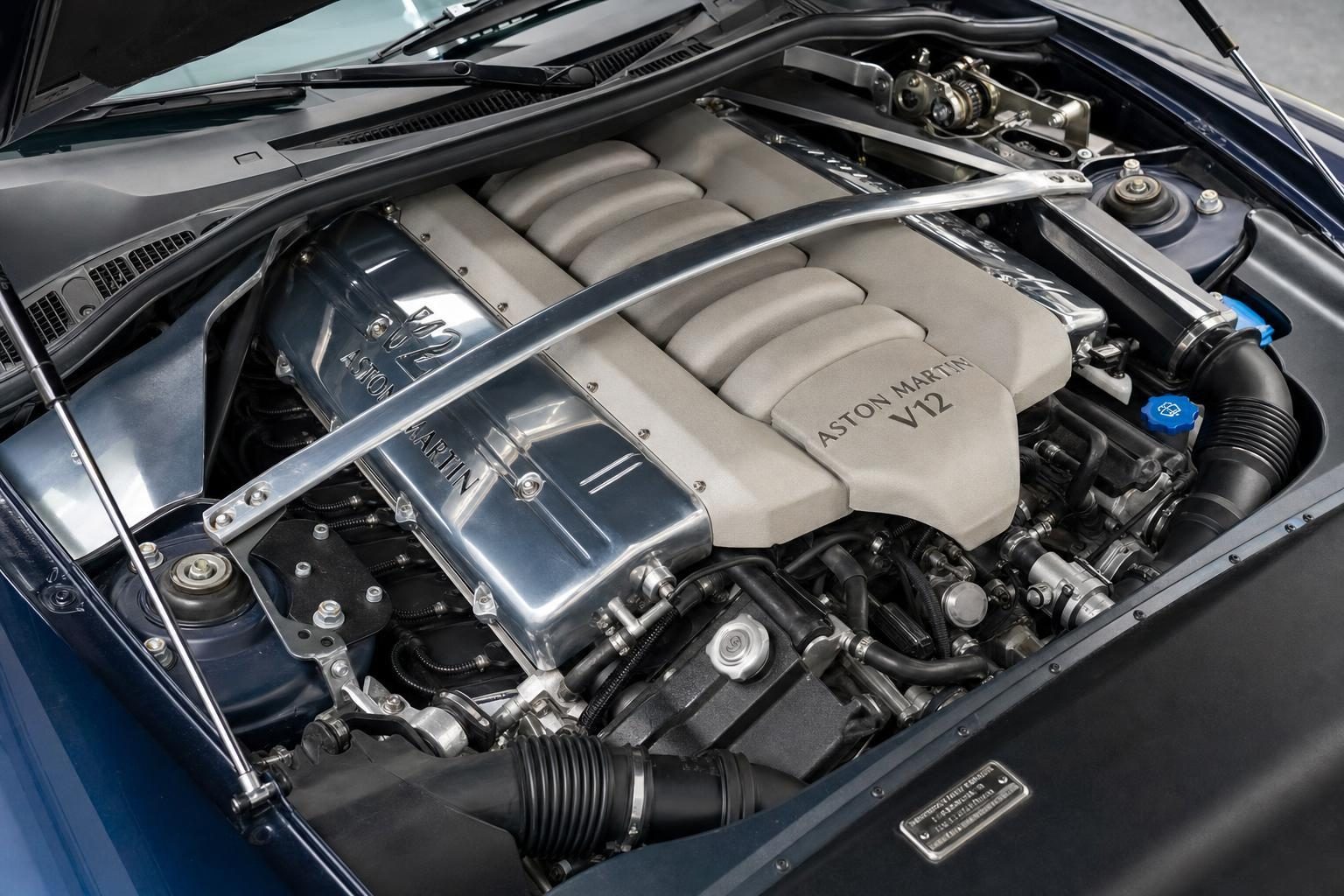
Under the bonnet, the 6.0-litre V12 with 460 bhp was paired with an F1-inspired paddle-shift gearbox. Together they gave the GT a head start, with more immediate mechanical response and torque management worthy of the badge. Composite body panels completed the light, technical approach, benefiting inertia and surface quality.
Beyond the figures, the first iteration set a vocabulary: mixed aluminium–carbon structure, steering wheel-mounted transmission controls, and the V12 as the beating heart. Viewed through the Vanquish 25 years lens, these choices were anything but a one-off. They opened a path that would bring coherence to the lineage, while leaving room for future revolutions in style and powertrain.
The 2012 Vanquish: One-77 influence and widespread exterior carbon
The second generation, unveiled in 2012 (production from 2013), clearly drew inspiration from the One-77. According to Aston Martin, it pushed carbon use even further, with aerospace-grade panels across the entire outer body. The message was clear: the GT now carried, as standard, solutions previously reserved for the hypercar.
This widespread visible carbon reshaped the car’s perception. The skin became structural in spirit and delivered superior fit precision, serving aerodynamics and high-speed stability. The Vanquish thus became the bridge between the exclusivity of the One-77 and the brand’s road-going DNA, a finely calibrated balance.
On the Vanquish 25 years map, this phase confirmed the model’s stylistic and material maturity. The aluminium architecture remained in the background, but the omnipresent carbon skin established a modern, visible and technical flagship signature. A choice that cemented its place at the top, without betraying the discreet elegance so dear to Aston Martin.
Vanquish MK3 in 2024: 835 PS, 5.2-litre twin-turbo and a super-GT redefined
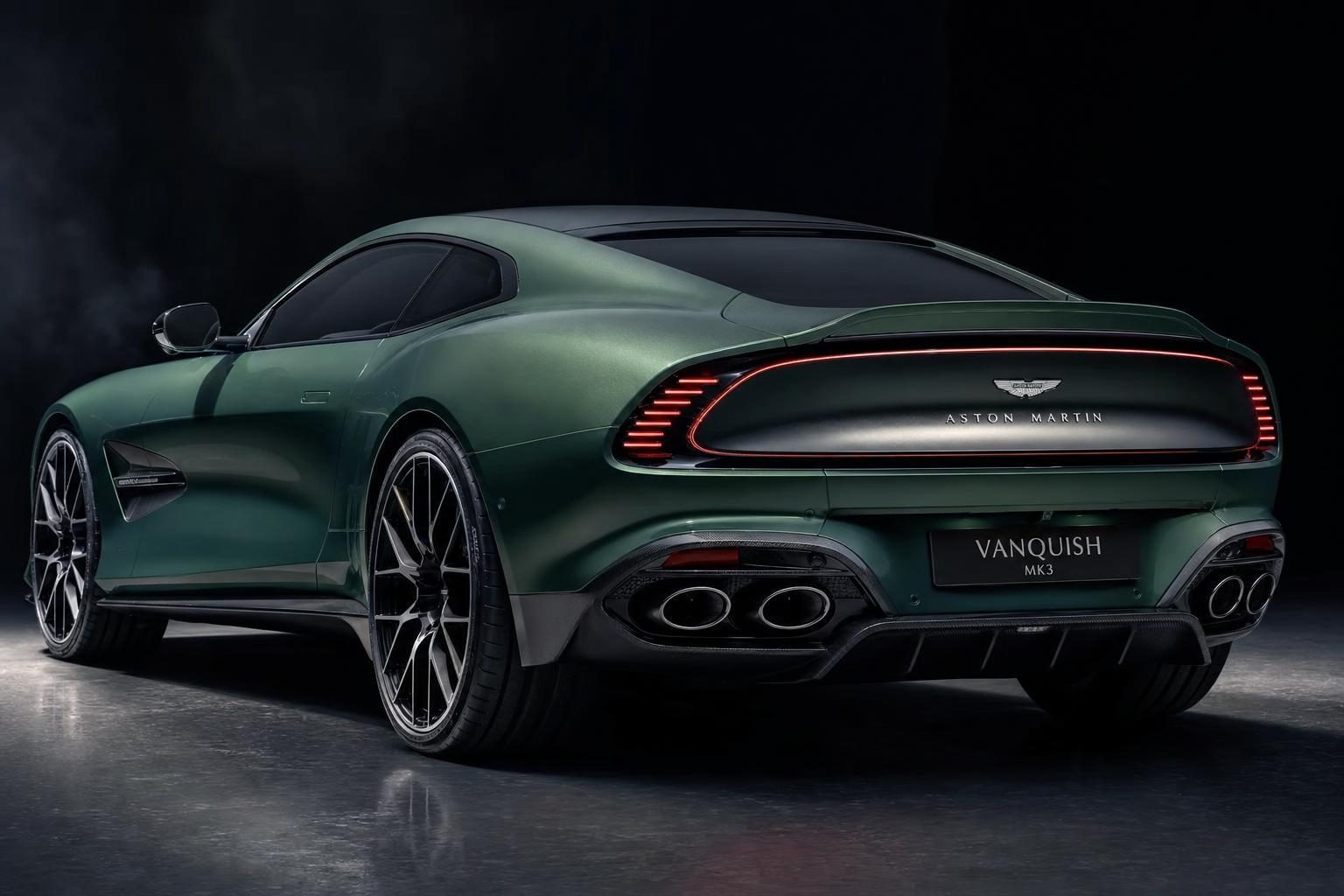
Act three in 2024: the Vanquish MK3 introduces a 5.2-litre twin-turbo V12 and claims 835 PS plus 1,000 Nm of torque. According to Aston Martin, it is the most powerful production model in the marque’s history, cementing the standard-bearing role of this nameplate as it celebrates its quarter-century.
The move to twin-turbocharging changes the engine’s response grammar. The plentiful low- and mid-range torque reinforces grand touring ability, while the peak power places the coupé among the most serious super-GTs. The expression is different, the intention remains: mechanical sovereignty and contemporary efficiency.
In the Vanquish 25 years perspective, this generation is not mere continuity. It is a redefinition of the range summit through the force of its numbers and the evolution of V12 architecture. The heart remains twelve cylinders, but the playing field has changed: optimisation through forced induction takes over from sheer displacement.
Thread across three generations: what hasn’t changed in 25 years
Running through all three chapters is a constant: the V12 at the top of the range. Naturally aspirated 6.0 litres at the outset, then 5.2 litres twin-turbo, it remains the symbol of Aston Martin’s mechanical sovereignty. This is the core of the Vanquish 25 years promise: to embody, unequivocally, the production flagship.
A second constant is the pursuit of a light, rigid structure. Extruded aluminium and carbon elements form a conceptual backbone that spans generations. From joint engineering with the University of Nottingham and the Cupertino team to the aerospace carbon panels of 2012, the line is clear: reduce inertia, increase precision.
Finally, positioning. In every iteration, the coupé sits above the rest of the range through its technical ambition and road presence. The aesthetics evolve, the tooling is refined, but the intent does not waver. Vanquish at 25 is the constancy of a role — that of the flagship — performed to different scores.
Conclusion — Vanquish at 25, three acts and one fixed idea
Twenty-five years after Geneva 2001, the story reads in chiaroscuro: visible breaks, assumed continuities. Mixed structure, composite materials, then widespread carbon and, today, a 5.2-litre twin-turbo V12 with 835 PS and 1,000 Nm: each chapter refines the idea of an authoritative super-GT without abandoning elegance. That is, at heart, the essence of Vanquish at 25.
The first opus defined the framework and F1-inspired paddle shift, the second democratised the carbon rigour inherited from the One-77, the third redraws the summit through the might of its twin-turbo V12. Three genealogies in one, united by the same badge. And a simple conclusion: as long as the V12 reigns at the top of the range, the Vanquish 25 years promise will be kept.
- Official retrospective of the three generations of Vanquish
- Detailed file on the Aston Martin Vanquish (EN)
- History of the Aston Martin Vanquish (FR)
To read more on each opus: