AMR26 2026 dévoile cinq ruptures majeures: boîte interne, Honda RA626H, ailes actives, carburant durable Aramco et défis de mise au point. À lire.
AMR26 is the name of the first Aston Martin designed by Adrian Newey and the rolling laboratory where the 2026 regulations take very concrete shape. Beyond the slogans, this single-seater stands out for five technical breaks that redraw the engineering scope of the Silverstone team: an in-house designed gearbox, Honda power, active aerodynamics without DRS, Aramco sustainable fuel and sometimes bruising learning on track. Here is what changes, and why it matters.
The AMR26’s in-house gearbox: a first at Silverstone since 2004
It is a discreet but structuring fact: the AMR26’s 8-speed semi-automatic gearbox is the first transmission developed in-house at Silverstone since 2004, according to Aston Martin. In short, the team is repatriating a critical organ to the heart of its chassis architecture, with control over the design, materials and packaging around the rear suspension.
This homecoming also means a shorter iteration loop between aerodynamicists, designers and the track. A tightly sized casing offers gains in aerodynamic efficiency and local rigidity, while the 2026 era demands finer management of the flows towards the diffuser. By making its transmission both compact and integrated, the AMR26 gives itself extra levers of balance.
The choice has cultural weight: after two decades of more outsourced approaches, Silverstone is once again taking charge of a sub-assembly where reliability and shift precision dictate performance. The risk is real, the potential reward too, especially in combination with the new power unit.
The Honda RA626H engine: a first-of-its-kind partnership for Aston Martin
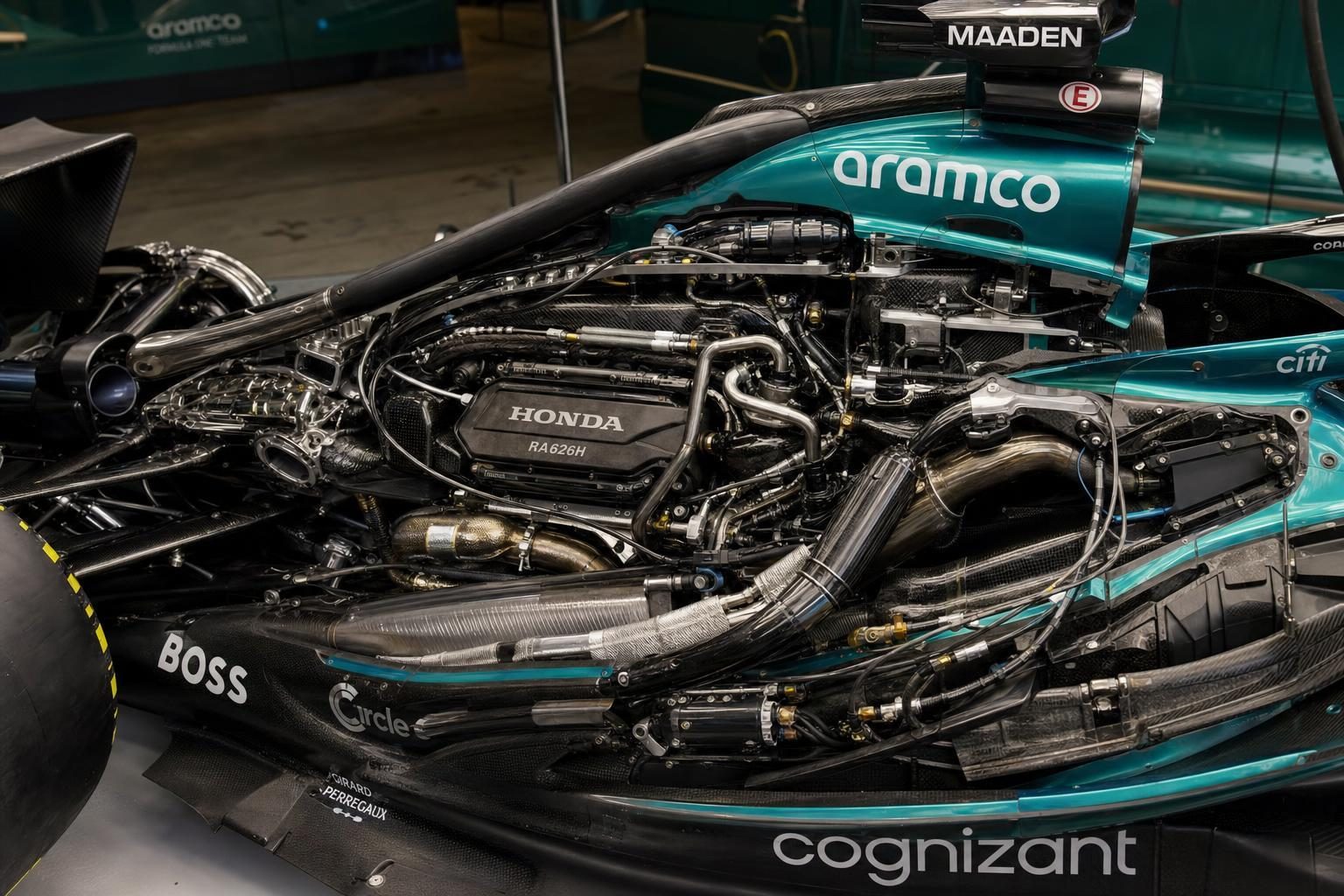
For the first time, a Grand Prix Aston Martin is powered by a Honda engine: the RA626H equips the AMR26, as Wikipedia notes. It is also the first Japanese-engined single-seater from Silverstone since the Toyota-powered Midland M16 in 2006. One page turns, another opens, with chassis–power unit integration conceived from the outset.
This partnership is not a simple badge swap: it requires aligning packaging, cooling and energy management with the balances of 2026. The in-house gearbox mentioned above makes full sense here: by tightening the rear, the team seeks to exploit the RA626H’s compactness and cooling requirements while preserving accessibility for track operations.
The duo of Adrian Newey at the drawing board and Honda on the test bench imposes an overall discipline: CFD–wind tunnel correlations, maps and hybrid strategies must speak the same language. Fernando Alonso and Lance Stroll, in their fourth and sixth seasons with the team respectively, embody continuity at the wheel, while the technology scales up.
Active wings in 2026: Corner Mode, Straight Mode and the end of DRS
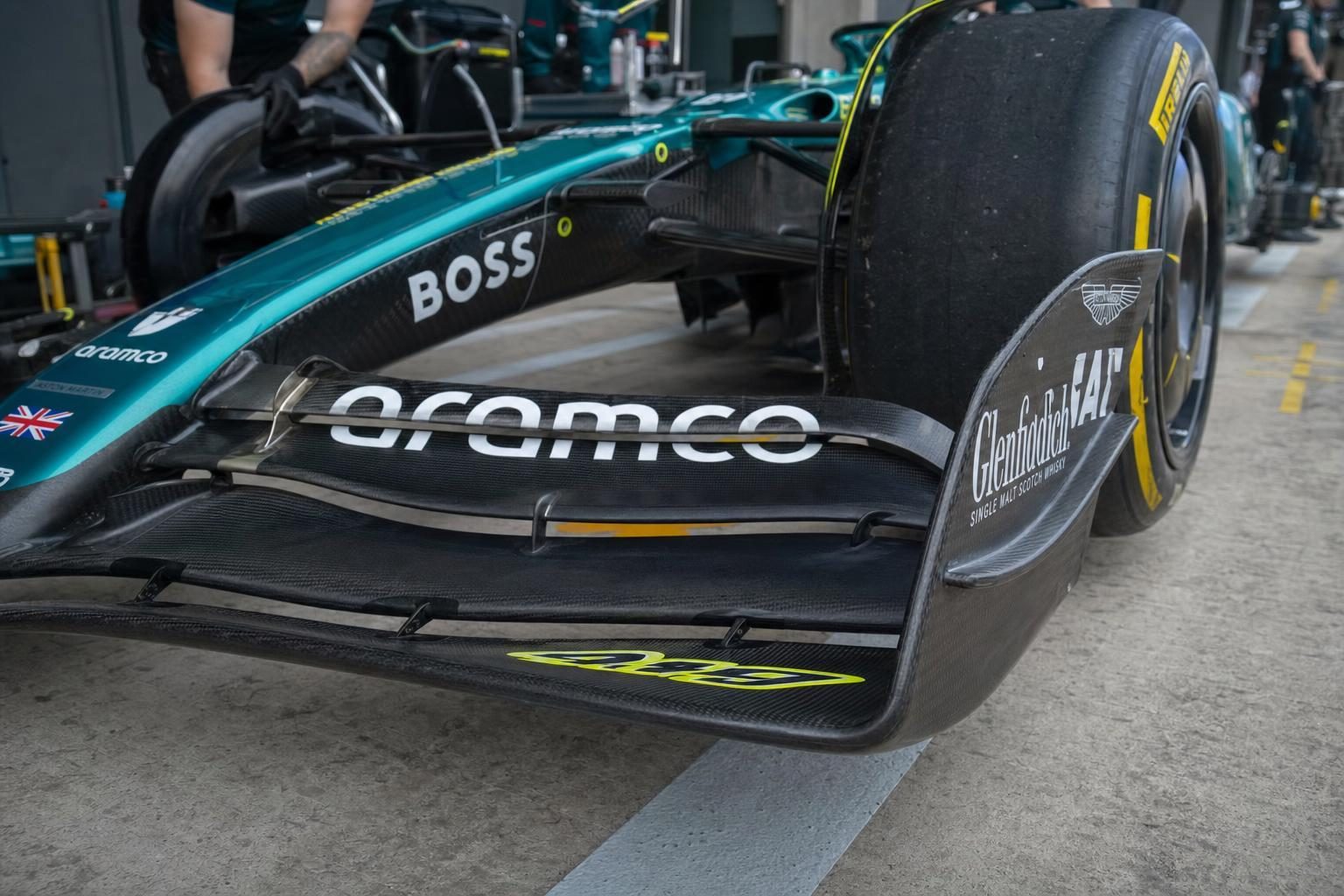
The 2026 regulations introduce active wings that operate continuously in two states: Corner Mode and Straight Mode, with no DRS zones, around an entire lap, according to Aston Martin. The AMR26 therefore adopts a logic of downforce and drag variation that is no longer occasional but systemic, serving overall efficiency.
In practice, the car modulates its aero elements to generate more downforce in corners and reduce drag on the straights, without zone triggers. This redefines balance management and the tyre operating window, with a chassis that “breathes” differently over the lap. The driver’s role also evolves: anticipation and confidence in transitions become essential.
For aerodynamicists, removing DRS zones shifts the optimisation focus towards a “living” aero package coordinated with the mechanics. The AMR26 expresses this philosophy through tight integration of actuators and the pursuit of a cleaner wake, in line with the pack-racing objectives set by the regulations.
Aramco ProForce+ sustainable fuel: regulatory constraint or competitive edge
The Aramco ProForce+ fuel used by the AMR26 is billed as 100% sustainable, derived from non-food sources and compliant with FIA 2026 standards, supplied exclusively to Aston Martin Aramco, according to Aston Martin. The stakes go beyond symbolism: the chemistry of this fuel and its lot-to-lot consistency influence combustion strategies, calibration and reliability.
Such a fuel imposes specific ignition and mixture windows. For the RA626H, it is an opportunity to optimise the synergy between compressor, injection and mappings, provided the chassis accepts cooling and weight adjustments. The AMR26 serves here as a full-scale test bench, with potential gains in efficiency.
Advantage or constraint? In the short term, the uniqueness of ProForce+ can increase the correlation workload on the dyno and on track. In the medium term, a stable formulation and a fine-tuned understanding between Honda, Aramco and the design office can generate cumulative benefits. A calculated technical bet.
Tough beginnings: vibrations, test failures and the season’s opening races
The track laid down its law. During pre-season testing in Bahrain, the team suffered three engine failures, and vibration issues marred the first runs, according to Wikipedia. The vibrations were declared resolved at the Japanese Grand Prix, a first reassuring milestone in a demanding development phase.
In Japan, Fernando Alonso recorded the team’s first finish of 2026, 18th, again per Wikipedia. The raw result is nothing spectacular, but it marks a step: making the AMR26 reliable while learning to exploit its active systems, in-house gearbox and new energy chain. The foundations are laid in silence, far from the podiums.
In this context, it makes sense to set the season within a broader cycle. The switch to Honda and ProForce+ fuel, combined with active wings, is not just about “parts”: it is an architectural change. Teams that capitalise on it fastest reap dividends later in the year. Patience is often part of the brief.
Conclusion: why the AMR26 already matters to Aston Martin
The AMR26 concentrates five breaks that redefine Silverstone: an in-house developed gearbox, Honda RA626H engine, continuous active aero, Aramco ProForce+ fuel and real-world learning. Together they sketch a clear intention: to take back control of strategic components and synchronise chassis, power unit and aerodynamics through the lens of 2026.
Quietly, this Aston is sowing the seeds of a more integrated technical identity. The bruising start does not cancel the project’s scope; it reveals its level of ambition. To read further, our season file gathers the context and first images of the Newey-signed AMR26 with Honda, while our endurance section puts into perspective the transfer of know-how from road to race with Valkyrie in the WEC and tracks the Aston Martin programmes at Le Mans and in the World Championship. As the 2026 regulations bed in, the trajectory set by the AMR26 could well be a landmark.
Main sources: technical presentation on the official Aston Martin site and result summaries via Wikipedia. For factory releases and visuals, see also the Aston Martin media centre.