DB4 GT: short chassis, 302 PS, 75 examples and a key role between DB4 and DB5. A look back at its engineering, racing and stylistic legacy.
The DB4 GT is the Aston Martin that, in October 1959, shifted the goalposts: shortened chassis, three Weber carburettors and a clear promise to go faster and further than the standard DB4. At the London Motor Show, this crisply honed coupé asserted itself as a fully fledged model, poised between sharpened grand tourer and circuit campaigner. Here’s what we know, with figures to hand, about its engineering, its 75 examples, its racing campaign against Ferrari, and what it passed on to the DB5.
DB4 GT unveiled in October 1959: short chassis and supercharged intent
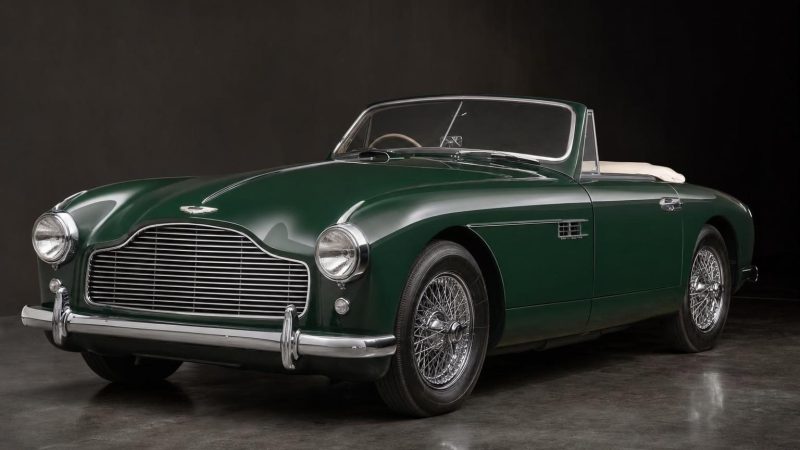
Revealed at the October 1959 London Motor Show, the DB4 GT cemented a simple, effective strategy: lighten, shorten, hone. According to Aston Martin, it adopted a shortened chassis, faired headlamps and a beefed-up evolution of Tadek Marek’s twin-cam straight-six fed by three Webers. The aim was crystal clear: to offer a livelier, more competitive version than the road-going DB4, without abandoning Touring’s elegance.
This shortening of the wheelbase is anything but anecdotal: it tightens the car around its driver, makes the steering more direct and improves response in loaded corners. Aerodynamics also progressed with the faired lamps, a detail at once aesthetic and functional, reflecting a pursuit of performance that goes beyond mere styling exercise.
The factory also detailed a substantial weight saving. Compared with the standard DB4, the coupé shed 85 kg, a diet that changes everything in acceleration and braking. The result, as we’ll see below, catapulted the DB4 GT to the status of reference of its era.
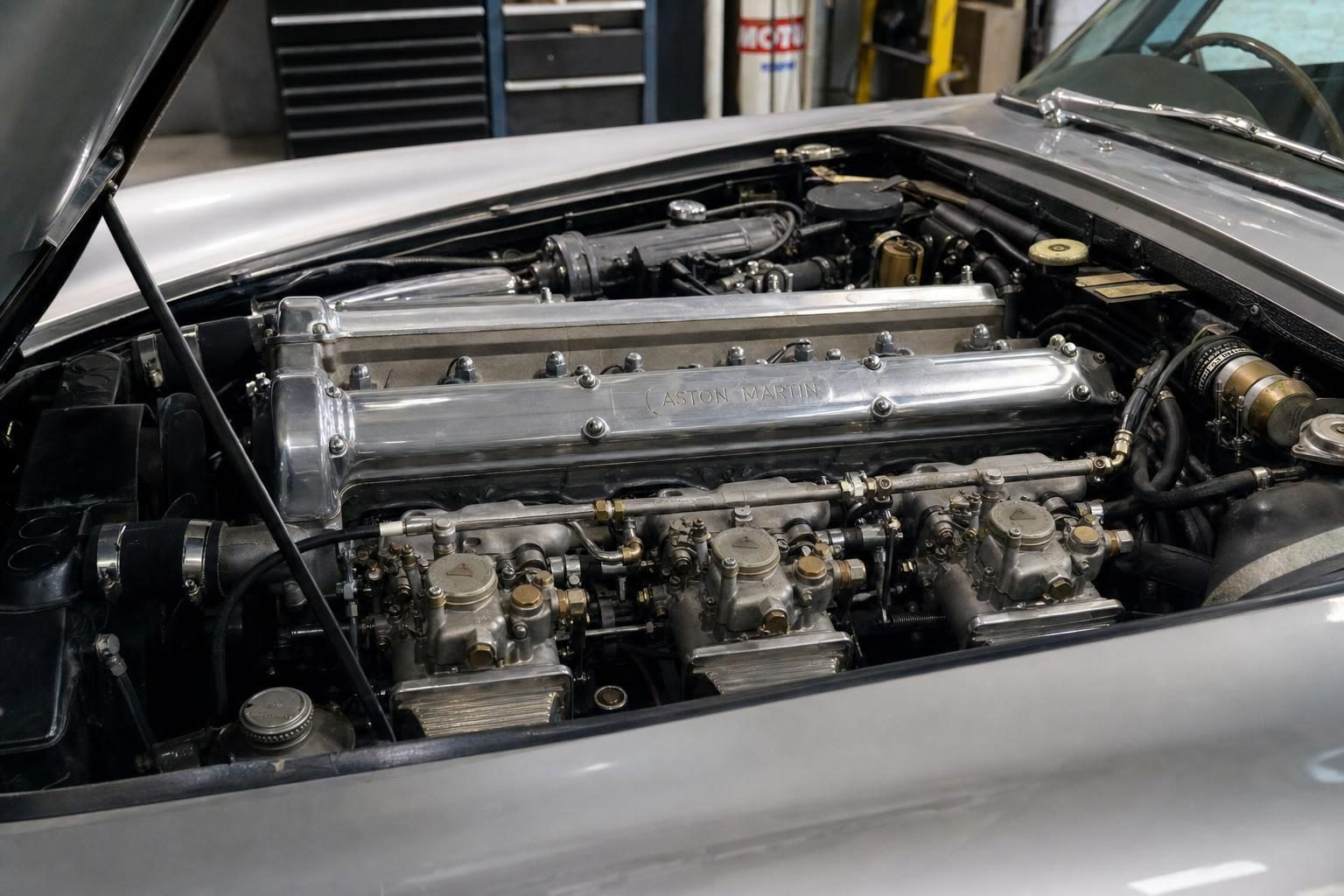
On the engine front, the base is familiar: the 3.7-litre twin overhead cam designed by Tadek Marek. But the specific preparation, triple Weber induction and dedicated tuning endowed the unit with elasticity and verve that made the difference on road and track alike.
Three Weber carburettors and 302 hp: what that meant on the road in 1959
According to data compiled by Wikipedia, the DB4 GT claimed 302 hp, a top speed of 153 mph (246 km/h) and 0–60 mph in 6.1 s. At the end of 1959, these figures were no technical frippery: they put the car, as standard and road legal, at the summit of the period’s hierarchy. The symbolic 150 mph barrier placed the Aston in a very rare club where, at the time, it set the pace.
The three Weber carburettors did more than inflate a power figure. They sharpened throttle response, stabilised fuelling at high revs and contributed to the stopwatch. Road manners benefited: more punch at mid-range, less inertia on pickup and, when needed, an unprecedented cruising speed for a grand tourer.
The 85 kg saving over the standard DB4 is the other pillar of performance. Lighter, the car stopped shorter, turned in more cleanly and spared the drivetrain needless effort. This weight-to-power alchemy, combined with the more compact chassis, explains why the DB4 GT became an instant benchmark for testers and gentlemen drivers alike.
Symbolically, being “the fastest in the world by its own figures” in 1959 is no boast: it is a promise kept by engineering. The DB4 GT thus asserted itself not as a mere sporty variant, but as the synthesis of a clear programme focused on real, measurable performance.
75 examples built, including several lightweight racers
The series remained deliberately limited. According to the manufacturer and Wikipedia records, 75 DB4 GTs bodied by Touring were produced. Within that total, several lightweight competition versions were created, with the explicit goal of optimising the car for Goodwood, Le Mans and continental jousts against Italian rivals.
This rarity, far from being today’s collector’s ploy, is explained by the model’s very vocation. The car is an instrument: on track, a few fewer kilos or a sharper induction setting can decide a grid position. The “lightweight” variants fully embraced this stance while preserving the road coupé’s DNA.
In the workshop, pragmatism prevailed: remove weight where it counts, make reliable what must be, and keep the looks. The Touring bodies, of rare finesse, offered that compromise between elegance and efficiency that would be seen elsewhere in the DB lineage.
This measured production still contributes to the model’s historical value today. Not by an artificial scarcity effect, but because it attests to a clearly targeted project: to make the DB4 GT a credible weapon on the circuits, without divorcing it from the open road.
DB4 GT on track: Goodwood, Le Mans and the Ferrari showdown
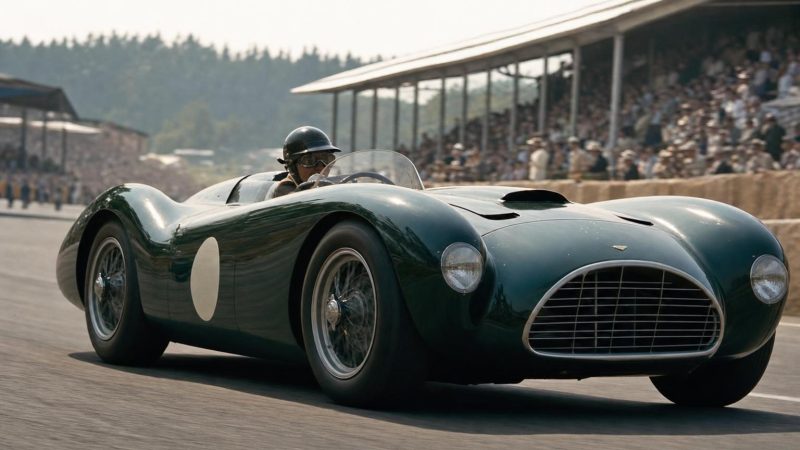
The DB4 GT’s calling is heard as much in the paddocks as on the Mall in London. If we speak of Goodwood and Le Mans, it’s not for folklore: it was indeed on these tracks and other European stages that the lightweight versions came into their own. The confrontation with Ferrari is a leitmotif of the 1959–1963 period, each camp refining its take on the sporting grand tourer.
Against the Maranello contenders, the Aston countered with increased rigidity, weight saving and the availability of its straight-six. The sometimes fierce duel validated the technical choices: short wheelbase, braking and Weber induction were all weapons to hold the pace in competition.
Beyond precise results, which we won’t settle here for lack of further quantified sources, the essence lies elsewhere: the DB4 GT proved that one could design a genuinely competitive road car without renouncing minimal comfort and elegance. This typically British synthesis is anything but theoretical; it is measured by the stopwatch as much as by the full-beam drive home.
For an overview of the DB4’s road-going DNA, readers can explore the dedicated presentation of the standard DB4 and its evolutions, useful for placing the GT in its immediate lineage, then dive into our competition feature on the DB4 GT versus Ferrari between 1959 and 1963.
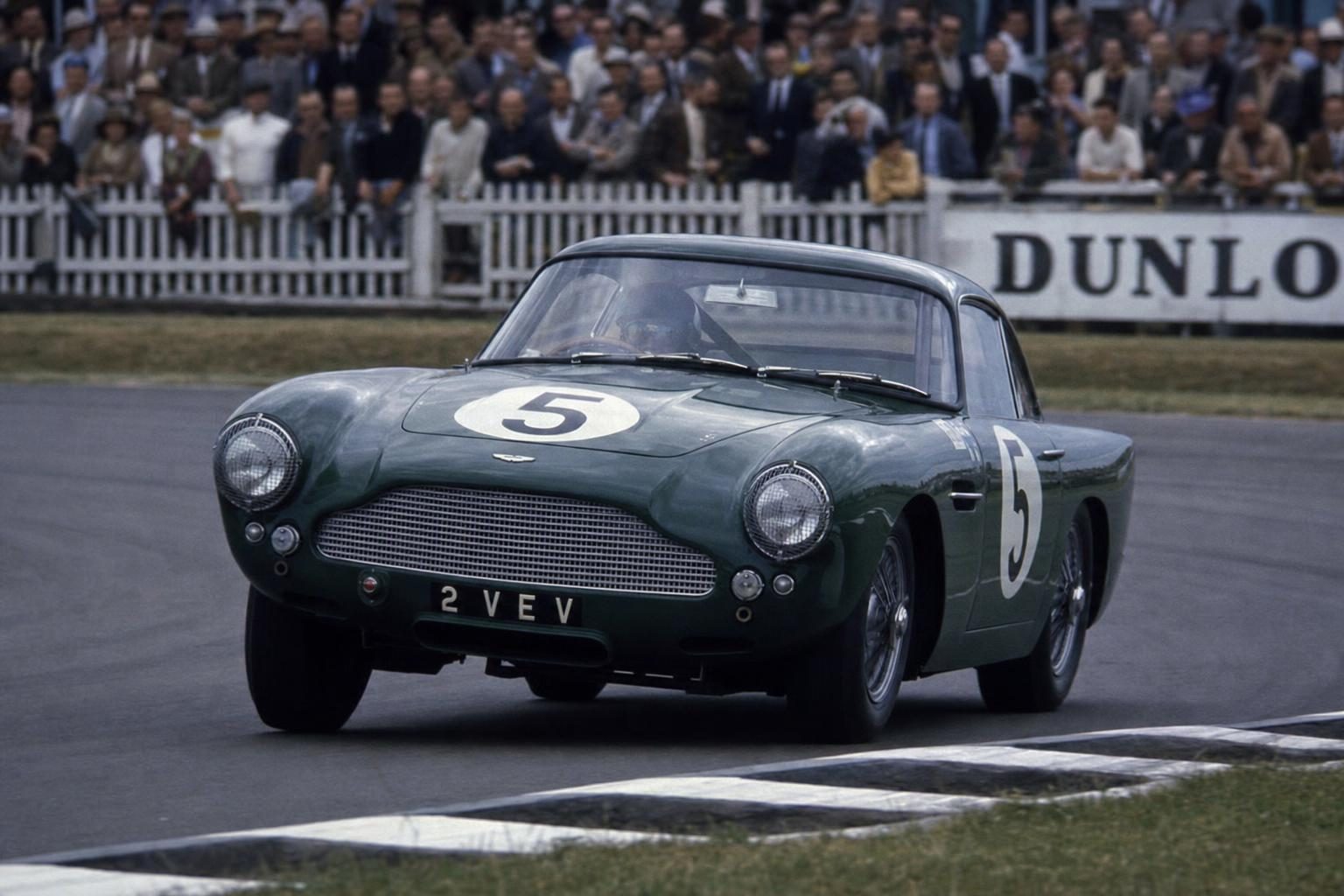
Lineage between DB4 GT and DB5: what carried over and what did not
Between the DB4 GT and the DB5, the thread is more than narrative. According to the manufacturer, these two models play a foundational role in contemporary Aston Martin design codes. Grille, proportions, clean flanks and overall stance: on the DB5 we find an elegant continuation of this grammar, refined without being denatured.
What carries from one to the other is the idea of a fast grand tourer capable of holding its own in competition while remaining civilised. Tadek Marek’s imprint continued mechanically, the twin-cam straight-six architecture remaining at the heart of the driving experience. For a detailed look at the most famous descendant, see our page dedicated to the DB5 and its heritage.
What, by contrast, did not transfer wholesale is the short-wheelbase radicalism and the weight paring of the lightweights. The DB5 took the spirit, not the letter. It consolidated comfort and equipment, leaning further into its role as a road icon. The DB4 GT remains the purest expression of that late-1950s sporting temptation.
Design, stance and dynamic credibility: the transmission is intact. Radical wheelbase, relative austerity of racing versions: these remain specific to the GT. This discernment likely explains the longevity of the house style, able to reconcile presence and performance without lapsing into one-upmanship.
Conclusion — why the DB4 GT remains a pivot
Ultimately, the DB4 GT combines three rarely united virtues: sharp yet coherent engineering, limited production conceived for effectiveness, and a stylistic influence acknowledged by the marque itself. The figures published by Wikipedia — 302 hp, 153 mph, 6.1 s — put it on top in 1959, while the short chassis and weight saving from Aston Martin made the difference on track.
Between the standard DB4 and the future DB5, this model forged its own furrow, faithful to the GT spirit yet resolutely focused on measurable performance. That’s doubtless why the DB4 GT still speaks to enthusiasts: because it matches words with deeds, from the Goodwood pitlane to the drive home, with elegance that never overreaches.
Sources and further reading: the official page devoted to the DB4 GT according to Aston Martin and the summary sheet dedicated to the DB4, complemented by a general perspective on the marque on the reference encyclopaedia.