James Bond V8, de Timothy Dalton à Daniel Craig : la V8 revient, sème la confusion entre séries et façonne la mémoire des fans d’Aston Martin.
James Bond V8, or how a calmly elegant Aston wrote a discreet yet persistent chapter of the 007 saga. From Timothy Dalton in 1987 to Daniel Craig in 2021, the V8 spans three decades, two eras of the character and, above all, a healthy confusion between production series. Here’s why we often think we recognise three cars… when only one configuration truly stands as canon on screen.
The Living Daylights, 1987: Timothy Dalton and the V8 Series 4
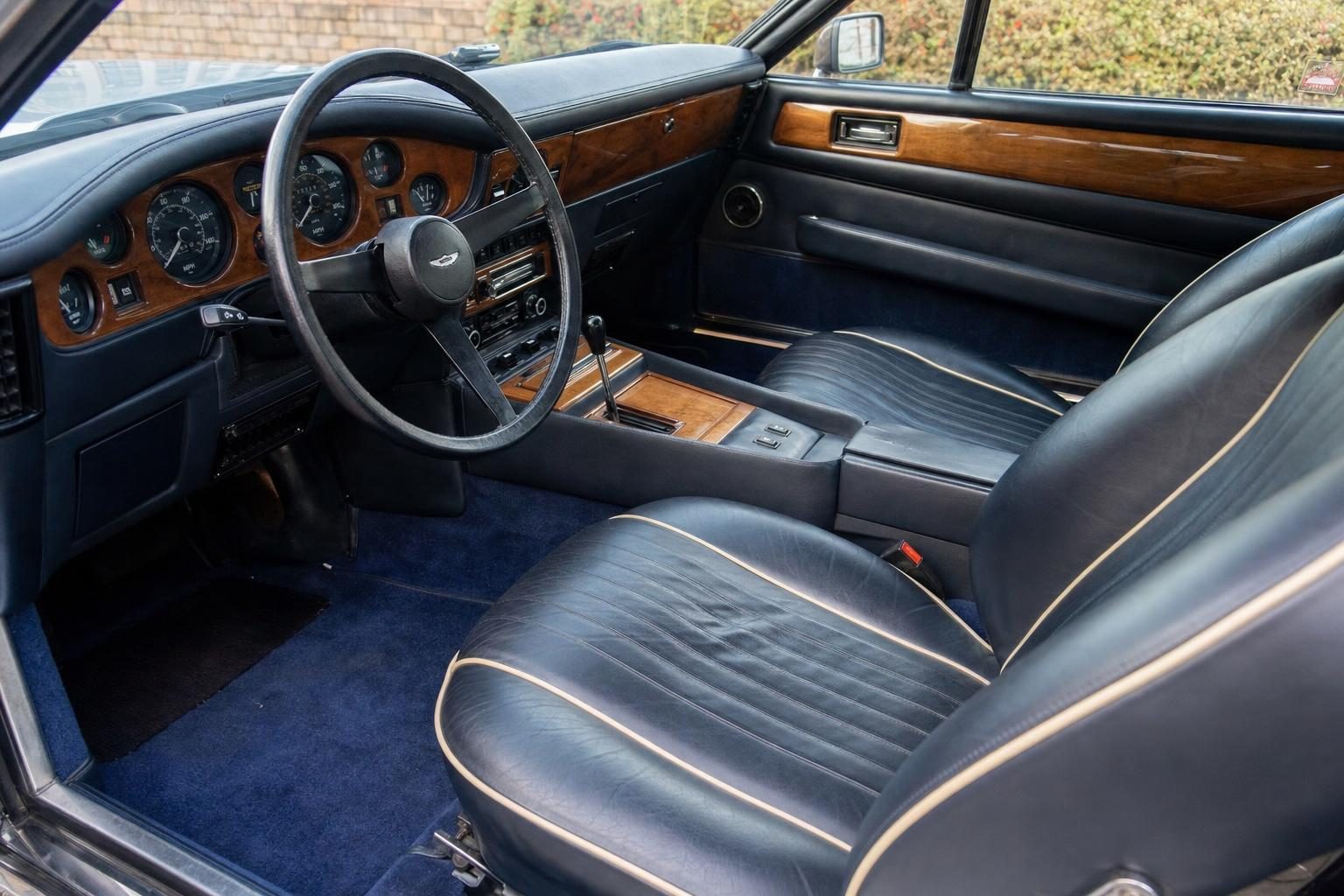
In 1986, EON Productions decided to bring Aston Martin back into the Bond universe for Timothy Dalton’s debut, and to equip the Series 4 with gadgets as a nod to the DB5. According to the Wikipedia page Aston Martin V8, it is indeed a Series 4 V8 that appears in The Living Daylights (1987). The tone is set: a muscular yet restrained silhouette, British Grand Tourer spirit, and a technological veneer calibrated for the Cold War.
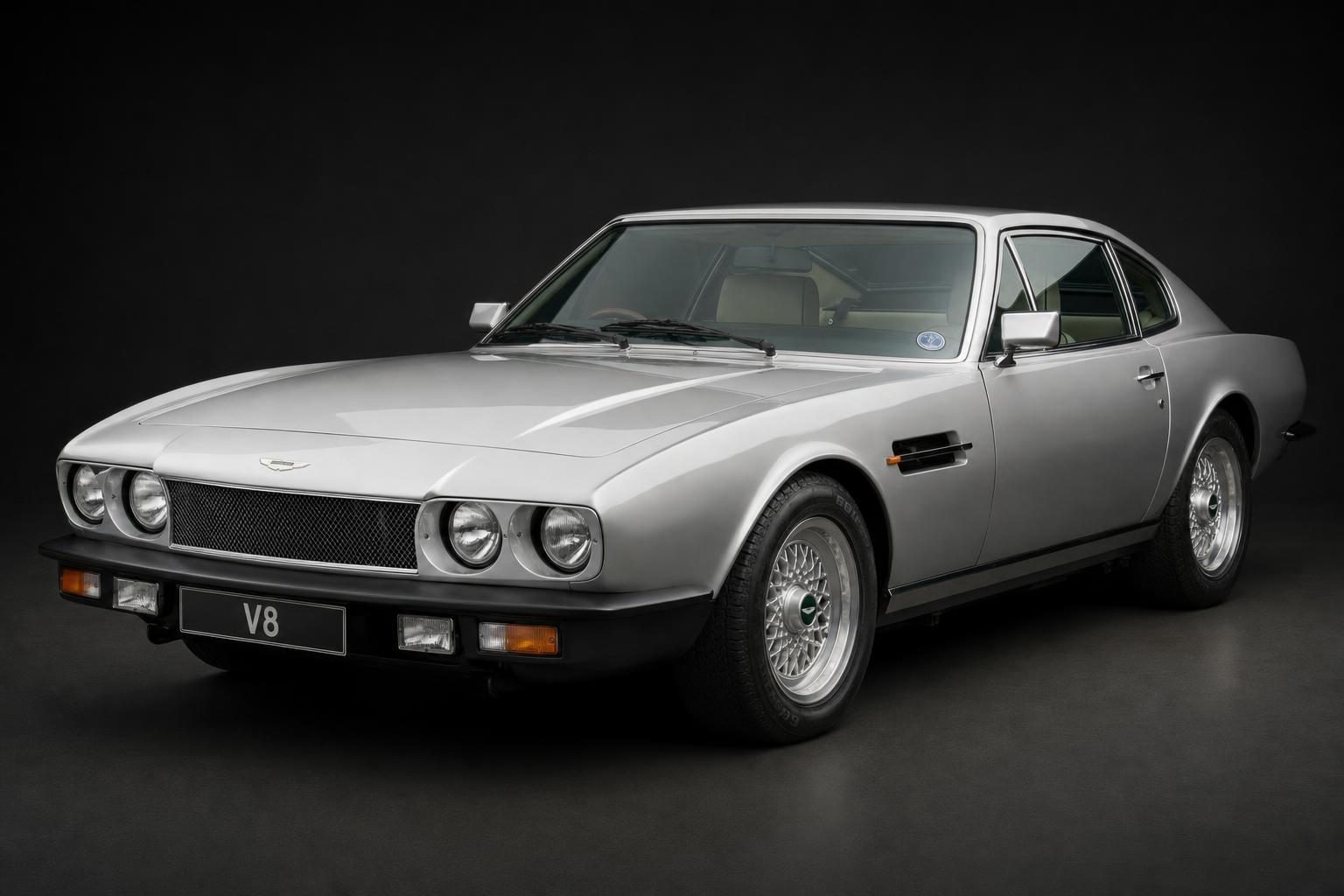
William Towns’ design gives the car its taut profile, with rear quarters he himself acknowledged having “borrowed” from the first Ford Mustang. This subtle American kinship, set on a very “Newport Pagnell” chassis, serves its on-screen presence perfectly: virile without swagger. The 5.3-litre V8 engine, produced without fundamental displacement change from 1969 to 1989, provides the apt soundtrack and the stamina needed for the action scenes.
For purists, The Living Daylights thus marks the return of a “contemporary” Aston – and not just the gilded memory of the DB5. The same source further indicates that the V8 Series 4 was explicitly chosen, anchoring the film in Aston Martin’s industrial present of the latter half of the 1980s.
Series confusion: why viewers struggle to identify the exact car
If we often think we see several different “versions”, it’s because the AM V8 family evolved by incremental steps. From a distance, a Series 3, 4 or 5 can seem like twins on screen: the same overall Towns-penned line, unchanged proportions, the same 5.3-litre V8 architecture. This stylistic and mechanical continuum muddles things for anyone not hunting for details.
Another source of ambiguity is timing. Series 5 (1986–1989) would total 405 coupés before replacement by the Virage in 1989. Yet The Living Daylights was released in 1987, precisely when the final series in the lineage coexisted in recent production. To the untrained eye, a filmed Series 4 and a Series 5 registered in the same year can be confused.
Add to this the James Bond V8 effect in popular culture: we recall the “Bond V8” as a monolithic block, and collective memory erases the series suffixes. The result is that many believe they recognise three different car(s) where the screen really authenticates only one precise configuration in The Living Daylights, then a late return of the same stylistic genes in 2021.
No Time to Die, 2021: the V8 Coupé makes a discreet return 34 years on
Thirty-four years after Dalton, the V8 Coupé reappears in No Time to Die (2021). Again, the choice doesn’t tip into noisy nostalgia: the car appears with the reserve that defines it, as a rougher counterpoint to the DB5. Wikipedia explicitly records this model’s return in 2021 within 007’s filmography.
This callback places the James Bond V8 in a generational continuum. The same crisply cut silhouette, the same engine with unchanged displacement across the model’s history – which reinforces the idea of an intangible technical signature. The public sees the same Aston; experts spot the incremental updates: it is precisely this subtle gap that still fuels a healthy debate among enthusiasts today.
To gauge the handover, remember that the V8 lineage would officially give way to the Virage from 1989. Aston Martin’s past models page documents this transition and the Virage’s pivotal role after the V8.
The 1987 gadgets: between a DB5 homage and Cold War autonomy
The brief set by EON in 1986 was clear: bring Aston Martin back and, in The Living Daylights, sprinkle the V8 with gadgets in homage to the DB5. But unlike the silver icon of the 1960s, the Series 4 does not try to hijack the plot. It remains a field tool, aligned with a tale of defections, borders and East–West tensions.
This restraint serves the story. The viewer recognises the James Bond V8 lineage through the nods, without losing sight that the car is neither a high-tech capsule nor a museum relic. The understated elegance of Towns’ design, combined with the robustness of a V8 proven over two decades, does the rest.
It also reads as an image strategy: let the DB5 keep its mythic charge, while the V8 embodies the Bond of the 1980s, more realistic and less gadget-happy. A discreet yet effective way to signal that 007 is changing era – without losing his crest.
Current values of the AM V8: what Bond exposure has (or hasn’t) done at auction
It’s hard to isolate, figures in hand, the 007 effect on AM V8 auction results. What we do know is that media exposure shapes perception. Between the imprint of The Living Daylights (1987) and the reminder of No Time to Die (2021), the James Bond V8 has stayed on the radar, without becoming a frozen totem like the DB5.
Two tangible markers help frame value. First, Series 5 production limited to 405 coupés (1986–1989): relative rarity, especially compared with later decades. Second, the continuity of the 5.3-litre unit from 1969 to 1989: a continuous technical thread prized by fans of coherent engineering. Within these bounds, the Bond effect acts mostly as an amplifier of attention.
As for series confusion, it feeds an aesthetic hierarchy rather than a rigid price table. Savvy collectors discriminate; the wider public rallies under the “Bond V8” label. In both cases, the car gains in notoriety without losing its complexity – which, in the long run, is often healthier than a passing frenzy.
Conclusion: what the James Bond V8 says beyond the credits
In the end, the James Bond V8 links two key moments of the saga without seeking the limelight. In 1987, Series 4, measured gadgets, a tilt toward plausibility. In 2021, the return of a familiar profile, like a bridge between heritage and present. In between, William Towns’ design, the longevity of the 5.3-litre V8 and the transition to the Virage compose a continuous story, of which the series confusion is almost the signature.
So we’ll keep this simple idea in mind: three decades, several very similar cars, and an identity recognised at a glance. It’s the quiet strength of the James Bond V8 – more a line that endures than an appearance that eclipses. For enthusiasts, that is precisely where the pleasure lies.
- To explore the variants and the model’s history in detail, see our feature on the AM V8: all AM V8 generations decoded.
- To set it within six decades of 007–brand synergy: Aston Martin and James Bond, 60 years of history.
- And for the Craig era garage, our DB5, DBS and DB10 overview: all of Daniel Craig’s Astons.