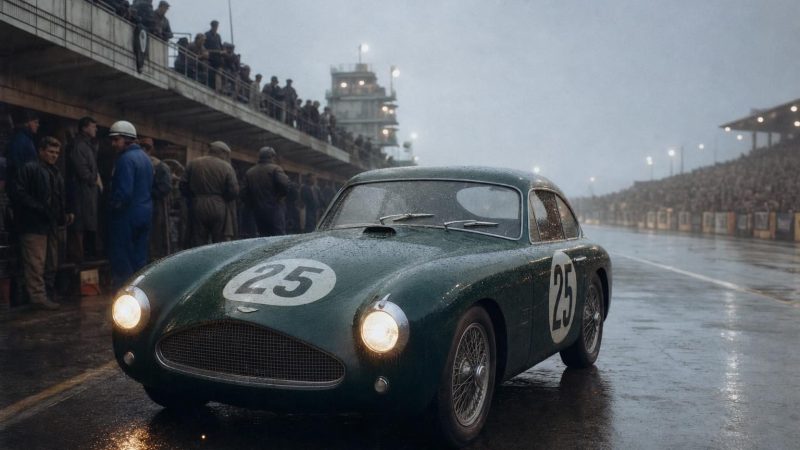
DB3S: how body, engine and De Dion axle shaped Aston Martin’s endurance method from 1953 to 1956, before the advent of the DBR1.
The DB3S is the decisive link that anchors Aston Martin’s endurance method: a sharpened design, an evolutive powertrain and a disciplined rear end. Often eclipsed by the DBR1, it nonetheless laid down, as early as 1953, three engineering choices that would shape what followed. Here is why Frank Feeley’s bodywork, the 2.9‑litre straight‑six and the De Dion axle did more than race: they taught.
Frank Feeley’s bodywork: why the DB3S broke with the DB3 on proportions
From 1953, the Newport Pagnell works entrusted the body to Frank Feeley. Compared with the DB3 it replaced, the stylist tightened the volumes, according to the page dedicated on en.wikipedia.org. Shorter overhangs and a reduced frontal area targeted lower drag and better high‑speed stability. The silhouette, lowered and smoothed, served a clear ambition: make the air work, not just the engine.
This break in proportions was not mere aesthetic flair. It reflected the search for a balance between downforce and top speed on varied circuits, from Goodwood to the long straights of La Sarthe. By slimming the windscreen, lightening the tail and controlling the curvature of the wings, Feeley answered the concrete needs of endurance: visibility, cooling and a steady attitude.
The coherent whole paved the way for the factory bodies of the latter half of the 1950s. In other words, the DB3S introduced a formal language that favoured efficiency without sacrificing elegance. It is an Aston recognised for the rightness of its proportions rather than showiness, a hallmark that would endure.
The 2.9‑litre engine: evolution of the Tadek Marek straight‑six and power management
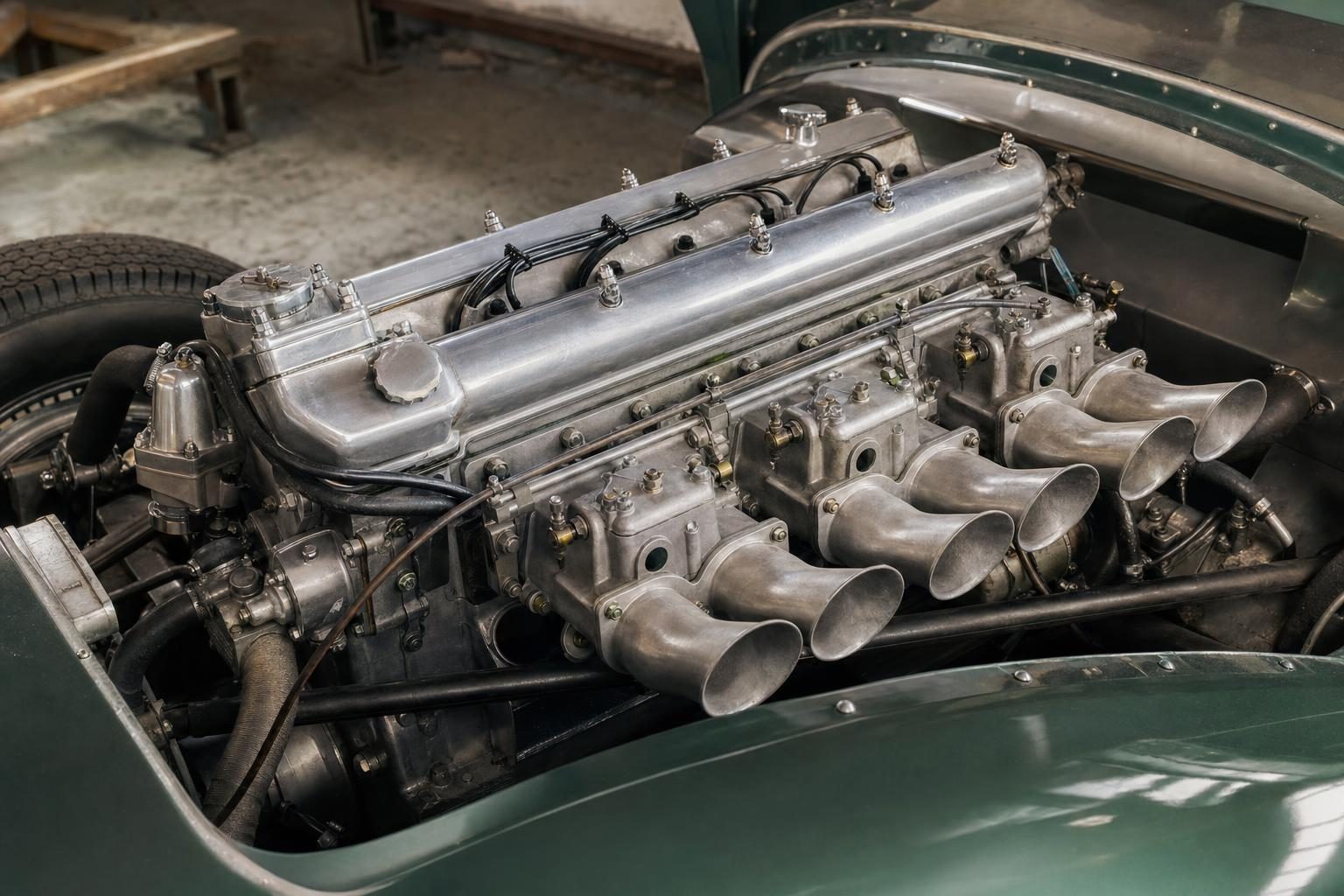
At the heart of the chassis, the 2,922 cm³ straight‑six fits the Aston school: flexibility first, power second. According to en.wikipedia.org, the racing version delivered about 180 PS at the outset, then rose to around 225 PS in later iterations. Rather than chase peak power alone, the team focused on the usable: tractable torque, reliability and cooling over extended stints.
This progressive climb, tweak by tweak, accompanied endurance’s triathlon: performance, longevity and controlled consumption. At a time when mechanical failure decided results, thermal management and carburation mattered as much as horsepower. The DB3S thus became a rolling test bench, where each power gain was secured without compromising consistency over 24 hours.
The philosophy reads in the numbers and is understood in practice: a broad rev range, dependable ignition and peripheral systems (fuel, lubrication) designed to go the distance. This mechanical realism fed directly into the next generation, through to the DBR1, which inherited a methodical rather than spectacular approach.
The De Dion axle: a rear‑end choice that influenced the DBR1
At the rear, the Aston adopted a De Dion axle. The principle is well known to engineers: separate the unsprung mass from the transmission elements to keep the tyre planted and maintain camber under load. In lap‑time language, that yields faithful traction and more progressive reactions over bumps and compressions, conditions typical of Silverstone and especially Le Mans.
The choice paid off and would be carried over to the DBR1. It highlights Aston Martin’s mid‑1950s priority: preserve tyre‑to‑tarmac contact and consistent angles rather than pursue flashy solutions. In endurance, a forgiving rear end is better than a capricious one that, come dawn, demands more arms than fuel.
This De Dion axle formed, with the tubular chassis and weight distribution, a biddable high‑speed base. It also allowed finer tuning of springs and dampers, a condition for stint regularity. Again, the DB3S set the example, and the future 1959 winner would reap the dividends.
The racing record: Goodwood, Silverstone and the 24 Hours of Le Mans between 1953 and 1956
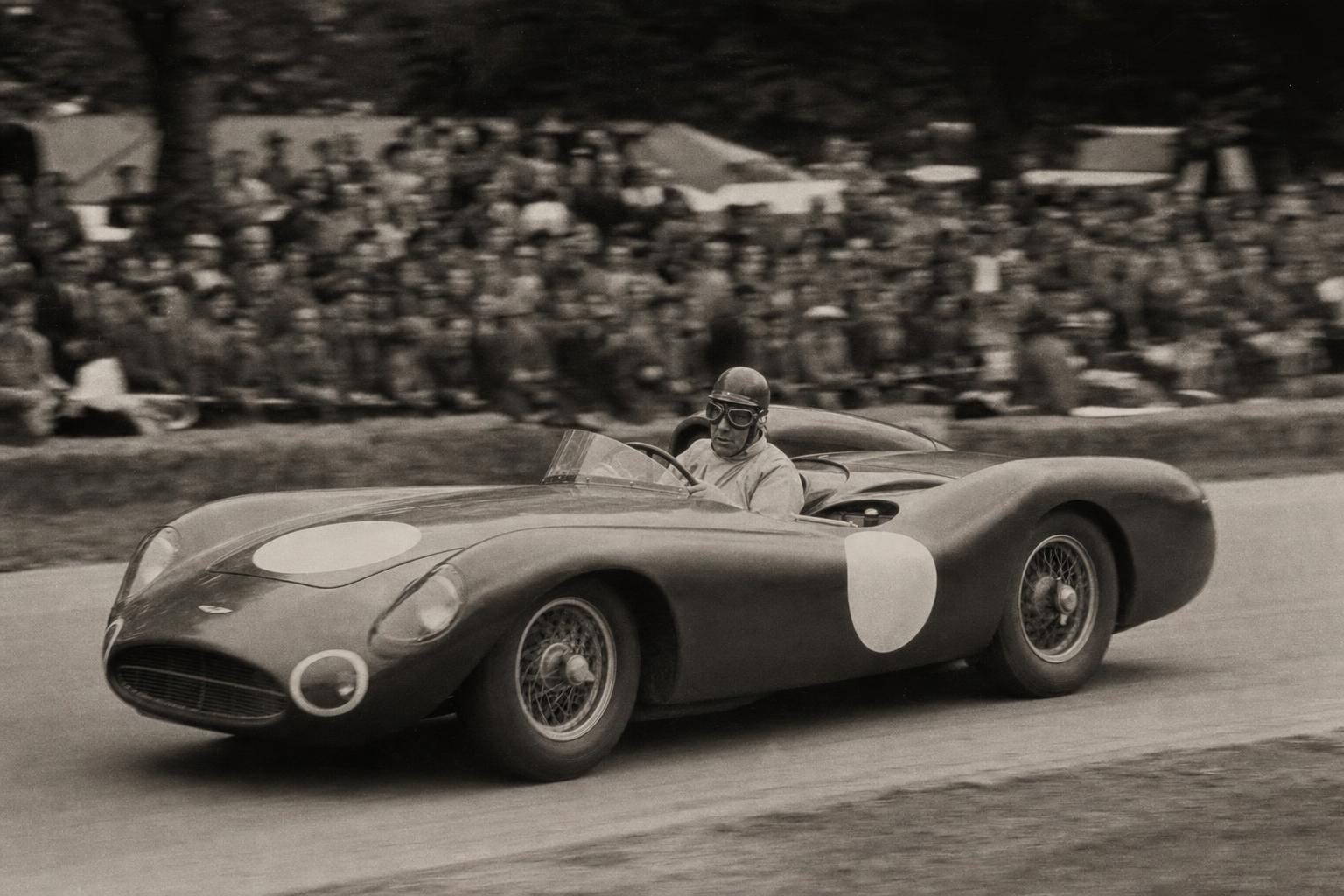
On track, the DB3S was more than a laboratory; it scored. Stirling Moss won several races in the barchetta, notably at Goodwood and Silverstone, a ringing endorsement of the chassis‑engine package’s competitiveness. These successes validated the iterative approach: formalise what works, eliminate what wears out the machinery and the tyres.
Between 1953 and 1956, the car started the 24 Hours of Le Mans several times. The exercise there was different, almost another discipline. The long flat‑out sections put Frank Feeley’s bodywork and the De Dion axle up against endurance realities: stability, mechanical freshness, preserved braking. While ultimate glory would come with the DBR1 in 1959, these Le Mans campaigns honed the method.
This composite record — British sprints and Sarthe marathons — built a unique experience base. Stints won at Goodwood taught agility and steady pace; La Sarthe demanded temperance and robustness. This back‑and‑forth shaped Aston Martin’s racing culture, made of unabashed speed and prudent engineering.
The transition to the DBR1: what the DB3S taught John Wyer’s team
For John Wyer and his team, the DB3S acted as a stern teacher. It taught the value of small, invisible wins: better cooling, finer setup, making every detail reliable. The retained De Dion axle was the perfect example. The continually optimised straight‑six was another. All of this fed an endurance logic where the sum of details makes the difference at the flag.
This transfer of experience nourished the DBR1, victorious at Le Mans in 1959. To place that triumph in context, our feature on the keys to the DBR1’s victory at Le Mans in 1959 maps out this technical and human legacy precisely. The DB3S holds a central place there, not as an absolute icon, but as a crucible.
More broadly, the decade illuminates Aston Martin’s competitive strategy in the World Sports Car Championship, between factory programmes and targeted entries. Read it in perspective in our panorama devoted to Aston Martin’s history at Le Mans and in the championship, which follows the thread opened in 1953.
Conclusion — the DB3S, discreet foundation of the Aston Martin method
In short, the DB3S crystallised three fruitful decisions: Frank Feeley’s body that cuts the air cleanly, an evolutive 2.9‑litre straight‑six and traction security via a De Dion axle. This triptych forged the in‑house discipline, of which the DBR1 would reap the harvest. For lovers of mechanical genealogy, the lesson is clear: before glory, there was method — and its name was DB3S.
To explore the road‑going legacy of this era, a detour via the DB4, cornerstone of the range, sheds light on the transition from circuit to road. And to place this story within the marque’s grand history, consult the official Aston Martin site and the historical overview offered by Wikipedia on Aston Martin, useful complements to the established facts here.