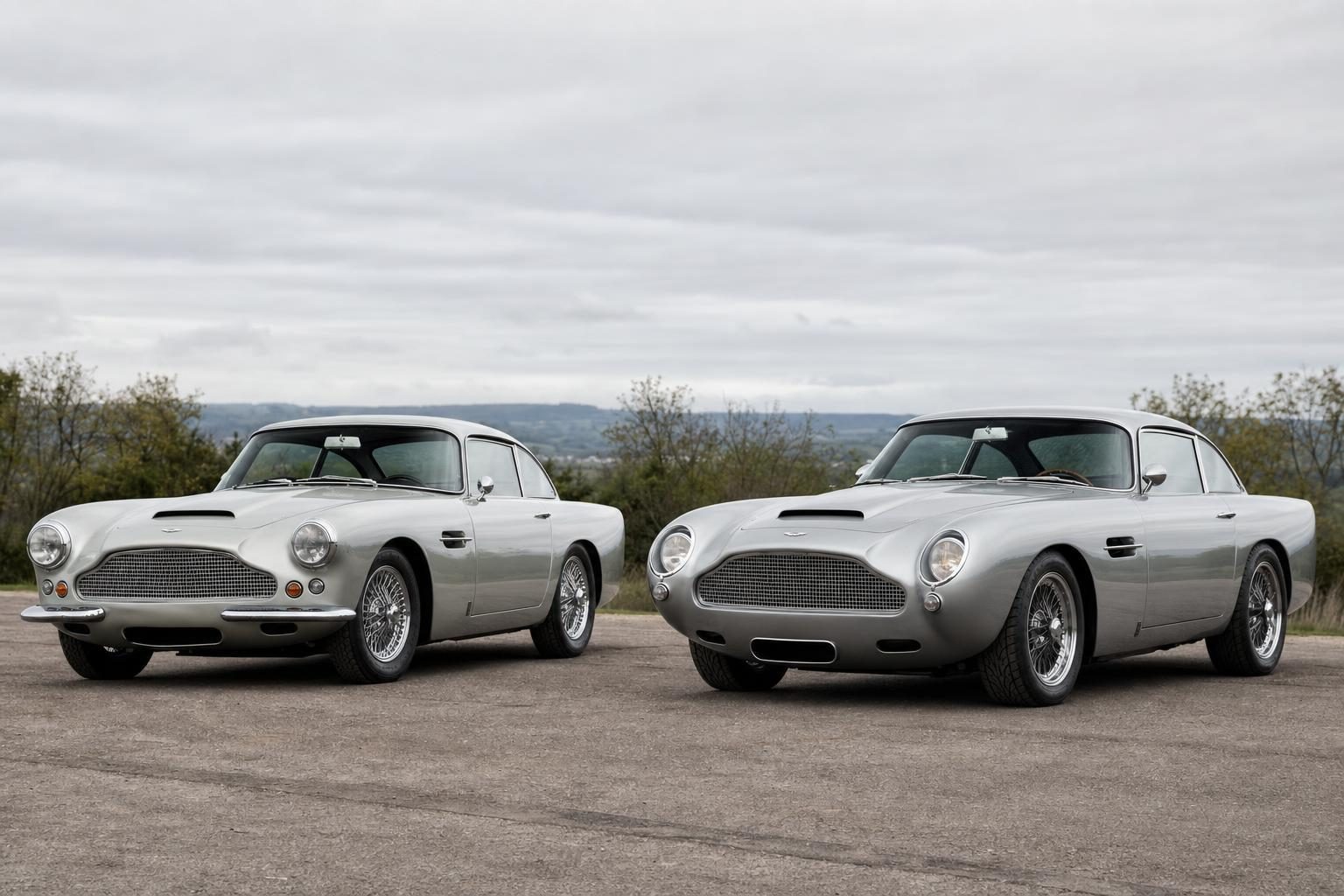
DB4 GT Continuation : 25 exemplaires à 1,5 M£, 4 500 heures, 340 ch et retour de production à Newport Pagnell. Comparée à l’originale 1959.
The DB4 GT Continuation marks, in 2017, Aston Martin Works’ confident return to Newport Pagnell with an unprecedented heritage programme. Announced in February 2017, this series of 25 new cars follows a logic of managed scarcity, with a unit price of £1.5 million and around 4,500 hours of build time per car. We revisit five key numbers, compare them with the 1959 original, and highlight what this project changes for Aston Martin’s heritage strategy.
Why 25 cars and not more: the logic of controlled rarity
The decision to build 25 is no whim. According to media.astonmartin.com, Aston Martin Works sized the run to preserve historical authenticity and the value of the original, while making possible a restoration of know-how. Unlike an open-ended production, the limited number ensures consistency with the spirit of the small runs of the period.
This restricted volume also protects owners of the 1959 icon. The original DB4 GT was produced in 75 units between 1959 and 1963, while the same source mentions 94 examples when including certain variants; the discrepancy, as explained by Aston Martin, stems from the accounting perimeter of special versions. By stopping at 25, the Continuation does not blur the hierarchy of rarities.
The positioning assumes a clientele of connoisseurs, more attracted by faithful execution and access to dedicated track events than by volume. The intent is clear: build a short “new” series respectful of 1959 without diluting the legend.
4,500 hours per car: what Newport Pagnell rebuilt from scratch
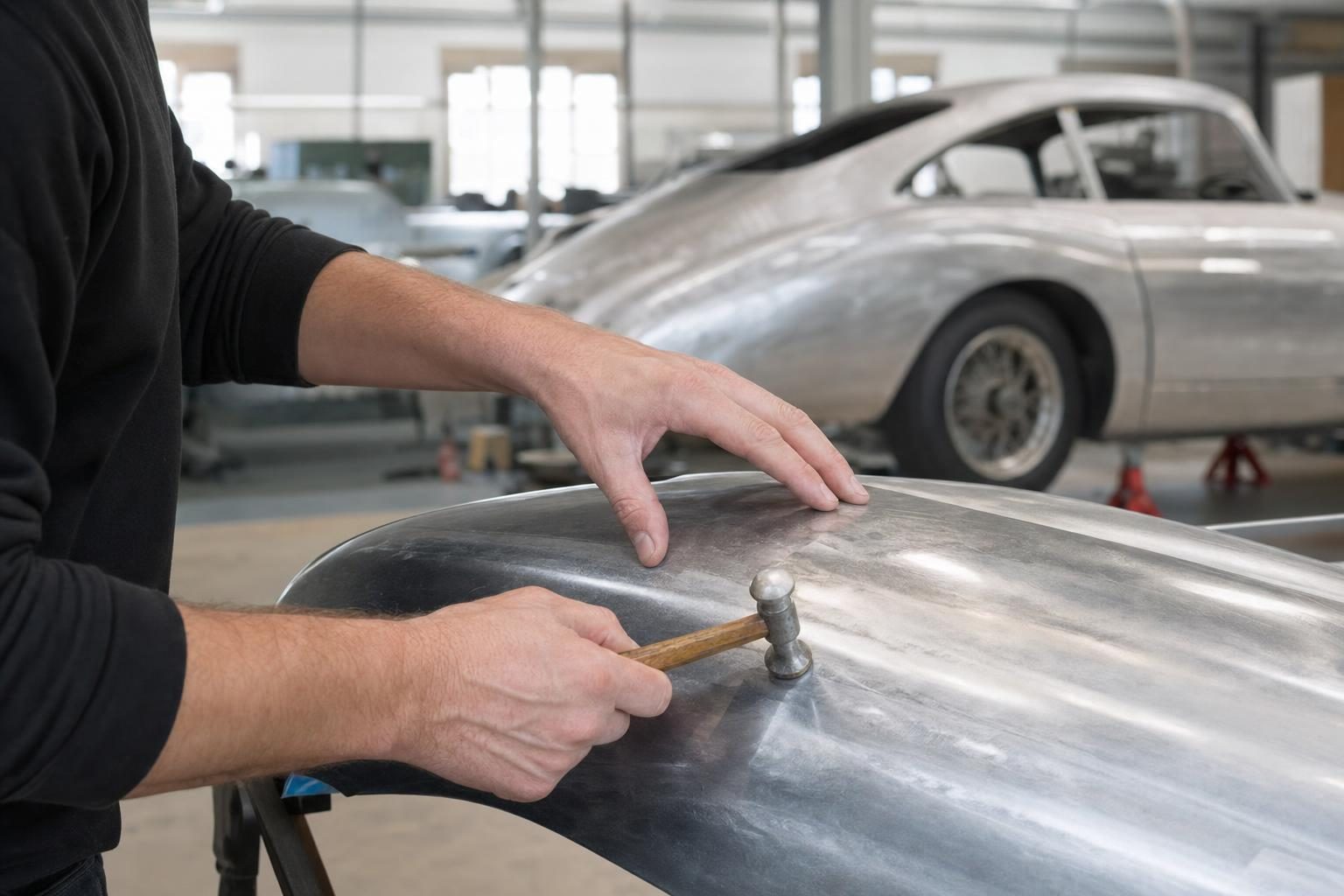
The figure may seem extravagant: around 4,500 hours of build time per example, attested by magazine.astonmartin.com. In reality, it measures a unique industrial and artisanal undertaking: redeploying at Newport Pagnell processes, jigs and skills that had disappeared from the line since the last Vanquish S left the site in 2007.
This return to production in the historic factory is anything but symbolic. It required reconstituting tooling and methods linked to the Superleggera chassis, fine panel beating and hand assembly. The 16-inch Borrani wheels are even remade by the original supplier to the 1959 specification, a detail reported by the same source. This fidelity of execution explains the time invested, and thus the price.
Newport Pagnell is also a house culture. Reviving a short-wheelbase competition coupé within its walls means reactivating transmitted skills, not just job descriptions. The programme thus becomes a tool for the living preservation of the brand’s industrial heritage.
The Tadek Marek engine revisited: 340 PS instead of 302 PS, the differences explained
Aston Martin Works documents a carefully managed evolution of the straight-six designed by Tadek Marek. The 1959 DB4 GT claimed around 302 PS, while the Continuation reaches 340 PS according to media.astonmartin.com. The goal is not gratuitous inflation, but optimisation based on contemporary tolerances and materials, without denaturing the mechanical architecture.
The gain results from slight internal updates and meticulous assembly made possible by today’s processes. The philosophy remains that of a long-stroke, expressive engine, fuller and more reliable than in period without betraying its sound or character. The block remains a landmark of classic engineering, tuned today with greater consistency than in 1959.
For the record, the original DB4 GT already stood out with a chassis shortened by 127 mm compared with the standard DB4 and a body lightened by around 85 kg according to Wikipedia and media.astonmartin.com. The Continuation’s extra 38 PS fits this logic of a civilised track car.
Values and market: where the Continuations sit today versus the 1959 originals
The available facts structure the comparison without imposing a public price grid. We know each Continuation was invoiced at £1.5m and that only 25 exist. Opposite them, the 75 to 94 period DB4 GTs, depending on the scope considered, form a historic and emotional pinnacle, intimately tied to late-1950s and early-1960s competition.
The hierarchy that emerges is less a battle of numbers than a distinction of use and aura. The 1959 originals embody history and set the benchmark. The Continuations, meanwhile, offer a near-identical driving experience, with new-build production, Borranis remade to 1959 spec and assembly measured in thousands of hours. Their controlled rarity and manufacture in the historic factory make them heritage pieces in their own right.
For a collector, the choice rests on three axes: period authenticity, precision of reconstruction and suitability for use (private track time, dedicated events). The official data published by Aston Martin Works and magazine.astonmartin.com allow these trade-offs to be framed without speculating beyond the facts.
The legacy of the approach: from the DB4 GT to the 2019 Zagato Continuations
This 2017 series is presented by Aston Martin as a modern first at Newport Pagnell since 2007. It serves as a testbed for a fully-fledged heritage strategy: rebuild icons, in short runs, with period processes, in the right place. This direction paved the way for other projects, including the Continuation cars inspired by Zagato launched in 2019, following the same logic of fidelity and rarity.
The trajectory is significant for the brand’s image: beyond the contemporary range, Aston Martin maintains a living, transmissible memory. The precision of 4,500 hours, adherence to specifications such as the Borrani wheels and the anchoring of Newport Pagnell position the company in a niche that few manufacturers master with this degree of rigour.
To locate the reference models, our dossier on the roadgoing DB4 sheds light on the technical and stylistic context of 1958: history and specifications of the DB4. And to extend the coachbuilder angle, see our focus on the DB4 GT Zagato, which fed the imagination behind the post-2017 continuations.
Conclusion — what the DB4 GT Continuation really changes
The DB4 GT Continuation is not an opportunistic reissue: it is a manifesto. 25 cars, £1.5m, 4,500 hours and 340 PS form a precise score that puts Newport Pagnell back at the centre of the Aston Martin story. By embracing rarity, the reconquest of skills and respect for the 1959 original (75 units, or 94 depending on scope), the brand has laid the foundations of an active heritage policy.
For anyone considering a historic DB4 or its reconstructed descendant, the reading grid rests on three lines: authenticity, execution, use. On these axes, the DB4 GT Continuation offers a singular equation, faithful in spirit, exacting in form. Above all, it proved that Newport Pagnell could once again build new Aston Martins, and that the original culture remains a strategic asset.
Also worth consulting for manufacturer context: the official Aston Martin site and the Wikipedia entry dedicated to the DB4. Finally, for the factory’s behind-the-scenes, our tour of Newport Pagnell and its five secrets usefully completes this panorama.