grand tourer, wind tunnel testing, Kammback, wheelbase, Superleggera and Vantage: discover why the DB6 surpasses the DB5, without folklore.
In the world of grand touring, the 1965 DB6 is often reduced to a stretched DB5. Convenient, but wrong. Born from a wind tunnel test programme and precise industrial trade-offs, it corrects high-speed instability, gains interior space and reduces manufacturing costs. Here, in detail, is why this grand tourer marks a real break, not just a cosmetic evolution.
The February 1965 wind tunnel: why the DB5 lifted its rear wheel at high speed
The revelation begins in February 1965, when wind tunnel tests laid bare the DB5’s Achilles’ heel: clear lift on the rear axle. According to Wikipedia (Aston Martin DB6), this tendency explains the slight lightness felt at very high speed, that moment when the driver senses the car “floating” rather than biting into the tarmac. For a grand tourer meant to devour long distances, this was no trivial finding.
The airflow was separating too early from the roof, creating a low-pressure zone at the rear and reducing load on the driven wheels. Put another way: the sleek beauty inherited from the DB5 created an imperfect aerodynamic compromise. The engineers therefore tackled the wake, not the power. A very British elegance: fix the invisible before inflating the numbers.
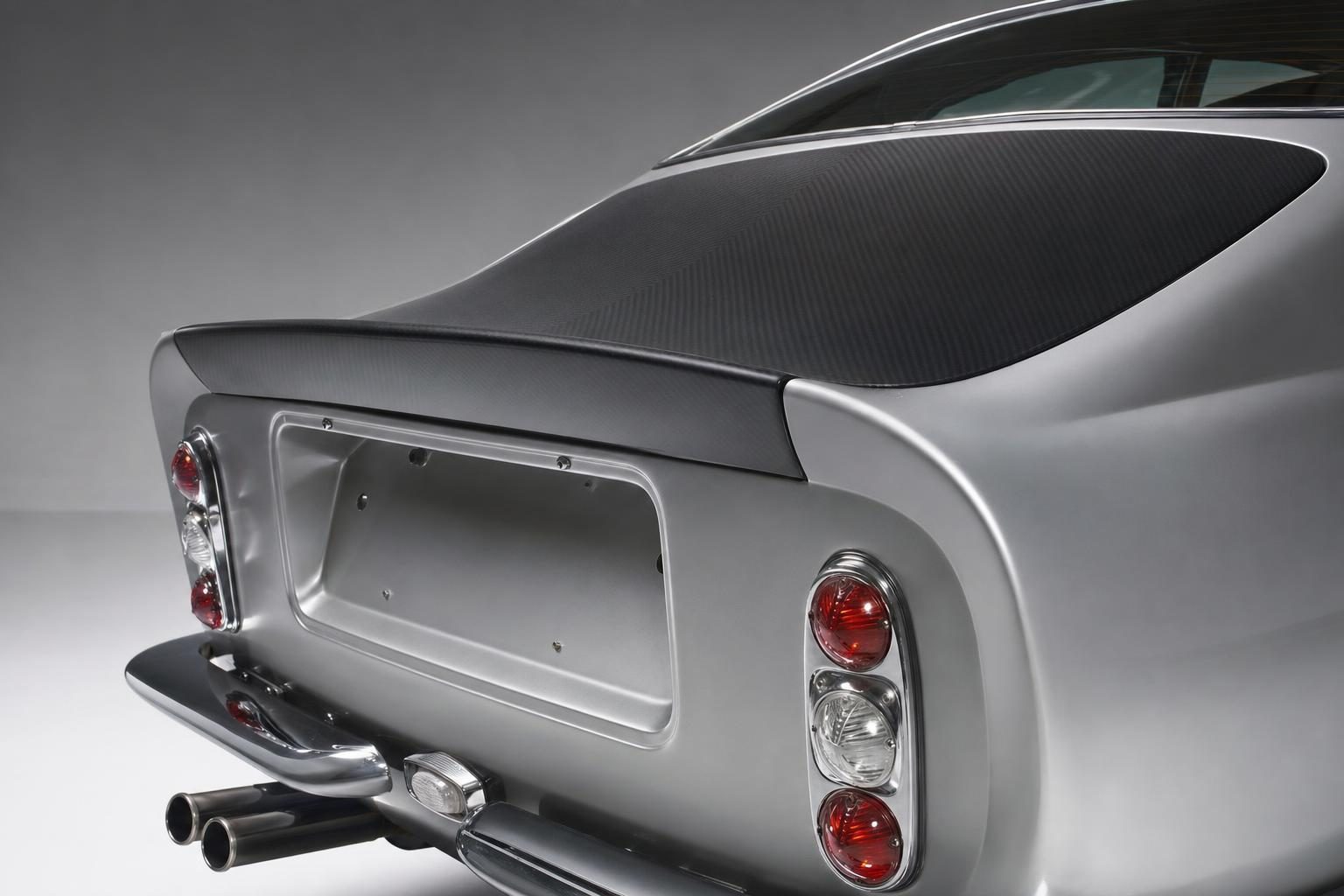
The diagnosis did not stop at theory. Scale-model runs confirmed that downforce could be restored by neatly reworking the tail. The future “spoiler” was not just another appendage: it stemmed from a rigorous reading of the pressure curves. And it is precisely this methodical seriousness that anchors the DB6 in grand touring culture, more than any flashy badge.
The Kammback spoiler and longer wheelbase: two answers to the same stability problem
First answer, a Kamm-style tail treatment. According to the Aston Martin pressroom, adopting a “Kammback” spoiler reduced rear lift by more than 30%. In driver’s terms, that means a tail that squats more at high speed, a rear end that remains readable, and a line that no longer widens by surprise. The aesthetics gain a signature, but the goal remains clear: channel the wake.
Second answer, the wheelbase extended by 95 mm. According to Carjager.com and Wikipedia, the DB6 is not only longer but also slightly taller than the DB5. The wheelbase grows, the stance becomes calmer, yaw movements are better damped. For a grand tourer, the sum of these micro-gains turns fatigue into serenity: you drive longer, faster, with less effort.
This “Kammback + wheelbase” duo follows the same logic: stabilise the airflow and the chassis simultaneously. The DB6 does not chase dramatic downforce; it aims for balance. The car becomes more predictable in fast corners and less sensitive to load variations. And, a detail that isn’t one, access to the rear seats improves, making this grand tourer a more versatile companion.
The end of the patented Superleggera: what Touring of Milan could no longer supply
The DB6 was still born under the tutelary shadow of Touring of Milan and its Superleggera patent, which earned Aston Martin a £5 royalty per car. Technically, construction by tubular lattice clothed in aluminium continued, but the industrial reality changed tack: Touring ceased operations in 1967, and the badges disappeared during the production run (Wikipedia). Here the grand tourer collided with a prosaic question: who builds it, and at what cost?
This withdrawal forced Newport Pagnell to rationalise. Without denying the light philosophy, the marque refined its processes to gain in throughput and repairability, with more steel and steel/aluminium depending on the area. The result was a body a little less “Milanese goldsmith” and a little more “mastered in-house”. Less spectacular, certainly, but consistent with the ambition of a grand tourer produced over a longer period and in a cost-controlled context.
We can thus better understand why the DB6 is not just a reworked design. It embodies a transitional industrial strategy, respecting the Superleggera spirit while partially moving beyond it. For the buyer, the promise shifts subtly: the artisan charm remains, but with simpler maintenance and more secure parts availability. Discreet virtues, foundational for a grand tourer used daily.
The Tadek Marek engine retained: 282 PS standard, 325 PS Vantage and carburettor choice
What’s the point of revisiting the wind tunnel if you denature the heart? The inline-six designed by Tadek Marek was retained, with 282 PS at 5,500 rpm in standard tune according to Wikipedia. Carjager.com cites 285 PS, likely a rounding difference. The Vantage version received triple Weber 45DCOE carburettors and climbed to 325 PS, a figure corroborated by Wikipedia and Nicholas Mee. For a grand tourer, the message is clear: refine the chassis and aero, keep the mechanical nobility.
The choice of carburettors speaks to the era and the intent. The SUs on the standard version favour progressiveness and civility — that urge on a feather of throttle, suppleness in town. The Webers on the Vantage demand finer touch, but deliver a fuller response at high revs. Driving pleasure is no abstraction: it colours the coupé’s character, between polished gran turismo and a sharper temperament.
This mechanical continuity serves the project’s coherence. By preserving the matte timbre and fullness of the Marek, the DB6 embraces the DNA of the British grand tourer: going fast for long stretches, in a more relaxed driving position than a circuit brute. The aerodynamic downforce gained is not squandered on showy power; it is converted into useful stability, in service of the journey.
DB6 Shooting Brake and 140 Volantes: the body styles few collectors know
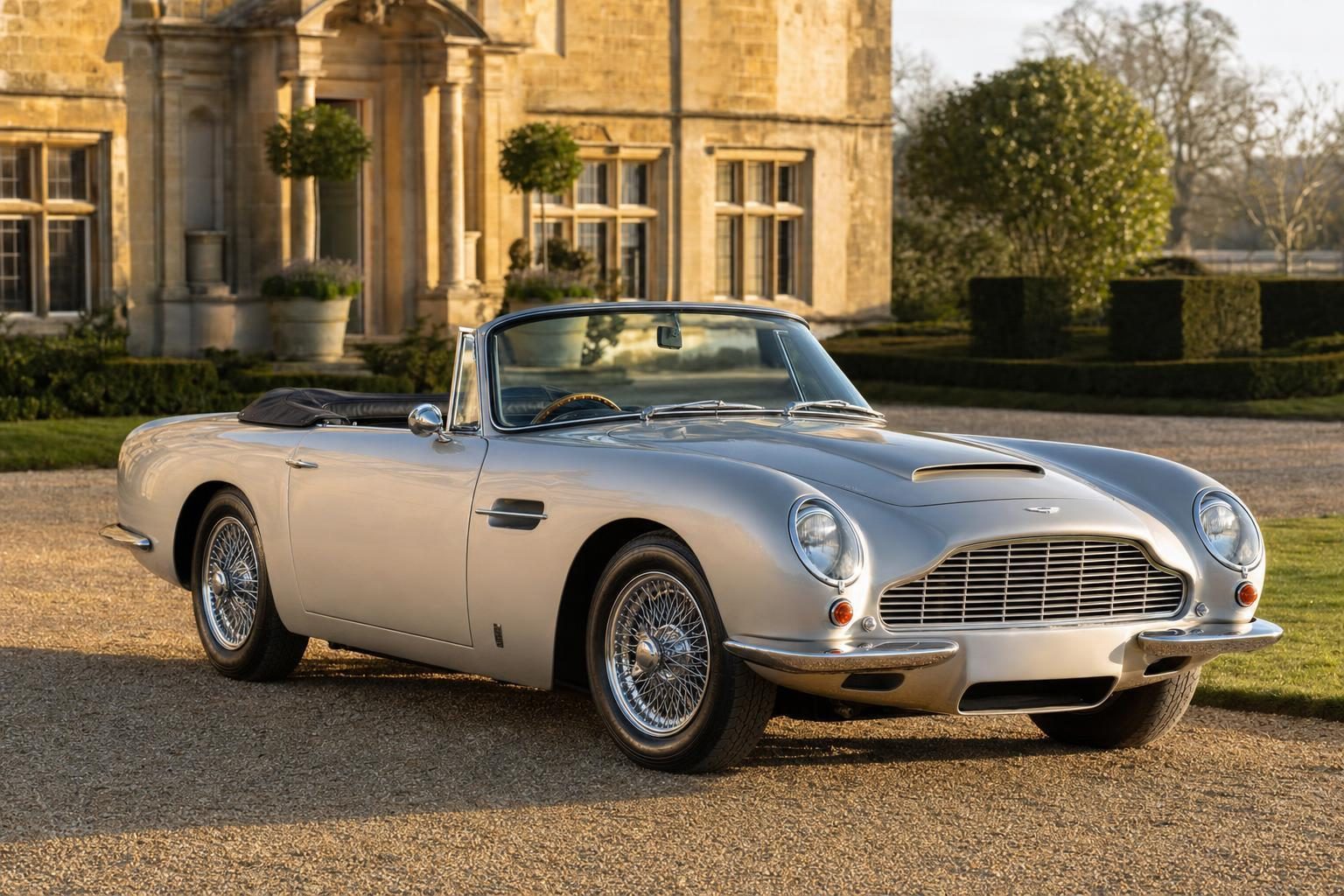
The DB6 was offered in forms whose rarity suits connoisseurs. According to Wikipedia, there are only 6 Shooting Brakes by Harold Radford and 2 by FLM Panelcraft. As for the DB6 Volante, only 140 examples were produced, 29 of which were Vantage Volantes. These figures give a sense of a grand tourer also conceived for singular uses: carrying dogs and luggage in a chic estate, or savouring the open sky without forgoing mechanical refinement.
Posterity has given the Volante a royal showcase: Charles III owns a DB6 Volante MkII converted to E85 (Wikipedia). Famous owners include Paul McCartney, Mick Jagger, Peter Sellers and Twiggy, as the official Aston Martin site recalls. Names that explain nothing to the wind tunnel, but say a lot about the aura of a grand tourer turned cultural icon.
To place these variants within the lineage, it is worth consulting the DB6 page at Aston Martin, Wikipedia’s detailed entry, and the marque’s pressroom for the aerodynamic aspects. These resources usefully extend the technical and historical analysis, beyond the myths that cling to this grand tourer.
Conclusion — the DB6 grand tourer, a full-fledged engineering programme
The DB6 is not a facelifted DB5; it is a grand tourer redrawn by the wind tunnel, stabilised by a Kammback and a longer wheelbase, and rationalised by post-Superleggera evolution. By retaining the Tadek Marek straight-six (282 PS standard, 325 PS Vantage), Aston Martin chose harmony over one‑upmanship. The result: a car that is more stable, more habitable and more coherent to produce, faithful to the ideal of the British grand tourer.
To read more: our feature on the Aston Martin DB6 in detail, the DB5 and its specificities, and the roots of the straight-six with the DB Mark III. For sources, see the historical Wikipedia overview of the DB6, the Aston Martin pressroom devoted to the DB6 for aerodynamics, and the official DB6 page in past models for iconography and range notes. Thus, without folklore, we illuminate this grand tourer whose technical precision shaped the legend.