V8 Vantage, VH partagée avec DB9, V8 Jaguar et poids: trois choix discrets qui ont façonné le succès de 2005. Conception, chiffres et contexte.
V8 Vantage, or how an entry-level sports car from Gaydon built its success on three design decisions that official communications kept in the background for longer than expected. Shared VH platform with the DB9, Jaguar–Ford-origin V8 and a pragmatic approach to mass: this trio, too often summed up hastily, nevertheless explains the car’s relevance in 2005 and its trajectory right to the end of its career.
The VH platform: DB9 architecture in a compact sports car body
Behind the tight proportions, Gaydon’s compact sits on the VH (Vertical-Horizontal) platform introduced two years earlier with the DB9. According to Wikipedia EN, the 2005 V8 Vantage adopts its extruded and bonded aluminium architecture, a guarantee of more efficient industrialisation and controlled rigidity for a model intended to open the range. In other words: same framework, different dynamic promise.
This sharing was no accident. It reflected a nascent Aston Martin strategy in the mid-2000s: reduce fixed costs, speed up cycles and secure quality by capitalising on a common base. A modular logic that allowed wheelbases, tracks and mechanical mountings to be calibrated for a shorter, more agile model without starting from a blank sheet. VH gave the latitude to design a dense, muscular coupé while keeping tooling rational.
From a product standpoint, the benefit is twofold: perceived homogeneity with the DB9 in terms of assembly and soundproofing, and dynamic tuning appropriate to the sports car’s size. The technical kinship does not detract from its personality; it does, however, explain the V8 Vantage’s surprising maturity from launch. For a detailed overview of the model in our database, see the V8 Vantage 2005 profile.
The Jaguar AJ-V8 4.3-litre engine: a deliberate choice or a budget compromise?
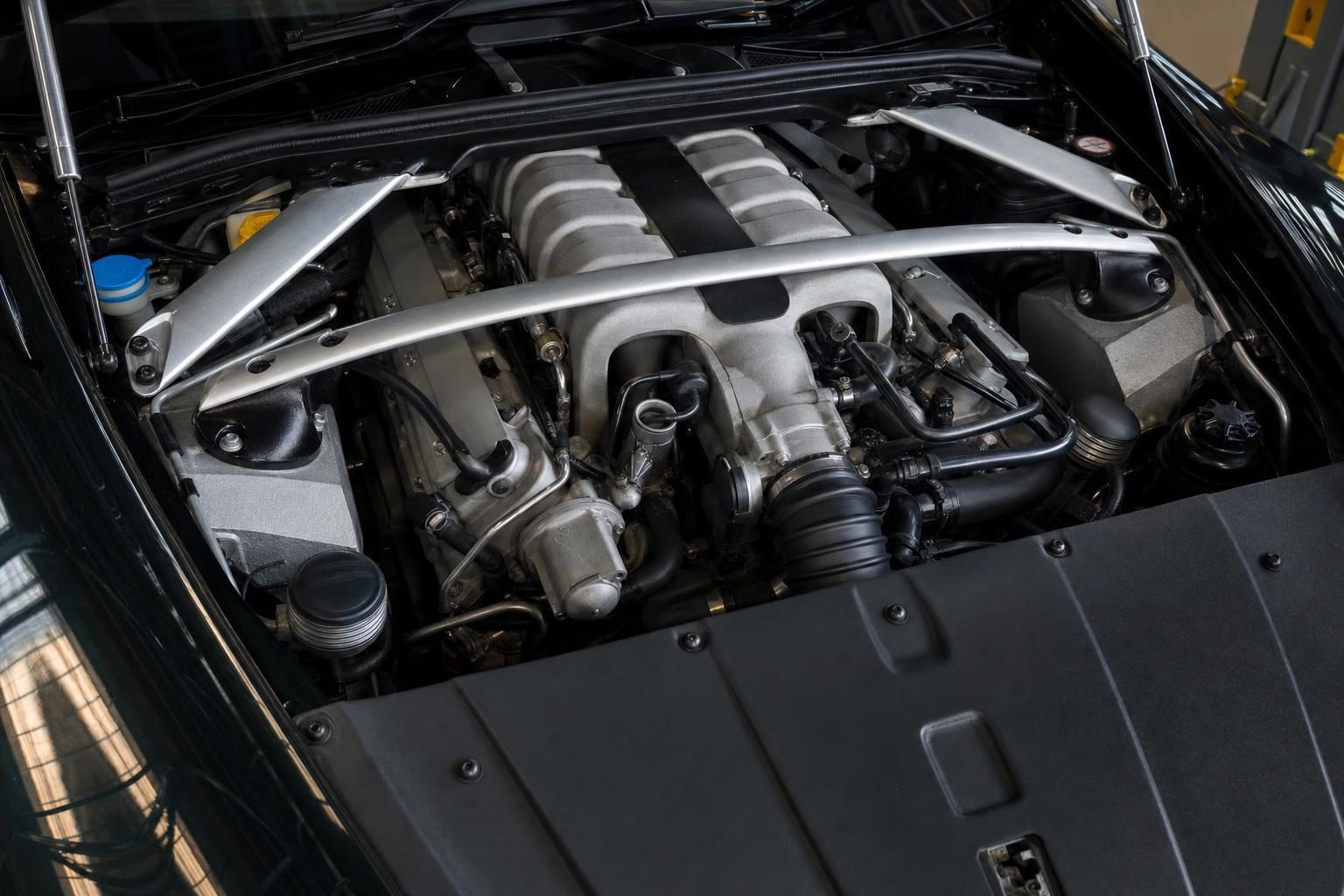
Under the bonnet is the 4.3-litre AJ‑V8 developed in partnership by Ford/Jaguar. According to Aston Martin Media, it delivers 380 PS and 410 Nm in this application. That figure sits in the official register; it mainly underscores that Gaydon’s engineering favoured a robust, well-proven base to reach reliability and performance levels suited to the segment more quickly.
The “deliberate choice or compromise” debate is an old one. In reality, Aston’s adaptation was comprehensive: mapping, intake, exhaust and chassis integration gave this V8 its very “in-house” sound and response, while the shared supply chain reduced industrial risk. Note that the Roadster version, launched in 2006 with the same mechanical package according to Aston Martin Media, confirms this commitment to continuity.
This base also enabled incremental evolutions. In 2008, the limited-run N400 peaked at 400 PS, notes Wikipedia EN. A sign that the technical DNA chosen in 2005 offered headroom without overhauling the architecture or denaturing the driving experience.
Henrik Fisker’s design: the silhouette that revived the entry level
Sketched by Henrik Fisker, then Aston Martin’s design director, the bodywork marked an aesthetic turning point. According to Wikipedia EN, we owe to him this near-classically balanced silhouette: taut wings, long bonnet, racy tail. A language that echoes the marque’s icons without pastiche, visually anchoring the V8 Vantage as the desirable “baby Aston”, not a scaled-down DB9.
The point is all the stronger as it coincided with a strategic return to a V8 at the entry level. The historical pages of Aston Martin recall that it was the first since the DB7 to offer an eight-cylinder at this level, reconnecting with a lineage inaugurated by the V8 Series of 1969. Fisker’s lines gave this ambition a clear face: compact, planted, yet subtle in its volumes.
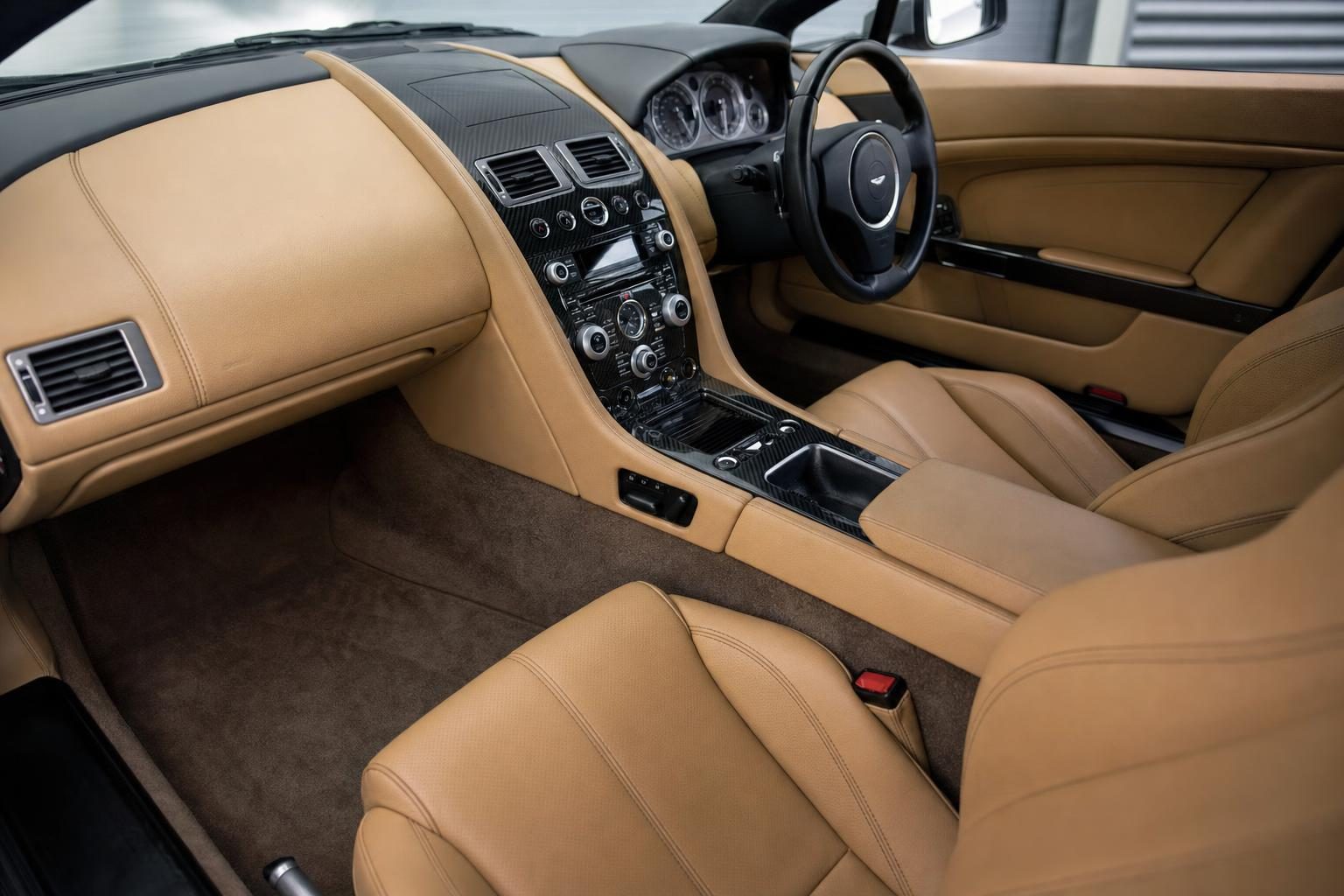
In use, the design served the positioning. It allows adequate cabin space, a decent boot and a neat hooding solution for the Roadster, while keeping the overhangs short. Proof that elegant styling can also be an industrial tool: fewer costly compromises, greater coherence between aesthetics and the VH platform.
Three production figures that challenge the model’s ‘exclusive’ image
Legend has it that every Aston is exceedingly rare. The reality, more nuanced, contributed to the V8 Vantage’s success. According to Wikipedia EN, around 17,500 units were produced between 2005 and 2017. The figure warrants nuance depending on the variants included, but the order of magnitude is clear: this is one of the most-produced models of Aston Martin’s modern era.
This relatively wide diffusion has positive effects. First on parts availability and workshop expertise, then on usability value: a network that knows the car, upgrade options, and an active community. The very opposite of a production run so confidential it becomes fragile day to day.
Finally, that volume validated Gaydon’s strategy: a VH base shared with the DB9 to control costs, a shared V8 to secure industrialisation, a strong design to unite. Three discreet levers, three tangible consequences. To place the technical kinship, see our DB9 file, and for the direct successor, the Vantage MkII that took over.
Conclusion — why the V8 Vantage has aged well
Beyond the heroic narratives, the V8 Vantage owes its success to a rational equation: shared VH platform, in-house adapted AJ‑V8, and pragmatic mass management in bodywork signed by Fisker. The facts cited by Wikipedia EN and Aston Martin Media outline a common-sense strategy, sometimes kept quiet at the time, but rewarding in the long run.
Time did the rest: a timeless style, controlled evolutions (up to the N400), and sufficient production to support everyday use without diluting the aura. In short, the V8 Vantage thrived not despite these choices, but because of them — a lesson many now reread in the light of an exemplary career.