DB7 Vantage, cinq anecdotes clés sur le V12 Ford-Cologne né chez Ford, sa plaque de technicien, la fin du 6 cylindres, le non-DB8 et un record inédit.
DB7 Vantage, five anecdotes, and a common thread: how a V12 derived from a 1996 Ford concept repositioned Aston Martin from 1999 onwards. Here is the genesis, the industrial choices and their consequences — often happy, sometimes abrupt — of an engine that left its mark on the Newport Pagnell firm.
The Ford-Cologne V12: from the 1996 Indigo concept car to the Newport Pagnell assembly line
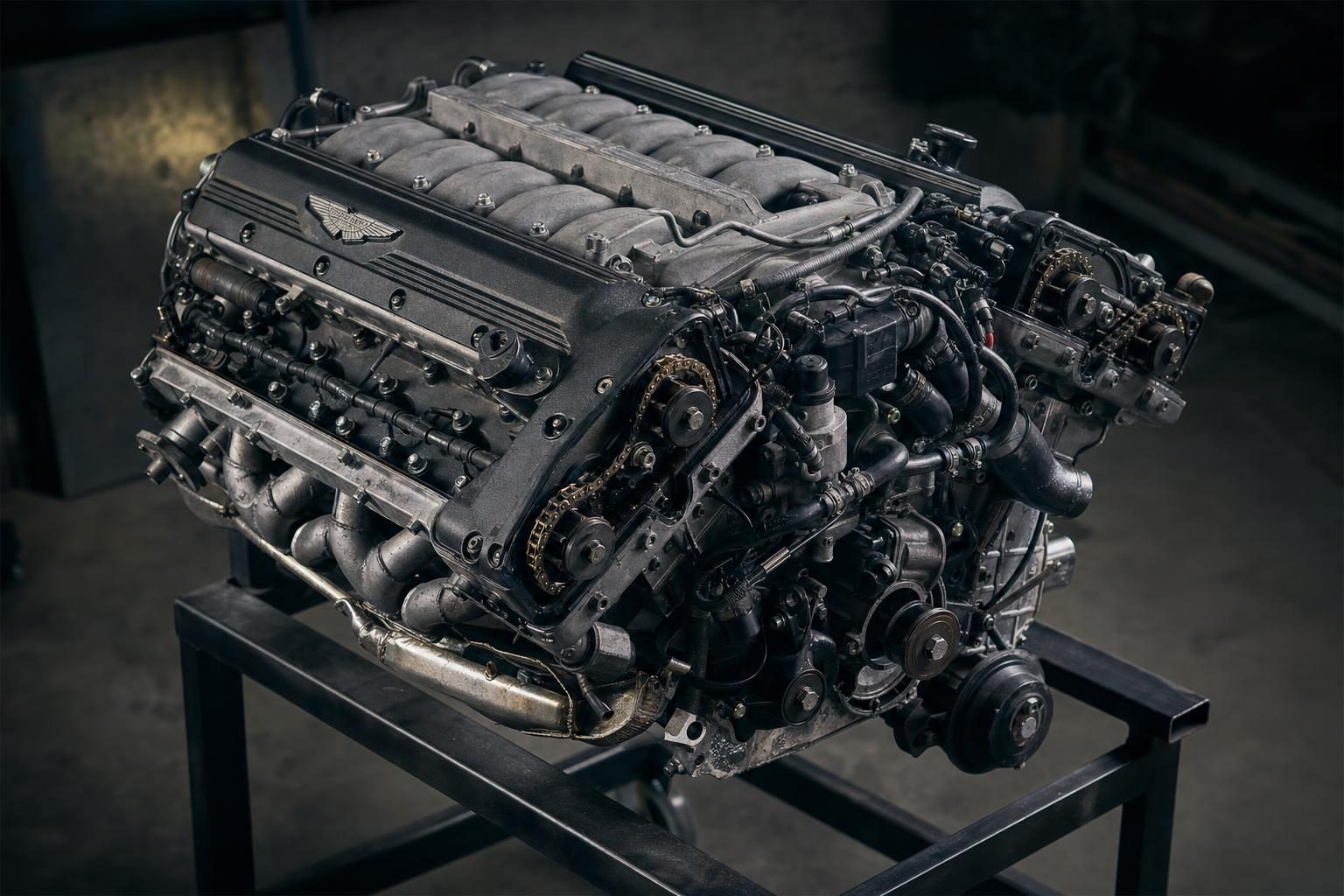
Before 1999, Aston Martin had never offered a series-production V12. The breakthrough came from an idea as pragmatic as it was effective: mate two Duratec V6 blocks to create a V12. According to the brand’s official magazine, Engines of Change, this approach took shape around the Ford Indigo concept unveiled in 1996, an open-air laboratory for a twelve-cylinder that Ford was then developing in Cologne.
This technical lineage, openly acknowledged, in no way diminishes the care Aston Martin took in integrating the powertrain into the DB7. At Newport Pagnell, the change was first cultural: switching from a supercharged straight-six to a naturally aspirated 5.9-litre V12 changed the car’s character, its mechanical mountings and its positioning. The car nevertheless retained its Jaguar-derived steel monocoque base, a peculiarity of this generation within a marque later more closely associated with aluminium (source: Wikipedia DB9).
The shift is also visible in the power curve. Again according to Aston Martin Magazine, the DB7 Vantage’s V12 delivers 420 PS, before being reworked for the Vanquish (460 PS), then the first DB9 (quoted at 450 PS). Published figures may vary slightly depending on the source, a divergence well known to enthusiasts and one the marque readily places within the continuous evolution of its V12.
Each engine assembled in Cologne, technician’s plaque engraved: a tradition few marques have maintained
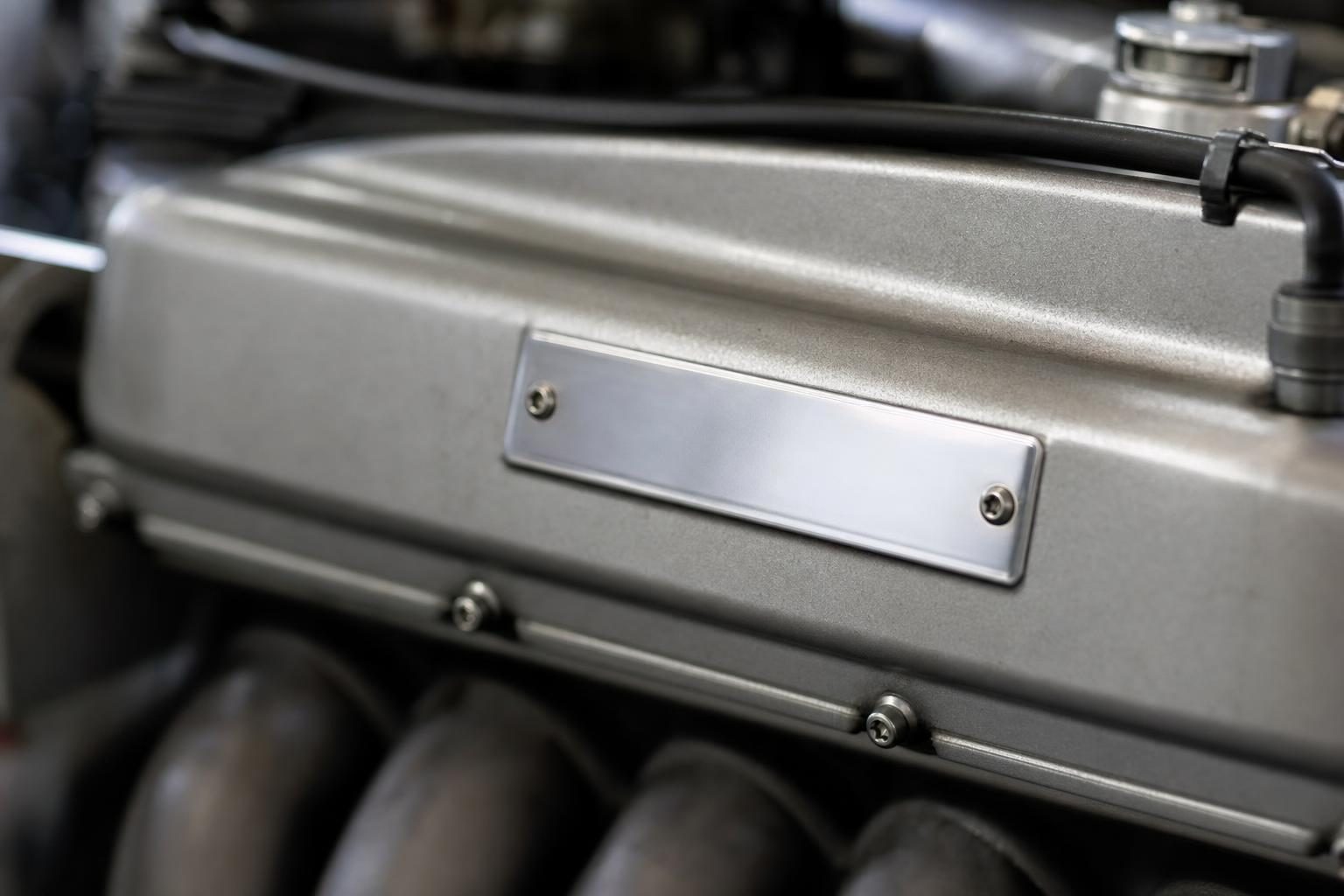
The DB7’s V12 was born in Cologne, in Ford’s workshops, not at Newport Pagnell. There, each engine was assembled by hand and carried a plaque engraved with the responsible technician’s name. Engines of Change details this rare and precious practice, which places the mechanics in a lineage of artisans rather than anonymous workshop hands.
This plaque, a simple rectangle of metal fixed to the cam cover, speaks volumes: an Anglo-German industrial partnership under Ford’s direction, attention to detail inherited from Aston Martin, and the wish to sign a mechanical heart in the manner of a watchmaker. A nod to customers, certainly, but also a method of traceability and pride in craftsmanship.
The fact that the car was then assembled at Newport Pagnell while receiving an engine fashioned in Cologne symbolises a watershed period for the marque. As volumes rose, the manufacturer embraced a broader supply chain without renouncing personalisation or final quality control.
The six-cylinder DB7 sacrificed by its own successor in 1999: how the DB7 Vantage cannibalised sales
The success of the V12 version was immediate. Wikipedia (DB9 entry) explains it clearly: the DB7 Vantage launched in 1999 proved so popular that it hastened the end of the six-cylinder variant… in the same year. A textbook case of internal cannibalisation, accepted on the grounds that customers were switching to the nobility of the twelve-cylinder and the accompanying pleasure.
In product terms, the V12 did more than replace an engine: it shifted the car’s perception. With comparable equipment, the Vantage’s usability, soundtrack, rev range and image ultimately made the entry-level version less desirable. For a GT that seeks status, the argument carried weight. And the marque’s strategy, at this precise moment, is understandable.
This evolution also fits into the longer history of the DB7, detailed at length in our dedicated feature. To reset the context of the model and its iterations, you can consult our overview of the DB7’s full career and its place in the range, as well as the DB7 models page on AstonLegacy.
Why the DB7’s successor wasn’t called DB8: a marketing decision with lasting consequences
After the DB7, logic would suggest “DB8”. The marque chose DB9 instead. The official reasoning, supported by Wikipedia and Aston Martin’s model page: avoid any confusion with a V8, while the new GT actually inherited the V12. A semantic precaution that would become a signature: the number doesn’t necessarily follow the expected sequence; it conveys the architecture and the ambitions.
This choice was not trivial. It anchored the idea that the V12 had become a pillar of Aston Martin’s upper range, and that the lineage with the DB7 was no longer played out solely in the silhouette, but in mechanical nobility. The future would confirm it: the V12 would continue to evolve, gaining in refinement and efficiency while retaining its kinship with the block developed in Cologne.
To gauge the industrial and commercial legacy of this succession, a cross-reading of the DB9 entry on Wikipedia (Aston Martin DB9) and Aston Martin’s official DB9 page offers a useful overview of the technical and image choices made in the early 2000s.
Around 7,000 DB7s: a production record that transformed Aston Martin, but not without trade-offs
Produced until 2004, the DB7 reached around 7,000 examples, notes Wikipedia (DB9). It was an absolute record for the marque at the time — a record that the DB9 would later surpass. For a house accustomed to more confidential volumes, the achievement marked an industrial and financial metamorphosis.
There was, however, a trade-off: for the last major Aston of this era with a Jaguar-derived steel structure, the ramp-up demanded a production discipline unfamiliar to Newport Pagnell. Again, relying on Cologne for the engine and final integration in England mapped out a hybrid model between craftsmanship and platform logic.
The DB7 Vantage embodies this turning point. The 420 PS V12 as presented by the marque’s magazine paved the way for subsequent iterations — Vanquish, then DB9 — with quoted outputs that fluctuate according to sources (460 PS for the former, 450 PS for the latter). Quibble if you like: figures sometimes differ from one document to another; take the broader view, and it’s the continuity of the V12 programme initiated in 1999 that stands out.
To dive into the next era, our page dedicated to the DB9 model and its evolutions sets the shift from steel to aluminium and the wider diffusion of the V12 across the range in perspective.
Conclusion — what the DB7 Vantage really changed
Beyond the anecdotes, the DB7 Vantage introduced to Aston Martin a V12 born in Cologne, validated by the 1996 Indigo and elevated at Newport Pagnell. It sealed the swift disappearance of the six-cylinder, established a new sonic and symbolic benchmark, imposed DB9 rather than DB8, and drove production to an unprecedented level for the marque.
We should also remember a method: an assumed industrial collaboration, an engine signed by its technician, and an architecture that would survive and flourish in the following decade. In short, the DB7 Vantage didn’t just add cylinders: it redefined Aston Martin’s scale.
- For the origins and evolution of the V12: the Engines of Change feature in Aston Martin Magazine.
- For the DB7–DB9 timeline and naming: the dedicated Wikipedia entry on the Aston Martin DB9 and the official Aston Martin DB9 page.