DB5 Continuation : fabrication à Newport Pagnell, gadgets validés par EON, statut non homologué et premières reventes discrètes décryptées.
DB5 Continuation, three words that rekindle a silhouette and a whole imagination. This article revisits the programme launched in 2018, its 25 examples assembled at Newport Pagnell, the integration of gadgets developed with the special effects team at EON Productions, and the question that irritates (or reassures) collectors: what is this model worth on the secondary market? We talk culture, workshop and method rather than nostalgia, to understand what this series says about Aston Martin today.
Newport Pagnell, 57 years on: why the original factory and not Gaydon for the Continuation cars
The choice of Newport Pagnell is no retro whim: it was here, on Tickford Street, that the original DB5s were produced between July 1963 and September 1965, roughly two years of manufacture. According to Aston Martin press materials and Nicholas Mee’s files, it is also here that the DB5 Continuation took shape, in a strictly limited number. Rooting the series in the historic factory safeguards the know-how, but above all the symbolic authenticity: it’s not reproducing the DB5, it’s reinterpreting it in the right place.
At Gaydon, the industrial tool is calibrated for contemporary platforms. At Newport Pagnell, the approach is artisanal, suited to 1963 drawings and manual adjustments. This context allows work with tolerances and processes close to the period, while integrating special elements that did not exist on the original line. The result is neither a restoration nor a mere replica: a new car built as yesterday, but delivered today.
For lovers of living history, this location weaves a direct link with the brand’s culture. It also converses with popular touchstones, from the “British Auto Legends” stamp issued by Royal Mail in 2013 to the James Bond story, without ever being reduced to them. To extend the technical and heritage context of the model, see our feature on the DNA and evolution of the DB5.
The EON Productions collaboration: which gadgets are present, which were dropped and why
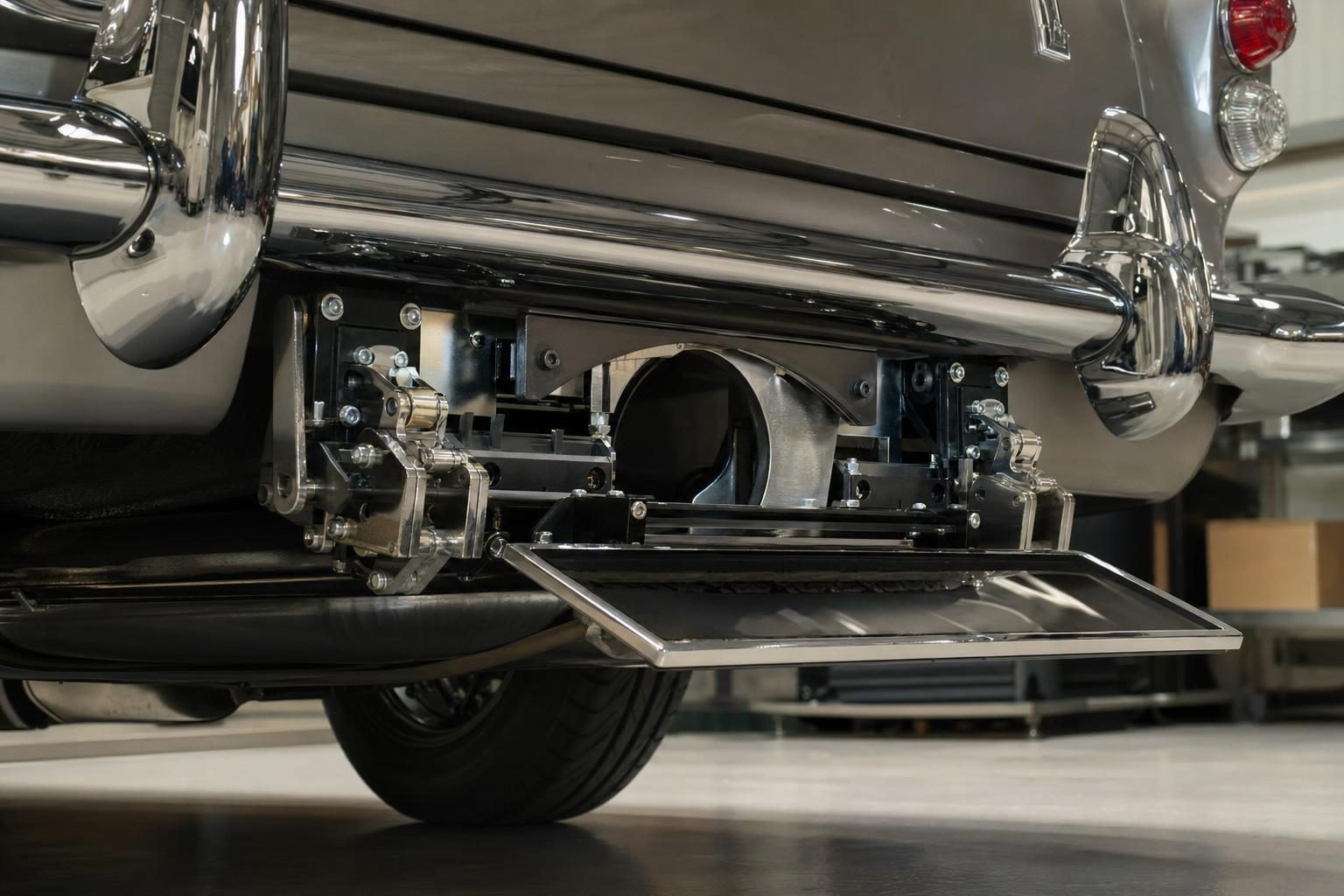
The brief is clear in the official communications: the gadgets were developed with the 007 franchise special effects team. According to Nicholas Mee, the kit includes external and internal devices inspired by the films, designed to create the illusion rather than tear up a runway. The idea is not to turn the sports car into a paramilitary machine, but to deliver an immersive, legal and safe experience in the EON spirit.
In practice, the spectacular modules remain simulated or rendered harmless. Elements deemed dangerous, illegal or incompatible with current standards were excluded — for obvious safety and liability reasons. The perceived realism comes from the quality of integration: dedicated controls, visual and mechanical staging, all devised by cinema illusion specialists.
This collaboration, embraced by Aston Martin, places the DB5 Continuation at the crossroads of two legitimacies: the Newport Pagnell workshop and the workshop… at EON. You don’t drive a set prop, but you do find effects validated by those who made them famous. For more on the intertwined history of the marque and agent 007: sixty years of Aston Martin with James Bond, and on the manufacturer’s side, the DB5-dedicated pressroom.
Not road-legal, not intended for the track: a unique legal status that raises practical questions
The DB5 Continuation cars are not road-homologated — a point repeated by specialist sheets and by Aston Martin. Nor are they born as turnkey track cars. This singular status defines their use: private events, demonstrations, static collections, or closed contexts where the legal and insurance framework is controlled. The angle is not lap-time performance, but the experience of a rolling cultural object.
For owners, the question becomes logistical and administrative: where, when and how to enjoy them? Answers involve organising private events, hiring circuits for controlled running, and suitable insurance conditions. It is a constraint, but also a clarification: the value of these examples lies more in the quality of execution and the aura produced by this dialogue between history and cinema than in versatility of use.
This framework avoids ambiguity: the DB5 Continuation claims a special place, neither a road-legal youngtimer nor a radical track-toy. A functional collector’s object, designed to be seen, heard and, at chosen moments, driven — within the rules.
25 examples delivered: what it means to build a new car from 1963 drawings
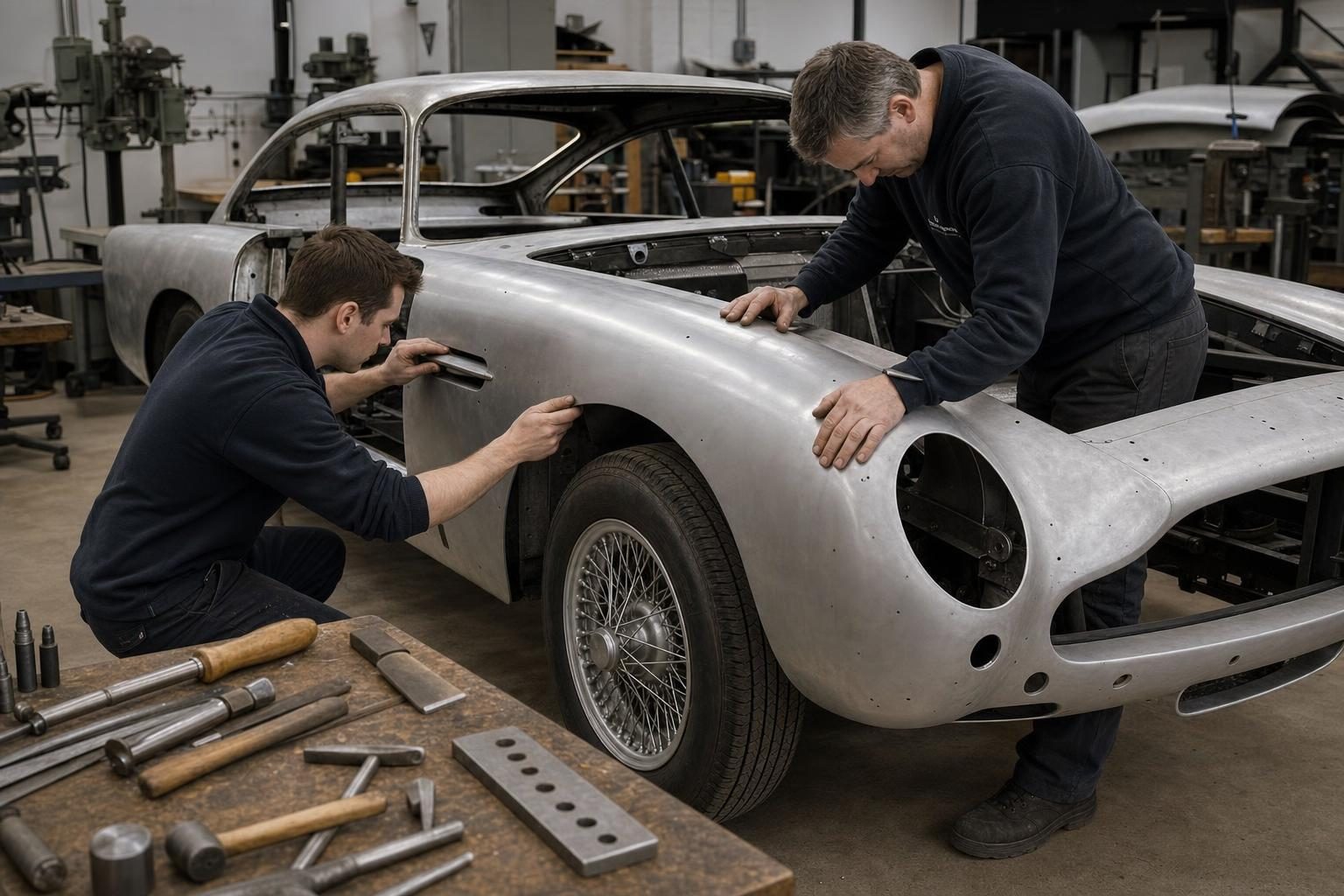
The 2018 announcement set the course: 25 units, assembled at Newport Pagnell. Building today from 1963 drawings requires painstaking reverse engineering and craftsmanship. According to Nicholas Mee, these are new cars that reprise the period architecture and dimensions, with adjustments related to contemporary gadgets. The assembly cycle demands skills that modern tools do not industrialise: fine panel work, fitting, trimming, traditional electrics.
This method reframes time. Where an industrial flow targets cadence, here each example absorbs a sum of hours that can be read in the panel gaps, the feel of materials and the overall coherence. The gesture matters as much as the spec sheet. That is precisely the raison d’être of Newport Pagnell: a workshop, not a factory.
This dialogue between past and present also clarifies the Continuation cars’ place in the market for exceptional objects. Neither “matching numbers” in the museum sense, nor a free-form replica, they claim a manufacturer lineage. To continue exploring the places and methods, our guided tour revisits five workshop secrets at Newport Pagnell.
Secondary market values: what the first discreet transactions reveal
Central question: how do these cars behave once they leave the workshop? Specialists cited by Nicholas Mee highlight a deliberate ambiguity. Original 1964–1965 DB5s in very good condition, with matching numbers, generally change hands well below the new price of a DB5 Continuation. In other words, the period icon retains, at a lower price, a measure of historical authenticity that the contemporary series does not aim to compete with.
The first discreet resale movements confirm a nuanced reality: the value rests on rarity (25 examples), the cultural appeal of EON-signed gadgets and the aura of the assembly site. It remains, however, dependent on a defined circle of buyers, more attuned to the “experience” object than to strict concours orthodoxy. In short, no implicit promise of appreciation — rather niche liquidity, consistent with the original intent.
To place this dynamic in the longer story, Aston Martin notes that the DB5 celebrates six decades as an icon — a continuity carried through to the personal involvement of Lawrence Stroll, owner of a DB5 and the brand’s Executive Chairman. For cultural and institutional context: the DB5 at 60 dossier and, encyclopaedically, the dedicated Aston Martin entry.
Conclusion — what the DB5 Continuation tells us about the era and the marque
Between the lines, the DB5 Continuation tells a method: anchor production at Newport Pagnell, partner with EON for credible special effects and embrace a non-homologated status, designed for experience rather than daily use. On the secondary market, early signals confirm a singular position, neither a substitute for an original DB5 nor a guaranteed speculative product.
The essential remains: this programme has recreated a conversation between a workshop, a 1963 icon and a popular myth. For those who know what they are buying, the DB5 Continuation is a living link — controlled, discreet and fully assumed — with the brand’s history and the 007 legend. An elegant way to honour the DB5 without freezing it, and a reminder, if one were needed, of why it remains one of the most recognisable cars in the world.