DBR1 : genèse technique, cinq châssis numérotés et trois victoires au Nürburgring, jusqu’au doublé du Mans 1959 et au titre mondial d’Aston Martin
DBR1, a racing prototype designed in 1956, is not only the Aston Martin that won Le Mans: it is a coherent engineering programme, sharpened by three consecutive Nürburgring victories and crowned in 1959 by the marque’s only world manufacturers’ title. Here, without triumphalism but with precision, is how this model was born of the new rules, how its five chassis lived, and why the Eifel was its proving ground.
1956: why the new World Championship rules forced Aston Martin to build a pure prototype
In 1956, the regulatory framework of the World Sports Car Championship evolved. According to Aston Martin’s official archives and their press room, these revised rules demanded a dedicated technical response. The Newport Pagnell firm therefore designed a true prototype, uncompromised for the road, conceived for the track and for the international season.
This decision gave birth to the DBR1. The model immediately stood as Aston Martin’s competition platform to take on world endurance. The ambition was clear: to meet the technical demands of the moment, optimise reliability, and allow headroom for engine and chassis development over time.
The strategy would pay off over the seasons. First honed at modest capacity in keeping with the spirit of the regulations, the racing roadster — a barchetta by definition — would become the weapon of a world title, but at the price of a maturation demanded by the most selective circuits, with the Nürburgring foremost.
Ted Cutting and the multi-tubular chassis: torsion bar, aluminium straight-six of 2.5 then 3 litres
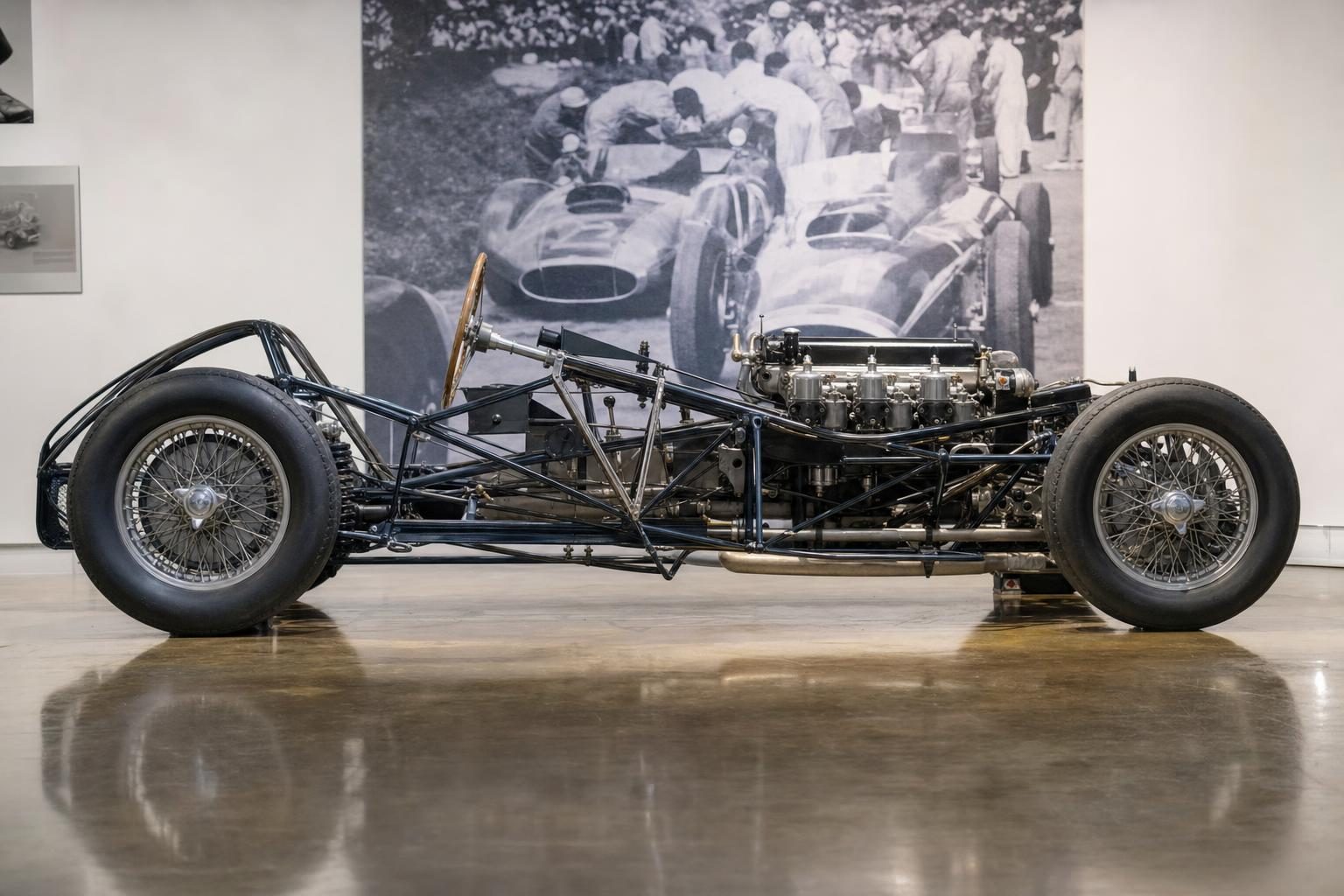
Chief designer Ted Cutting orchestrated the whole. From official documentation and specialist summaries, he adopted a light and rigid multi-tubular chassis, paired with torsion-bar suspension. This choice aimed for precise guidance and steady ride height over long stints, a decisive point on bumpy, sinuous tracks.
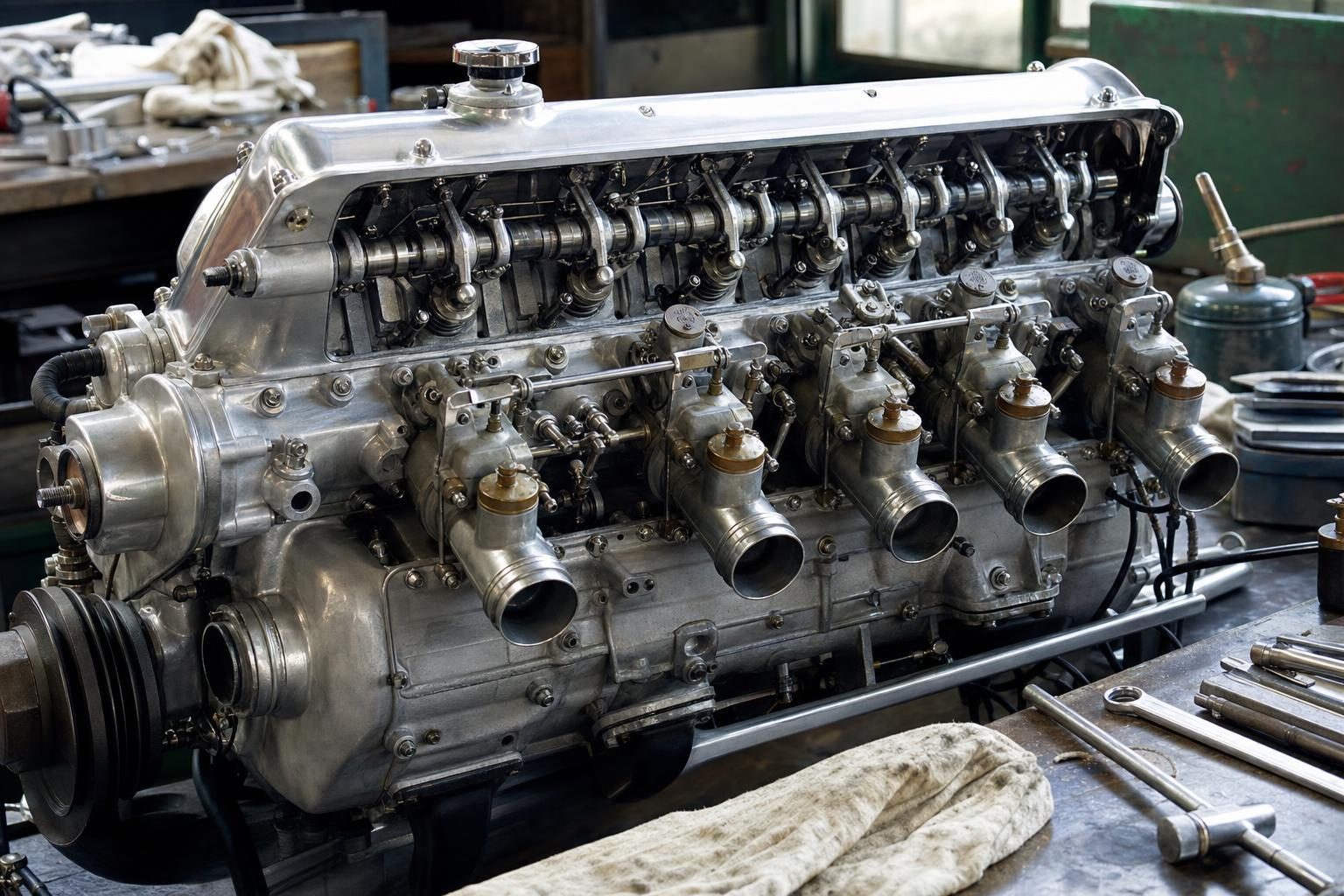
At the heart of the DBR1, an all-aluminium inline six-cylinder. Initially at 2.5 litres, it grew to 3 litres from 1958. The increase in displacement came with a holistic effort on mechanical endurance. The gain was not only in top speed: it was also about breathing better on the fast sections and picking up more cleanly out of corners.
Cutting’s equation had a distinctly British restraint: rigidity, lightness, and a powertrain simple to read yet subtly optimised. The facts bear it out. With this tubular chassis and this evolutive straight-six, the DBR1 asserted itself progressively, race after race, as a homogeneous and strategically adaptable prototype.
The 5 DBR1 chassis: four for the works, one for a privateer — individual stories and current destinations
Production was limited: exactly five examples, numbered DBR1/1 to DBR1/5, according to official sources and reference listings. Four were destined for the works team, a fifth for a privateer. This rarity shaped the model’s history and allows us to trace clearly distinct individual paths.
DBR1/2 is the car that would win the 1959 24 Hours of Le Mans, driven by Carroll Shelby and Roy Salvadori, with DBR1/1 alongside it on the podium for a one-two. At that 1959 Sarthe start, three works cars were fielded under the direction of John Wyer and Reg Parnell, which shows the scale of commitment and confidence placed in the programme.
DBR1/3 today has a museum life: it is displayed at the Simeone Foundation Automotive Museum in Philadelphia. It is one of the very rare public certainties as to the current exhibition site of a chassis, as recorded by specialist compilations. For DBR1/4 and DBR1/5, the literature mentions their existence and use, without delivering unequivocal detail on their present residences; above all, note that each chassis contributed, in racing or through its role as a mule and in development, to writing the overall effectiveness of the DBR1 programme.
These five numbers tell a measured industrial and sporting project. Few examples, maximal use, and a clear allocation logic between the works and a private client. This low volume also explains the historical value and the demand for traceability that still surround every identified DBR1 today.
The Nürburgring 1957, 1958, 1959: a treble that history too often reduces to Le Mans alone
The record speaks plainly: three consecutive victories at the Nürburgring, in 1957, 1958 and 1959. Aston Martin documents and reference summaries agree on this treble. Yet by looking too closely at Le Mans, we forget that the Eifel was the preferred test and validation ground for the chassis and the evolutive straight-six.
In 1957, the victory validated the Cutting formula at the car’s first maturity. In 1958, the move to 3 litres broadened the engine’s answer and reinforced versatility: same track, different tempo, and a success that endorsed the increase in capacity. In 1959, the DBR1 confirmed its full competitive strength, in the wake of methodical preparation.
The Nürburgring is an uncompromising judge. Long, technical, it rewards the rigidity of the multi-tubular chassis, the fine reading of load transfer and mechanical robustness. Winning three years in a row is anything but anecdotal: it shows that the platform works, whatever the constraints. It is this consistency that led to the summits of 1959, and which deserves to be reconsidered at its proper level, alongside the Sarthe.
1959, double crown: Le Mans and world title — how these two victories ended the works programme
In 1959, the DBR1 took a rare symbolic double: victory at the 24 Hours of Le Mans and the world manufacturers’ title — Aston Martin’s only one. The facts are established by the marque and specialist references: DBR1/2 won at Le Mans, DBR1/1 completed the triumph, and the campaign consecrated the constructor in the final standings.
These two peaks marked the technical and sporting culmination of the programme. After four seasons of development, the prototype had reached its point of balance: a mastered chassis, a 3-litre straight-six at full efficiency, a well-drilled team. In this light, it is no surprise that history records 1959 as the logical conclusion of the works-led DBR1 cycle, the model having fulfilled the maximum objective a constructor can set itself in endurance.
Beyond the trophy, the legacy is twofold. First, the effectiveness of steady, continuous development, validated at high intensity on the Nürburgring and consecrated at Le Mans. Second, the demonstration that a prototype conceived from the outset for modularity — as with the DBR1 and its move from 2.5 to 3 litres — can, with discipline, climb the world ladder without skipping steps.
To extend this reading, see our breakdown of the Sarthe one-two, focused on the drama and keys of the Le Mans night, in our analysis of the 1959 Le Mans victory. And to place this title in the timeline of the marque’s campaigns, see our feature on Aston Martin in competition and the World Championship, as well as a contemporary look with the page dedicated to the DBR9 in GT.