Lagonda Series 2 1976: William Towns’ wedge design, LCD dashboard, 645 built in 14 years — 4 decisions that split purists and fascinated the Middle East.
Lagonda Series 2, four gambles and the same underlying question: how far to push ambition when reliability must keep up? Unveiled at the end of 1976, this very particular luxury saloon dared the wedge profile, digital instrumentation with touch-sensitive controls and an electronic cockpit inspired by National Semiconductor, at the cost of a three-year wait before the first delivery. A fact-led look back at the design decisions that forged this model’s reputation — polarising, yet influential.
William Towns and the wedge design: where did this silhouette, so unlike an Aston Martin, come from?
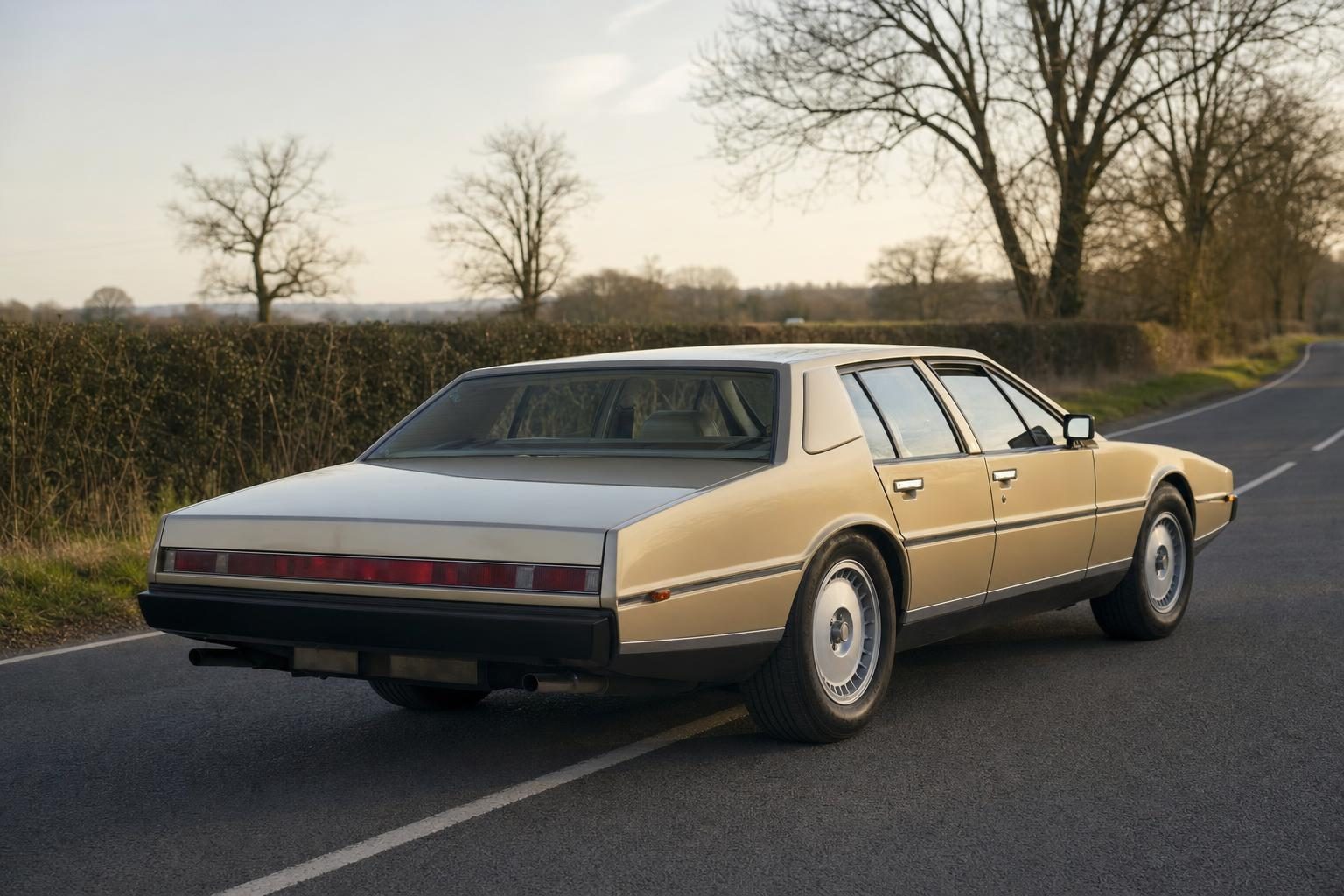
Signed by William Towns, the bodywork broke with the house style. A former Rootes then Rover designer who joined Aston Martin in 1966, he did not continue the tradition of smoothly sculpted coupés: he froze a sharpened wedge line, closer to the geometric school of the 1970s than to classic British curves. The aim was clear: to give the marque a technological and formal showcase with a very low, taut and theatrical saloon.
This wedge vocabulary did not come out of nowhere. Towns, who followed developments in industrial and automotive styling, sought coherence between the car’s long, low architecture and razor-cut surface treatment. The edges echoed the perceived precision of the on-board electronics that the marque was developing in parallel. According to Aston Martin’s historic releases, the intention was also to break decisively with the previous, more traditional Lagonda, sending a strong signal to the prestige saloon market.
This silhouette long divided opinion. But it placed Series 2 in another category: a manifesto. The spectacular line, combined with an unusual on-road presence for a luxury saloon, laid the groundwork for an even more disconcerting interior, where analogue ceded to digital.
Digital instrumentation and touch-sensitive controls: an engineer in a National Semiconductor lift
The second gamble was a creative short circuit. Mike Loasby, an Aston Martin engineer, discovered touch buttons in the lifts at National Semiconductor’s US facilities. This encounter, made possible by Peter Sprague — then Aston Martin’s leader and deeply involved at the semiconductor specialist — sparked the idea of a touch-controlled interface and digital instrumentation. The marque’s official information explicitly links this genesis to the National Semiconductor ecosystem.
The digital dashboard, a pioneer for a large European saloon, promised clarity and modernity. Touch-sensitive pads replaced physical switches, in a “cockpit” spirit. It was bold, at a time when the high-end car world still leaned heavily on analogue.
But the electronics of the era had limits. Digital displays and capacitive-contact systems required fine calibration, protection against interference and thermal robustness. Aston Martin’s ambition, as documented in its archives, was to bring the grand tourer into the semiconductor age. The real cost of that ambition would play out in the timeline and industrial choices.
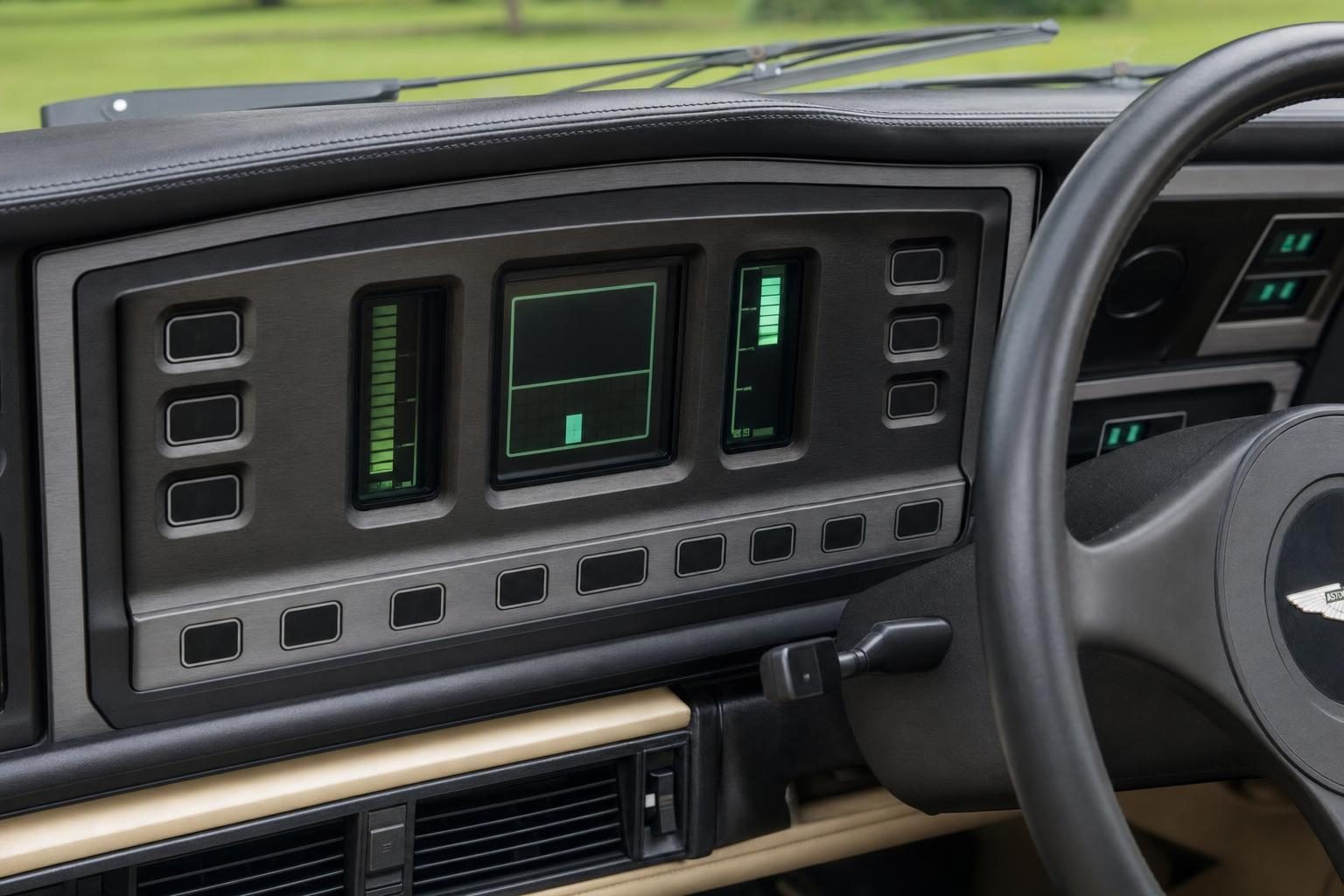
From Earls Court 1976 to first delivery in 1979: three years of electronic development
Presented in October 1976 at the Earls Court Motor Show in London, the Lagonda captivated with its looks and promised technology. Yet the first delivery would not occur until 1979. Aston Martin’s official sources put this delay in perspective: it represented substantial development time to make the electronic subsystems reliable and to align production with everyday-use standards.
Three years is a long time in a model’s life. But the marque preferred to refine the electronic chain and the integration of displays and controls rather than deliver an unfinished product. This period of maturation, commercially constraining, was the direct counterpart to the bets placed on the digital interface and control logic. A manifesto always demands more than a simple move to production.
This lag also framed public perception: the car was identified as a rolling laboratory. The influence of National Semiconductor, highlighted by the marque’s archives, cemented the idea that the automobile could draw from the semiconductor world — provided one accepted the complexity and slow pace of industrialisation.
The 5.3‑litre V8 from the AMV8: the sole survivor of old-school mechanics in a futuristic cockpit
Amid this interior revolution, the engine was a fixed point. Series 2 retained the 5.3‑litre, twin overhead camshaft V8 derived from the AMV8. According to data compiled by Wikipedia, its version claims 280 hp at 5,000 rpm for Series 2. A choice of mechanical continuity that likely helped steady the project while electronics reinvented the on-board experience.
The contrast was deliberate: a known, powerful thermal heart surrounded by a futuristic driving position. This duality allowed the saloon to deliver grand touring performance while experimenting with an interface from another age. For those seeking a more “classic” Aston in its fundamentals, the V8 remained a useful anchor.
This direct link to the AMV8 clarifies the strategy: capitalise on a proven powertrain to focus innovation where the marque wanted to make a statement — the cabin. Enthusiasts may wish to revisit the AMV8 specifications in our dedicated feature on the AMV8 V8 and its evolutions.
645 built over 14 years, Middle East market dominant: what the order map reveals
Production numbers set the scene. Official sources summarise 645 chassis across all series up to the end of 1989. In that period, Series 3 — one year and 75 examples — introduced fuel injection, then Series 4, redesigned by William Towns in 1987, softened the angles and dropped the pop-up headlamps. This trajectory shows a continual update of the initial formula.
As for sales distribution by market, the documents used here do not detail the “order map”. They do not state a regional dominance. However, the 1980 price position — £49,933 according to Wikipedia, above a Ferrari 400 or Maserati Kyalami but below a Rolls-Royce Corniche — clarifies the target: a circle of wealthy clients receptive to technical originality and status.
In other words, rarity was no accident: it flowed from a particular cost/complexity/customer-expectation equation. To deepen the context and the series timeline, see the official past models page Aston Martin Lagonda and the technical overview on Wikipedia for the Aston Martin Lagonda, which summarise these milestones.
Conclusion — what the Lagonda Series 2 says about Aston Martin’s tech gamble
The Lagonda Series 2 embodied four simultaneous bets: a wedge design by William Towns, digital instrumentation with touch-sensitive controls, direct inspiration from National Semiconductor and a launch delayed by three years. The facts show unapologetic ambition, paid for up front through industrial complexity and measured cadence.
By combining a 5.3‑litre V8 inherited from the AMV8 with a forward-looking cabin, the Lagonda Series 2 traced a ridgeline: retain a proven core to dare elsewhere. In doing so, it opened a demanding path where innovation is not a promise but sustained work. To set this chapter within the model’s full history, our feature history, design and engineering of the 1976 Lagonda provides the panorama.
To continue exploring, the official archives of the October 1976 presentation are available via Aston Martin’s historical release, while our guide Lagonda 1976: versions and series summarises the key evolutions through 1989. In short, the Lagonda Series 2 remains the best answer to its own question: ambition has a price, but it leaves a mark.