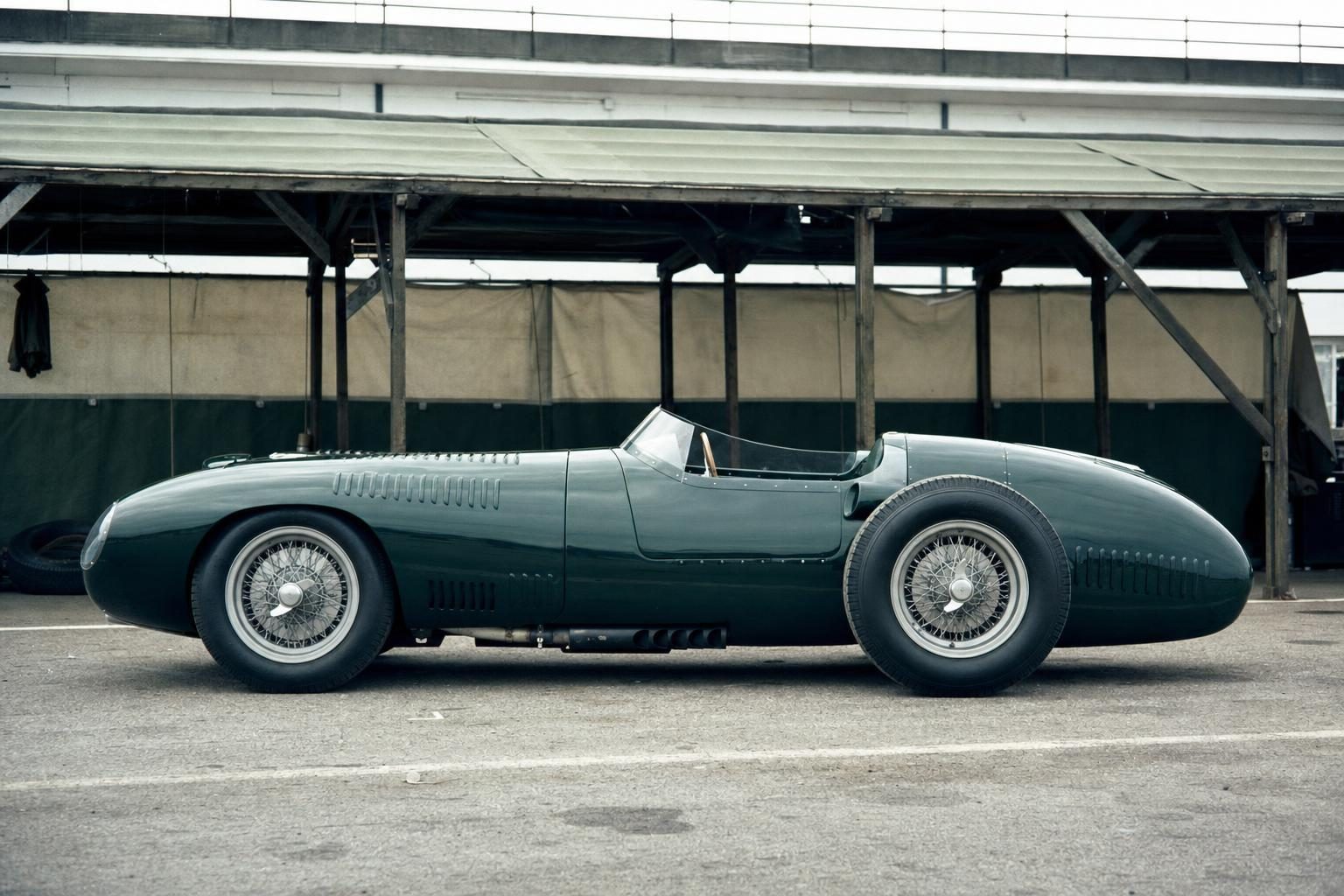
DBR4 1959: Aston Martin’s lone foray into Formula 1 with Roy Salvadori and Carroll Shelby, and why it couldn’t rival Ferrari and Lotus.
DBR4: three letters and a number that say a lot about 1959 at Aston Martin — a Formula 1 gamble, signed by Ted Cutting, run in parallel with an endurance programme that swept all before it. This single-seater appears on the calendar the same year as victory at Le Mans, yet scores no points in the world championship. Retracing this episode shows how the marque made a clear — and rewarding — choice by focusing its strength on endurance rather than Grands Prix.
Ted Cutting and the DBR4 project: designing a Formula 1 alongside the endurance programme
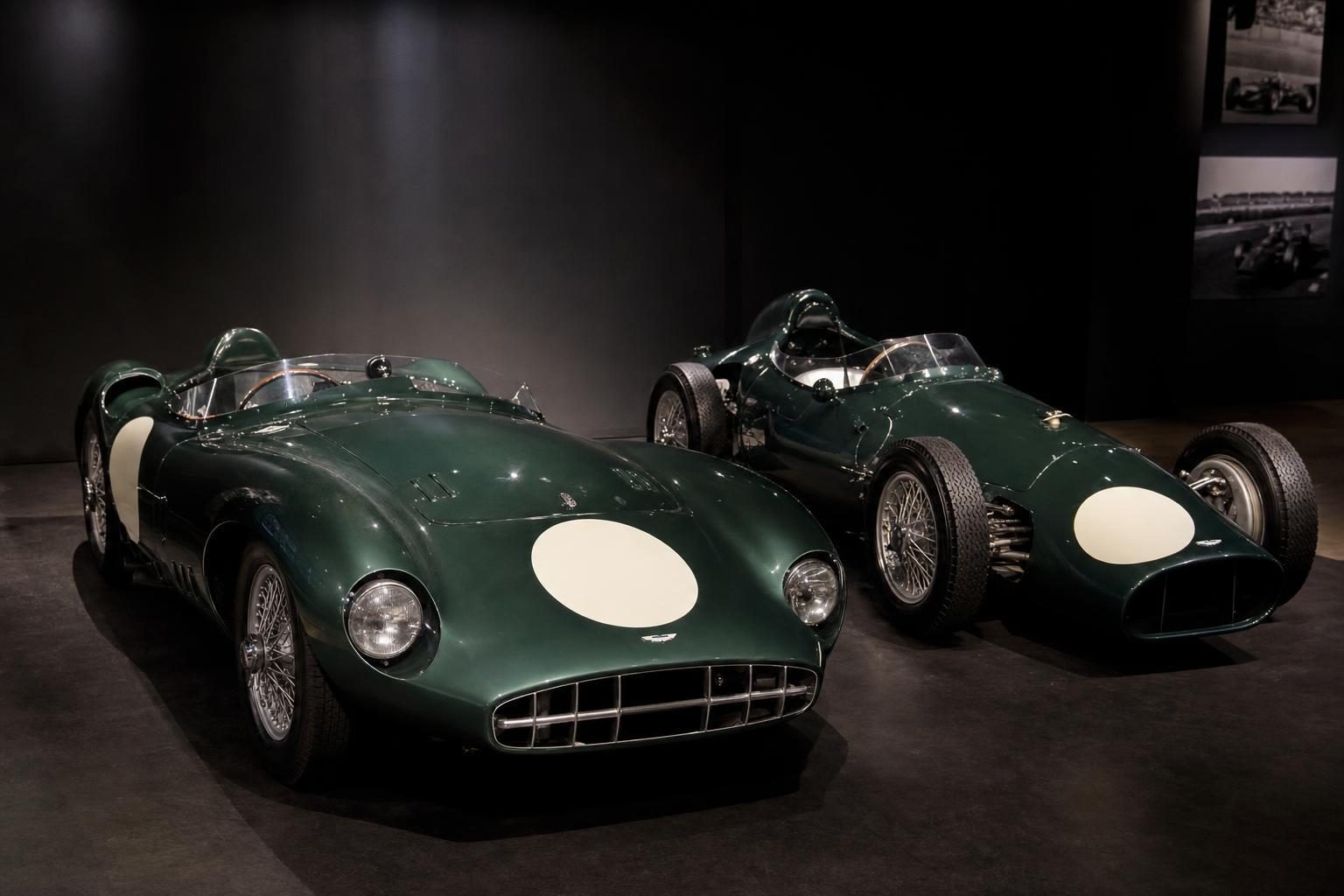
The DBR4 was designed by Ted Cutting for Aston Martin and unveiled in April 1959, even as the factory was fully committed to sports cars. According to Wikipedia (EN) on the DBR4, four examples were built between 1957 and 1959, which shows the scope and duration of a development conducted on the fringes of a demanding Le Mans programme. The project was not improvised, but it was not the main thrust of the year either.
This two-front effort required trade-offs. The team entrusted the DBR4 to two in-house drivers — Roy Salvadori and Carroll Shelby — while pursuing the primary endurance objective. Reading the 1959 results, the intuition is clear: Aston Martin kept most of its technical edge for the DBR1, leaving the single-seater an exploratory role. A strategy privileging overall coherence rather than headline-grabbing.
Even so, the DBR4 remains a milestone: an Aston Martin Grand Prix car, built for the world championship. Three chassis survive today, proof that despite a brief and thankless track career, the car has found its place in the marque’s material memory — and with collectors.
Roy Salvadori and Carroll Shelby at the wheel: the 1959 Dutch Grand Prix and its lessons
The baptism of fire came at the 1959 Dutch Grand Prix. According to Wikipedia (FR) on the DBR4, both Salvadori’s and Shelby’s cars retired very early with engine problems. The episode sums up the season: a promising start on paper, aborted by reliability. In a championship where machinery dictates the hierarchy as much as talent, the DBR4 never had time to find its rhythm.
This first setback was not isolated. The DBR4 showed spirit, but Sundays often ended sooner than expected. As the races went by, one conclusion imposed itself: without robustness, no points — and without points, no accelerated learning. In this context, Roy Salvadori remained the internal benchmark, extracting the best from a still-green single-seater, Shelby bringing his endurance craft to a capricious Formula 1 car.
For the team, the lesson was clear. The resources concentrated on endurance could not be duplicated in Grands Prix without dilution. The DBR4 thus became a rolling laboratory, useful for understanding the gap to bridge, but too fragile to weigh in the world championship.
No world championship points: the technical reasons for failure
The bottom line is stark: the DBR4 scored no points in the world championship. Its best results remained two sixth places for Roy Salvadori — in Great Britain and then Portugal — which, at the time, brought nothing to the standings. This ineffectiveness was not down to driving, but to a sum of technical handicaps.
Sources first cite engine reliability, a weakness illustrated from Zandvoort onwards. Without mechanical endurance, there was no converting starts into finishes. Next, the car arrived late into a 1959 season of rapid technical evolution; it had neither the testing mileage nor the fine-tuning of a machine developed as a priority. The factory’s main effort was focused, that same year, on endurance with the DBR1, as Wikipedia (EN) on the DBR1 reminds us.
Finally, the calendar worked against it. Launched in April 1959, the DBR4 entered the championship with no adjustment window. The long timelines of endurance — where settings and strategy are honed — are not those, unforgiving, of Formula 1. Result: flashes but no consistency, and a blank season in the standings.
The DBR5 of 1960: a corrective attempt that wasn’t enough
Aston Martin did not give up immediately and launched the DBR5 for 1960. According to Wikipedia (EN) on the DBR4, the new car was more compact and lighter, with fully independent suspension. In other words, the factory directly addressed several implicit criticisms of the DBR4: weight, bulk and behaviour.
On paper, the direction was right. In practice, it came too late. The two DBR5 examples were ultimately destroyed, closing Aston Martin’s Formula 1 episode for many decades. Lacking a sustained programme over time, the accumulation of learnings — the paddock’s true currency — never happened.
Even so, the DBR5 marked a strategic inflection point. By gauging the scale of investment needed to compete in Grands Prix, the marque validated, by contrast, the wisdom of refocusing on its domain of excellence at the time: endurance. A clear-eyed decision, dictated by results.
What scrapping the F1 programme freed up for Le Mans and the 1959 world title
1959 was a binary year, rich in lessons. While the DBR4 struggled, the DBR1 delivered for Aston Martin at the 24 Hours of Le Mans and the world sports car title. According to Wikipedia (EN) on the DBR1, this double triumph consecrated the factory’s technical choices and organisation. Put another way: the team that wins Le Mans cannot, in the same year, build a world-championship-level single-seater from scratch without spreading itself too thin.
By closing the Grand Prix parenthesis, Aston Martin freed up testing time, budget and brainpower to perfect its endurance weapon. This focus embedded the marque in the Le Mans and sports car championship imagination, a legacy that runs through to modern programmes, from GT to prototypes. To trace this lineage, revisit our analysis of Aston Martin’s DNA at Le Mans and in world endurance.
The rest of the story would confirm this trajectory. Contemporary GTs, such as the DBR9, extend this logic of excellence in endurance and GT — see our feature on the DBR9 and its GT record. And to set 1959 in its true light, our retrospective on the DBR1’s Le Mans victory illuminates the winning trade-offs of the era.
Conclusion — the DBR4, a instructive detour that set the course
Because it barely features in the record books, the DBR4 might seem anecdotal. In reality, this single-seater highlights, by contrast, the power of Aston Martin’s 1959 strategic choice: prioritising endurance — where the marque won Le Mans and the world title — rather than diluting resources in Formula 1. From Zandvoort to Salvadori’s sixth places, the adventure was short but instructive.
In negative space, the DBR4 served as a compass: it revealed the true cost of a Grand Prix commitment and confirmed the factory in what it did best at that moment. A parenthesis closed, but not forgotten — if only for what it enabled elsewhere. To delve deeper, browse the historical models on the official Aston Martin – Past Models site, and dive back into the reference data on the DBR4 in French and in English. Here, the DBR4 is no failure: it is a strategy lesson, written with a fine nib.