One-77 revealed at Geneva 2009, 77 units sold at once: seven build details — carbon, aluminium, 7.3-litre V12 — beyond the 750 PS and the price.
The One-77 may have entered history for its quoted 750 PS and its stratospheric price, but the essence lies in how it was made. Here are seven design and assembly facts — carbon-fibre monocoque, hand-formed aluminium bodywork, naturally aspirated 7.3-litre V12 — often less discussed than the spec sheet. Enough to shed new light on this out-of-the-ordinary Aston, unveiled at the 2009 Geneva Motor Show and limited to 77 units, all of which found buyers within weeks.
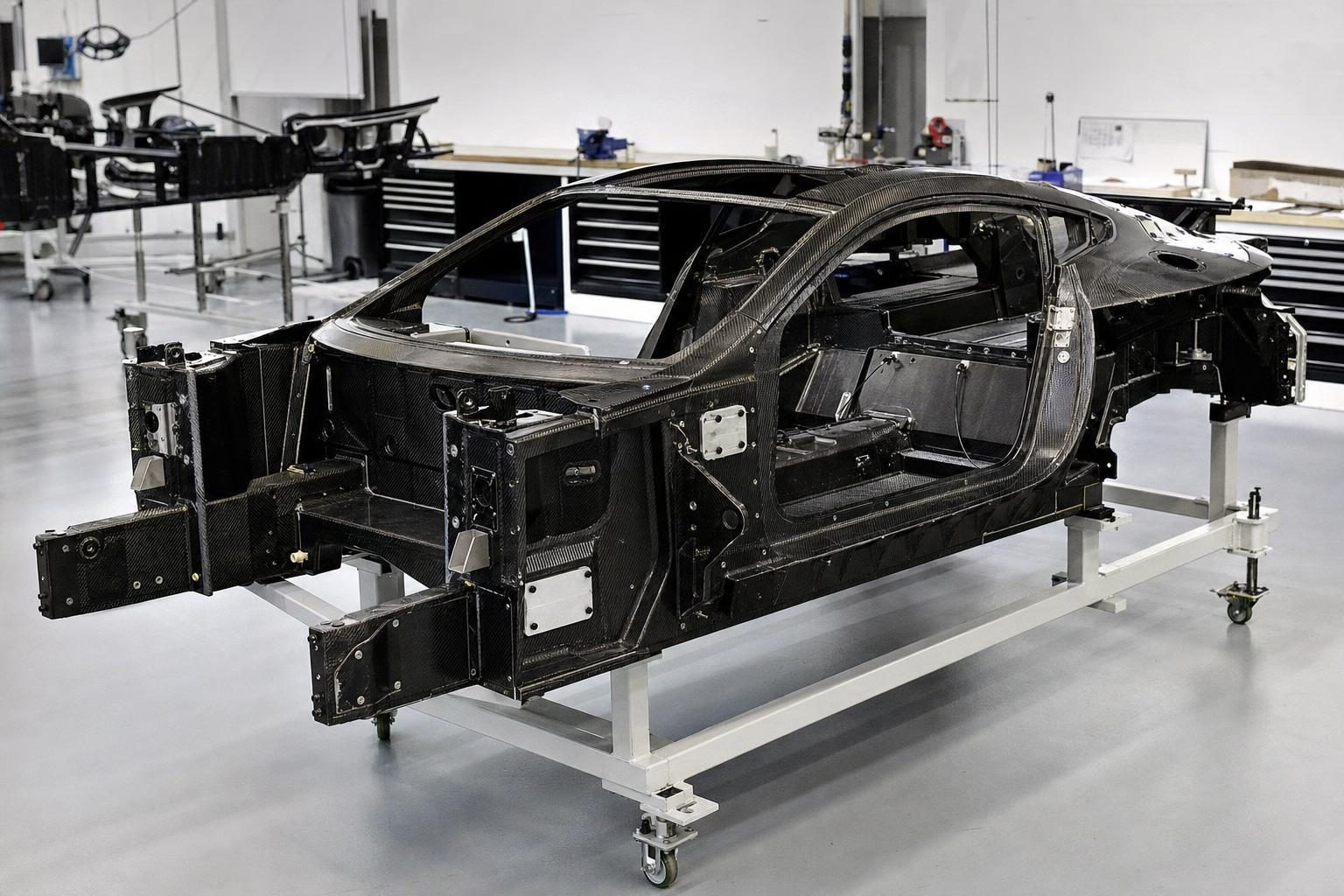
The carbon-fibre monocoque: a first for a series-production Aston Martin
For the One-77, Aston Martin chose a carbon-fibre monocoque clothed in a hand-formed aluminium body. According to the dedicated English Wikipedia page, this was a first for a mainstream-production Aston Martin, a clean break from the marque’s previous architectures. The benefit is twofold: high rigidity and contained mass, the ideal base to channel the power of the 7.3-litre V12.
This structural choice, usually reserved for the most exclusive hypercars, allowed the One-77 to target a top speed of 354 km/h, a figure that made it at launch the fastest British series-production car (source: Wikipedia EN). The approach was not just about innovation: it also set a technical course for the following decade at Aston Martin.
The rarity of the process in Gaydon’s production partly explains the aura of this model. For readers curious about the broader technical detail and its context, our dedicated feature usefully complements this overview: history and technology of the Aston Martin One-77.
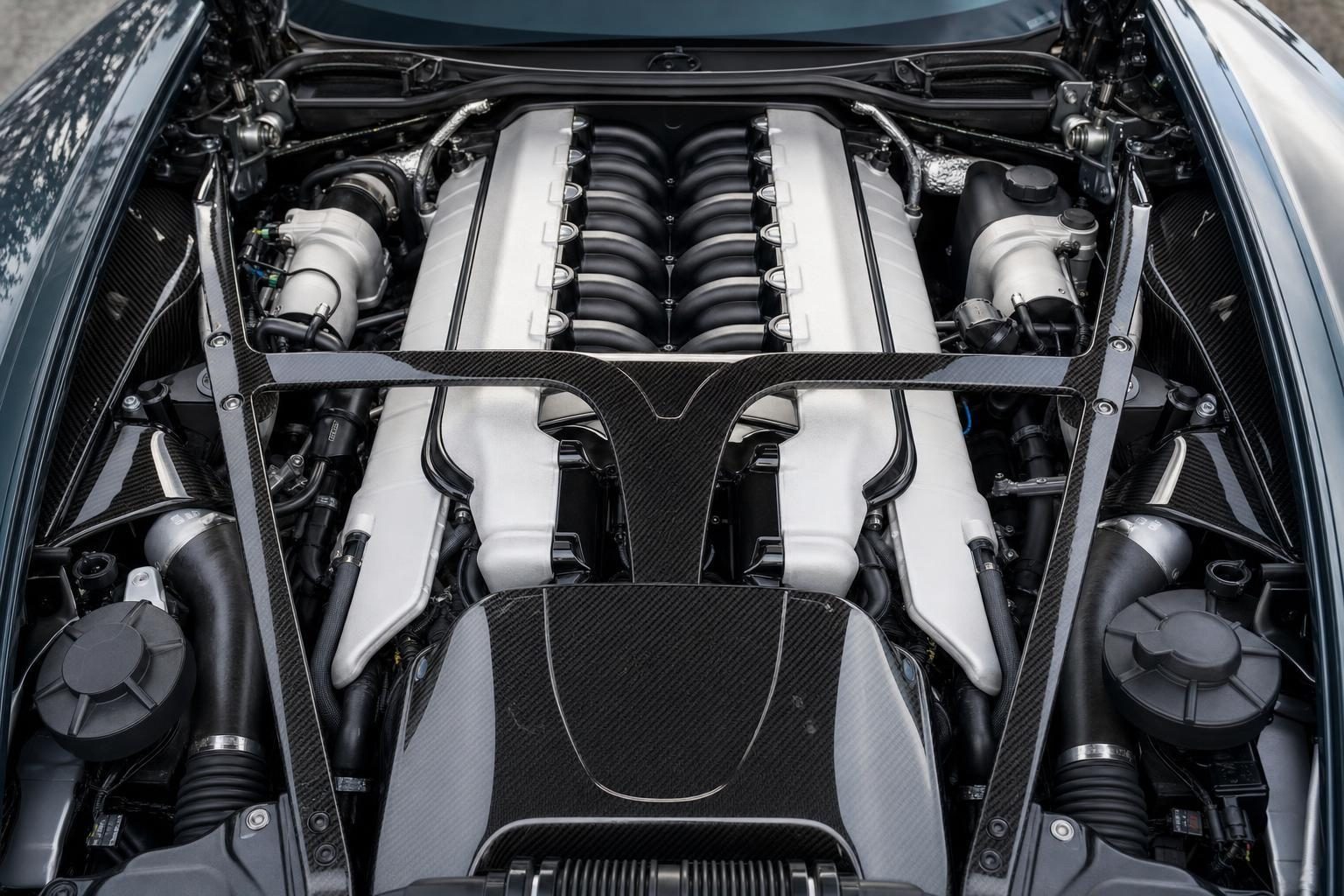
The 7.3-litre naturally aspirated V12: why Aston Martin refused forced induction
The heart of the One-77 is a naturally aspirated 7.3-litre V12, officially rated at 750 PS by Aston Martin (source: official Aston Martin media). Some English-language publications quote 760 PS: the gap comes down to measurement methods (DIN versus SAE), a useful reminder when comparing spec sheets from different eras and standards.
A crucial yet modestly communicated fact at the time: the architecture is entirely naturally aspirated. Rather than forcing the issue with turbo- or supercharging, the One-77 prioritises rev range, immediate response and the musicality of a great unassisted V12. This stance, confirmed on the production version, goes a long way to explaining the car’s character without resorting to a numbers arms race.
To place this engine within the lineage of the marque’s extreme models, the Aston Martin page dedicated to past models is a useful read: Aston Martin’s landmark models. As for the community summary, it lists the One-77’s key technical milestones: Aston Martin One-77 on Wikipedia EN.
The hand-formed aluminium body: between 10,000 and 12,000 hours per car
Behind the data point most striking to the public — 77 units — hides the time scale. The hand-worked aluminium panels, mounted on the carbon monocoque, demand considerable labour. The encyclopaedic source mentions an envelope of around 10,000 hours per car. That is the order of magnitude to bear in mind to gauge the One-77’s artisanal intensity.
This sum of hours explains the discreet production cadence and the micro-series logic. It also says much about the car’s positioning: a hypercar whose structural technology coexists with artigianato-style methods worthy of the finest coachbuilt bodies of old. The Aston Martin DNA — elegance shaped by hand — finds maximal expression here.
To extend the reflection on this craft-first school at Aston Martin, note that the marque also developed extreme, small-series models such as the Vulcan. Read: Aston Martin Vulcan, the track laboratory.
The launch price and waiting list: what ‘77 units’ really meant in 2009
At Geneva 2009, Aston Martin announced a launch price pitched between £1.15 and £1.2 million before taxes according to available sources. This range, rarely detailed in period communications, was matched by a more discreet phenomenon: the rapid closing of the order book. According to Wikipedia EN, all 77 units were sold within weeks.
In practice, ‘77 units’ was not only a number struck into metal, but a calibrated strategy of rarity. It set the One-77’s value from the outset and fed that distinctive relationship between lead times, personalisation and desirability. All without excessive noise: the announced top speed of 354 km/h was enough to set the scene.
For a return to the model’s fundamentals, its reference page on AstonLegacy gathers the data sheet, background and our analyses: Aston Martin One-77, overview and notes.
The 77 chassis and where they are now: what auctions have revealed since 2012
Since production ended, several One-77s have surfaced at public sales. These documented hammer prices offer a rare glimpse of chassis movements. Public market data indicate that in 2023, one example was sold at RM Sotheby’s for over US$1.8 million. The value trajectory thus remains well above the original price, without a spectacular surge.
These auction-room appearances highlight an oft-forgotten point: of the 77 chassis, a non-negligible fraction remains discreet, protected within private collections. Auctions reveal only a sample, but sufficient to confirm robust demand. They also remind us that a hypercar born with a carbon monocoque and hand-hammered bodywork has strong long-term credentials.
For an overall snapshot of public elements — from the Geneva 2009 unveiling to the specifications — the English Wikipedia page brings the essentials together: One-77 file. The official site also preserves useful range references: archive of Aston Martin past models.
Conclusion — One-77: seven build truths no longer left in the shadows
Beyond motor-show numbers, the One-77 is best appreciated for its carbon-fibre monocoque, its naturally aspirated 7.3-litre V12 and its hand-shaped aluminium bodywork — around 10,000 hours per car. The original £1.15–£1.2m price and the order book closed within weeks sealed its rarity, while auctions confirm its staying power. The 2009 hypercar is thus neither summed up by 750 (or 760) PS nor by 354 km/h: above all it tells a story of the automobile that is crafted as much as it is measured — and that is where the One-77 remains unforgettable.