James Bond, OHMSS and the 1969 DBS: three narrative choices that redefined the Bond–Aston Martin link, from gadgets to emotion. Cultural and historical analysis.
James Bond changed register in 1969, and the DBS with him. On Her Majesty’s Secret Service (OHMSS) quietly reshuffles the deck: almost no gadgets, an Aston Martin as an emotional backdrop, and a final scene that would haunt the saga. Here are three narrative shifts we tend to see as minor… but which rewired the Bond–Aston Martin grammar for good.
The 1969 DBS without gadgets: why Eon Productions deliberately broke with the DB5 precedent
After the gadget-laden DB5 icon in Goldfinger, the OHMSS DBS plays against type. According to Wikipedia (Aston Martin DBS), James Bond’s car carries no gadgets, save for a housing for a telescopic sight in the glovebox. The choice is surprising, but it puts the agent back at the centre of the story: it is the man, not the machine, who must do the job. This restraint fits the more realistic aesthetic the production wanted for this chapter.
The DBS also arrives at a pivotal moment for the marque: the last Aston Martin developed under David Brown, it was produced from 1967 to 1972 (Wikipedia DBS). Eon Productions therefore does not parade a “gadget car”, but a contemporary, status-laden coupé that establishes a muted presence rather than a technical firework. A stance that echoes OHMSS’s cool elegance.
This break sheds light on the relationship between James Bond and “his” Aston: the car is no longer a deus ex machina. As a counterpoint, it becomes a visual marker, almost a silent supporting character. To place this turning point in the DB5 lineage, our in-house feature on the DB5 and its successive reinventions provides the necessary perspective.
To delve into the model’s specifics, the dedicated page on astonmartin.com for the DBS and the detailed Wikipedia entry (Aston Martin DBS) precisely situate the OHMSS car against the earlier DB5.
George Lazenby, a one-off actor for the role: what the casting imposed on the choice of car
Replacing Sean Connery with George Lazenby required a repositioning. With a more vulnerable James Bond, OHMSS sidesteps mechanical showboating. The DBS chosen for Lazenby does not need mock cannons to convince: its long, almost architectural line signals a quiet authority, in step with the film’s more human direction.
The facts confirm this minimalist reading: no gadgets (barring the sight housing) and sparing on-screen use (Wikipedia DBS). Where the DB5 was a stage partner, the DBS becomes a meaningful backdrop — a case — that lets the character move without a technological safety net. The car, like the actor, must impose itself by presence.
This shift matters in the joint history of Aston Martin and James Bond. It quietly prepares the future back-and-forth between spectacle and restraint that we chart in our panorama 60 years of Aston Martin – Bond liaisons, and which the Daniel Craig era would revisit with different balances, from the DB5 to the DBS and the DB10, analysed here: the Daniel Craig period in Aston Martin.
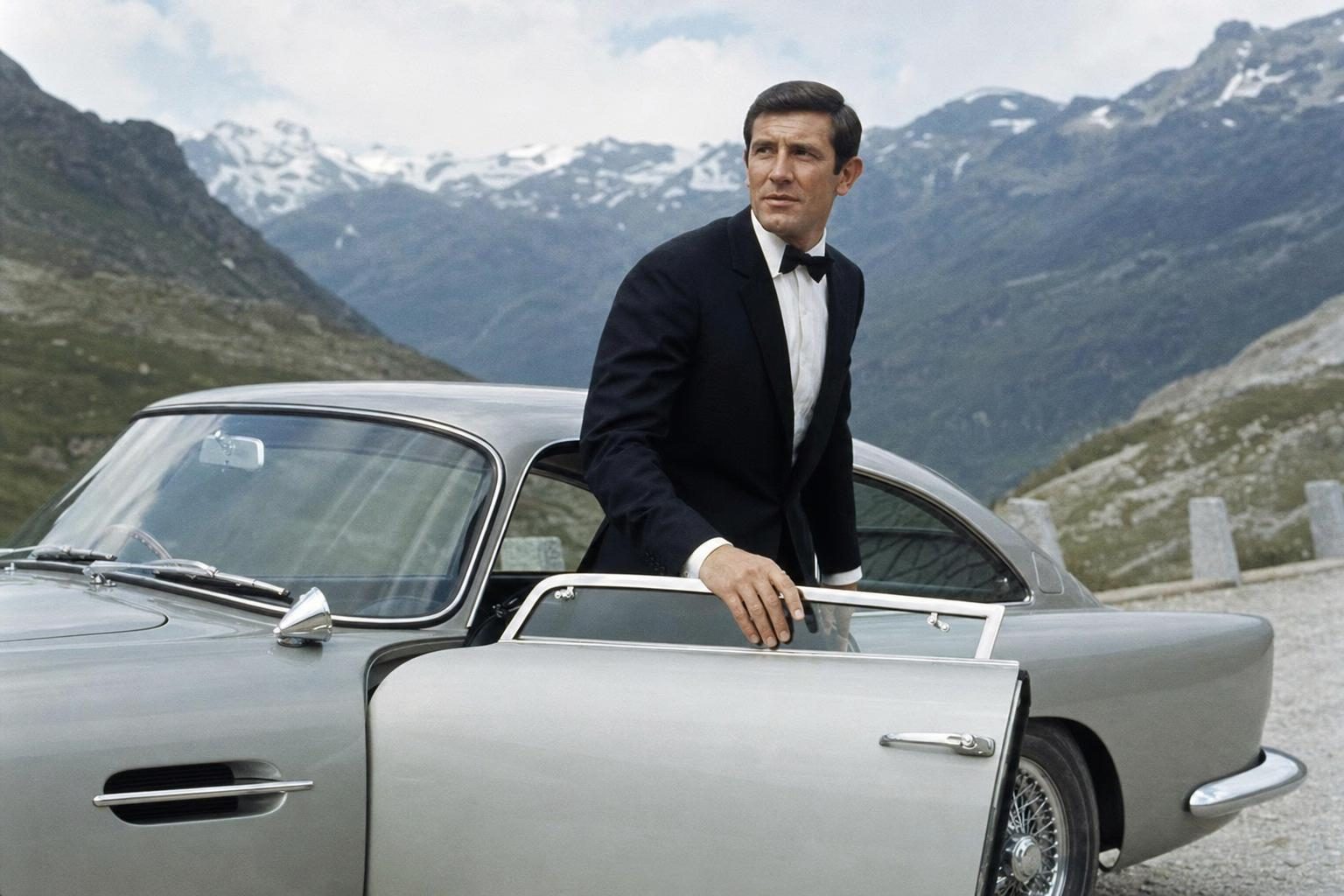
Tracy’s death in the DBS: how a final scene turned the Aston Martin into a cinematic object of mourning — James Bond
In OHMSS’s final scene, Tracy Bond (Diana Rigg) is shot dead while sitting in the DBS. Wikipedia (DBS) notes that it is the only time James Bond loses his wife aboard an Aston Martin. This image etched the car into a less triumphal collective memory: the bodywork becomes a screen for an intimate tragedy.
In terms of cinematic language, the sports car is no longer a tool of escape or domination, but a vector of emotion and loss. The scene recodes Aston’s presence in the saga: not just a sign of power, but also a marker of the human cost of a spy’s life. A shift that would grant the marque a rare narrative depth among cinema’s machinery.
This shift likely explains why, much later, audiences would read every glint of chrome differently in subsequent James Bond episodes. The OHMSS DBS installs a discreet yet persistent melancholic subtext that still colours the later returns of the DB5 or other models on screen.
The DBS in Diamonds Are Forever and The Persuaders: a discreet television career after the big screen
After 1969, the coupé returned at the margins: a second DBS appears briefly in the background at Q’s in Diamonds Are Forever (1971) (Wikipedia DBS). A wink, more than a role. The machine remains at the frame’s edge, as if OHMSS’s distant elegance still followed it.
Television would offer it more exposure: The Persuaders! (1971–1972) features a Bahama Yellow 6-cylinder DBS (chassis DBS/5636/R), driven by Roger Moore (Wikipedia DBS). There, the Aston becomes a visual and social signature, lighter, more pop, confirming its malleability as a cultural object beyond James Bond.
This post-cinema path illuminates the era: between 1967 and 1972 (Wikipedia DBS), the DBS embodies Aston Martin’s transition under David Brown towards a broader span of styles and uses. The archives of Wikipedia in English on the DBS (1967) usefully complete this chronological panorama.
What OHMSS told Aston Martin about its image: 3 lessons the brand took years to absorb
First lesson: restraint can speak louder than the gadget. By depriving James Bond of mechanical toys, OHMSS proved that the mere presence of an Aston Martin is enough to establish symbolic capital. For the marque, this legitimises an aesthetic of sober authority rather than showy technicality.
- The gadget-free DBS (Wikipedia DBS) shows that Aston’s prestige does not need artifice to exist on screen.
- This austerity lends credibility to the character and, by extension, to the automobile.
Second lesson: emotion anchors more durably than demonstration. Tracy’s death aboard the DBS ties Aston Martin’s image, for a long time, to an affective memory within the James Bond saga. This emotional charge — rare for a cinema car — revalues the car as a storytelling partner, not merely an accessory.
Third lesson: cultural continuity also plays out off-screen. Between the fleeting appearance in Diamonds Are Forever and the television career in The Persuaders!, the DBS settles into the collective imagination beyond close-ups. An organic, patient strategy that mirrors Aston’s in-house prudence under David Brown.
To place these lessons within the brand’s broader trajectory, the official Aston Martin resources on the DBS provide the industrial framework, cross-referenced with the chronology on Wikipedia (DBS).
Conclusion: a pact of restraint that redefines James Bond and the Aston
In 1969, OHMSS rewrote the score between James Bond and his Aston Martin: less artifice, more human. The DBS, the saga’s second Aston (Wikipedia DBS), becomes a sign of style and emotion, not a spy’s Swiss Army knife. From Tracy’s death to later appearances, the film installed a melancholic elegance that still irrigates the Bond–Aston relationship. A lesson in restraint that has continued to set the tone right up to recent re-readings of James Bond.