V12 Speedster: 88 examples, DBR1 as a guiding thread, Vantage/DBS chassis and a detuned twin‑turbo V12. Technical breakdown, price and collector positioning.
The V12 Speedster is no motor show frippery: the V12 Speedster arrived in 2020 with 88 units, a base price announced at $950,000, and a spec sheet that puts clear distance between it and a mere roofless Vantage. Beyond the statement piece, this model summons the DBR1, blends elements of Vantage Roadster and DBS Superleggera, and adopts a slightly detuned twin‑turbo V12. Here are the four decisions that make it a distinctive Aston, aimed at collectors who like to understand what they’re buying.
The number 88 and the DBR1 reference: why this number and not another
Building 88 units is choosing rarity without slipping into anecdote. This limited run was announced from 2020, with a starting price of $950,000 according to data compiled by Wikipedia. A volume that signals exclusivity and aids traceability for collectors, while ensuring there are enough cars to keep future auctions lively.
The nod is explicit: the V12 Speedster’s design draws directly from the late‑1950s DBR1, the barchetta that wrote some of Aston Martin’s finest racing chapters, and from the 2013 CC100 Speedster concept. The proportions, the central divide, the lack of windscreen and the bonnet volumes all borrow this vocabulary. The lineage isn’t decorative; it dictates usage and the onboard experience.
The DBR1 reference also sets a frame of interpretation. This isn’t a “stripped” Vantage Roadster, but a modern barchetta, allied to Aston’s customer‑racing culture. By pegging the dial to the DBR1 icon rather than the GT, Gaydon announces a car for the enthusiast in the literal sense: the enthusiasm of airflow and unfiltered sensations.
Vantage Roadster chassis, DBS Superleggera front structure: the bespoke architecture few articles have detailed
The recipe is singular. The V12 Speedster sits on the aluminium of the Vantage Roadster, but receives the front structure from the DBS Superleggera to house the larger‑format V12. This hybridisation of major components is uncommon: it goes beyond simple parts sharing and results in a truly bespoke architecture.
This technical choice clarifies the model’s positioning. The Vantage base brings compactness and agility, while the front end inherited from the DBS provides the space and rigidity needed for the 5.2‑litre twin‑turbo V12. The result is an open Aston Martin that keeps tightly packed proportions, with a strong nose and a cooling layout designed for a unit far more imposing than the Vantage’s V8.
It’s easier, then, to see why this Speedster can’t be reduced to a roofless Vantage. Its geometry, mechanical packaging and local rigidity differ. And the peripherals follow suit: 21‑inch forged centre‑lock wheels and carbon‑ceramic brakes, all elements that betray a serious sporting vocation, far from a mere styling exercise.
To go further on the contemporary genealogy, our feature on the Vanquish Mk2 and its place in the GT lineage sheds light on the chassis and engine mix at Gaydon over the same period.
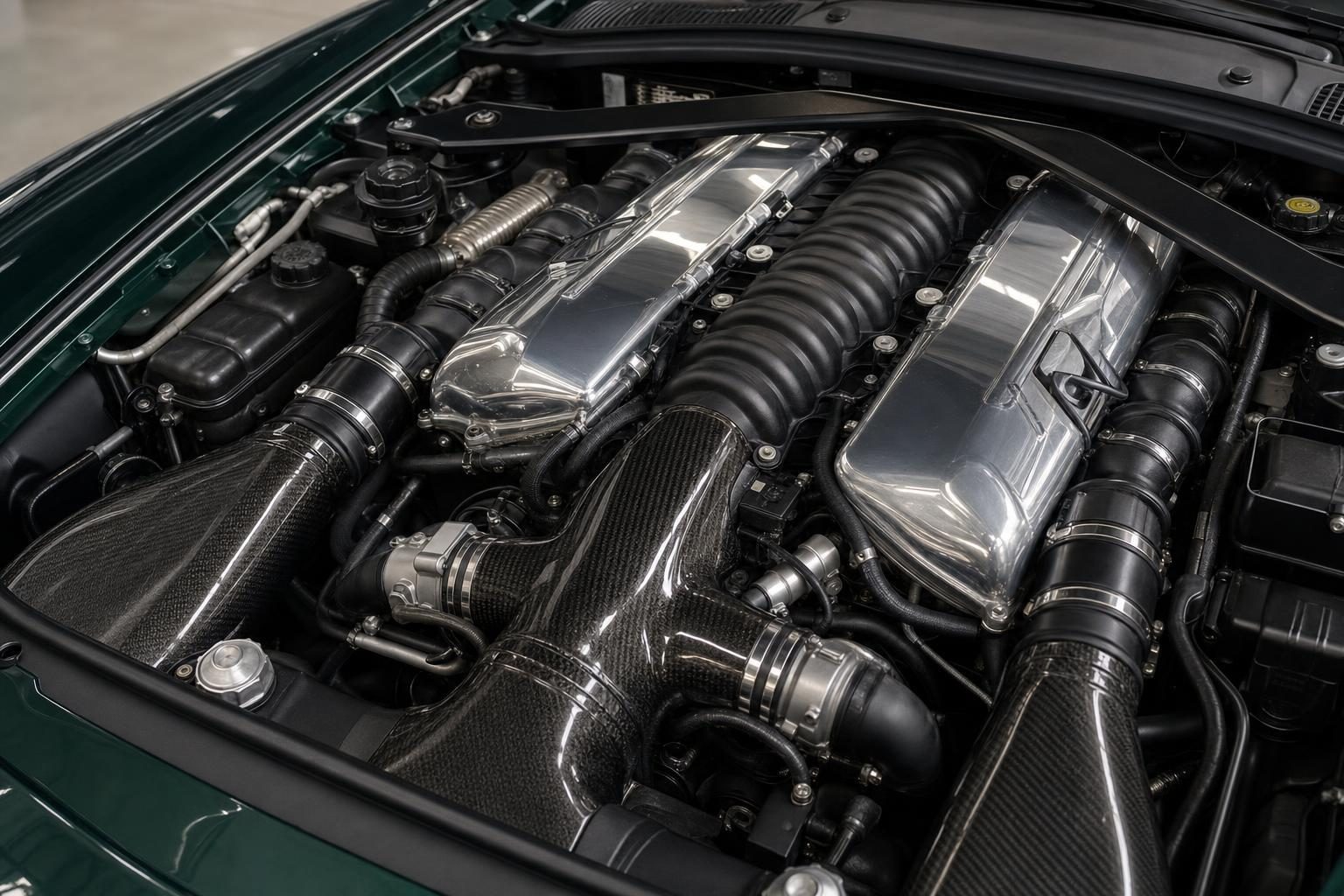
The 700 PS twin‑turbo V12: what was detuned versus the DBS Superleggera, and why
At the heart of the V12 Speedster lies the 5.2‑litre twin‑turbo V12 from the DBS Superleggera, here slightly detuned to 700 PS (690 hp) instead of 725 PS. The 8‑speed ZF gearbox handles transmission. 0–100 km/h is quoted at 3.5 s and top speed at 300 km/h, figures that place this model in the same performance zone as the V12 Vantage S, to which Wikipedia attributes an identical sprint.
Why this detuning? For a Speedster without a windscreen, exploitable thrust takes precedence. Trimming power slightly helps optimise cooling, response and mechanical endurance in a particular aerodynamic environment. A torque regime calibrated for the open road, with no roof or wind‑deflector, calls for greater progressiveness and careful thermal management.
The top speed limited to 300 km/h follows the same pragmatic logic. In a barchetta, air becomes a protagonist. Stabilising aero and preserving high‑speed refinement come before chasing the last kilometre per hour. Aston Martin communicated these specifications at launch, and the official announcement page reiterates the essentials. For institutional detail, see the V12 Speedster presentation on the brand’s site.
This calibration doesn’t diminish the mechanical appeal. It concentrates the V12 signature — silkiness, rev range, timbre — in a configuration more usable on road and club circuit. A very British compromise, in short.
No roof, no screen: the pods, integrated helmet and the claimed driving experience
The absence of roof and windscreen isn’t a gimmick. The V12 Speedster opts for two arches and a central divider, with pods behind the seats that house helmets. A leather pouch replaces the glovebox — a sign you travel light. This minimal ergonomics reinforces the idea of a machine for the moment, rather than a long‑legged GT.
The architectural brief translates clearly on the road: you drive with a helmet on, visor down, and the air shapes the experience. Induction and exhaust noise rise unfiltered. Steering, carbon‑ceramic braking and the 21‑inch fitment give the chassis a precision that suits a star‑billed V12.
This stance, inherited from the DBR1 and the CC100 concept, is documented by Wikipedia’s technical summaries and Aston Martin’s communications. Enthusiasts will see it as a chance to reconnect with “analogue” driving in the noble sense, carried by combustion and airflow. Others will see… a lot of wind. Both are right.
To position this choice against the brand’s other V12s, our guide to the V12 Vantage and its evolutions offers a useful counterpoint, from closed coupé to open barchetta.

Values in 2024–2025 and the Speedster’s place in the hierarchy of collectible Aston Martins
With 88 units, the V12 Speedster immediately joins the select club of modern Astons built in minimal numbers. This rarity, coupled with singular usage, makes it an identifiable collector’s piece. Values will hinge on classic criteria: provenance, specification, mileage, and above all enduring appeal for contemporary barchettas.
Alongside established icons, the hierarchy takes shape. Hypercars with extreme production caps like the One‑77 sit higher in absolute value. But the barchetta stands out for its narrative and key numbers the market likes: twin‑turbo V12, 700 PS, 0–100 in 3.5 s, 300 km/h, and an architecture blending Vantage and DBS. It’s a textbook case for a collector looking to diversify beyond GT coupés.
To place the car within the galaxy of in‑house limited series, our panorama of the One‑77 hypercar and its technical imprint draws a direct line between engineering manifestos and these cars of pure passion. The V12 Speedster earns an original spot there: less radical on the spec sheet, more radical in sensation.
As for available public sources, the Vantage (2018) page on Wikipedia recalls the pricing and context at launch, useful for tracking market evolution. For a dedicated summary, consult the Wikipedia article on the 2018 Vantage and the page devoted to the V12 Speedster.
Conclusion: what the V12 Speedster says about Gaydon
The V12 Speedster is not a Vantage Roadster with its roof lopped off. It’s a bridge‑car between heritage and contemporary engineering: 88 units, a clear nod to the DBR1, a structure mixing Vantage and DBS Superleggera, and a twin‑turbo V12 detuned for real‑world use. By combining these decisions, Gaydon signs a collectible barchetta that speaks to the senses without denying the metrics.
As GTs close up and electrify, the V12 Speedster offers a rare counterpoint. Those hunting one in 2024–2025 will likely see values underpinned by rarity and carried by a coherent story. Others will take away a lesson: when Aston Martin sets a V12 under open sky, it doesn’t merely remove a roof; it adds an idea.