Valhalla: limited to 999 units, Aston Martin's first PHEV combines a 828 PS AMG V8 with three electric motors for 1,079 PS according to L'Argus.
Valhalla stands as the greatest engineering breakthrough of modern Aston Martin, a manifesto that unites plug-in hybridisation, active aerodynamics, and expertise derived from F1. This Valhalla concentrates sharp technical choices — a thoroughly revised engine, dual electrification of the front axle, and a very lightweight carbon monocoque — and opens a new chapter for the brand. To follow the genesis and specifics of the Valhalla through updates, also check out our dedicated page on the Valhalla.
From the AM-RB 003 V6 to the Hybrid AMG V8: A Long Path to Production
First presented in 2019 as the AM-RB 003 concept with a hybrid V6, the Valhalla underwent a major reorientation of its powertrain. According to public sources, this shift occurred in the summer of 2021, when the project adopted a 4.0-litre twin-turbo Mercedes-AMG V8, marking a crucial step towards a credible and industrialisable production model. This transition reflects Aston Martin’s desire to anchor the Valhalla in a proven technical framework while maintaining an experimental spirit.
The switch from the in-house V6 to the hybrid AMG V8 is reported by Wikipedia and confirmed by specialist press, which highlights the role of the July 2021 revision. The challenge for the Valhalla is twofold: to secure very high-level performance and to ensure reliable production. Overall coherence takes precedence over mechanical originality, without sacrificing the technological ambition of the original concept.
Aston Martin Performance Technologies, the brand’s F1 division, participates in the development, a contribution cited by several specialist publications. Through the Valhalla, this transfer of skills is expressed as much in aerodynamics and simulations as in architectural choices. The result is a hybrid supercar that embraces its prototype roots while aiming for the road.
The PHEV Powertrain: Power, Divergences, and Architecture
The Valhalla adopts a PHEV architecture that combines the 4.0-litre twin-turbo V8 with an advanced electric component. Total power figures vary according to sources: L’Argus mentions 1,079 PS (828 PS for the V8 + 251 PS electric), while other media such as hellobiz.fr and bmw-actu.com mention 1,065 PS (816 PS for the V8 + electric motors). According to available facts, the official site has not yet published a definitive homologation, which explains these discrepancies. This plurality of figures does not prevent the Valhalla from positioning itself very high in the hierarchy of hybrid supercars.
Two electric motors positioned on the front axle ensure torque vectoring and reverse gear. This is a key uniqueness of the Valhalla, as the DCT gearbox with 8 speeds does not feature a mechanical reverse. This configuration optimises traction, paves the way for fine stability adjustments, and contributes to agility on throttle response. It confirms the choice of an “intelligent” front axle, designed for both efficiency and driving precision.
This hybrid chain is integrated into a total weight of 1,655 kg (according to L’Argus), a figure that is contained given the sophistication of the system. The balance between the power of a twin-turbo V8 and electric immediacy promises an explosive yet adaptable Valhalla, capable of alternating between power phases and consumption control. Underlying this is the goal of harnessing the best of both worlds without compromising the experience of a high-intensity Aston Martin.
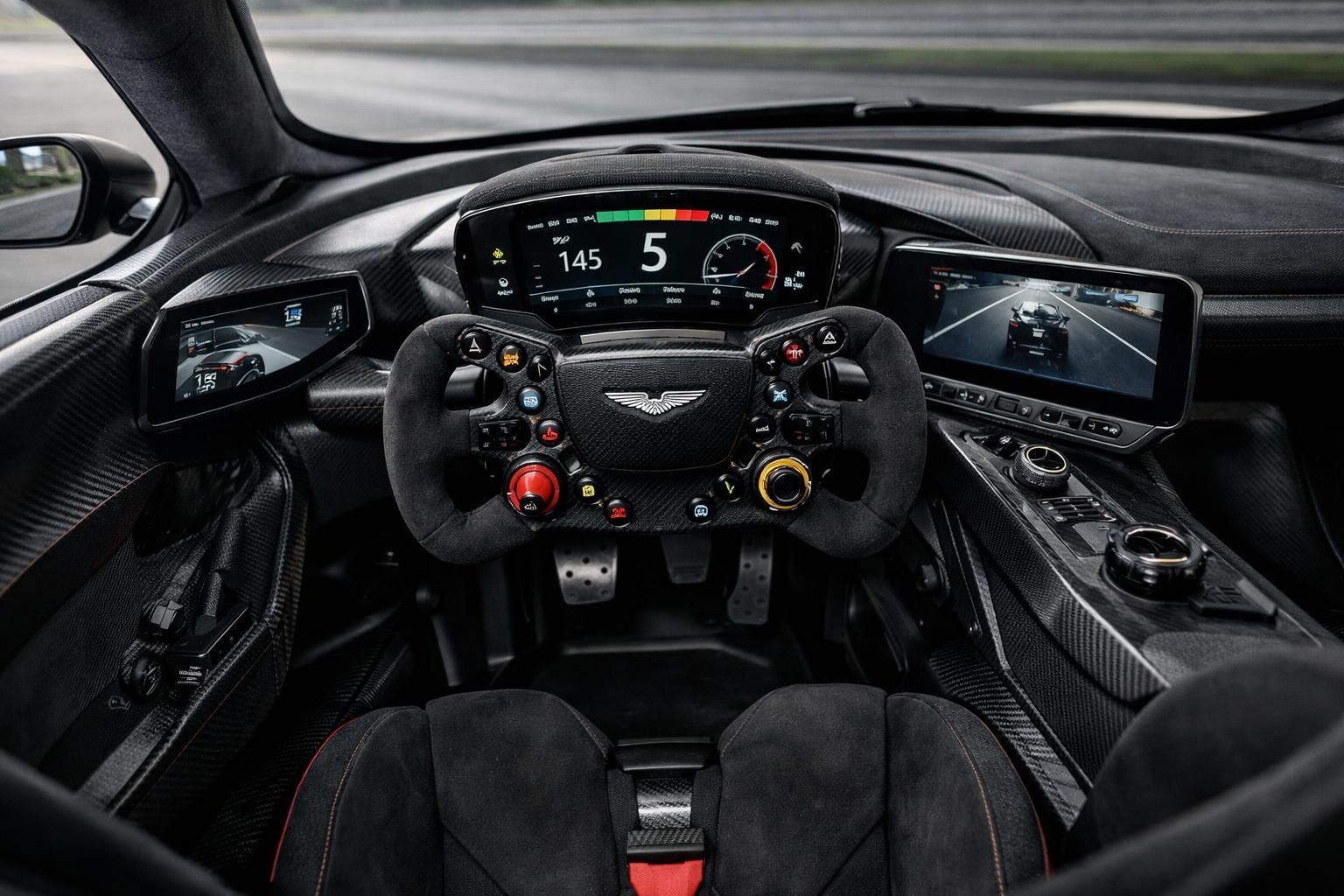
Active Aerodynamics and 600 kg of Downforce: The F1 Heritage
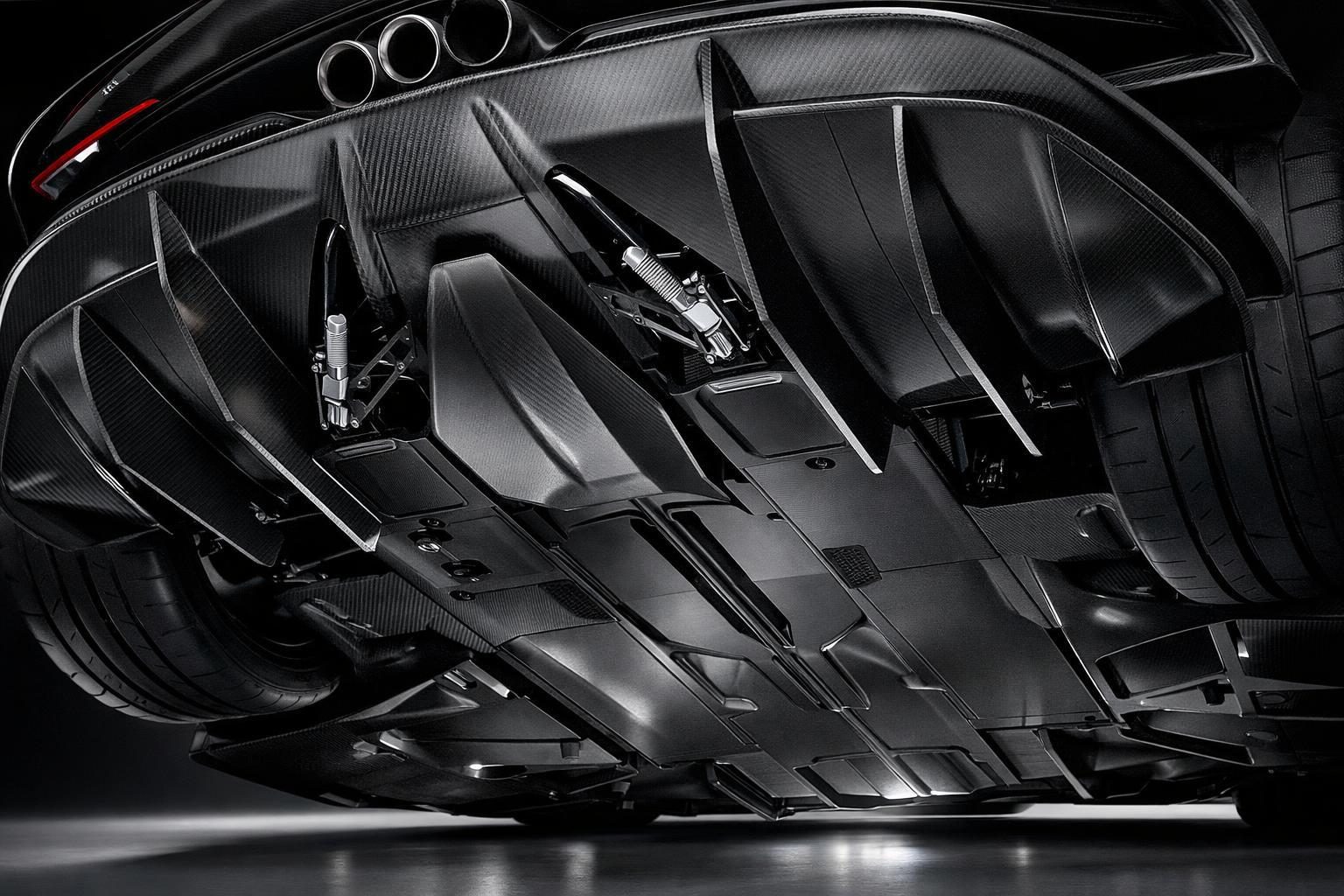
The active aerodynamics of the Valhalla embodies the transfer of know-how from F1. The movable elements and fine management of airflow contribute to generating over 600 kg of downforce at 240 km/h, a figure cited by fr.motor1.com and by the manufacturer. This colossal downforce aims to maintain the widest possible performance window, ensuring stability and grip as loads increase.
Beyond the figure, the interest lies in variability: the Valhalla adapts its downforce level according to conditions, maximising efficiency in a straight line while enhancing grip in fast corners. This philosophy, derived from the tools and methods of Aston Martin Performance Technologies, allows for aerodynamic tuning that does not sacrifice versatility on the road. It is one of the major breakthroughs that distinguishes the Valhalla from traditional GTs.
The manufacturer highlights these choices on its dedicated page, where one can perceive the coherence between style and function. To delve deeper into the official knowledge of the model, explore the Aston Martin Valhalla presentation, which summarises the technical approach and aerodynamic choices of this hybrid supercar.
Carbon Monocoque and Chassis: References to the Valkyrie
The structural core of the Valhalla is a carbon fibre monocoque announced at 120 kg (L’Argus). This lightweight and ultra-rigid base serves as an anchor point for the entire mechanical system and active aerodynamics. By combining body rigidity and weight reduction, the Valhalla prepares the ground for more precise steering and better-calibrated suspensions, while containing the inherent masses of the PHEV architecture.
This approach echoes methods already proven on the Valkyrie, the ultimate reference of the brand in terms of radicality. The technical similarities are not coincidental: the Valhalla adopts the idea of an optimised chassis from the outset, with integrated aerodynamics. To measure the common DNA, refer to our dedicated page on the Aston Martin Valkyrie, which illuminates the connections and differences between hypercar and hybrid supercar at Aston Martin.
In line with the brand’s icons, this Valhalla fits into a timeline of breakthrough innovations. To put this engineering quest into perspective, our dossier on an emblematic predecessor can usefully complement the reading: technical history of the Aston Martin One-77. Without being redundant, it recalls how structural weight reduction and functional design have shaped the character of exceptional models.
999 Units and Position in the Range: Between Valkyrie and DB12
The Valhalla will be produced in 999 units, a volume announced by the manufacturer and relayed by L’Argus. This limited series gives the Valhalla an assumed rarity, consistent with its status as a technological showcase and collector’s item. In the Aston Martin ecosystem, it is a way to ensure exclusivity while mastering the phases of industrialisation and development of a high-performance PHEV.
In the brand hierarchy, the Valhalla positions itself between the radical hypercar Valkyrie and the GTs in the range, embodying a bridge between extreme technology and road use. This positioning confirms the Valhalla’s vocation: to embody a technological breakthrough that remains usable, with plug-in hybridisation, active aerodynamics, and a lightweight carbon base. It becomes the flagship of an era where efficiency, downforce, and control electronics go hand in hand.
For a documented overview of the data made public and the power estimates that still surround the Valhalla, you can consult the summary page of the Valhalla on the official site as well as the synthesis made by L’Argus. These resources reflect the current status of a project where the definitive homologation of figures has not yet been communicated by the manufacturer.
Conclusion – Why Valhalla Marks a Turning Point for Aston Martin
By aligning sophisticated plug-in hybridisation, active aerodynamics capable of over 600 kg of downforce at 240 km/h, and a 120 kg carbon monocoque, the Valhalla represents a concentration of breakthroughs. The shift from the initial V6 to the hybrid AMG V8, the electrified front axle for vectoring, and the absence of mechanical reverse in the DCT 8, replaced by the electric function, illustrate a taboo-free approach. The Valhalla embodies this new mindset, nourished by the contribution of Aston Martin Performance Technologies.
Limited to 999 units, the Valhalla rises as the flagship of a transitioning range, putting technology at the service of controlled performance. To follow the evolution of the Valhalla and its final specifications, keep an eye on the official presentation and the dedicated encyclopaedic page, which gather the essential milestones of this programme.