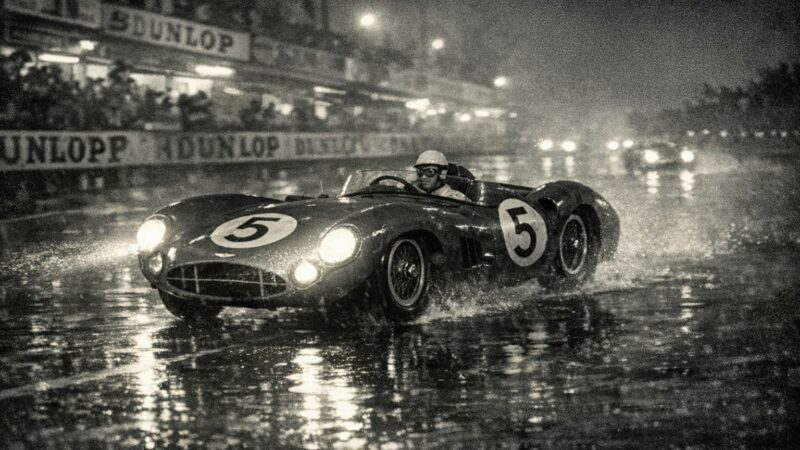
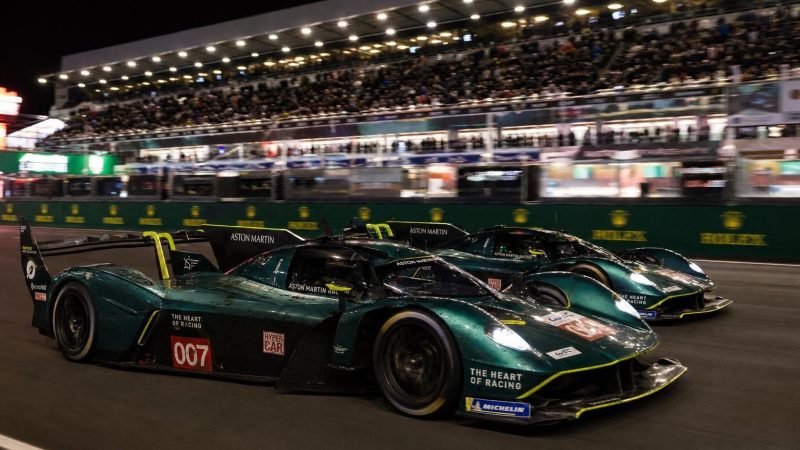
Le Mans 1959 reviewed from the pit wall: three cars, a 255 PS engine for Moss, pinpoint pit stops and Ferrari’s stroke of misfortune. A 1-2 built on clear choices.
Le Mans 1959 was not a late miracle, but the culmination of a series of choices made by John Wyer and his team, from the number of cars to the uprated engine, through to pit stop management under pressure. By following these four structuring decisions, we understand how Aston Martin turned three decades of attempts into an outright 1-2, without romanticising the Sarthe night.
The starting line-up: why Wyer chose three cars, not four
From the outset, John Wyer, the team manager, opted for three works cars and no more. The crews were clearly set: Moss/Fairman, Salvadori/Shelby, Trintignant/Frère. This tight composition followed a logic of risk control and resources concentrated on a homogeneous trio. According to Wikipedia, 1959 24 Hours of Le Mans, it was this trio that would carry the 1959 campaign, with Reg Parnell as team director to enforce strict execution on the pit wall.
This was no trivial choice: a smaller entry limited the dispersion of mechanics, avoided the temptation of discordant pace between cars and strengthened tactical authority. Wyer favoured depth over breadth, accepting that at Le Mans, one retirement can compromise two others if logistics are overstretched. Over 24 hours, the robustness of the set-up counts as much as peak speed.
The presence of a DB4 GT in the prototype class entered by Écurie Trois Chevrons (Patthey/Calderari), outside the works trio, underlined the clear line between the official programme and satellite initiatives. This DB4 GT retired shortly after the start (source Wikipedia, DB4 GT page), a reminder that in the Sarthe, simply expanding numerical firepower is not always synonymous with sporting effectiveness.
The uprated engine: 255 PS for Moss, standard configuration for Salvadori and Shelby
The second decision, almost clinical: differentiate the weapons. The car of Stirling Moss and Jack Fairman received an engine lifted to 255 PS. The intention was explicit: hold direct comparison with the Ferraris on flying laps, creating strategic space for the other two crews. The cars of Roy Salvadori/Carroll Shelby and Maurice Trintignant/Paul Frère kept a standard, more conservative configuration.
This mechanical asymmetry was a measured gamble. It concentrated the pathfinder role on Moss, capable of setting the early tempo, while the sister cars retained headroom in reliability. In practice, a more highly strung engine increases thermal and mechanical risk, but also allows you to dictate the race. By splitting functions this way, Wyer opened two routes to victory: frontal attack and methodical endurance.
Behind this choice lay a team vision: turn the fastest car into an icebreaker that draws the Ferraris and frees the stage for regular stints by the partners. Accounts often remember the panache of speed; here, it was above all about creating a strategic window for the team-mates. The DBR1 technical sheet, available via the dedicated DBR1 page, sheds light on this balance between performance and durability.
Pit stop strategy at Le Mans 1959: how Wyer managed Ferrari pressure through the night
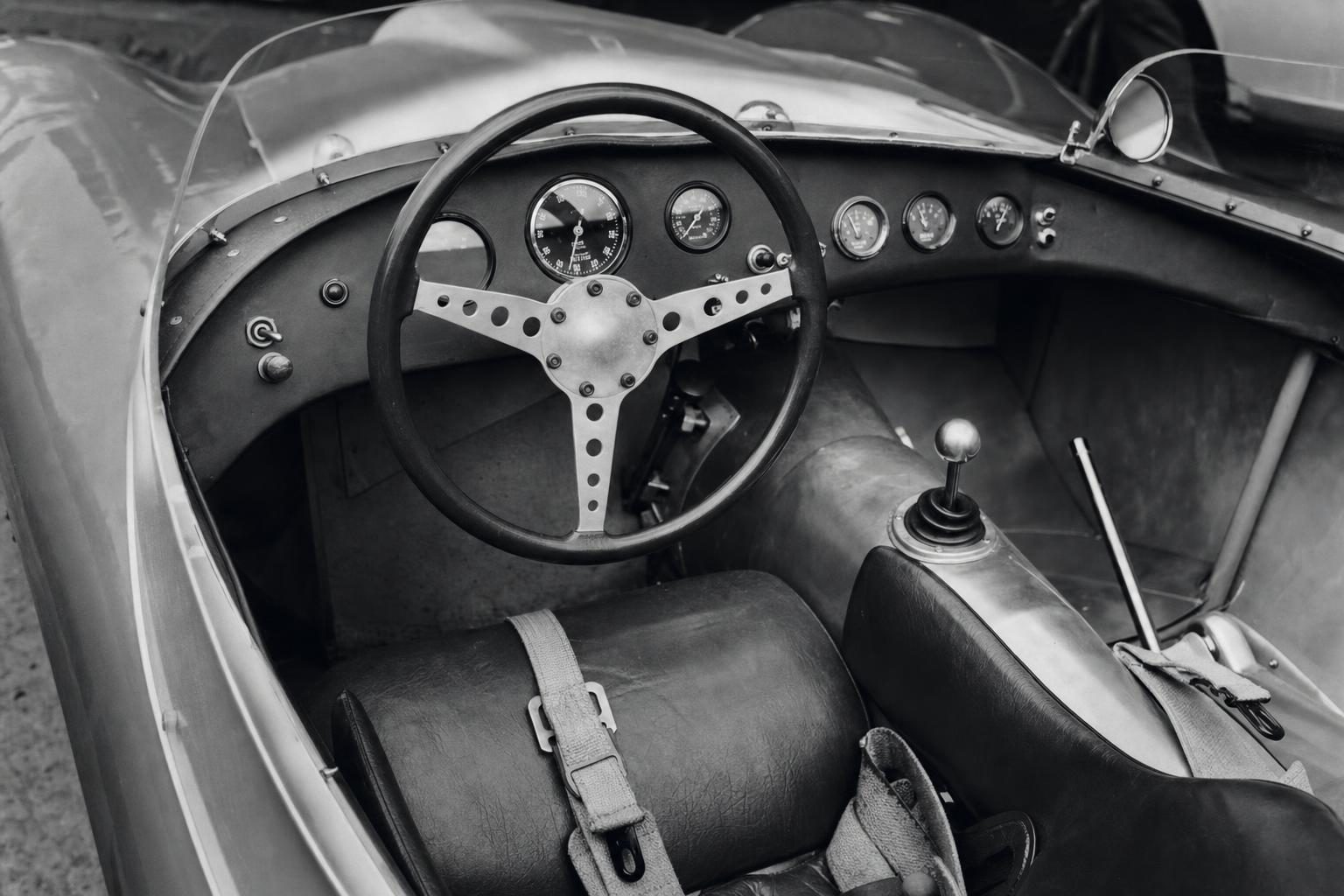
Le Mans 1959 was also won in the pit lane. Faced with Ferraris dominant on pace, the team had to smooth the stops, protect the transmissions and preserve the brakes. Wyer imposed disciplined sequences, with stints calibrated to avoid exposing the cars to hazardous end-of-stint sprints. The idea was simple: when the opponent sprints, maintain an impeccable baseline pace and minimise randomness at every service.
The Moss/Fairman car, armed with its 255 PS, was used as a tactical lever. It could force a strategic overtake, then yield to a sister car to capitalise around a better-timed stop. This choreography required mechanics working to the millimetre and a clear briefing for the drivers, all co-ordinated by Wyer and Parnell. At night, when an error can cost two laps, clean procedures serve as an anti-panic barrier.
In this game, consistency paid. The plan, as relayed by Wikipedia sources, aimed to absorb pressure without overreacting. Temperatures were monitored, refuelling was timed to avoid the midnight bottleneck, and fresh stints were kept for dawn. Without unnecessary theatrics, pit stop management became an instrument of regularity — the most British quality of all.
The fortuitous retirement of the leading Ferrari and what it reveals about Aston Martin’s preparation
The turning point was brutal: the leading Ferrari — three laps ahead after more than nine hours — suffered major overheating problems and dropped out. The bare fact, noted by Wikipedia, swung the race back towards Aston Martin. In the moment, it looked like a stroke of luck. On analysis, it was mainly a revelation: sustaining the pace means mastering temperature, fluids and wear at a relentless cadence. Here, the Italian attack met physics.
Aston Martin’s more tempered preparation sought to avoid this kind of failure. Between standard engines on two cars and disciplined servicing, the marque invested in resilience. Regular stints, parameter monitoring, and the ability to keep brakes and healthy lubrication at dawn all build cumulative time — and turn a rival’s failure into a decisive advantage.
This is not to downplay Ferrari’s performance, but to read its limits over 24 hours. Le Mans 1959 restated the obvious: a strategy that sacrifices a few seconds per stint to spare the machinery often claws back whole minutes. The double-edged approach — prudence on two cars, incisiveness on the third — put Aston Martin in position to exploit the opportunity when it arose.
The final classification and what the 1-2 meant for the marque after 31 years of attempts
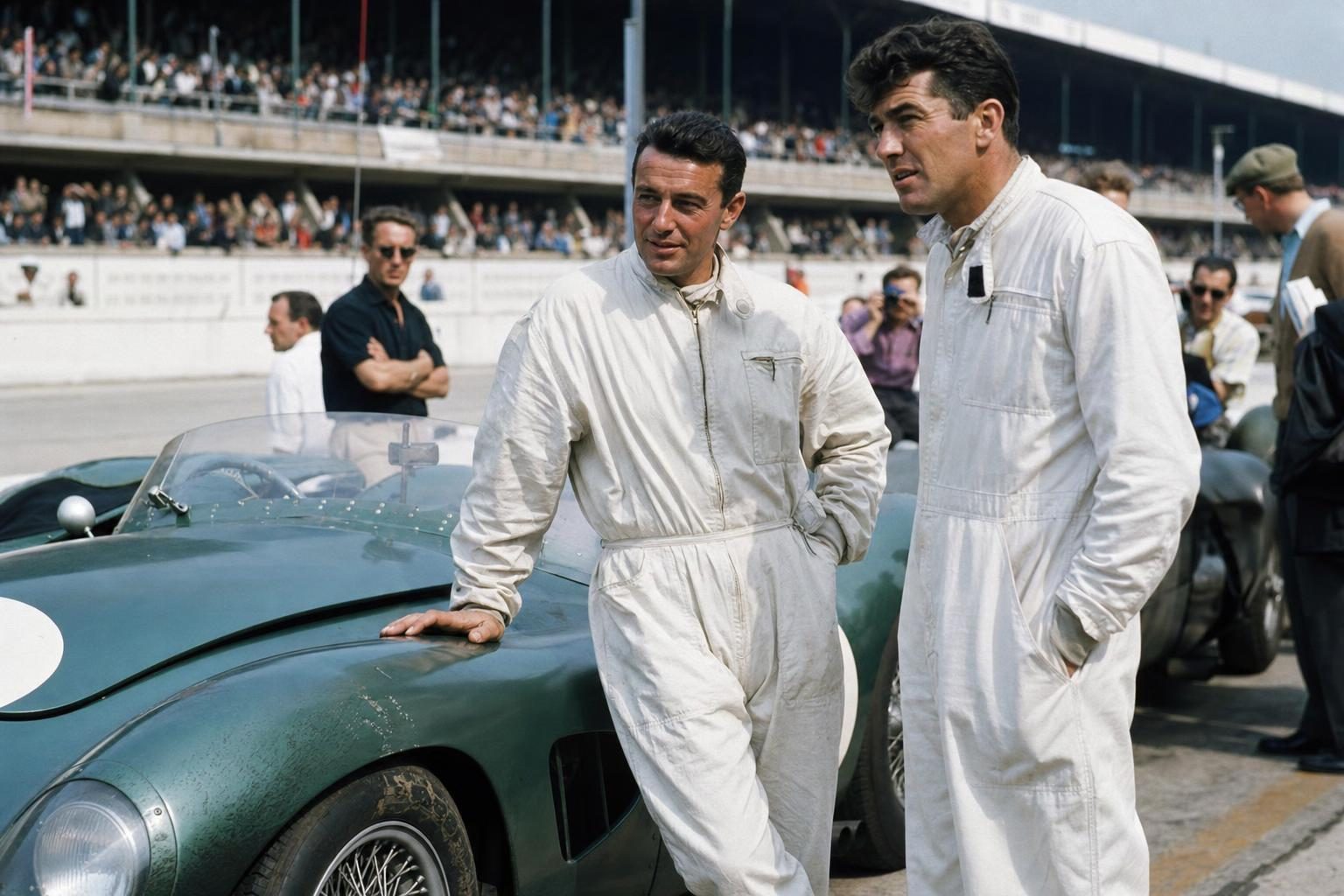
The verdict was clear: an outright 1-2 for Aston Martin at the end of Le Mans 1959. The historical weight stands out when you recall the marque had been racing at Le Mans since 1928 (without interruption since 1931) and had accumulated three second places and two third places before that year. In other words, 1959 was no enchanted parenthesis; it was the completion of a long continuum of learning.
This result crowned the methodical approach of Wyer and Parnell: a compact team, measured technical differentiation, controlled pit work, and the clarity to absorb randomness — here, the retirement of the leading Ferrari. For an overview of the edition, the summary on the 1959 24 Hours of Le Mans page places this 1-2 in the context of a dense, competitive field.
In Aston Martin’s history, this victory marked a heritage milestone that feeds the brand’s culture as much as its present on track. Our retrospective of Le Mans campaigns and the world championship puts Le Mans 1959 at the heart of a common thread — rigour, endurance, tactical intelligence — that can be seen, in its own way, even in the marque’s current motorsport. For further insight, the official page dedicated to Aston Martin’s racing DNA is available via the history of Aston Martin’s motorsport programme.
Conclusion — Le Mans 1959, four decisions that make a victory
Stripped of grandiloquence, Le Mans 1959 is explained by four clear decisions: three cars rather than four, a “spearhead” DBR1 with 255 PS for Moss/Fairman, a no-frills pit strategy, and the ability to turn rivals’ mechanical woes into lasting advantage. Nothing exotic, everything effective. To extend the analysis through the winning car, our feature on the DBR1 and the keys to 1959 follows the same logic, with parts and drivers to hand, and our DB4 profile revisits the road-going cousin of a pivotal era. In a discipline fond of myths, this 1-2 reminds us that precision is often the finest legend.