Vulcan AMR Pro: in 2017, Aston Martin fine-tunes the delivered Vulcan with dive planes, louvres, twin-element wing and shortened final drive, downforce raised to 4,000 N.
Vulcan AMR Pro is the unusual story of a track hypercar delivered to 24 owners in 2016, then reworked by Aston Martin in 2017 to gain downforce and precision without touching the 7.0-litre V12 with 831 PS. Announced at Goodwood, the AMR Pro package increases total downforce, moves the centre of pressure forwards and shortens the final drive ratio. Here, piece by piece, is what sets the Pro version apart from the original car already in owners’ garages.
Goodwood 2017: why Aston Martin presented an upgrade for a car whose production had ended
On 29 June 2017, at the Goodwood Festival of Speed, Aston Martin officially unveiled the AMR Pro package for the Vulcan (source: Aston Martin media release). The manufacturer did not restart production: it offered an upgrade for the 24 existing cars, via the Q division, at owners’ request (source: dedicated Wikipedia page). The approach is clear: refine an already extreme machine without overhauling its mechanics.
According to Aston Martin’s official communication, aerodynamic downforce rises from around 3,150 N for the standard Vulcan to 4,000 N at 100 mph with the AMR Pro, while moving the balance forwards (from 41.5% to 47%). In other words, the upgrade corrects load distribution and strengthens stability, to the benefit of traction and steering. For a circuit car, the gain lies in these nuances.
The positioning is also strategic. The Vulcan, launched at Geneva in 2015 in 24 units (2.3 million dollars each, source: Wikipedia), is not intended to race, but to offer its owners a complete track experience. A factory package, validated by the marque, anchors the technical and heritage value of these exceptional barchetta coupés without unnecessary mechanical one‑upmanship.
Dive planes and wing louvres: the measurable effect on front downforce
Top objective of the AMR Pro: strengthen front downforce and move the centre of pressure forwards. Aston Martin reports precisely this shift from 41.5% to 47% and the increase in total load at 100 mph (source: official news). The translation on track is clear: a front axle that bites harder in long loaded corners, better support under braking, and more readable steering in fast sequences.
The available documents list the achieved effect, not a line‑by‑line parts breakdown. They do, however, confirm the aerodynamic intent and its measured figures. That is the key takeaway: the update acts first on front‑end behaviour, with results publicly quantified by the manufacturer, then validated by the retrofit offer for all existing cars via Q by Aston Martin.
To place the car within Gaydon’s hypercar lineage, our dossier on the original Vulcan recalls its role as a track laboratory against road models such as the One‑77. For context and key specifications, see: the dedicated Vulcan profile and the One‑77’s technological DNA.
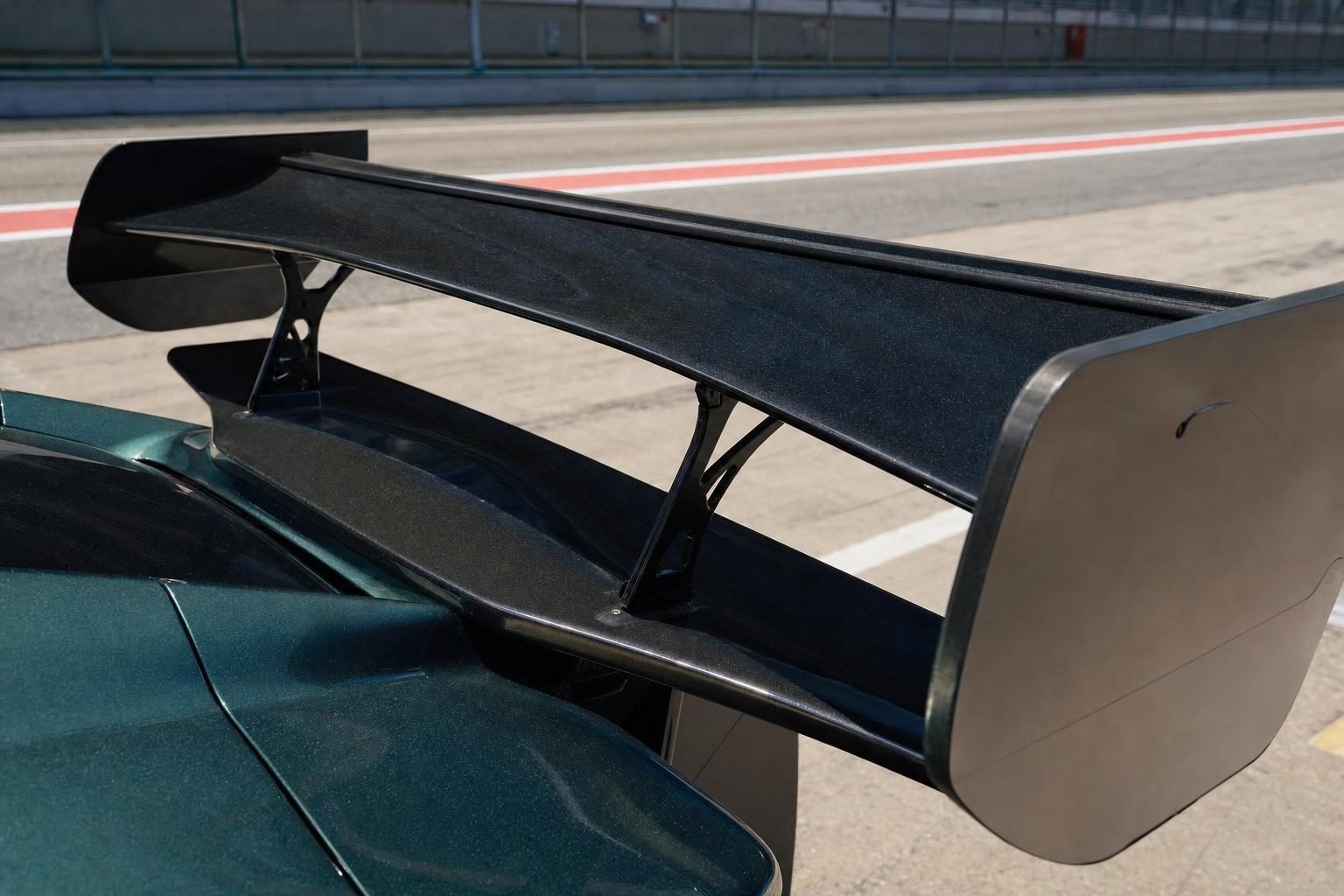
The twin‑element rear wing with Gurney flap: from 3,150 N to 4,000 N at 100 mph
The number that sums up the AMR Pro philosophy is a clear step: about 3,150 N of downforce for the standard Vulcan, 4,000 N at 100 mph once the update is installed (source: Aston Martin official site, 29/06/2017). This extra margin brings the car closer to modern endurance behaviour: more high‑speed stability and a more planted rear, while retaining exploitable traction.
Beyond the total downforce, Aston Martin publishes the forward shift of the centre of pressure. Together, these two data points explain why the AMR Pro version feels keener on turn‑in and more neutral mid‑corner. The benefit is not just a figure in a press release: it is a load distribution that breathes better, boosting driver confidence.
To trace the lineage and return to Vulcan fundamentals, our analysis of the track hypercar and its naturally aspirated 7.0‑litre V12 with 831 PS is here: the 820 PS track hypercar in detail. It places the Vulcan AMR Pro within the technical framework that precedes it.
The shortened final drive: what the transmission change brought between corners
Wikipedia notes that the AMR Pro adopts a shortened final drive to improve acceleration between corners, without modifying the engine or the six‑speed sequential gearbox. The mechanical heart therefore remains identical, but the final ratio tightens response in the useful ranges of technical circuits.
In practice, this choice sharpens the punch out of bends and lets you use the V12’s power core at 7,750 rpm more often. On a circuit where the straights cap out at certain speeds, that’s lap time gained without touching reliability. True to the AMR Pro spirit, the optimisation happens where it counts most.
This point illustrates the package’s overall philosophy: act on measurable levers (downforce, balance, final drive ratio) to transform the experience rather than piling on horsepower. On a car delivered in 24 examples, the move is both technical and heritage‑minded.
The driver training programme and chosen circuits: why Spa, COTA and Yas Marina
The official sources listed here focus on the presentation, downforce figures, the shift in centre of pressure and the final drive. They do not detail any potential driver training programme or the circuits associated with the Vulcan AMR Pro. We therefore remain factual: the AMR Pro is a factory package offered by Q to all owners of the 24 cars, with publicly quantified aerodynamic gains.
In the absence of documented information on this precise point in the sources used, let’s retain the essentials: Aston Martin’s intervention targets parameters that directly shape on‑track behaviour, and it is accessible to the entire delivered fleet. That is rare, and telling enough without extrapolation.
To follow the marque’s official announcements and technical publications, the manufacturer’s pages and their press room remain the most reliable references: Aston Martin site and AMR Pro launch media release.
Conclusion: what the Vulcan AMR Pro really changes
From the facts published by Aston Martin, the Vulcan AMR Pro boils down to three precise moves: more downforce (around 4,000 N at 100 mph), a forward balance (47% centre of pressure to the front) and a shortened final drive. The 7.0‑litre V12 and six‑speed gearbox remain unchanged, a guarantee of mechanical integrity.
Presented at Goodwood in 2017 and offered via Q to all owners of the 24 cars launched at Geneva in 2015, this package marks the maturity of an already extreme track project. The Aston gains stability, clarity and bite between corners — exactly where a circuit weapon is judged.
For more, Aston Martin’s data published on 29 June 2017 and Wikipedia’s summary of the Vulcan put the AMR Pro in its technical context: the official AMR Pro figures and the Vulcan overview page. The rest lies in the right settings: a discreet evolution on paper, obvious on the stopwatch.