British supercar and 1977 V8 Vantage: engines, power figures, variants and X-Pack, with a precise buying guide and sources that diverge
The British supercar began as a black-and-white ambition in February 1977 with the V8 Vantage. From a technical and heritage angle, this monograph revisits four engineering decisions that made that claim credible, while confronting the disputed power figures. On the agenda: timeline, engines, body styles, X-Pack and valuation markers — without hype, but with the right sources.
February 1977: an announcement that caught rivals off guard
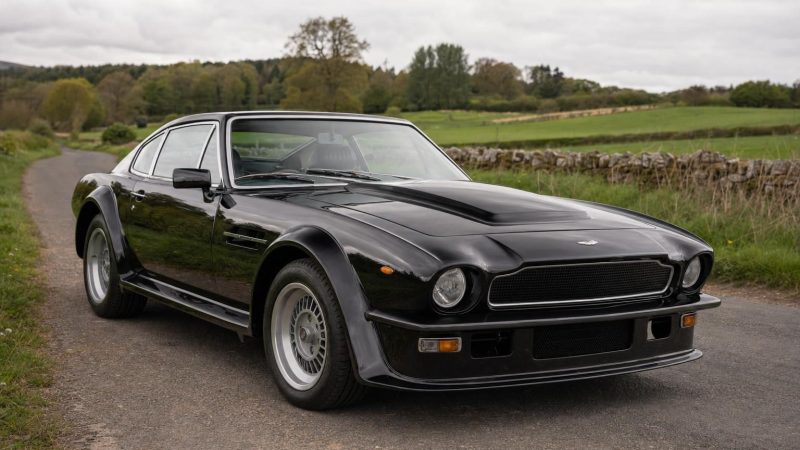
On 18 February 1977, Aston Martin made the V8 Vantage official, a declaration of intent as crisp as its louvred bonnet. According to Aston Martin, the car claimed a top speed of around 170 mph and 0–60 mph in 5.2 s, figures which, at the time, put Newport Pagnell in the conversation for the fastest road cars. This immediate authority stemmed from a clear strategy: start from the AM V8 and elevate it to a brawny GT, without losing British driving manners.
Faced with the natural scepticism of rivals, independent measurements add texture. Autocar recorded 5.4 s for 0–60 mph, while Motor noted 168 mph flat out (figures reported by Nicholas Mee). A modest gap, yet revealing: the V8 Vantage plays in the very fast league while remaining a dense, civilised British GT.
This break sits in the lineage of the AM V8 launched in 1969, whose architecture it radicalised. To place the V8 Vantage on its family tree, our dossier on the AM V8, first production V8 at Aston Martin sheds light on the technical continuities, from heads to fuelling, that make the evolution credible rather than spectacular.
The 5.3‑litre V8 and the 380 PS question: where sources disagree
Behind the rhetoric of the “first British supercar” lies a deeply optimised 5.3‑litre carburetted unit. Aston Martin cites an increase of around 40% in power over the standard V8, via targeted work: raised compression ratio, sharper cam profiles, freer intake and exhaust. But how many horses in reality? Here the sources diverge.
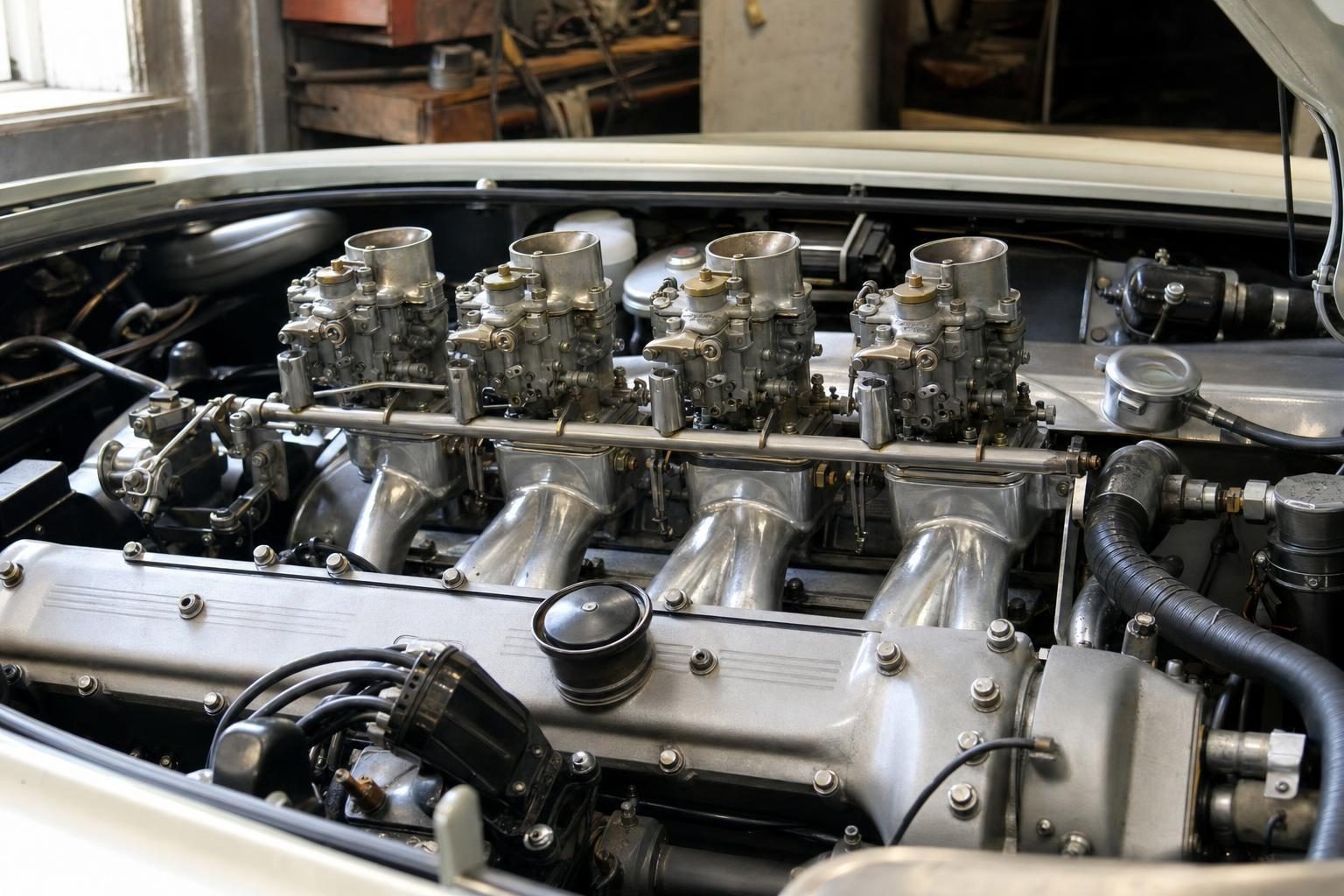
According to Nicholas Mee, long‑standing specialist and dealer, the “regular” V8 Vantage delivers 375 PS at 6,000 rpm. Wikipedia mentions 380 PS at 5,800 rpm with four Weber 48 IDF. Aston Martin’s communications prefer to highlight the percentage gain rather than a raw figure, which speaks volumes about Newport Pagnell’s caution in the face of independent dynos.
Beyond peak power, the V8 Vantage shines for its mid‑range punch. In 4th, from 50 to 70 mph, it records 6.3 s, almost a second better than a contemporary Porsche Turbo (measurement reported by Nicholas Mee). It is precisely this in‑gear shove that anchors the idea of a British supercar: a heavy GT that pounces like a big cat at the merest brush of throttle.
Three body variants, 304 Series 2 coupés and 192 Volantes: the geography of production
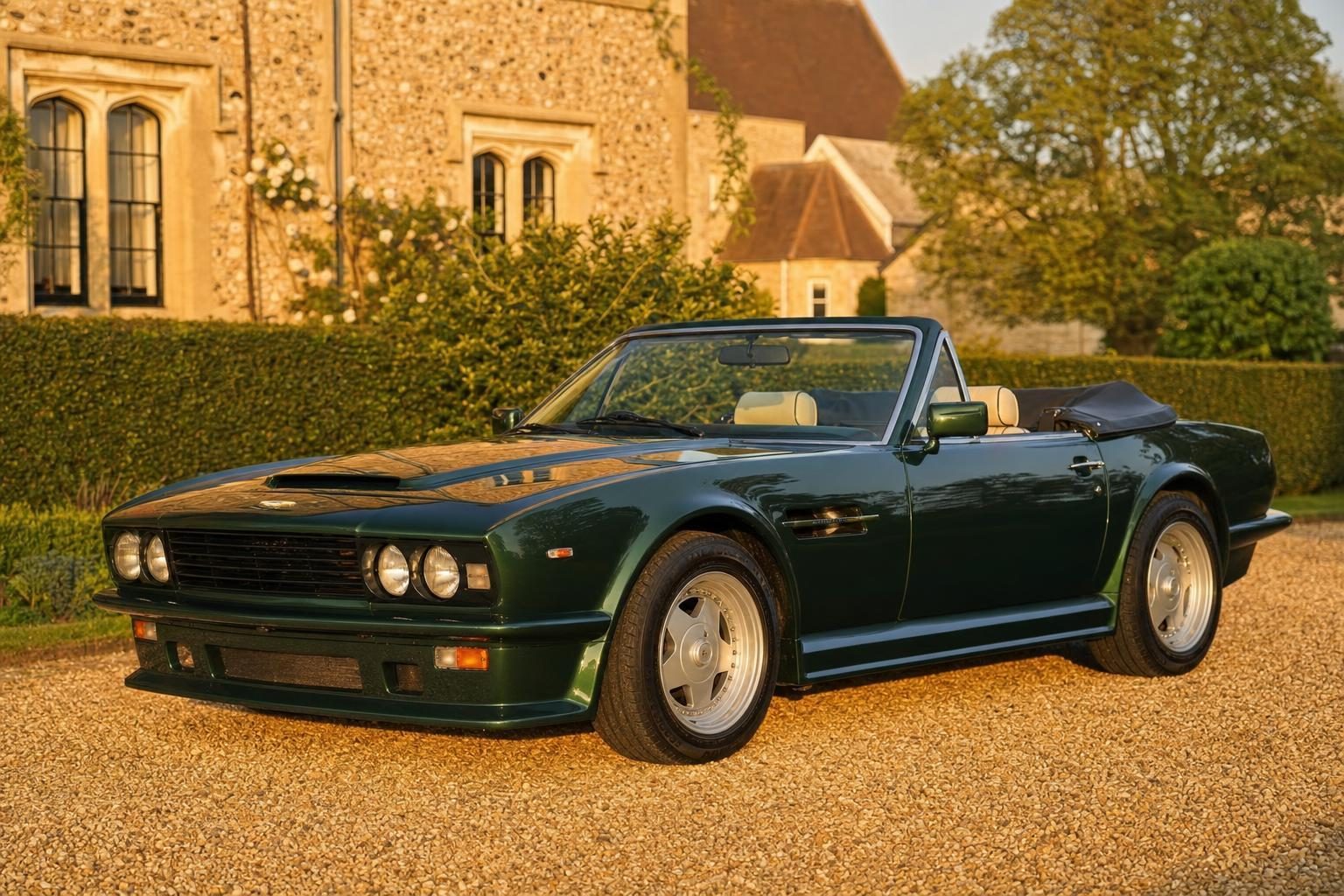
The 1977 V8 Vantage evolved into a carefully managed constellation of variants, each body telling a nuance of use. Wikipedia lists 304 Series 2 coupés built, a significant portion of which would later adopt X‑Pack specifications, and 192 Volantes, the convertible that translates speed into a more contemplative grammar. Modest figures on an industrial scale, they contribute to the heritage rarity sought by collectors.
The segmentation first answered markets: coupé for rigour, Volante for milder climates and grand touring pleasure. Exterior details — prominent front spoiler, “bulged” bonnet, side louvres — evolved by successive touches, yet the signature remained identifiable. To explore the product environment of the following decade, our profile on the Virage helps grasp the continuity of style and philosophy.
The technical base remains that of the AM V8, reinterpreted. In this respect, the page our AM V8 models offers a useful panorama of this lineage, to spot at a glance the visual and mechanical cues separating a Vantage from a classic AM V8.
The 580 X‑Pack of 1986: Newport Pagnell pushes the slider without changing capacity
In 1986, Aston Martin introduced the 580 X‑Pack, a synthesis of engine updates grouped under an in‑house designation. Without touching capacity, Newport Pagnell further optimised breathing and chambers, bringing the Vantage to a level of performance and reliability compatible with late‑1980s demands. Again, the marque cultivated discretion on absolute numbers, preferring dynamic appraisal to dry statistics.
In the same spirit of continuous improvement, Works Service offered the 6.3‑litre RS Williams conversion, credited with over 460 PS (figures reported by Nicholas Mee). A parallel, more demonstrative path, underlining how the original architecture tolerated substantial increases without betraying its character. The V8 Vantage thus asserts itself as a chassis with headroom, true to the ethic of a British supercar made for the road, not just a dyno.
This abundance of late options explains the diversity of cars on the market: between a sober “early” Vantage and a muscled X‑Pack, the gap in sensations is tangible, even if the logbook reads the same. Hence the importance of thoroughly documenting the car, with maintenance history to hand.
Values and buying guide: what sets an ordinary example apart from a Prince of Wales Spec
At the summit of desirability sit the rare Prince of Wales Spec cars. Following an order placed by Prince Charles in 1987, 26 examples are said to have been built (per Wikipedia). You recognise this configuration by its more restrained presentation — often without a spoiler — and settings favouring overall elegance. It concentrates purist interest, with a logical heritage premium on the market.
Next come factory X‑Packs, highly sought after for their vigour. 137 units are said to derive from Series 2 according to Wikipedia, making a subset rare enough to merit particular attention in an inspection. Later conversions — including the 6.3‑litre kit — can appeal, but their value follows execution quality and traceability rather than sheer power figures.
To buy with confidence, check: the authenticity of specifications (build plates, archives), the condition of the loom and fuel system (Weber 48 IDF on many cars), thermal health (radiator, viscous coupling), and body/chassis fit. A road test should confirm expected performance: a healthy Vantage repeats its canonical in‑gear times with ease and tracks straight at high speed, underpinning its stature as an old‑school British supercar — more blue‑collar than sequinned suit.
Finally, factory documentation remains a useful compass. The official page dedicated to the 1977 V8 Vantage sets the historical frame, while the encyclopaedic entry and the Nicholas Mee guide gather period measurements and usual specifications — three complementary views to objectify a car where every detail counts.
Conclusion — British supercar, a claim owned
In the final tally, four decisions built the credibility of the 1977 V8 Vantage: the early, quantified announcement; the optimised 5.3‑litre V8 despite disputed outputs; a tight yet legible range of body styles; and the measured escalation of the X‑Pack. The British supercar concept takes on a precise meaning here: a torque‑rich GT, fast in the real world, shaped with a restraint that ages well. Whether sources prefer 375 or 380 PS, the essence lies elsewhere: technical coherence and road temperament, which made this Aston a cornerstone of Newport Pagnell.