DB2 Le Mans: how David Brown’s first car dominated the 3‑litre class in 1950 and achieved a class triple in 1951, with John Wyer calling the shots.
DB2 Le Mans is above all a story of consistency: between 1949 and 1951, the young Aston honed by David Brown racked up solid finishes, class wins and a reputation for reliability that would matter. We look back, season by season, at the factual results, the Wyer method and what they changed for racing at Newport Pagnell. The angle is simple: let the figures and the standings — overall and class — do the talking to understand why the DB2 at Le Mans became a template.
Le Mans 1949: three prototypes, a failed water pump and a mixed result
In 1949, Aston Martin entered three pre‑series cars at the Sarthe, one of them fitted with a Lagonda straight‑six. The move was bold; the penalty, immediate: that car retired on lap 6 with a failed water pump, according to Wikipedia (DB2). The other two prototypes, including one with a two‑litre four‑cylinder, played the long game rather than chasing fireworks.
That measured bet paid off: the four‑cylinder DB2 climbed to 7th overall (source Wikipedia, DB2), a sign of a sound technical base despite the heterogeneity of this trial trio. Not a thunderbolt, but a promising first snapshot of Aston’s post‑war endurance. For a marque that had just integrated the Lagonda twin‑cam acquired by David Brown, there have been far choppier baptisms.
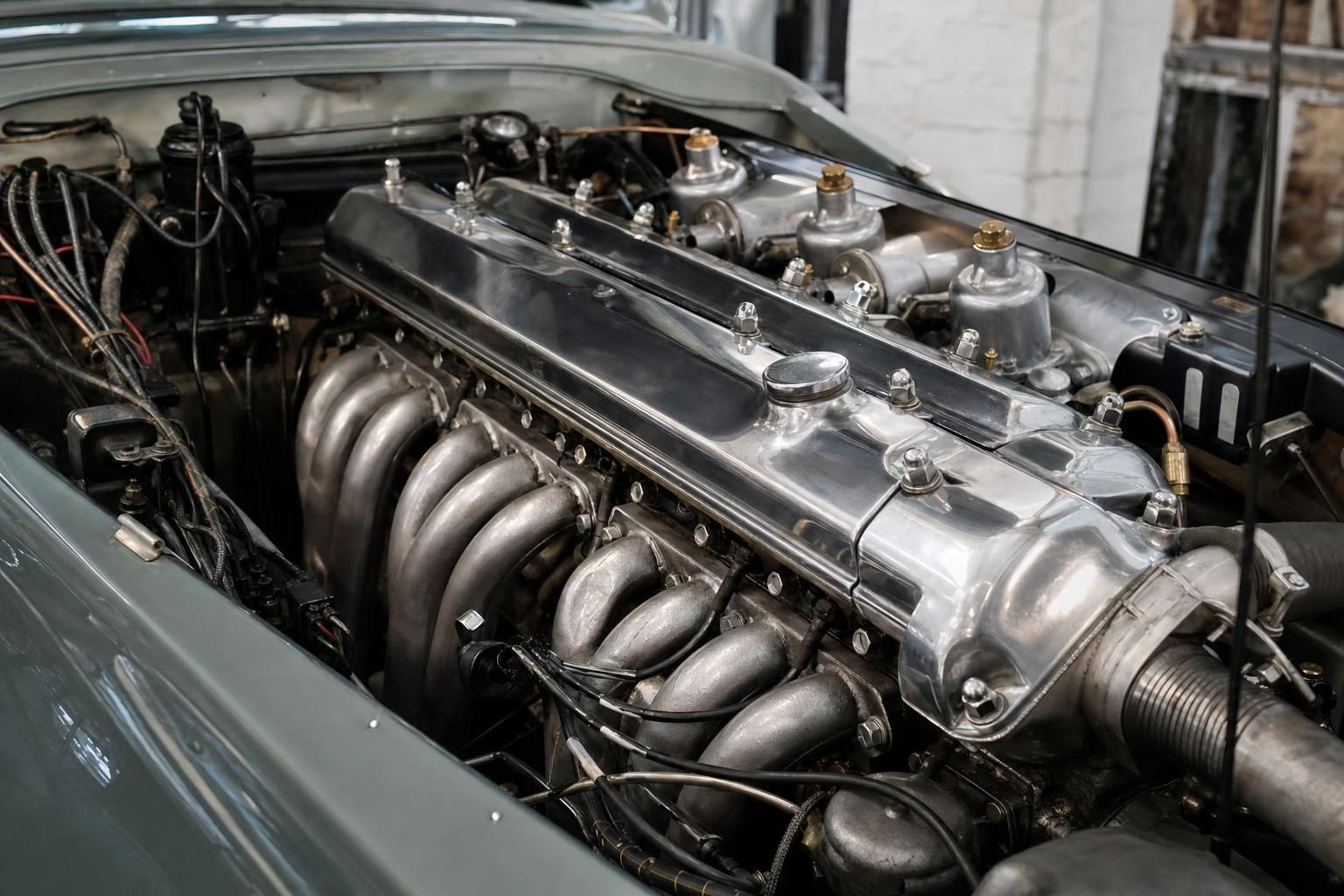
In the background, the mechanicals were evolving. The 2.6‑litre Lagonda twin‑cam engine, designed by W.O. Bentley’s team and acquired by David Brown in 1947, gradually established itself as the cornerstone of the project (source pressroom Aston Martin). It would give the DB2 its breathing and its endurance — two qualities that thrive on patience as much as power.
1950: two DB2s in the overall top five and the class win
A year later, things became far clearer. At Le Mans 1950, Abecassis and Macklin finished 5th overall, while Brackenbury and Parnell took 6th. According to Wikipedia (DB2 and 1950 24H Le Mans), the two crews delivered a one‑two in the 3‑litre class. On paper, a step forward. On track, a coherence: drive fast, but finish intact.
The contrast between overall and class results becomes readable here. Fifth and sixth on scratch may look modest; first and second in class is the loud message. In a post‑war context where reliability remained a scarce commodity, the Aston approach paid off. DB2 Le Mans began to shape its profile: disciplined, enduring, methodical.
That 1950 season also drew a cultural line: the idea that a class victory isn’t a lottery but the product of a strategy. The result fed the marque’s DNA and slotted into a long‑term programme, far beyond a roll of the dice over 24 hours.
1951: five entries, five finishers and a triple in the 3‑litre class
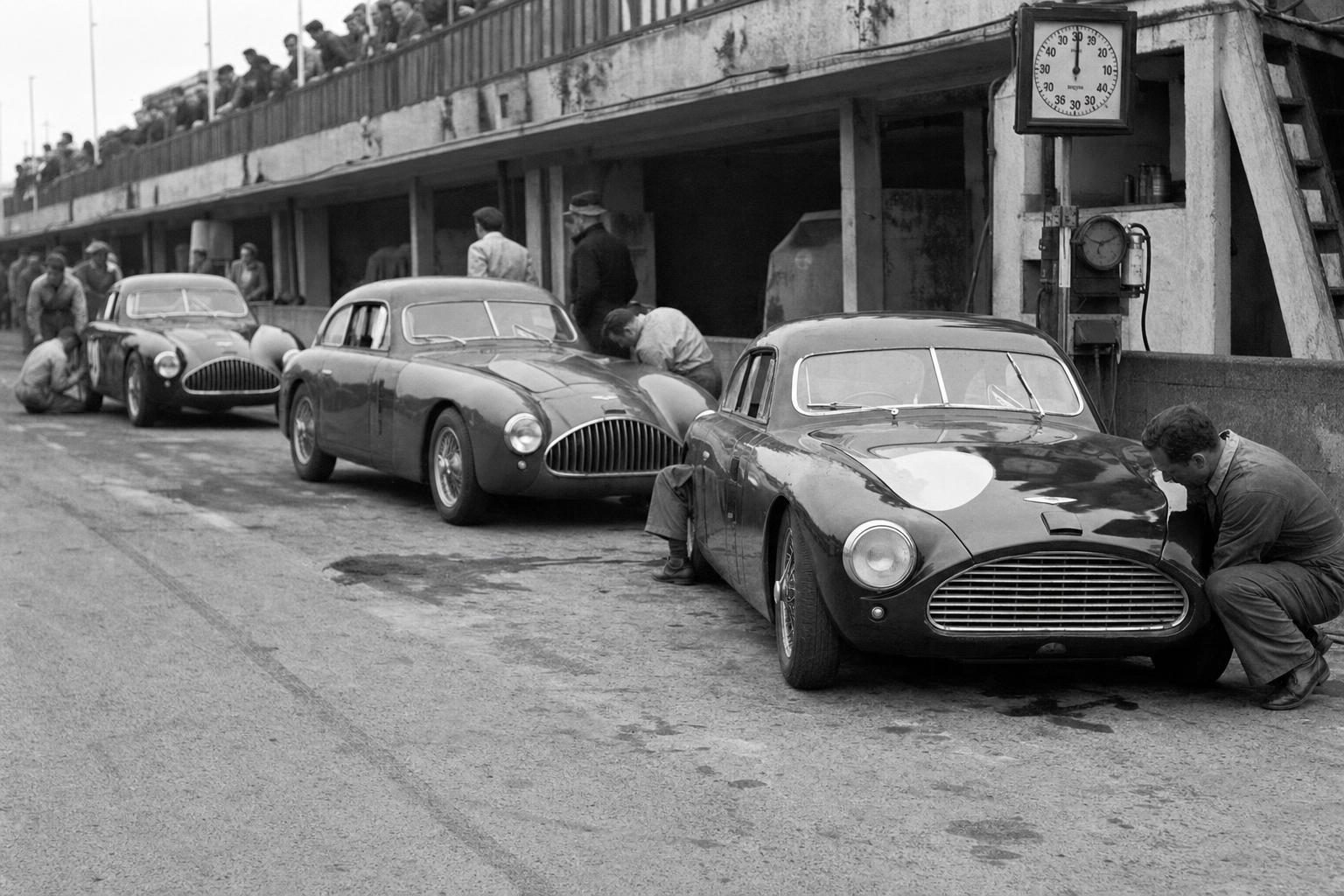
In 1951, John Wyer shifted up a gear. Three works DB2s were entered, joined by two privateers. The verdict, according to Wikipedia (1951 24H Le Mans): five cars started, five finished, with the best in 3rd, 5th and 7th overall — and, above all, a clean sweep in the 3‑litre class. DB2 Le Mans 1951 was the method at its point of balance: a homogeneous fleet, tidy stints, no‑drama pitwork.
The most telling example boils down to one figure. The Macklin/Thompson crew spent only ten minutes in the pits over the full 24 hours (Wikipedia, 1951 24H Le Mans). Ten minutes is a well‑timed fuel stop, an unhurried tyre change, and zero improvisation. At that level of parsimony, regularity becomes an art.
The 3‑litre class triple then endorsed the trajectory set in 1949 and affirmed in 1950. The overall placings — 3rd, 5th, 7th — gave Aston well‑rooted legitimacy. The class results confirmed the original intent: to be sovereign where you choose to play, without chasing the mirage of an absolute win out of reach. It may be less photogenic than a firework, but infinitely more durable.
John Wyer and the difference‑making method: reliability over speed
Wyer prioritised rational preparation, logistics and race discipline over raw speed. This almost ascetic choice was all the more convincing as it rested on a mechanical base signed Lagonda 2.6‑litre twin‑cam, inherited from W.O. Bentley and brought into David Brown’s portfolio in 1947 (source media Aston Martin). DB2 Le Mans became the rolling expression of this doctrine: no showboating, just results.
Those years revealed a simple truth: at the Sarthe, speed is rented by the minute, reliability is bought by the year. In 1951, ten minutes of pit time for Macklin/Thompson over 24 hours sketched Wyer’s signature better than a long speech. The gap between overall and class standings isn’t a misunderstanding; it’s a deliberate — and rewarding — strategic line.
Beyond the track, this method shaped an internal culture. It irrigated car preparation, crew selection and relations with privateers. It reminded, in filigree, that endurance is not the multiplication of one qualifying lap but the ability to repeat a clean gesture 300 times, by day and by night.
The legacy of these results for David Brown’s racing programme
Between May 1950 and April 1953, 411 DB2s left the workshops (Wikipedia, DB2). This measured production run, for a post‑war GT, anchored the idea that racing can feed the road car line without draining it. The grouped finishes of 1950 and 1951 gave substance to a clientele that wanted to drive far, not just fast. The foundations of a lasting reputation are clear to see.
Continuity also shows in the statistics. Aston Martin claims, across the 1950s, six class wins at Le Mans with the DB2 (Aston Martin release, 2023). It’s a line on the record often eclipsed by tales of overall victories, but it forged Aston’s endurance credibility and prepared the factory programme’s next steps.
That next step would later reach the summit with the DBR1 and the outright win of 1959 — a story detailed in our feature on the DBR1 and the keys to the 1959 Le Mans victory. In the meantime, the DB2 Le Mans school taught the factory to capitalise on reliability and to convert a strategy into measurable results, season after season.
To extend the technical and roadgoing portrait of the line, see our dedicated page on the Aston Martin DB2 road car, origins and specifications, and our overview of Aston Martin’s racing programmes at Le Mans and in the world championship.
Conclusion — DB2 Le Mans, endurance as a guiding principle
In three seasons, DB2 Le Mans progressed from an experimental trio in 1949 to a class one‑two in 1950, then to a clean sweep accompanied by five finishers in 1951. Solid overall placings and repeated class wins attest to a patient approach, shaped by John Wyer and served by the 2.6‑litre Lagonda. For Aston Martin, the lesson is clear: when reliability leads, performance follows. And, sometimes, it doubles and triples the stake.
To go further, explore the encyclopaedic entry on the DB2 and its detailed endurance results, the historical documentation from Aston Martin’s press office, and the reminder of class wins in the official release on the targeted 20th class win in 2023. History is never far from the pits — especially when you know how to count to ten minutes.