VH platform, how a bonded aluminium architecture relaunched Aston Martin with the DB9 and its derivatives, up to the DB11 and the AMG era.
The VH platform was Aston Martin’s common language for two decades: understand its logic and you grasp why so many coupés and GTs share such similar proportions, temperament and driving signature. Conceived as a modular bonded aluminium framework, the VH platform made it possible to industrialise in-house elegance without diluting it. Here’s how it was born, what it enabled, where it hit its limits and what it passed on to the next generation.
Birth of VH: what Ford funded at Gaydon in 2001
At the turn of the 2000s, Aston Martin benefited from Ford’s financial backing. The key investment focused on Gaydon, a new industrial site and development centre where a shared technical base would emerge. According to Wikipedia Aston Martin, the DB9 became in 2004 the first model produced at Gaydon, marking a handover from Newport Pagnell. The industrial tool was not the only factor: the very architecture of future Astons was scaling up.
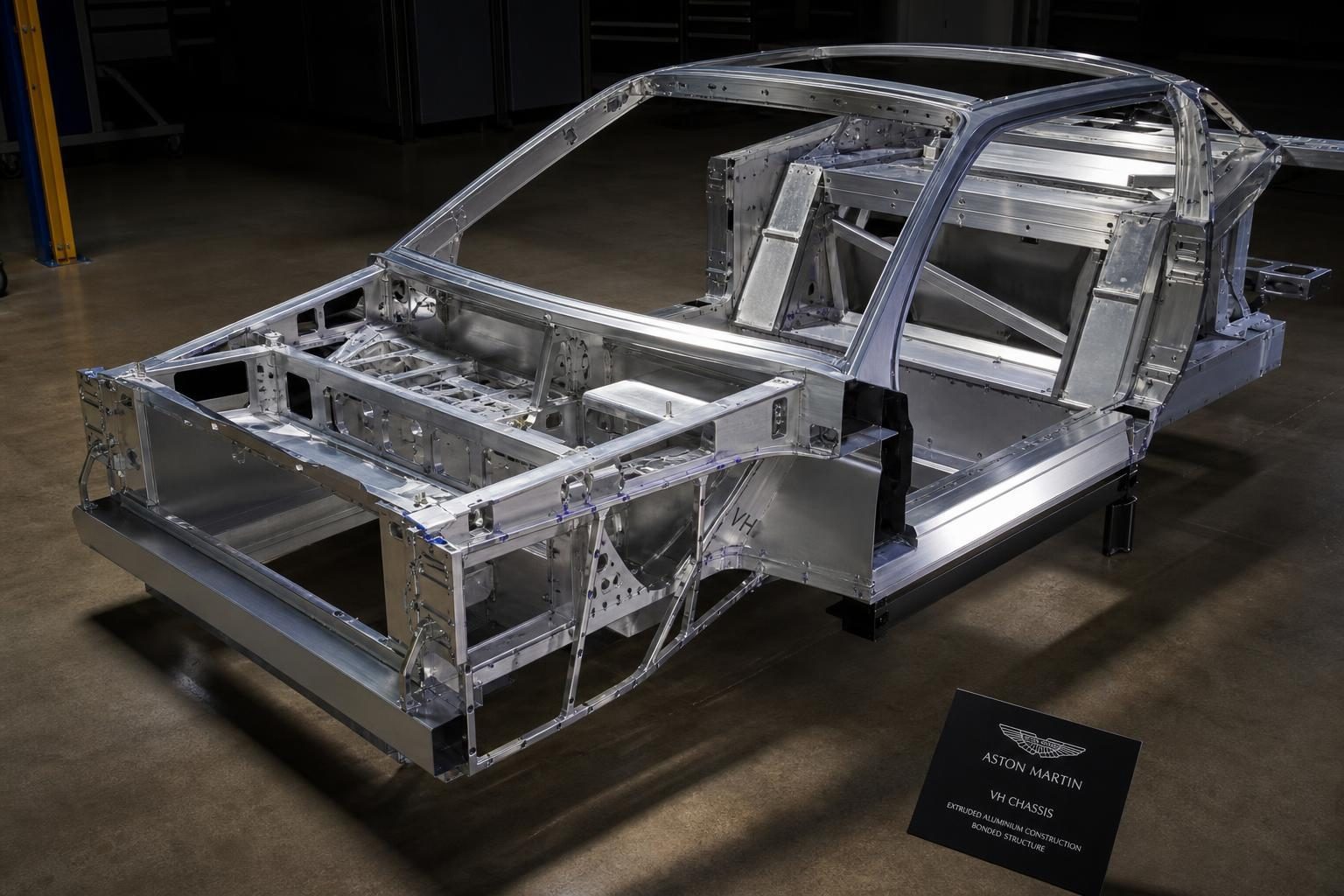
The VH platform, short for Vertical/Horizontal, structured this transformation. The idea: a scaffold of extruded and cast aluminium elements, assembled by bonding and riveting, able to be lengthened, shortened and stiffened according to the model. This VH platform was not a “single chassis” but a grammar, with as many declensions as there were body styles. The promise was twofold: control costs and guarantee a shared dynamic signature.
This technical foundation also became a brand tool. By basing different models on the same engineering core, Aston Martin could preserve a house style — long bonnet, set‑back cabin, muscular tail — while varying uses, from 2+2 coupé to sports saloon. Beneath the silhouette, a common framework and shared processes ensured coherence.
Bonding and aluminium: the technique that made the DB9 possible and profitable
The key to the VH platform lay in the structural bonding of aluminium. In place of a welded steel body, aluminium sections were extruded, machined, then bonded and riveted. Adopted in series with the DB9 launched in 2004, this technique lowered weight, increased torsional rigidity and simplified manufacture. It was the industrial lever that made the DB9 possible — and crucially, profitable at Aston Martin’s scale.
On the product side, the VH platform allowed noble powertrains and sophisticated running gear to be installed in a lighter envelope. On the industrial side, assembly by bonded modules, prepared off line, streamlined production at Gaydon. For a niche marque, this efficiency made the difference, as we explain in our feature on the DB9 and bonded aluminium architecture.
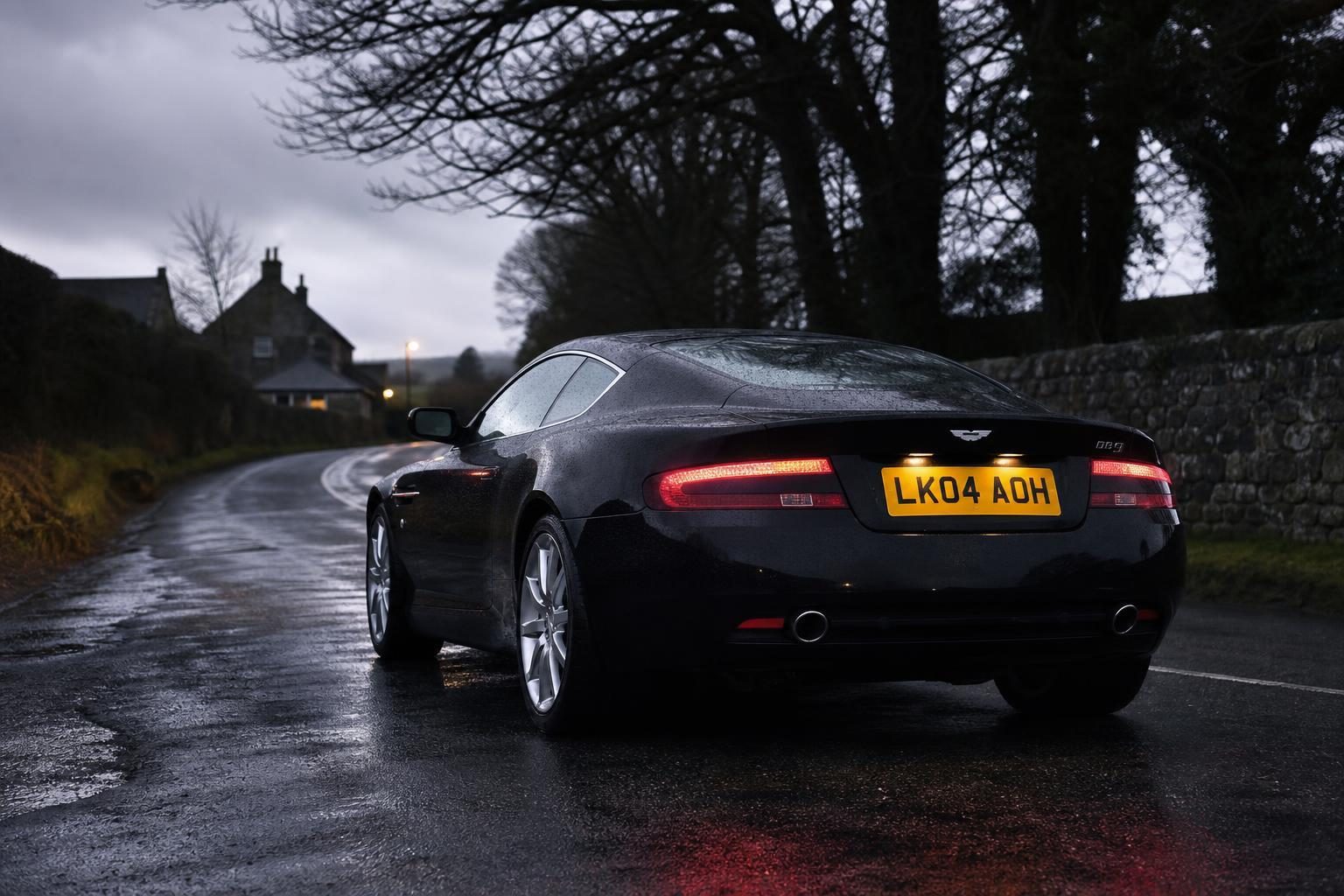
The DB9, the first series‑production model built on this approach, also served as a showcase. Its light structure, combined with high rigidity, opened the door to more precise chassis tuning, better‑filtered GT comfort and improved refinement through its derivatives. The VH platform was therefore as much a technical backbone as a range accelerator.
Six models, one chassis: DB9, DBS, V8 Vantage, Rapide, Virage, One‑77
The strength of a modular base is measured by how many variations it accepts without denying its character. From 2004 to the mid‑2010s, six major models shared the framework: DB9, DBS (2007), V8 Vantage (2005), Rapide, Virage and One‑77. All maintained the feline proportion and stance of a British GT, each interpreting it in its own register.
The DB9 set the template and balance. Its English Wikipedia entry recalls its role as the first Aston of the “Gaydon era” and the series pioneer for bonded aluminium. The 2007 DBS sharpened the approach, with a more sporting brief and honed chassis settings, as documented by Wikipedia’s dedicated page. The V8 Vantage (2005) condensed the recipe into a compact format, demonstrating the VH platform’s versatility, while the Rapide stretched it into a four‑door sports saloon without losing the house signature.
Between the two, the Virage occupied a subtle middle ground, proof that the play of modules and tuning could narrow gaps to speak to different clients. Finally, the One‑77 pushed the system to its limit. Our analysis of the One‑77 recalls its role as a manifesto: full carbon‑fibre body over a bonded aluminium chassis, 750 PS, and 77 examples. An ultra‑series illustrating the concept’s extensibility to the very exclusive.
In all, these variations prove the conceptual robustness of the format. The VH platform was not just an industrial base; it also forged an immediately recognisable “family likeness”, from coupé to saloon, from polished GT to hyper‑coupé.
The limits of VH: why it gave way to the AMG generation
No architecture lasts forever. As regulations and ambitions evolved, the VH platform showed its limits. On‑board electronics were advancing fast, energy efficiency too, and the need to integrate new powertrains imposed different compromises. The partnership signed with Mercedes‑AMG in December 2013, as Wikipedia Aston Martin notes, formalised the passage to a new era for engines and electronics.
The DB11, unveiled at the 2016 Geneva Motor Show, ushered in this shift with a 5.2‑litre twin‑turbo V12 of AMG origin and an all‑new platform. That was the end of the VH platform for new models. Yesterday’s structural coherence gave way to a base conceived for boosted powertrains, richer on‑board electronics and production volumes aligned with the following decade’s ambitions.
In this context, the decision was not a renunciation but pragmatic continuity. The VH platform had fulfilled its mission: rationalise, modernise, provide technical and stylistic headroom. The AMG generation would, in turn, deliver new gains in efficiency and digital integration, while preserving Aston Martin’s personality.
VH heritage: what it passed on to the DB11’s platform
While the DB11 turned the page, it did not forget the lesson. Dimensional rigour, attention to stiffness and a devotion to proportion remain embraced legacies. The obsession with a low centre of gravity, the pursuit of well‑judged weight distribution and the priority given to steering feel are all principles bequeathed by the VH platform and refreshed with other materials, other methods and denser electronics.
The modular logic endures too. What the VH platform instituted — body variants, refined positionings without starting from a blank sheet — carries over into the next generation’s approach. Engineers kept the idea of an evolutionary skeleton, able to accommodate multiple engines, gearboxes and equipment levels, so the lineage stays coherent from the serene GT to the attack coupé.
Finally, the industrial imprint is real: the Gaydon site, where the DB9 was born, continues to embody the relationship between careful craftsmanship and modern processes. In continuity, the teams perpetuate a development culture that puts driving pleasure before pure spec‑sheet numbers, a philosophy already enabled by the VH platform.
Current values of VH models: what are they worth today?
Twenty years after the DB9, the “VH effect” is also visible in the market. Models from this shared base often offer an attractive style/performance ratio. Early enthusiasts know it: the V8 Vantage and DB9, pillars of the VH platform, distil the GT DNA in packages still relatively accessible compared with new, with Gaydon’s hallmark homogeneity.
At the rare end, the One‑77 stands apart for its production run and engineering. Its 77 examples and manifesto status make it a singular collectors’ piece, whose value mirrors its exclusivity. At the other end, the Rapide and Virage appeal to connoisseurs seeking less common configurations, benefiting from the same technical footing as their sisters.
Before buying, a useful reminder: maintaining the structure and running gear conceived around the VH platform is essential to preserve the original balance. On that note, our model pages gather the essentials to position a car. The DB9 profile sheds light on the first series application, while the section dedicated to the genesis of the bonded aluminium platform details the launch context.
Conclusion – why the VH platform shaped two decades of Aston Martin
By making bonded aluminium modular, the VH platform allowed Aston Martin to multiply models without diluting its personality. From the founding DB9 to the 2007 DBS and the V8 Vantage, right up to the exceptional One‑77, it established a technical and stylistic coherence that sustained the marque for nearly twenty years. The AMG era, inaugurated at Geneva in 2016, picked up the spirit of rational engineering and added boosted engines and modern electronics.
To gauge this legacy, you can trace it back to the origins and follow the thread of emblematic models. The Wikipedia pages for the Gaydon‑era DB9, the 2007 DBS and the One‑77 offer a useful overview of the milestones. But it’s at the wheel that the VH platform tells its story best: a common base, shades of character, and that British restraint that never overstates the point.