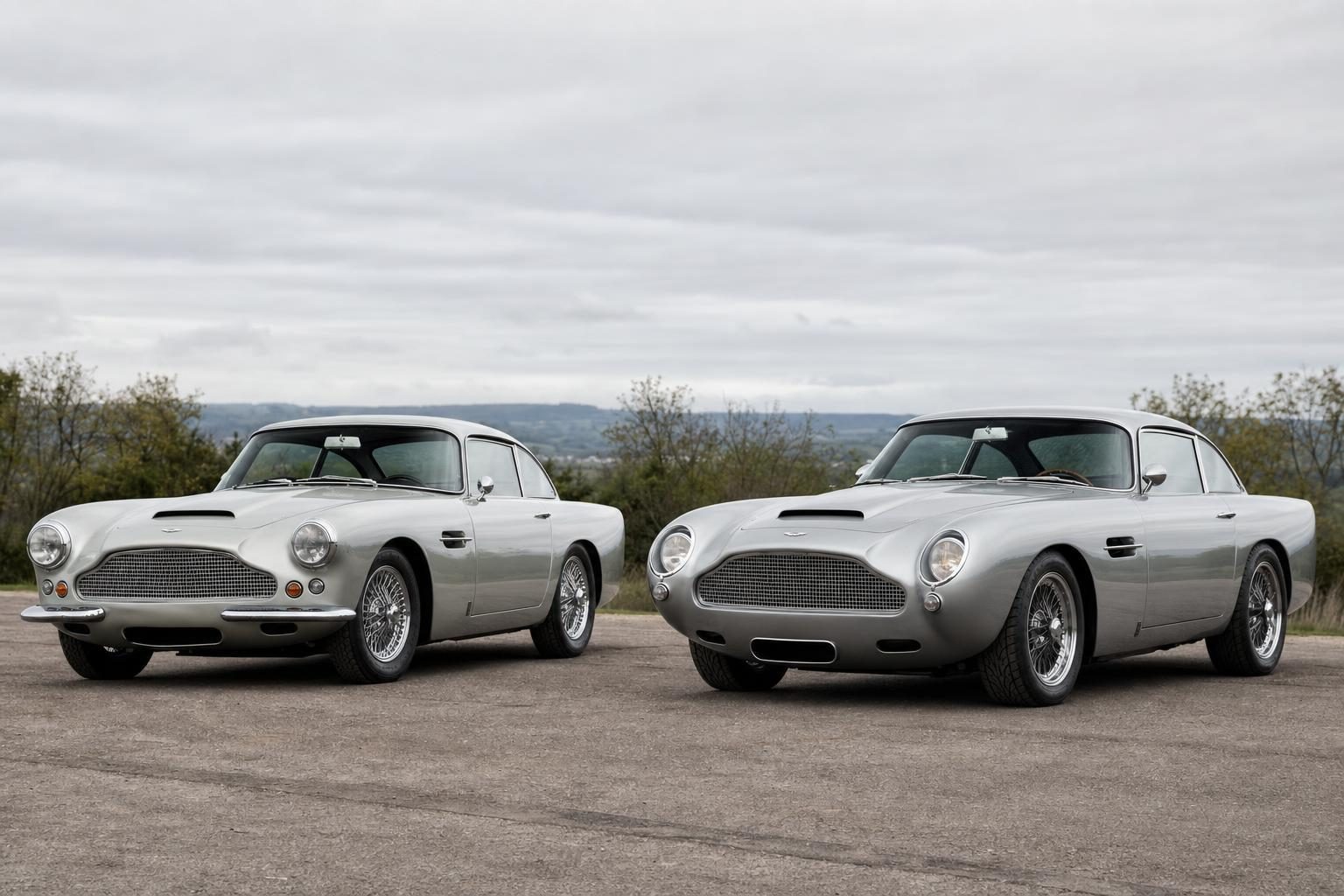
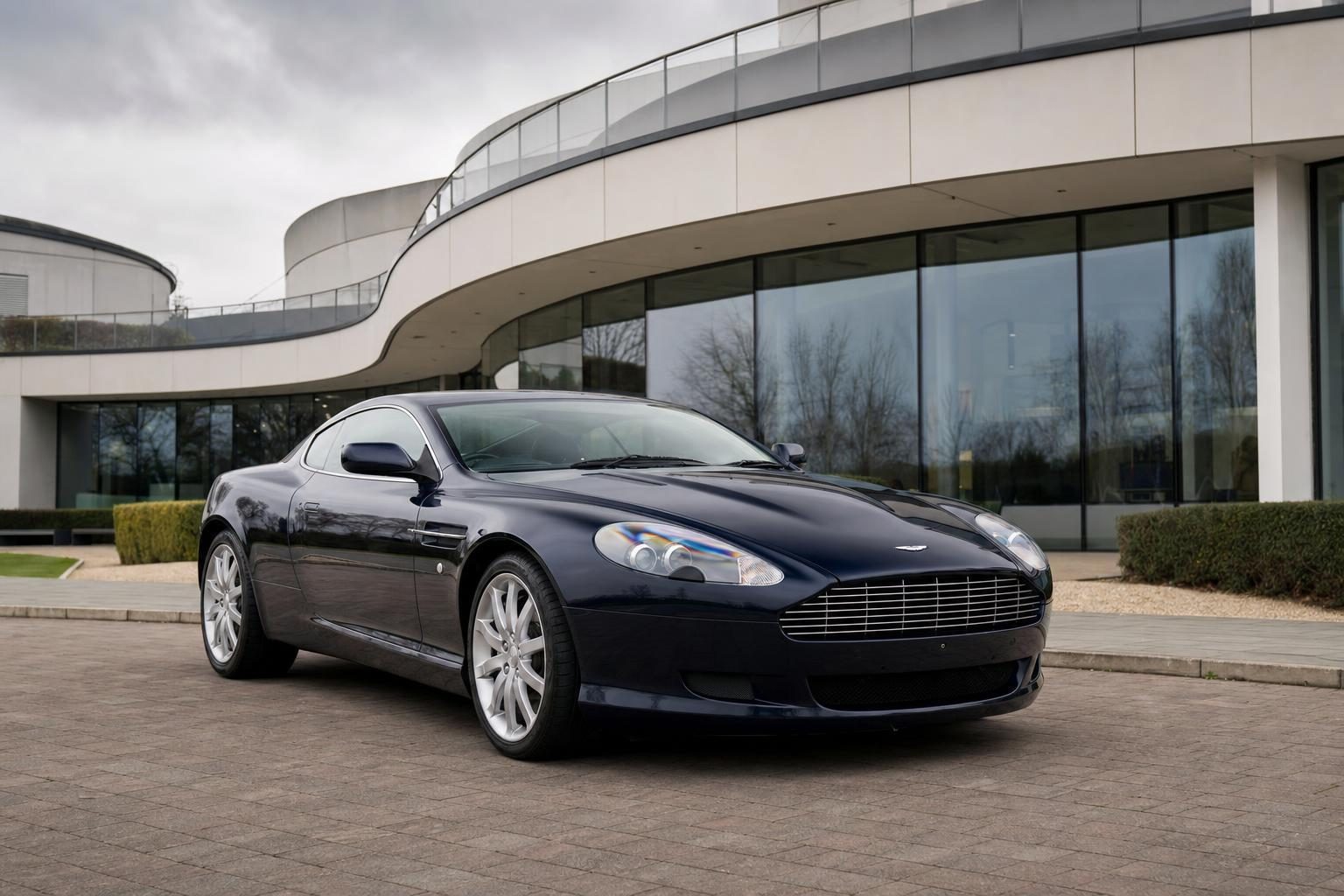
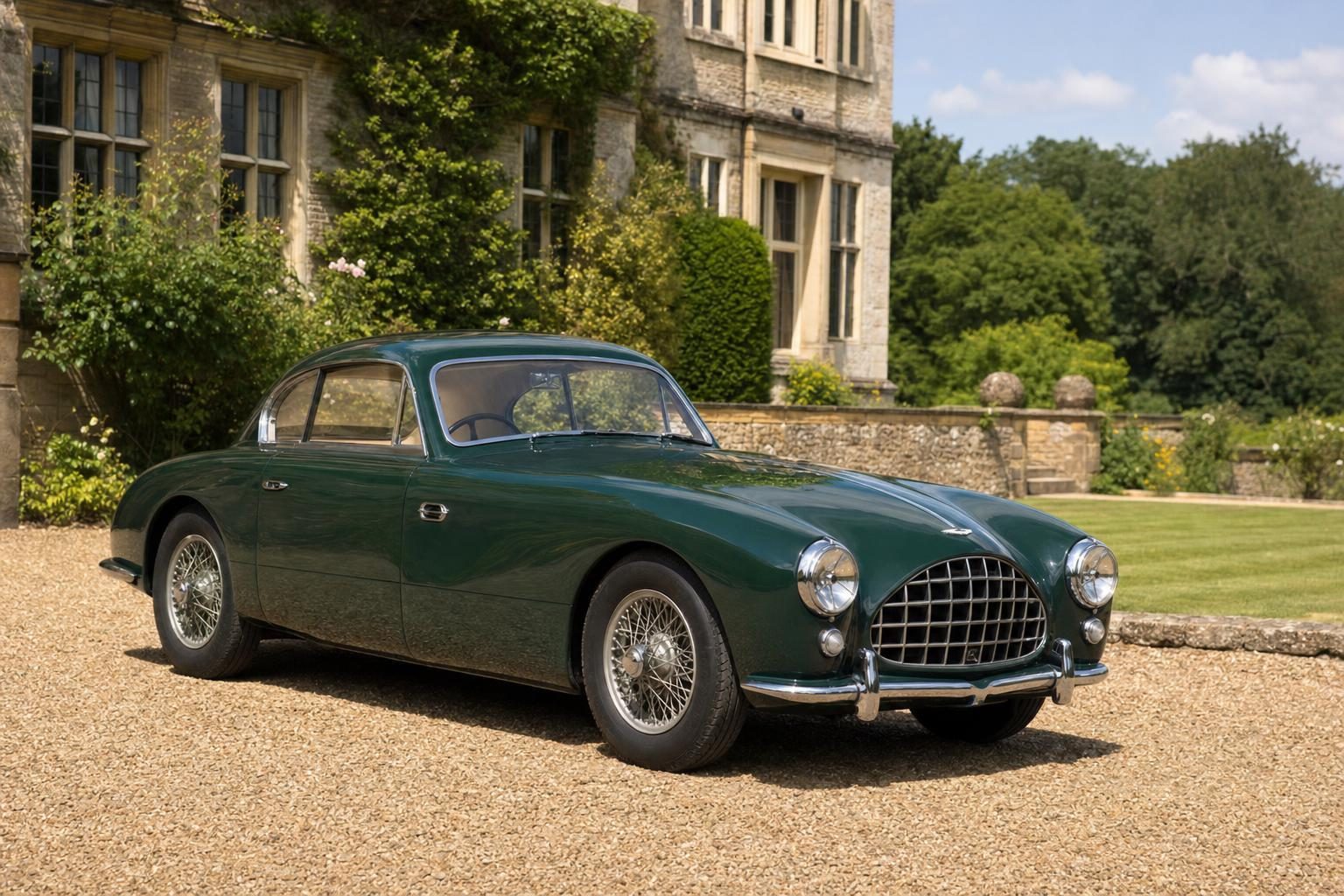
The DB4 GT Continuation marks, in 2017, Aston Martin Works’ confident return to Newport Pagnell with an unprecedented heritage programme. Announced in February 2017, this series of 25 new cars follows a logic of managed scarcity, with a unit price of £1.5 million and around 4,500 hours of build time per car. We revisit five key numbers, compare them with the 1959 original, and highlight what this project changes for Aston Martin’s heritage strategy.
Why 25 cars and not more: the logic of controlled rarity
The decision to build 25 is no whim. According to media.astonmartin.com, Aston Martin Works sized the run to preserve historical authenticity and the value of the original, while making possible a restoration of know-how. Unlike an open-ended production, the limited number ensures consistency with the spirit of the small runs of the period.
This restricted volume also protects owners of the 1959 icon. The original DB4 GT was produced in 75 units between 1959 and 1963, while the same source mentions 94 examples when including certain variants; the discrepancy, as explained by Aston Martin, stems from the accounting perimeter of special versions. By stopping at 25, the Continuation does not blur the hierarchy of rarities.
The positioning assumes a clientele of connoisseurs, more attracted by faithful execution and access to dedicated track events than by volume. The intent is clear: build a short “new” series respectful of 1959 without diluting the legend.
4,500 hours per car: what Newport Pagnell rebuilt from scratch
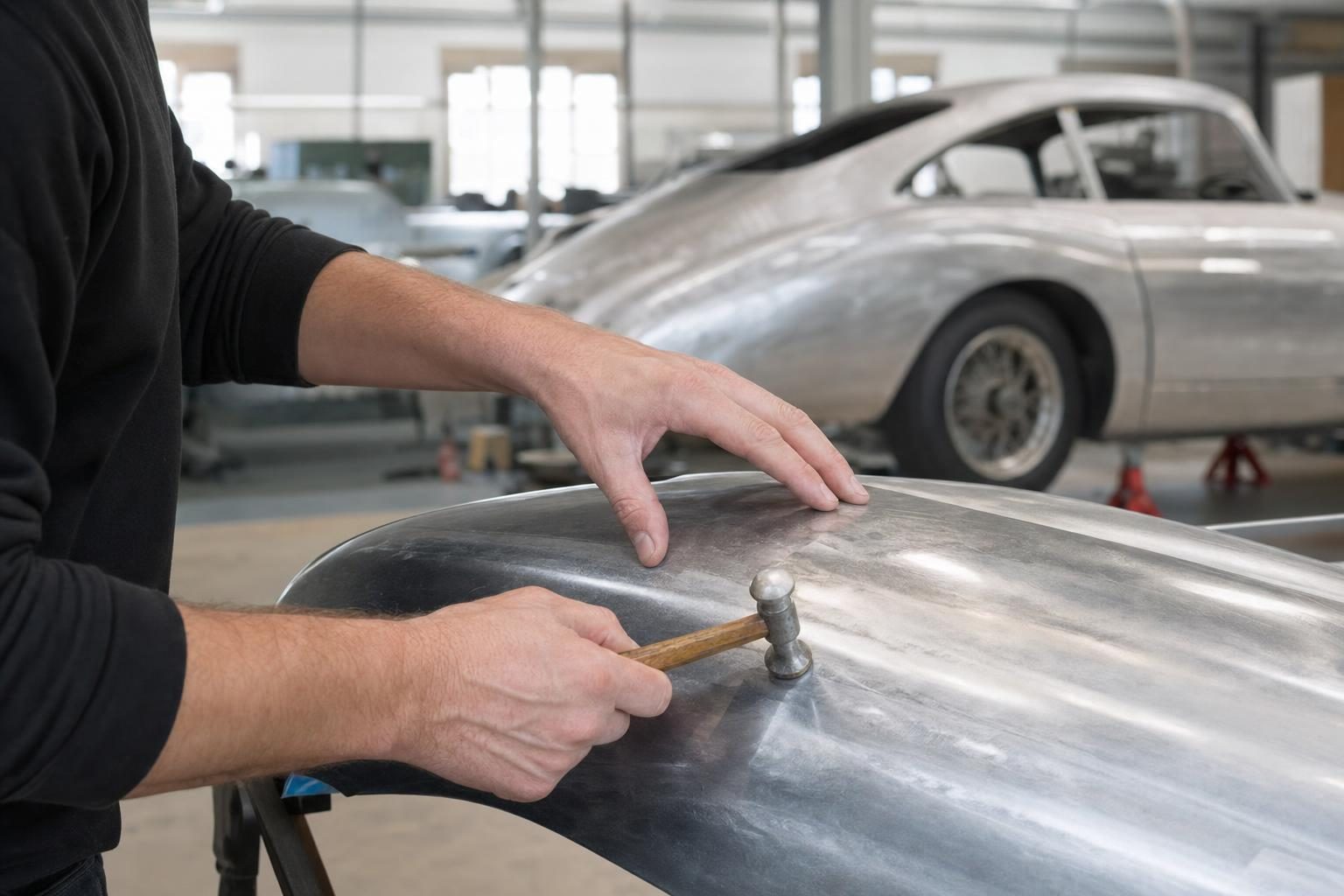
The figure may seem extravagant: around 4,500 hours of build time per example, attested by magazine.astonmartin.com. In reality, it measures a unique industrial and artisanal undertaking: redeploying at Newport Pagnell processes, jigs and skills that had disappeared from the line since the last Vanquish S left the site in 2007.
This return to production in the historic factory is anything but symbolic. It required reconstituting tooling and methods linked to the Superleggera chassis, fine panel beating and hand assembly. The 16-inch Borrani wheels are even remade by the original supplier to the 1959 specification, a detail reported by the same source. This fidelity of execution explains the time invested, and thus the price.
Newport Pagnell is also a house culture. Reviving a short-wheelbase competition coupé within its walls means reactivating transmitted skills, not just job descriptions. The programme thus becomes a tool for the living preservation of the brand’s industrial heritage.
The Tadek Marek engine revisited: 340 PS instead of 302 PS, the differences explained
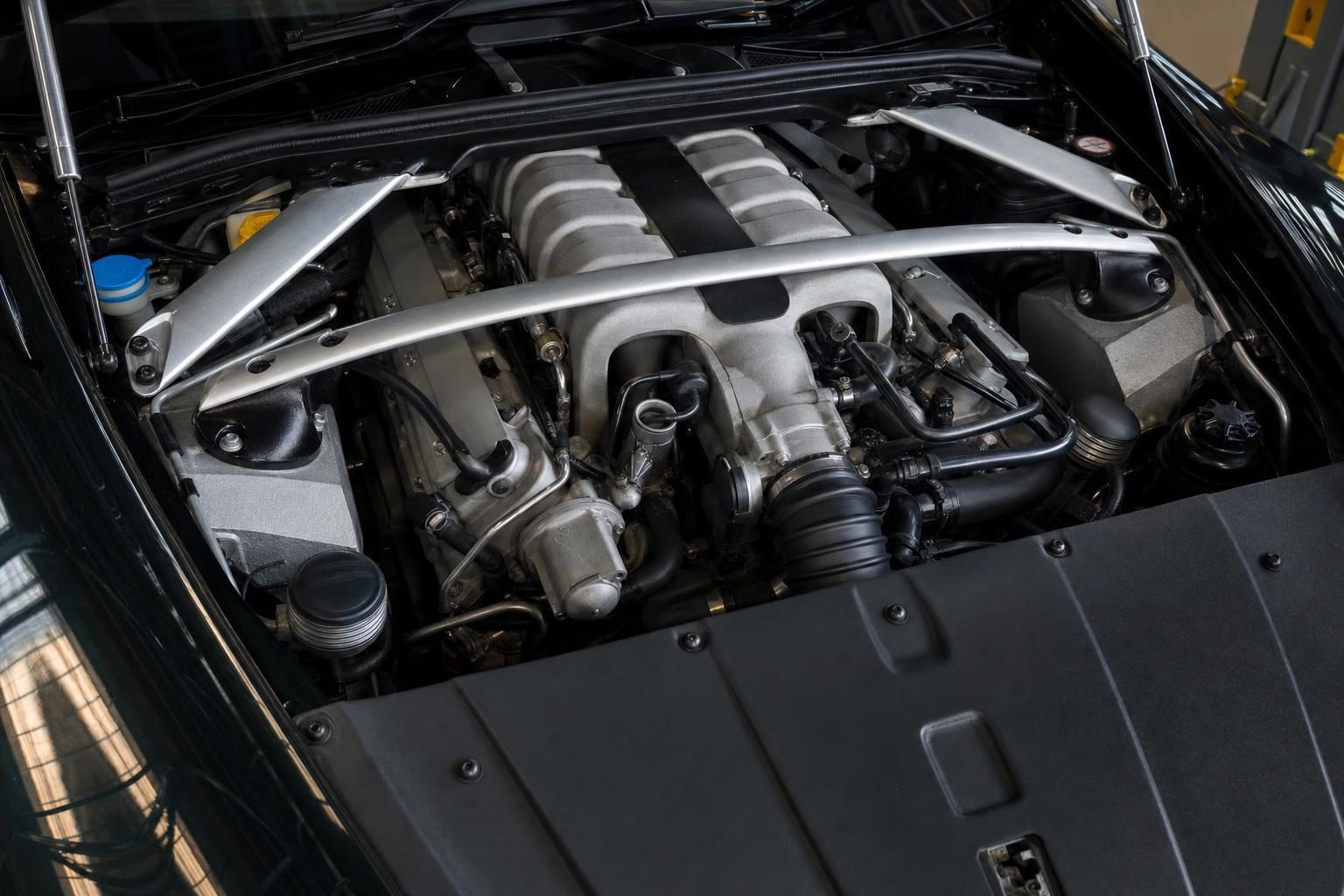
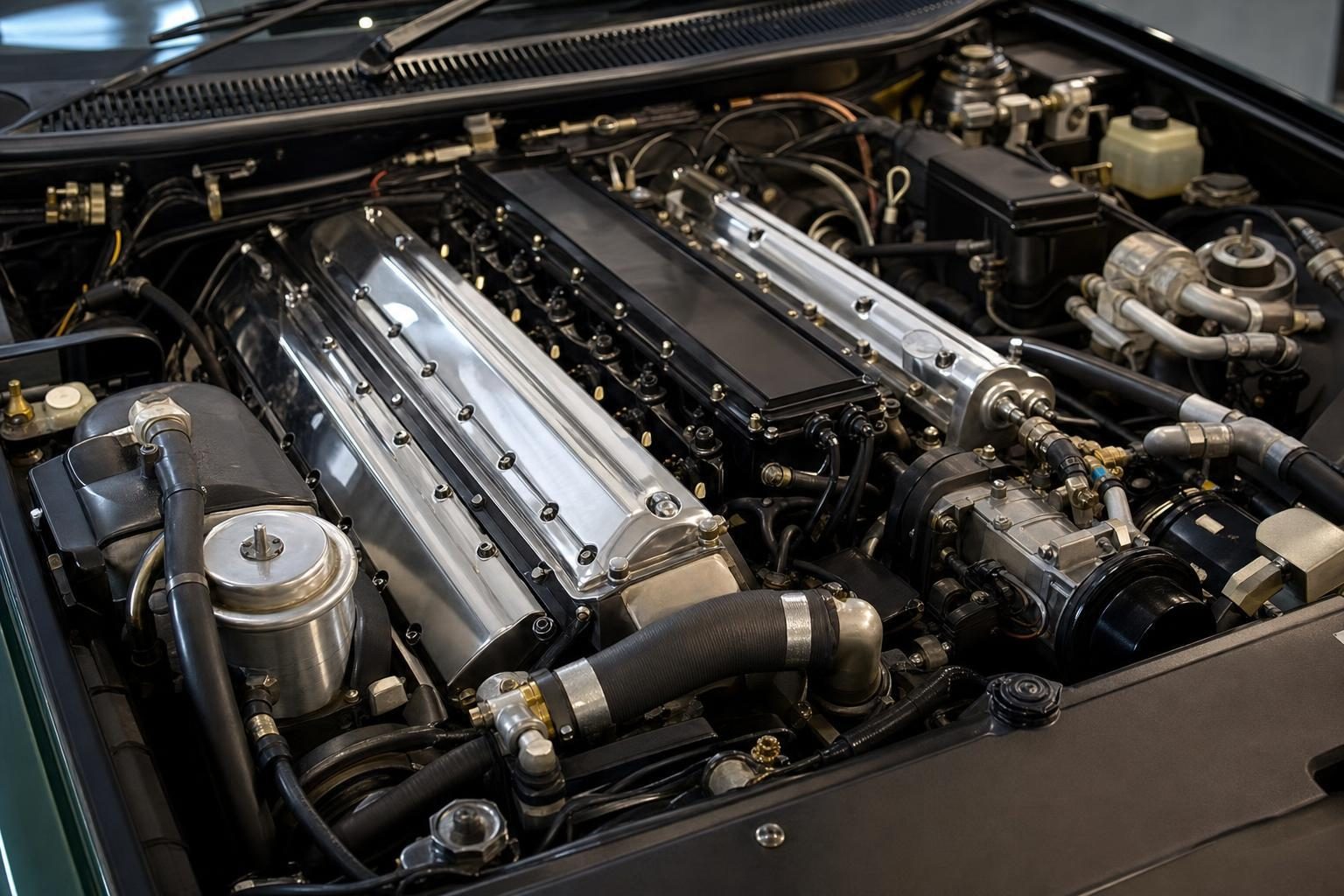
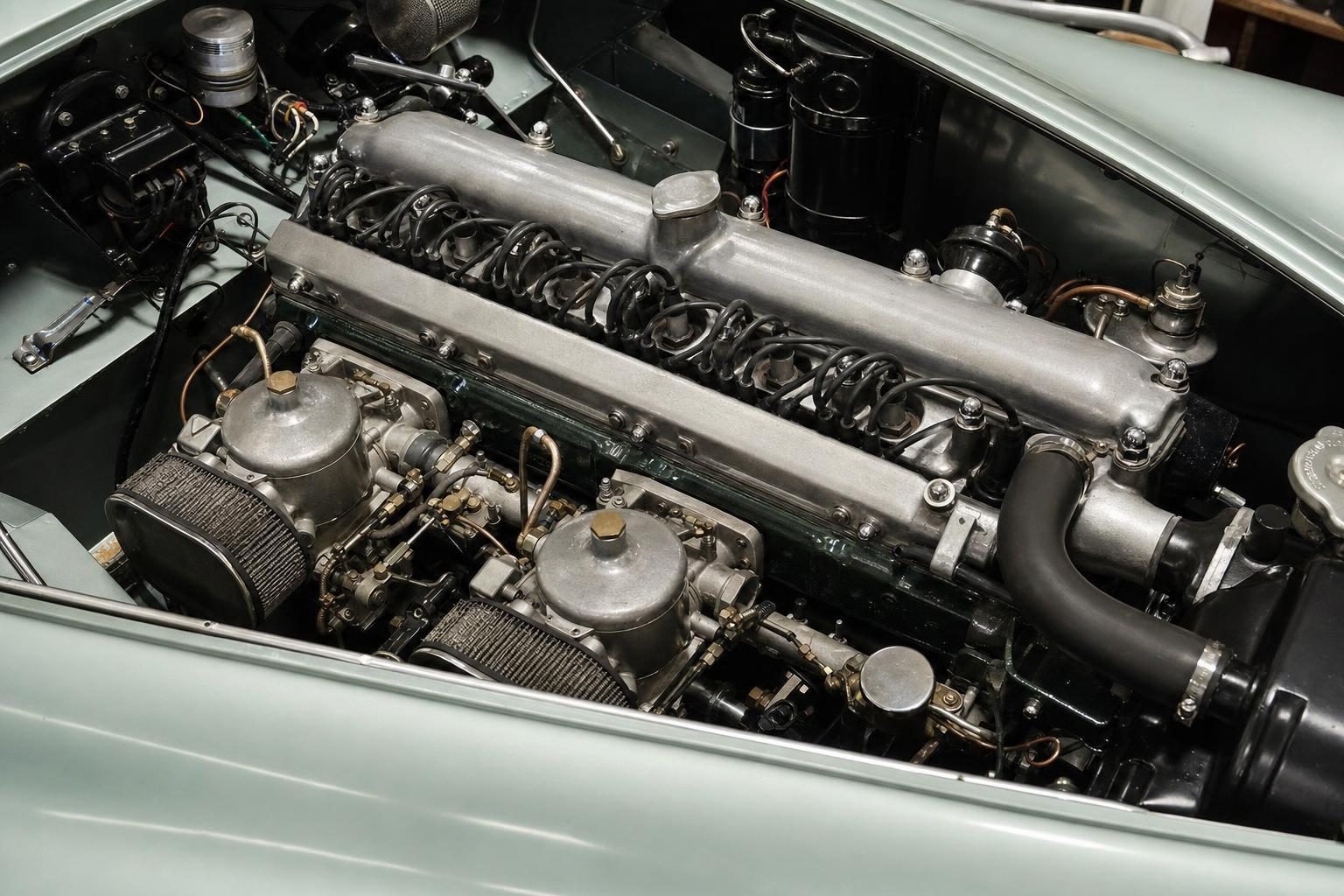
Aston Martin Works documents a carefully managed evolution of the straight-six designed by Tadek Marek. The 1959 DB4 GT claimed around 302 PS, while the Continuation reaches 340 PS according to media.astonmartin.com. The goal is not gratuitous inflation, but optimisation based on contemporary tolerances and materials, without denaturing the mechanical architecture.
The gain results from slight internal updates and meticulous assembly made possible by today’s processes. The philosophy remains that of a long-stroke, expressive engine, fuller and more reliable than in period without betraying its sound or character. The block remains a landmark of classic engineering, tuned today with greater consistency than in 1959.
For the record, the original DB4 GT already stood out with a chassis shortened by 127 mm compared with the standard DB4 and a body lightened by around 85 kg according to Wikipedia and media.astonmartin.com. The Continuation’s extra 38 PS fits this logic of a civilised track car.
Values and market: where the Continuations sit today versus the 1959 originals
The available facts structure the comparison without imposing a public price grid. We know each Continuation was invoiced at £1.5m and that only 25 exist. Opposite them, the 75 to 94 period DB4 GTs, depending on the scope considered, form a historic and emotional pinnacle, intimately tied to late-1950s and early-1960s competition.
The hierarchy that emerges is less a battle of numbers than a distinction of use and aura. The 1959 originals embody history and set the benchmark. The Continuations, meanwhile, offer a near-identical driving experience, with new-build production, Borranis remade to 1959 spec and assembly measured in thousands of hours. Their controlled rarity and manufacture in the historic factory make them heritage pieces in their own right.
For a collector, the choice rests on three axes: period authenticity, precision of reconstruction and suitability for use (private track time, dedicated events). The official data published by Aston Martin Works and magazine.astonmartin.com allow these trade-offs to be framed without speculating beyond the facts.
The legacy of the approach: from the DB4 GT to the 2019 Zagato Continuations
This 2017 series is presented by Aston Martin as a modern first at Newport Pagnell since 2007. It serves as a testbed for a fully-fledged heritage strategy: rebuild icons, in short runs, with period processes, in the right place. This direction paved the way for other projects, including the Continuation cars inspired by Zagato launched in 2019, following the same logic of fidelity and rarity.
The trajectory is significant for the brand’s image: beyond the contemporary range, Aston Martin maintains a living, transmissible memory. The precision of 4,500 hours, adherence to specifications such as the Borrani wheels and the anchoring of Newport Pagnell position the company in a niche that few manufacturers master with this degree of rigour.
To locate the reference models, our dossier on the roadgoing DB4 sheds light on the technical and stylistic context of 1958: history and specifications of the DB4. And to extend the coachbuilder angle, see our focus on the DB4 GT Zagato, which fed the imagination behind the post-2017 continuations.
Conclusion — what the DB4 GT Continuation really changes
The DB4 GT Continuation is not an opportunistic reissue: it is a manifesto. 25 cars, £1.5m, 4,500 hours and 340 PS form a precise score that puts Newport Pagnell back at the centre of the Aston Martin story. By embracing rarity, the reconquest of skills and respect for the 1959 original (75 units, or 94 depending on scope), the brand has laid the foundations of an active heritage policy.
For anyone considering a historic DB4 or its reconstructed descendant, the reading grid rests on three lines: authenticity, execution, use. On these axes, the DB4 GT Continuation offers a singular equation, faithful in spirit, exacting in form. Above all, it proved that Newport Pagnell could once again build new Aston Martins, and that the original culture remains a strategic asset.
V8 Vantage, or how an entry-level sports car from Gaydon built its success on three design decisions that official communications kept in the background for longer than expected. Shared VH platform with the DB9, Jaguar–Ford-origin V8 and a pragmatic approach to mass: this trio, too often summed up hastily, nevertheless explains the car’s relevance in 2005 and its trajectory right to the end of its career.
The VH platform: DB9 architecture in a compact sports car body
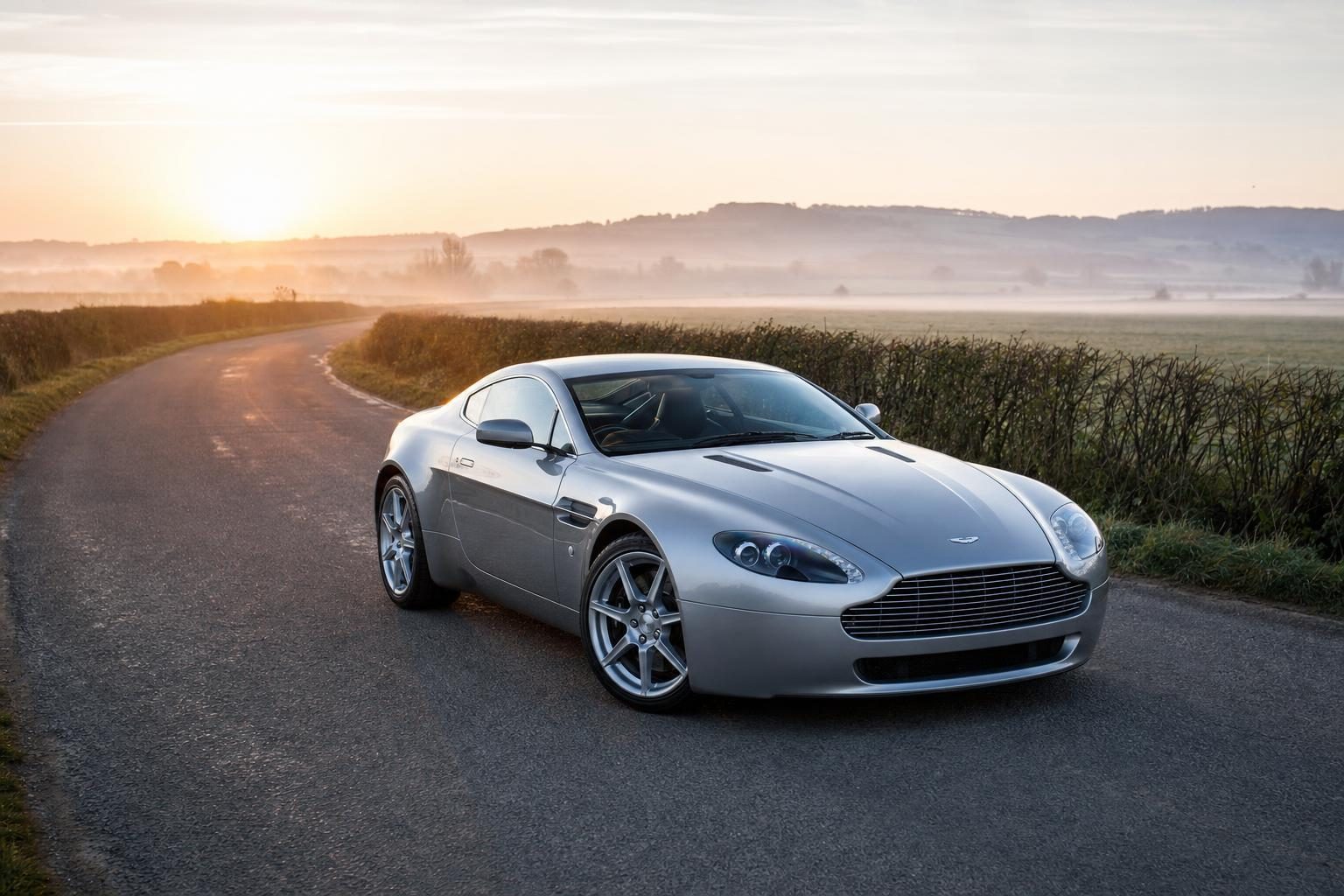
Behind the tight proportions, Gaydon’s compact sits on the VH (Vertical-Horizontal) platform introduced two years earlier with the DB9. According to Wikipedia EN, the 2005 V8 Vantage adopts its extruded and bonded aluminium architecture, a guarantee of more efficient industrialisation and controlled rigidity for a model intended to open the range. In other words: same framework, different dynamic promise.
This sharing was no accident. It reflected a nascent Aston Martin strategy in the mid-2000s: reduce fixed costs, speed up cycles and secure quality by capitalising on a common base. A modular logic that allowed wheelbases, tracks and mechanical mountings to be calibrated for a shorter, more agile model without starting from a blank sheet. VH gave the latitude to design a dense, muscular coupé while keeping tooling rational.
From a product standpoint, the benefit is twofold: perceived homogeneity with the DB9 in terms of assembly and soundproofing, and dynamic tuning appropriate to the sports car’s size. The technical kinship does not detract from its personality; it does, however, explain the V8 Vantage’s surprising maturity from launch. For a detailed overview of the model in our database, see the V8 Vantage 2005 profile.
The Jaguar AJ-V8 4.3-litre engine: a deliberate choice or a budget compromise?
Under the bonnet is the 4.3-litre AJ‑V8 developed in partnership by Ford/Jaguar. According to Aston Martin Media, it delivers 380 PS and 410 Nm in this application. That figure sits in the official register; it mainly underscores that Gaydon’s engineering favoured a robust, well-proven base to reach reliability and performance levels suited to the segment more quickly.
The “deliberate choice or compromise” debate is an old one. In reality, Aston’s adaptation was comprehensive: mapping, intake, exhaust and chassis integration gave this V8 its very “in-house” sound and response, while the shared supply chain reduced industrial risk. Note that the Roadster version, launched in 2006 with the same mechanical package according to Aston Martin Media, confirms this commitment to continuity.
This base also enabled incremental evolutions. In 2008, the limited-run N400 peaked at 400 PS, notes Wikipedia EN. A sign that the technical DNA chosen in 2005 offered headroom without overhauling the architecture or denaturing the driving experience.
Henrik Fisker’s design: the silhouette that revived the entry level
Sketched by Henrik Fisker, then Aston Martin’s design director, the bodywork marked an aesthetic turning point. According to Wikipedia EN, we owe to him this near-classically balanced silhouette: taut wings, long bonnet, racy tail. A language that echoes the marque’s icons without pastiche, visually anchoring the V8 Vantage as the desirable “baby Aston”, not a scaled-down DB9.
The point is all the stronger as it coincided with a strategic return to a V8 at the entry level. The historical pages of Aston Martin recall that it was the first since the DB7 to offer an eight-cylinder at this level, reconnecting with a lineage inaugurated by the V8 Series of 1969. Fisker’s lines gave this ambition a clear face: compact, planted, yet subtle in its volumes.
In use, the design served the positioning. It allows adequate cabin space, a decent boot and a neat hooding solution for the Roadster, while keeping the overhangs short. Proof that elegant styling can also be an industrial tool: fewer costly compromises, greater coherence between aesthetics and the VH platform.
Three production figures that challenge the model’s ‘exclusive’ image
Legend has it that every Aston is exceedingly rare. The reality, more nuanced, contributed to the V8 Vantage’s success. According to Wikipedia EN, around 17,500 units were produced between 2005 and 2017. The figure warrants nuance depending on the variants included, but the order of magnitude is clear: this is one of the most-produced models of Aston Martin’s modern era.
This relatively wide diffusion has positive effects. First on parts availability and workshop expertise, then on usability value: a network that knows the car, upgrade options, and an active community. The very opposite of a production run so confidential it becomes fragile day to day.
Finally, that volume validated Gaydon’s strategy: a VH base shared with the DB9 to control costs, a shared V8 to secure industrialisation, a strong design to unite. Three discreet levers, three tangible consequences. To place the technical kinship, see our DB9 file, and for the direct successor, the Vantage MkII that took over.
Conclusion — why the V8 Vantage has aged well
Beyond the heroic narratives, the V8 Vantage owes its success to a rational equation: shared VH platform, in-house adapted AJ‑V8, and pragmatic mass management in bodywork signed by Fisker. The facts cited by Wikipedia EN and Aston Martin Media outline a common-sense strategy, sometimes kept quiet at the time, but rewarding in the long run.
Time did the rest: a timeless style, controlled evolutions (up to the N400), and sufficient production to support everyday use without diluting the aura. In short, the V8 Vantage thrived not despite these choices, but because of them — a lesson many now reread in the light of an exemplary career.
Virage 1989: 4 Ultimate Reasons the Transition to Gaydon Wasn’t Smooth
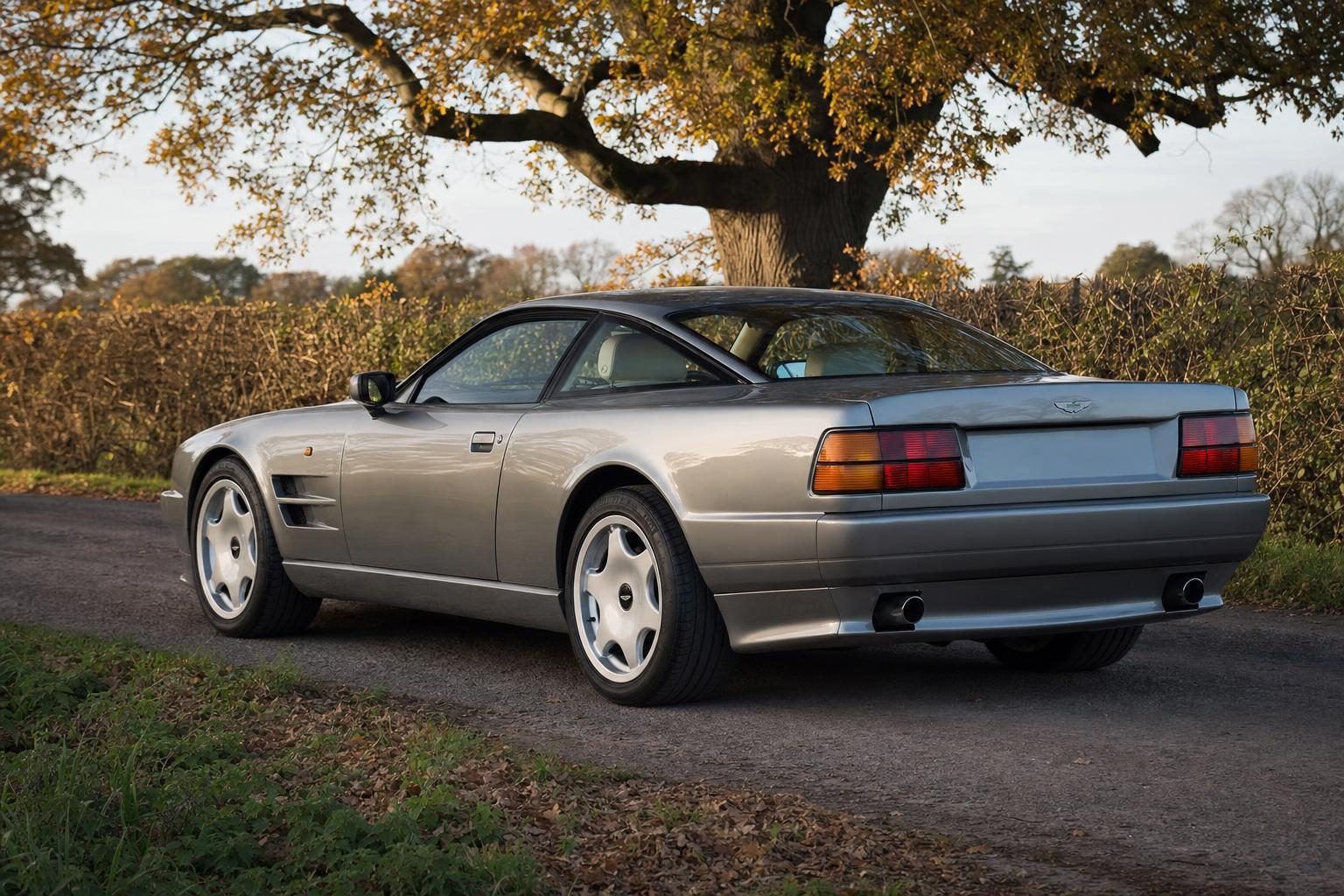
Virage, more hinge than totem, this coupé launched in the late 1980s distils Aston Martin’s in-between: a well-known V8 under an all-new suit, production still at Newport Pagnell while the horizon already read Bloxham then Gaydon. Here, in four very concrete angles, is how this model blurred the lines while laying decisive markers — and why it deserves a closer look today than period clichés allowed.
A familiar engine in a wholly new suit: what the 5.3-litre V8 hid
Beneath the refreshed lines lies the 5.3-litre Tadek Marek V8, a historic Aston Martin unit bored out and sharpened for the 1989 context. Depending on sources, the base version develops around 306 PS, while the future Vantage variant will peak at 550 PS. This deliberate mechanical continuity gave the coupé a soundtrack and torque signature familiar to brand loyalists, but also a hint of ambiguity: the tech reassured, the positioning was already reaching for something else.
The decision to retain this V8, rather than introduce an entirely new architecture, reflects the pragmatism of a small manufacturer in the late 1980s. According to the dedicated reference page, the Virage was unveiled at the Birmingham Motor Show in October 1988 and entered production in 1989, with specifications evolving rapidly as the range took shape. The industrial and stylistic transition had begun; the mechanical break would wait.
The Vantage variant presented in 1992 pushed the ambition further, with two Eaton superchargers and a quoted 550 PS according to Aston Martin Works, making this evolution one of the most powerful sports cars of its era in the UK. Between restraint and excess, the Virage thus embodied the two faces of Aston Martin at the dawn of the 1990s.
John Heffernan’s design: rupture or continuity with the DBS line?
Styled by John Heffernan and Ken Greenley (Heffernan Greenley), the Virage’s bodywork breaks with the volumes of the AM V8s descended from the DBS lineage. More angular, more pared-back, it steps away from 1970s muscle aesthetics in favour of sober modernism. This choice was no accident: it repositioned the marque between British elegance and the visual efficiency of a grand tourer, without denying a very “Aston” stance.
That said, this is no disconnected manifesto. The long-bonnet/rearward-cabin proportions continue the DBS/AM V8 grammar, while fuller surfaces and more integrated lights close the chapter on American references. The Virage carries out an elegant transition rather than a coup de théâtre. Again, a fruitful tension: brand continuity on one side, a desire to turn the page on the other.
This stance explains its mixed reception. Too square for some, subtly timeless for others, the Heffernan/Greenley design can now be appreciated on its own terms: a coherent update of Aston DNA, without easy effects. The marque’s archives also place this model as the last great Aston assembled at Newport Pagnell before the DB7 marked a true industrial turning point.
Volante and Vantage variants: when the Virage searched for an identity
The multiplication of variants quickly revealed the programme’s ambition — and hesitations. The Volante offers the open-air grand touring experience, while the supercharged Vantage claims 550 PS according to Aston Martin Works. Between these poles, the array of special bodies based on the Virage (including a “Lagonda Vignale” shooting brake) highlights the chassis’s versatility and the appetite of a connoisseur clientele.
This diversity has two readings. On the one hand, it gives the model a rare breadth, capable of spanning hushed luxury and spectacular performance. On the other, it sustains a certain image indecision, each iteration pulling the coupé in a different direction. The Virage thus emerges as a laboratory more than a perfectly canonical product.
In numbers, total family production remains limited. According to tallies, around 1,000 units are cited overall, with a range often quoted between 891 and 1,050 depending on which variants are included. Noting this discrepancy is essential: beyond the singular icon that is the Vantage, the entire lineage is confidential by nature.
Current values and market: is the Virage still the forgotten Aston Martin at auction?
Neither the definitive culmination of Newport Pagnell nor the true starting point of the Gaydon era, the Virage sometimes pays for its in-between status. Up against very clearly identified references such as the AM V8 “DBS series” on one side and the DB7 on the other, it attracts a knowledgeable but narrower audience. Proven rarity — roughly a thousand units across all versions — fuels interest without mechanically exploding hammer prices.
Several factors nonetheless work in its favour. First, the appeal of its Tadek Marek V8 in a late and carefully honed interpretation. Next, the Heffernan/Greenley signature, which has gained perceived elegance over time. Finally, the variety of the range, from grand touring Volante to supercharged Vantage, broadens the base of potential collectors — with differing sensibilities according to body styles and specifications.
To place this model in the Aston Martin timeline, our dedicated files help illuminate the industrial and stylistic pivot. The Virage and variants file sets the whole programme in perspective, the AM V8 line descended from the DBS explains the run-up, and the DB7, the Bloxham/Gaydon-era turning point sets the downstream. In this weave, the 1989 coupé appears less “forgotten” than in need of fine recontextualisation.
Conclusion: putting the Virage back at the centre of the board
At the end of this tour, the Virage reveals itself for what it is: a clear-sighted hinge between tradition and renewal. Familiar yet sharpened powertrain, modernist design without denial, strong-personality variants, limited production and a persistent debate over its positioning: the sum makes a discreet classic. Neither the epilogue of Newport Pagnell nor the prologue of Gaydon, it occupies a place apart — that of a milestone which allowed Aston Martin to navigate the 1990s with consistency and suppleness.
Vantage GT3 Imola 2026: 6-Hour Ultimate Cockpit Ride in No.27
Vantage GT3 Imola on onboard camera for six hours: the exercise speaks volumes about what a modern GT3 hides under full load and what Imola represents when it comes to opening a WEC season under tension. From the official feed of car No.27, you read the car, the team and the track — without fuss, but with everything that matters to understand a 2026 campaign that promises to be dense for Aston Martin and The Heart of Racing.
This feature places No.27 in context over the duration, from traffic to restarts, via grip management and steering-wheel tools. And as always at Imola, pace isn’t enough: you need the discipline of a Vantage GT3 perfectly driven, set up and operated.
No.27, a car and a team at the heart of the Aston Martin WEC project
No.27 is entered by The Heart of Racing (THOR), with a sharp trio: Ian James, Zach Robichon and Mattia Drudi. According to fiawec.com, Drudi set the best LMGT3 reference in FP3 with 1:41.973, a snapshot revealing the potential of this Vantage against the field. Set at Imola during the 6 Hours 2026, that marker sets the scene: the car has resources, and the team knows how to exploit them.
For 2026, THOR expanded to two Vantage GT3s in the WEC, taking over the No.23 previously operated by Racing Spirit of Leman. This step up is no trifle: it anchors the outfit as spearhead of Aston Martin’s customer programme at the highest level, while offering strategic levers on track — offset pace, data sharing, undercut coverage.
Note that Kobe Pauwels, winner of the Aston Martin Racing Driver Academy, made his WEC debut at Imola at the wheel of No.23, replacing Rubens Barrichello. A very clear signal: the pathway aligns talent development and factory-customer commitment, with the Vantage GT3 as technical and sporting pivot.
Imola 2026, default season opener: the context of a pressure-cooker race
Imola opened the 2026 FIA World Endurance Championship from 17 to 19 April, with Qatar postponed for geopolitical reasons, according to Wikipedia. Fourth running of the event and third consecutive on the WEC calendar, the Enzo e Dino Ferrari circuit thus became a first full-scale exam: spring temperatures, abrasive asphalt, close walls and heavy traffic. The whole immediately puts each Vantage GT3 to the test of “realistic” endurance.
Starting at Imola means accepting a reduced margin for error. In LMGT3, the slightest approximation in Tamburello or Variante Alta costs you dearly in rotation and tyre life. For No.27, the opener was therefore a revealer: pit-driver coordination, stint windows, calibration of the aids. The issue is not only the day’s result, but the set-up of a working base for the entire season.
To this sporting pressure is added the media magnifying glass effect of a season start without a Qatari prelude: weak signals — top speed, braking stability, lap-time consistency — take on outsized importance. The No.27 onboard then becomes an analytical instrument as valuable as the official timing.
No.27’s cockpit: what the onboard reveals
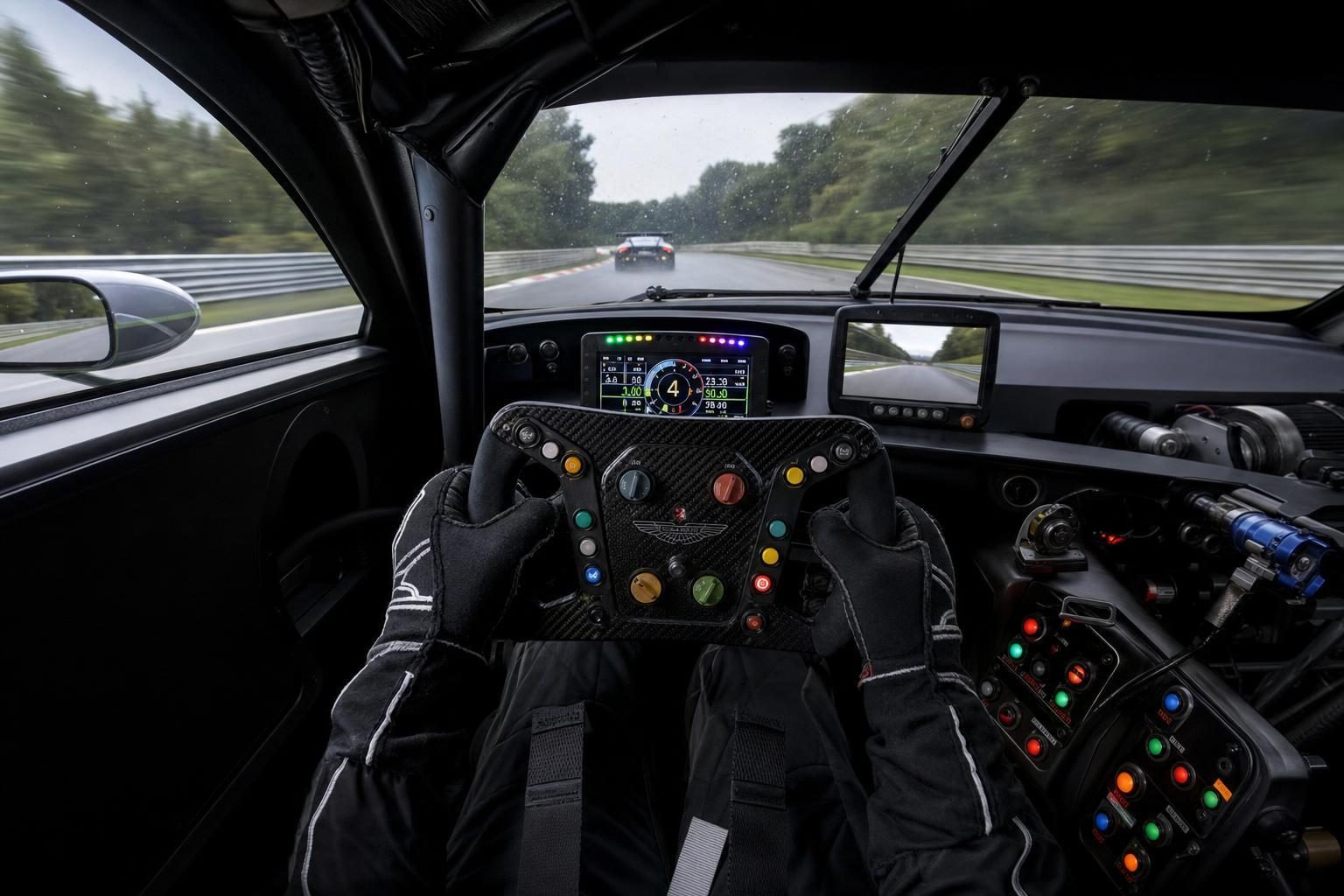
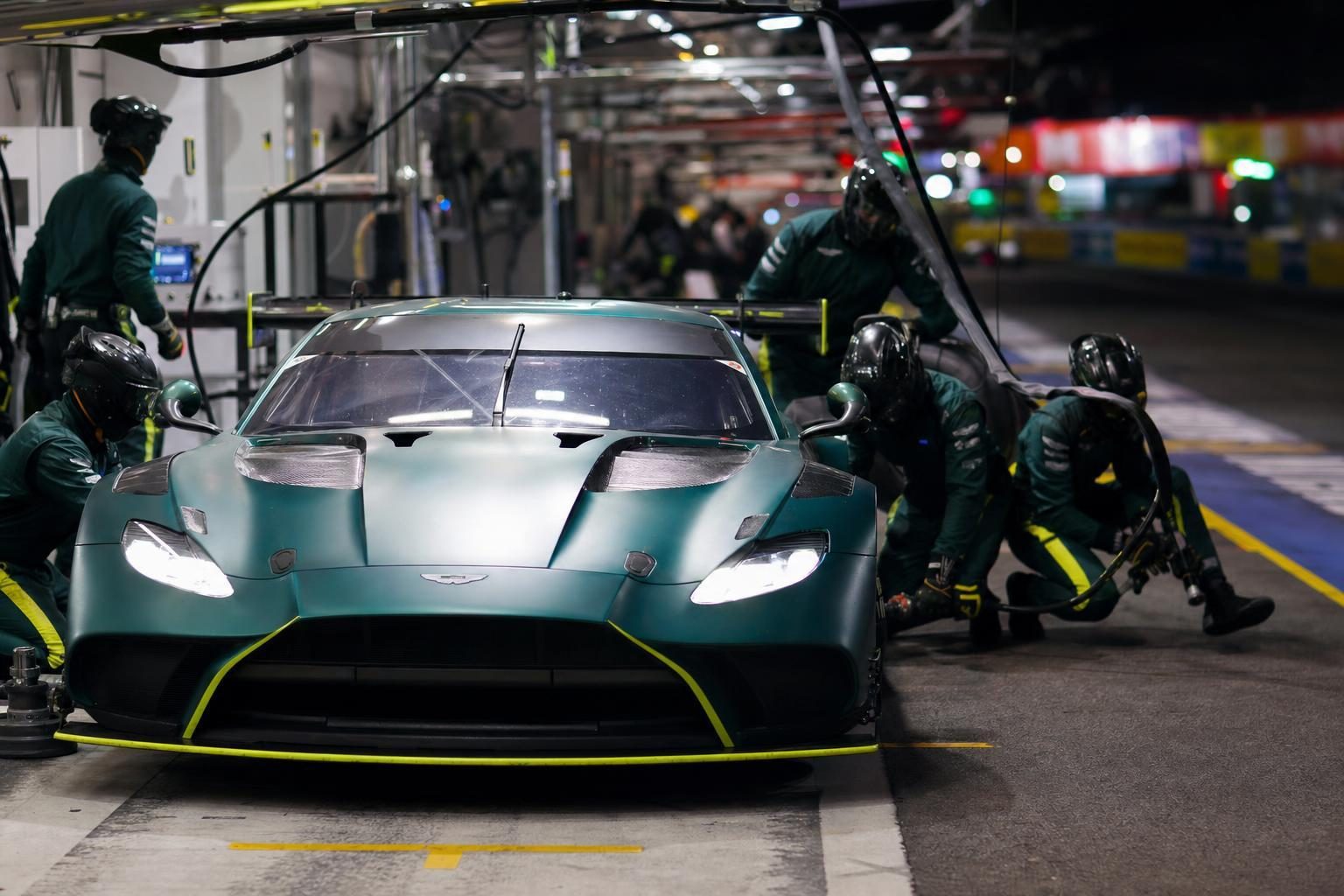
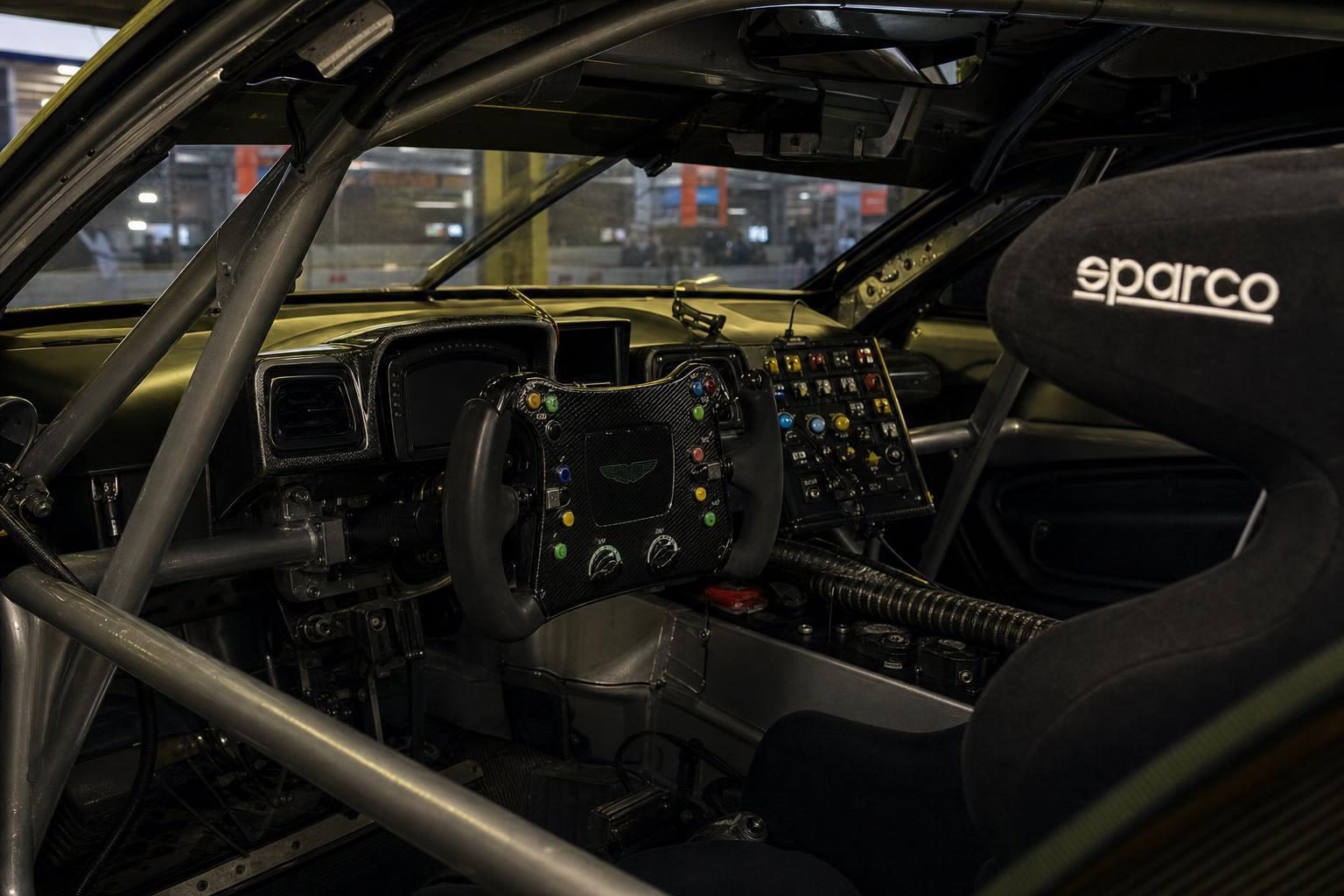
The official onboard feed published on 18 June 2026 by Aston Martin offers a fine reading of the fundamentals of a Vantage GT3 Imola in real conditions. You see a very alive steering wheel but never twitchy, a sign of a locked-in front end and steering that delivers information without over-amplifying it. Hands stay calm through rapid sequences, then tighten the angle over the kerbs, indicating a rear end free enough to rotate without stepping out.
The switches come to life as stints unfold: engine map tweaks, traction control and ABS settings adjusted to tyre state and track evolution. The redefined electronics for LMGT3 make the difference here, not to mask but to exploit: better managing traction out of Acque Minerali, securing degraded brakings into Tosa, or containing oscillations on throttle over kerbs that are more aggressive than they look.
Traffic management appears in filigree as one of the keys at Imola. Overtaking in LMGT3 requires shaping the move one or two corners earlier to present cleanly at the end of the straight. Discipline into the chicanes avoids “breaking” the flow, preserving temperature and balance. Again, the No.27 onboard illustrates this discreet art, where usable speed outweighs needless swagger.
The Vantage GT3, anatomy of a front-running GT3 born from a road car
The Vantage GT3 is based on the road car’s bonded-riveted aluminium chassis and a 4.0-litre twin-turbo V8, with aerodynamics, suspension and electronics entirely reworked for LMGT3. This road-to-race genetics, embraced by Aston Martin, places the car at the intersection of durable engineering and exploitable performance. It also explains the behaviour signature noted at Imola: a precise front, traction built more by balance than by electronic constraint.
The aerodynamic package, optimised within the regulations, targets stability in long loaded corners and tolerance over compressions. On an old-school circuit like Imola, the rear wing and diffuser work in concert to hold the platform, while suspension settings absorb kerbs without triggering parasitic yaw. On screen, that translates to a “planted” car, few late corrections and crisp exits.
The engine architecture contributes to managing base rhythm: available torque, linear response, controlled cooling over the stint. In this context, the Aston Martin technical universe claims continuity from a Vantage platform that has performed for over a decade. Since 2012, the marque has moreover amassed 11 WEC titles, a benchmark that places the Vantage as Gaydon’s most titled racing car over the period.
From FP3 to the chequered flag: race takeaways and season outlook
The lap-time high point came early: in FP3, Mattia Drudi put No.27 on top of LMGT3 in 1:41.973, as reported by fiawec.com. A useful indication of the performance window, but not an end in itself. The onboard reminds us of endurance’s essence: sustain that level over time, deal with neutralisations, and execute cleanly in the pits. In that logic, the first rendezvous at Imola chiefly served to stress-test methods and tools.
THOR’s 2026 trajectory sits within a broader frame. With two Vantages entered, feedback accelerates, and the lessons from an LMGT3 podium at Le Mans for No.23 — the Vantage’s eleventh at Le Mans — naturally feed into No.27’s work. The common thread remains the same: baseline reliability, consistent pace, and the ability to convert good track position into a class result.
For readers following the lineage, the Imola Vantage GT3 extends the latest-generation road Vantage. In that respect, it’s useful to refer to the Vantage MKII and its chassis and engine evolutions, which form the DNA of this coupé refined through the LMGT3 sieve. On the competition side, programme coherence is also visible across the Atlantic, with the 2026 IMSA campaign and its four podiums, a valuable technical and sporting mirror for the WEC.
There remains the human dimension, glimpsed in the cockpit: measured breathing, economical gestures, clear voices on the radio. At this level, the difference is often made in the quality of decision-making. And we circle back to Imola: a circuit that demands restraint. The Vantage GT3 Imola doesn’t reward emphasis, but accuracy — exactly what this onboard feed highlights.
Conclusion — Vantage GT3 Imola, what six hours teach us
From the official feed of No.27’s onboard camera, Imola 2026 delivers a clear synthesis: the Vantage GT3 Imola is a machine of pace and consistency, built to turn a strong road base into a honed endurance tool. THOR laid the markers — FP3 reference, diligent execution — in a shifted season opener where every detail counts.
What comes next will hinge on capitalising: tyre-fuel management, clean overtakes and fine calibration of the aids. For those who want to extend this perspective, our feature Road to Race, from the Imola opener to Spa and Valkyrie provides useful bearings. The message is crystal clear: with this Vantage GT3 Imola, method rules, and endurance rewards those who hold their line — for the long haul.
One-77 Auctions Ultimate Guide: 4 Sales That Reveal the Real Value
One-77 auctions: behind the sheen of a heavily publicised hypercar, this article compares known public sales, details price spreads by mileage, colour and provenance, and positions the One‑77 against its rivals on the secondary market. We draw on data published by Aston Martin and by Wikipedia, and we recall that auctions reflect a moment in the market, not a truth set in carbon.
77 examples in 3 years: why rarity was engineered from the outset
Built in 77 examples between 2009 and 2012, the One‑77 was conceived for rarity — a deliberate strategy. According to Wikipedia, its launch price hovered around £1.15 million, which placed it from the start in a very niche bracket. Better still for future demand: all units were sold before the end of production, according to Aston Martin’s official communications.
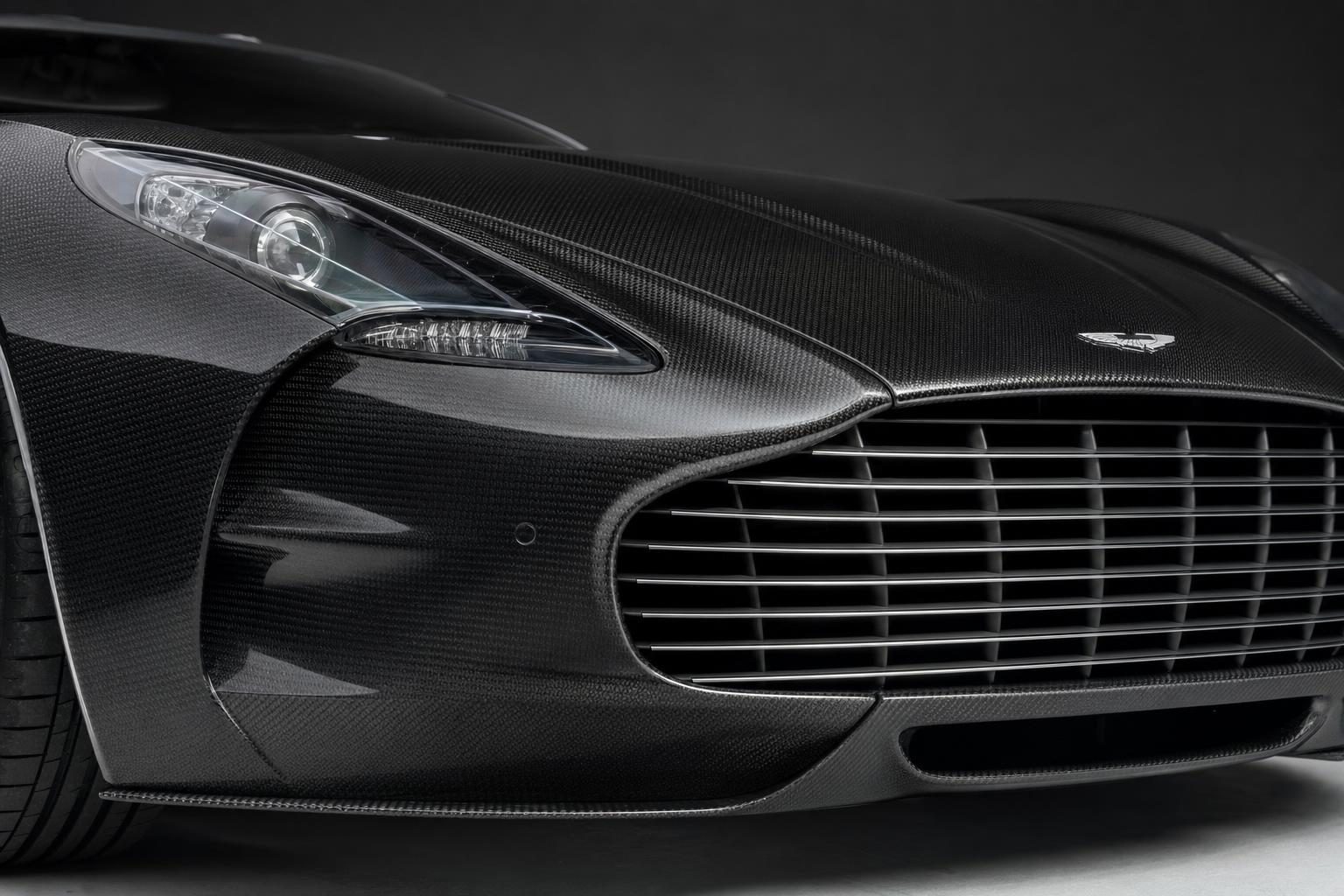
Rarity is not just a matter of arithmetic. The One‑77 programme also relied on artisanal construction and a carbon-fibre monocoque, with hand-formed panels — an approach detailed by the manufacturer on its dedicated page Aston Martin One‑77. This combination of low volume and craftsmanship mechanically limits supply on the secondary market, a key factor when observing One‑77 auctions a few years later.
This deliberate calibration has a direct consequence: public transactions remain rare and often hotly contested. Few cars change hands in the room, many favouring private sales. When One‑77 auctions do appear, they therefore focus attention — and comparisons.
Early auctions: hammer prices observed between 2013 and 2018
The first post-production appearances set a useful range for the market. According to public sources, hammer prices observed for One‑77s generally sit between €1.2 million and over €2 million, with spreads explained by condition, mileage and provenance. Early One‑77 auctions typically reflected the fact that a low‑mileage, well‑documented example in a sought‑after specification outperforms the average.
However, the right reading scale is essential. Auctions are not an official price list, but a snapshot. Two sales a few months apart can post very different results without contradiction: they simply reflect the relative quality of the cars presented and the mood of the moment. That is why we speak here of ranges, not certainties.
For enthusiasts tracking these transactions, the most instructive insight is not a single result, but the constant tension of demand within these price bands. In other words, One‑77 auctions do not contradict the thesis of a model supported by minimal supply and a highly qualified clientele.
750 PS naturally aspirated and carbon bodywork: the arguments that support the value
Technical substance matters in the market, especially when it tells a story. With its 7.3‑litre naturally aspirated V12 with 750 PS — at the time the most powerful road‑going Aston Martin ever built, notes Wikipedia — the One‑77 ticks the “last of the Mohicans” box in the hybrid era. This rare and resonant argument structurally supports One‑77 auctions.
The carbon-fibre monocoque, the hand‑built panels and the attention to detail, presented by the manufacturer on Aston Martin’s media centre, also play a part. They create an emotional and rational barrier to depreciation: the buyer knows why he is paying, and what he is paying for. In a world of sometimes overhyped hypercars, this balance between pure performance and elegant execution remains a strong marker.
Finally, brand identity matters. Gaydon’s DNA, less flamboyant than others, speaks to collectors who value understatement and line over a spectacular spec sheet. It is easy to see why One‑77 auctions tend to reward a sober combination, clear history and low mileage, sometimes more than a shouty colour.
One-77 versus Bugatti Veyron and Ferrari Enzo on the secondary market: trend comparison
Comparison does not mean conflation. The Veyron and the Enzo follow different production, technology and audience logics. But in terms of trends, the One‑77 sits in the circle of hypercars with limited public supply, an international clientele and price variance linked to use. One‑77 auctions show a comparable amplitude, sometimes lower in transaction volume due to production being lower than these rivals.
Technically, the One‑77 advances a singular proposition: 750 PS naturally aspirated and a hand‑fashioned carbon body. Versus the Veyron and its world of “total engineering”, or the Enzo and its direct link to Maranello, the Briton plays the atelier piece card. This different narrative also explains why demand responds finely to provenance and configuration, a phenomenon clearly visible at One‑77 auctions.
Lastly, value trajectories are a long‑term analysis. Public auctions, by definition selective, sometimes amplify the impression of rises or slowdowns. To read the One‑77 correctly, one sets several spaced‑out sales against known private supply. It is on this basis that the value stabilises, within the €1.2 million to €2 million‑plus range indicated by public sources.
What recent sales (2022–2025) indicate about the value trajectory
The latest One‑77 auctions confirm a robust market, still sensitive to the classic criteria of low‑volume hypercars. Ultra‑low mileage, complete documentation and restrained hues remain price catalysts; regular servicing within the network adds a welcome layer of reassurance. Conversely, sustained mileage or poorly documented work methodically weighs on the hammer.
Context matters too. In periods of appetite for naturally aspirated engines and “pre‑hybrid” limited series, the One‑77 enjoys a tailwind. When the market turns selective, the best examples pull up the average. In other words, dispersion in recent results is not a signal of instability, but the consequence of a small and heterogeneous sample.
To guide the buyer, we would retain three practical points observed at recent One‑77 auctions: 1) crystal‑clear provenance and low use justify the top of the range, 2) sober colours and coherent specifications aid liquidity, 3) private sales can show different levels without invalidating public prices — they answer to different constraints and opportunities.
Conclusion – One-77 auctions: reading the value without being dazzled by the carbon
At the end of this review, One‑77 auctions draw a constant: ultra‑scarce supply, informed demand and value underpinned by clear fundamentals — a run of 77, a 750 PS naturally aspirated V12, artisanal carbon bodywork. The published ranges between €1.2 million and over €2 million are not price certainties, but robust markers for anyone assessing this model.
To delve deeper into the One‑77’s history and engineering, our feature on the hypercar and its genesis usefully complements a market reading. Our dedicated model page gathers key information, while the Vulcan allows a comparison with another ultra‑exclusive approach from Gaydon. From manufacturer sources, the page Aston Martin One‑77 and the Wikipedia article offer useful factual background.
In short: if you’re looking for a rare, legible and elegant hypercar, the One‑77 has the attributes to hold its line. The task is to select the right example — and to remember that at One‑77 auctions, patience is often the best opening bid.
Vantage GT3 2026: 3 Ultimate Data Points Driving Championship Performance
Vantage GT3 2026, or how to connect engineering to results without hyperbole: here are three mechanical and regulatory keys that shape its performance from IMSA to the 24 Hours of the Nürburgring. Based on the Vantage Mk II and homologated to FIA GT3, the newcomer capitalises on a proven AMG biturbo V8, a decisive Balance of Performance, and bodywork evolutions specific to its generation. Breakdown, facts in hand.
The AMG biturbo V8 in an Aston Martin GT3: the history of the engine partnership
The adoption of the 4.0‑litre Mercedes‑AMG biturbo V8 on the Vantage GT3 has been a long time coming: it stems from the technical partnership announced in 2013. This unit, now the backbone of the racing car, is the direct heir to the powertrain in the Vantage Mk II on which the endurance car is based. The choice is therefore not a late graft but an industrial through‑line supporting the customer programme.
Unveiled in November 2017, the Vantage Mk II succeeded the best‑selling V8 Vantage in the brand’s history, offering a modern base for the GT3 variant. This platform/engine continuity fosters a coherent reading of the package: an architecture familiar to engineers, accumulated feedback, and interoperability of learnings between road and circuit. For a GT3, such technical familiarity is valuable when the set‑up window narrows.
Alignment between a recent road chassis and a high‑volume AMG powertrain also eases parts availability and stability of updates. Without revealing workshop secrets, it is fair to say that the predictability of a well‑documented biturbo V8 aids development work across varied competition frameworks, from sprint races to 24‑hour events.
2026 aerodynamics: bodywork changes between the Mk II generation and the current car
Based on the Vantage Mk II and homologated by the FIA for the GT3 category, the 2026 version fits within a framework of bodywork and appendages validated for competition use. Between the previous generation and the current one, the aim is not one‑upmanship but optimisation of surfaces and flows in the logic of a modern GT3—serving consistency over long stints as much as efficiency in traffic.
In this context, the bodywork updates relate both to the road‑car base and to adjustments permitted by GT3 homologation. Aerodynamic coherence with the Mk II provides a known foundation—this is the very principle of a GT3 derived from a series‑production model—while the 2026 iteration seeks to refine overall balance under the scrutiny of technical checks.
The expected result is not a magic number but behaviour exploitable by a range of drivers and customer teams. That is precisely where the Vantage has stood out this season, across fixtures where average efficiency outweighs an isolated performance spike.
FIA Balance of Performance: how the BoP positions the Vantage against Ferrari and Porsche
Homologated by the FIA for global GT3 competitions, the Vantage operates in a context where the Balance of Performance shapes the relative level between manufacturers. The point is not to rewrite the hierarchy of chassis, but to contain gaps so that race outcomes are decided by execution, strategy and exploitation on track. In this environment, the Aston naturally measures itself against the benchmark entries—led by Ferrari and Porsche—under BoP arbitration.
This BoP equation highlights the virtues of a homogeneous package. When the tool is sound—Mk II base, proven AMG biturbo V8—the technical crew can navigate the permitted adjustments without relying on a single trump card. The car becomes “rule of three” rather than “roll of the dice”: mass, power and downforce combine within the FIA‑defined window, and the difference is made through the clarity of behaviour, stint after stint.
The sporting reflection of this stability can be read in this season’s published results. In IMSA, the Vantage has taken at least four podiums in the 2026 campaign, as detailed in our roundup four IMSA 2026 podiums for the Vantage GT3. And in a very different arena, Walkenhorst Motorsport carried the Aston to the podium at the 2026 24 Hours of the Nürburgring, covered in our analysis of Walkenhorst’s Nürburgring podium.
IMSA, WEC, Fanatec GT3: three championships, three set‑up contexts
The Vantage is designed for the global GT3 sphere, which includes contrasting racing environments. Between IMSA, WEC and Fanatec GT3, the circuits, race formats and traffic profiles tell different stories. A chassis rooted in the Mk II and a well‑known AMG biturbo V8 offer an adaptable base, which helps “translate” the car from one context to another without distorting it.
In IMSA, the relevance of the package has already found tangible echo in 2026 with a series of podiums. This is no accident: when the BoP window and FIA homologation set the frame, mechanical consistency makes the difference in rounds often contested to a tenth. The same exploitation logic applies to other GT3 arenas, where set‑up optimisation must accommodate local specifics.
Customer programmes 2026: who runs the Vantage GT3 and with what objectives
Two 2026 milestones illustrate the model’s reach among privateers. On the one hand, Walkenhorst Motorsport secured a podium at the 24 Hours of the Nürburgring with the Vantage, a sign of a car exploitable in one of the most demanding settings imaginable. On the other, the AMR Academy fields Vantage GT3s in IMSA, proof that the car also serves as a development tool for up‑and‑coming drivers.
This double reading—seasoned team on one side, training programme on the other—shows a car sufficiently legible for varied profiles. Each time, the same backbone appears: Vantage Mk II base, AMG 4.0‑litre biturbo engine, FIA GT3 homologation. In a world where detail can decide a restart or a pit stop, repeatability of performance is a discreet yet decisive advantage.
Across a season, these campaigns structure complementary objectives: immediate results for established outfits, and experience‑building for young talents. The Vantage plays this dual role without forcing the issue, which in turn helps explain the regularity observed across different formats.
Conclusion — Vantage GT3 2026: what the engineering and homologation say
At the end of this overview, the Vantage GT3 2026 appears for what it is: a recent GT3 derived from the Vantage Mk II, powered by the 4.0‑litre Mercedes‑AMG biturbo V8 born of the 2013 partnership, and operating under FIA homologation. Add the mediation of the Balance of Performance and you obtain a car that is readable, adaptable and effective, as attested by podiums recorded in IMSA and at the Nürburgring.
This tripod—Mk II base, AMG unit, FIA/BoP framework—doesn’t explain everything, but it explains the essentials. The Vantage GT3 2026 does not win on a one‑off flash; it thrives on overall coherence. Across a season and a strong field, that is often the best bet.
Henrik Fisker Triumph: 3 Ultimate Aston Martin Designs
Henrik Fisker arrived at Aston Martin in the early 2000s with a clear mandate: to bring order and coherence to an aesthetic already revived by the DB7, yet still constrained by Ford heritage. Between 2001 and 2004, the Danish designer oversaw a quiet but pivotal shift from the last age of steel bodywork to modern aluminium architecture. Three models crystallised this passage: the DB9, the V8 Vantage and the DB7 Zagato. Here is how, without noise or fanfare, he laid the visual foundations for the following decade.
Fisker’s arrival in 2001: the context of the post-DB7 aesthetic renaissance
When he took the helm of design in 2001, Henrik Fisker followed in the wake of a DB7 redesigned by Ian Callum, who had cleverly capitalised on Ford elements to keep costs in check, according to encyclopaedic sources dedicated to the DB7. The stance was right, the charm undeniable, but the technical base remained dated and industrialisation, constrained. Fisker’s challenge: preserve the visual DNA while preparing the technological transition.
The industrial context then shifted up a gear. The marque was preparing a new era, as much stylistic as structural. The design director’s role was not only to draw beautiful lines: he had to orchestrate model-line coherence as a modular aluminium platform loomed. It was this tension between heritage and modernity that the Danish designer translated into crisp surfaces and more athletic volumes.
For those who mainly know the founder of Fisker Automotive, this spell at Gaydon is often underestimated. Yet he set a lasting brand language, as the portrait of Henrik Fisker recalls, and opened a technical trajectory of which the DB9 would be the first series-production embodiment.
DB9 2003: the grand tourer that breaks with the DB7’s steel bodywork
Unveiled in 2003, the DB9 inaugurated Aston Martin’s VH aluminium platform. Developed under Henrik Fisker’s design leadership, it broke with the steel architecture associated with the DB7 cycle. The result was a grand touring coupé with tauter lines, short overhangs and refined proportions, able to absorb the house DNA while gaining in structural modernity.
This technical shift can be read in the design: a more sculpted bonnet, a controlled waistline and volumes that favour continuity rather than ostentatious rupture. The precision of the lines served the platform, and vice versa. In short, form followed function… without denying British sangfroid. To gauge the magnitude of the turn, the official DB9 page and the DB9 media kit set out the industrial and aesthetic framework of this first VH.
The DB9 has since earned pivot status. It does not seek sleight-of-hand theatrics: it installs a lasting visual alphabet, picked up and sharpened over the years. Our detailed feature on the model covers its characteristics and career evolution: everything about the DB9 and its variants.
V8 Vantage 2005: the roadster that opened Aston Martin to a younger audience
Styled under Henrik Fisker’s supervision and unveiled in 2005, the V8 Vantage became, according to Aston Martin, the best-selling model in the marque’s history. This commercial success was no accident: a more compact footprint, more accessible positioning, an athletic silhouette without heaviness. The design distilled the house spirit into a compact format, with sharp lines and a planted stance.
Aesthetically, the car embraced more muscular surfacing, a tucked-in tail and an incisive gaze that spoke to a younger clientele without betraying the lineage. The whole sat within the language established with the DB9, proof that strong, coherent design direction can irrigate several segments without repeating itself.
To place this best-seller within the range and follow its evolutions, our dedicated guide reviews its specifics, from design to special editions: the 2005 V8 Vantage, milestones and legacy. Aston Martin also recalls this record status in its retrospective “113 Years in the Making”.
DB7 Zagato: overseeing a collaboration with Zagato as opening act
The DB7 Zagato was, in a way, the prologue to the Fisker cycle at Aston Martin. At the time of the project, he was design director and oversaw the internal team’s revision of the preliminary sketches signed by Nori Harada at Zagato, according to the marque’s official dossier. The collaboration with Andrea Zagato brought the historic relationship between the two badges back into the spotlight, with a more compact and muscular interpretation of the DB7.
The bodywork, blending steel and hand-beaten aluminium, testified to a rare artisanal exercise at a time when industrialisation was intensifying. This limited edition served as a laboratory: it reaffirmed Aston Martin’s taste for characterful collaborations, while consolidating the line discipline Henrik Fisker wished to impose on the regular range.
This opening act was not a simple heritage nod: it was a reveal. In it, laid bare, one could read the tension between artisanal tradition and the need for industrial coherence, which the design director would set out to resolve on the subsequent series models.
From Gaydon to Fisker Automotive: what this spell at Aston Martin built
Henrik Fisker left Aston Martin in 2004 to co-found Fisker Coachbuild, then Fisker Automotive in 2007. Between these two milestones, he took with him precious baggage: the practice of a coherent range, mastery of technological transitions (steel to aluminium) and the calibration of a desirable yet measured design. Three assets that would mark his trajectory as an entrepreneur and creator.
This spell at Gaydon above all clarified a key idea: strong design is not necessarily ostentatious. It can be a grammar of lines and proportions, stable enough to span product cycles. The DB9 set this grammar, the V8 Vantage democratised it, and the DB7 Zagato elegantly recalled the Italian roots of a certain audacity.
Finally, to place this chapter in Aston Martin’s recent history is to understand what his successors inherited. The continuity of the marque’s design owes much to these pivotal years, before the baton was later taken up by other design directors. On this subject, our portrait revisits the aesthetic choices that followed this period: Marek Reichman, continuity and inflections in Aston Martin design.
Conclusion: Henrik Fisker, the discreet imprint that redrew the course
In three clear markers — DB7 Zagato, DB9 and V8 Vantage — Henrik Fisker orchestrated the transition from steel to aluminium and installed a visual coherence that the marque would carry forward for years. No bombast or easy effects, but a sure hand and an eye for just-right proportions. To contextualise this role within his career, one can revisit the portrait of Henrik Fisker and compare the lines of the DB9 with what Gaydon was building at the time. A decisive page, written in sober ink, as it should be.
V8 Vantage GTE 2012: 4 Ultimate WEC Seasons That Forged Aston Martin’s Modern Racing Identity
V8 Vantage GTE: here is how the WEC programme, launched in 2012 after the abandonment of the AMR-One in LMP1, gave Aston Martin Racing a clear sporting direction once more. The common thread: a deliberate return to GTs, a championship podium from the very first year, robust LMGTE Am titles in 2014, and a gallery of drivers who defined the “British” aesthetic of endurance performance right up to the announcement of the GTE Pro withdrawal at the end of 2020.
Birth of GTE in 2012: LMP1 abandoned and a return to GT after the AMR-One fiasco
In spring 2012, Aston Martin Racing refocused its sporting strategy and fielded the V8 Vantage GTE in the FIA World Endurance Championship. The context was clear: the team drew a line under the LMP1 programme with the AMR-One, officially scrapped, to return to the brand’s natural arena, GT racing. This shift immediately put the Gaydon outfit back in a technical framework better aligned with its road product and its racing DNA.
According to the dedicated Aston Martin Racing page on Wikipedia, the debut came in 2012, under GTE regulations. This recentring had the virtue of coherence: capitalising on a Vantage base familiar to the workshops and legible to the public, without the complexity of a prototype. In the short term, it was also the quickest way to reconnect with performance at the highest level of endurance racing.
The V8 Vantage GTE then became the flagship of the factory GT programme. In the shadow of the withdrawn LMP1 prototype, this V8-engined coupé set out to write another story: less spectacular in absolute terms, but more effective for building a durable racing identity.
Inaugural WEC season 2012: second in the LMGTE Pro championship in year one (V8 Vantage GTE)
From 2012, the V8 Vantage GTE put Aston Martin Racing at the heart of the action in LMGTE Pro. Again according to Wikipedia, the team finished second in the LMGTE Pro championship in its debut WEC season. The statistic speaks for itself: return, settle in, score in the championship. In one campaign, the essentials were in place.
This result validated the technical and strategic choice. By restarting from a familiar GT base, the team shortened the learning curve and regained immediate competitiveness. For brand loyalists, the V8 Vantage GTE became “the car” that put Aston Martin back into a credible narrative of consistency and world championship podiums.
In image terms, the 2012 season also anchored a distinctly English driving and engineering signature: consistency, finesse in exploitation and a composed calm. The V8 Vantage GTE established itself as the factory GT that could perform without excessive noise, very much in the Aston Martin manner.
LMGTE Am: 2014 team and drivers’ titles with Poulsen and Heinemeier Hansson
The Am side of the V8 Vantage GTE programme delivered its most tangible harvest. In 2014, Aston Martin won the FIA WEC Endurance Trophy for LMGTE Am teams and drivers with Kristian Poulsen and David Heinemeier Hansson, again referenced by Wikipedia. A double crown underlining the seriousness of the commitment in the Pro-Am category, the backbone of the GTE grid.
This LMGTE Am success showcased the solidity of the technical package and factory backing around the V8 Vantage GTE. It also validated the effectiveness of an environment where team rigour allows mixed crews to convert consistency into titles. The 2014 honours weigh heavily in Aston Martin’s modern endurance image.
Bruno Senna, Darren Turner, Stefan Mücke: the faces of a decade in GTE Pro
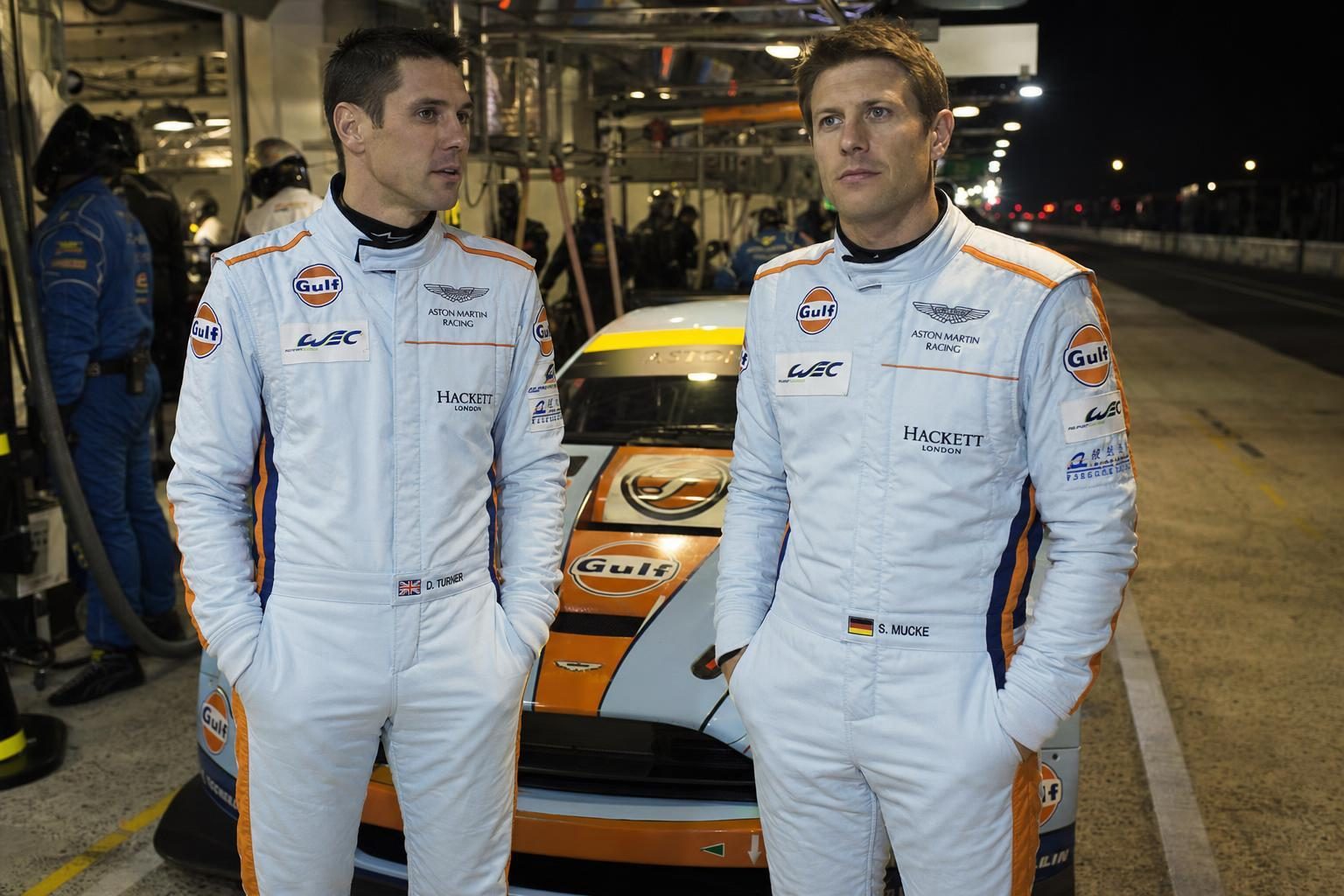
Beyond results, a car is embodied by its drivers. In 2013, Bruno Senna joined the GTE Pro crew, alongside Frédéric Makowiecki and Rob Bell (source: Wikipedia Aston Martin Racing). The Brazilian brought a nuanced reading of endurance pace and useful media credibility to the V8 Vantage GTE as it gathered momentum.
The beating heart of the GTE Pro programme, however, remained the duo Darren Turner – Stefan Mücke, identified as the main axis, joined by Peter Dumbreck at Le Mans 2013 (source: Wikipedia). Turner, a house stalwart, and Mücke, sharp and effective, established technical and human continuity aboard the V8 Vantage GTE.
The brand’s centenary in 2013 provided the setting for this ensemble. For the occasion, two 2013-spec Vantage GTEs were entered in GTE Pro, and two 2012-spec Vantages in GTE Am (source: Wikipedia). A way to celebrate history by fielding both the latest evolution and the initial base, while consolidating presence in Pro and Am.
To slot these figures into Aston Martin’s GT lineage, revisit our overview of the DBR9 and its 2007–2008 Le Mans victories, and, on the road-car side, the genealogy begun by the 2005 V8 Vantage, whose spirit the V8 Vantage GTE translates to the track.
December 2020: withdrawal from GTE Pro and switch to the Hypercar programme
On 23 December 2020, withdrawal from the GTE Pro programme was announced (source: Wikipedia Aston Martin Racing). This marker closed the chapter opened in 2012 and sealed the V8 Vantage GTE’s arc in the World Endurance Championship. Eight seasons of continuous presence, with structuring milestones: a category podium from 2012, LMGTE Am titles in 2014, and a sporting identity refined by reference crews.
Beyond the date, the essence lies in the legacy. The V8 Vantage GTE re-established Aston Martin in a coherent, credible and sustained global GT narrative. It also prepared the public and the team to envisage the next stage of endurance racing, in a technical universe in flux.
Conclusion: what the V8 Vantage GTE fixed in the racing DNA
In eight years, the V8 Vantage GTE did more than fill timing sheets: it set out a method. Return to GT fundamentals in 2012; target efficiency over showiness; turn consistency into a LMGTE Pro podium in the very first season; and finally inscribe a line of titles in LMGTE Am in 2014. Add drivers of high practical value — Senna, Turner, Mücke — and you get a clear, durable imprint.
The V8 Vantage GTE remains Aston Martin’s answer to a simple question: how to build a modern racing identity, faithful to the brand’s spirit, in a global, exacting championship? In GT, with measure and return. That is precisely what the V8 Vantage GTE delivered.
DB2 Le Mans 1950: 3 Races, Ultimate Foundations of the Marque
DB2 Le Mans is no historical frill: it is the moment when a modern Aston was born, in equal parts on the road and on the circuit. From 1949 to 1951, three successive entries sealed a method – prototype even before pre-series, development in competition, immediate feedback to the road model – which would become the Newport Pagnell signature. Here is why these results, sometimes tragic, often brilliant, are far more than a footnote.
Le Mans 1949: three DB2 prototypes as a preview, even before production
Even before its public unveiling and start of manufacture, the DB2 appeared at Le Mans in 1949 as three prototypes. According to the dedicated Wikipedia page (Aston Martin DB2), one was powered by a Lagonda straight-six while the other two received the Aston Martin 2-litre four-cylinder. This dual mechanical path, undertaken from the outset, reflects engineering pragmatism and post-war urgency: move fast, but validate in real conditions.
The race spares no one. Again according to the same source, the Lagonda-engined prototype retired with overheating related to the water pump and Pierre Maréchal lost his life in an accident. A baptism could hardly be worse. Yet this early entry before production shows David Brown’s conviction: the DB2 must be born in the field, not merely on a drawing board.
This gamble placed the DB2 squarely at the heart of a “road through racing” logic. It is not a marketing ploy, it is a development shortcut. Cooling issues, transmission loads, suspension endurance: everything that breaks in the Sarthe feeds back into the fine-tuning of the production coupé.
1950: 5th and 6th overall, class one-two — DB2 Le Mans: what these results meant
In 1950, the tune changed. According to Wikipedia, the DB2s finished 5th (Abecassis/Macklin) and 6th (Brackenbury/Parnell), taking 1st and 2nd in the 3-litre class. For a car from a still-evolving project, it was an eloquent calling card. The overall performance, as much as the authority in class, signalled an extremely sound base: enduring chassis, pragmatic aerodynamics, effective powertrain.
The symbol goes beyond the results column. The DB2 was shown at the New York Auto Show in April 1950 (again per Wikipedia), at the very moment these results legitimised its vocation. The coherence is crystal clear: international exposure of a road coupé, endurance proof over 24 hours. Customers grasped that this “road” Aston shared the essentials with the “racing” Aston, and not the other way round.
The Vantage option also appeared in April 1950 and raised power to 125 PS via larger carburettors and a higher compression ratio, as documented by the same source. Without triumphalism, this was an immediate transfer of know-how: endurance demands breathing and consistency, and the Vantage option distilled a measured yet tangible road version of that.
1951: 3rd overall with Macklin and Thompson, the high point of the series
In 1951, the DB2 turned promise into accomplished fact. According to Wikipedia, Lance Macklin and Eric Thompson took 3rd overall, with Abecassis and Brian Shawe-Taylor 5th. A Le Mans podium is not obtained on the cheap: it reveals a fast car, frugal in mechanical stresses and perfectly exploited by the crew and the team.
This result closed a founding triptych. 1949 defined the testbed, 1950 proved the robustness of the architecture, 1951 delivered sporting stature. In a marque where consistency often reveals more than flash, the DB2 strung together three seasons that anchored a method and a tone. One can glimpse, in filigree, the trajectory that would lead a decade later to the victorious DBR1 in 1959, a subject we detail in our analysis of the keys to the 1959 Le Mans triumph.
Note that road production ran until April 1953, for a total of 411 examples (source Wikipedia). This figure, modest in absolute terms, is a reminder that volume was not the point, but the rightness of the tool: a refined coupé, born of the field, built to endure.
The Lagonda 2.6-litre straight-six: the centrepiece inherited from the 1947 acquisition
None of this without the 2.6-litre Lagonda straight-six, designed by W.O. Bentley. According to Wikipedia, David Brown acquired Lagonda in 1947 and thereby got his hands on this engine which would become the heart of the DB2. It is an architect’s choice: lengthen inertia, gain smoothness, and offer endurance a durable torque rather than a peaky temper.
In the DB2, this unit set the development axis. It withstood the demands of the 24 Hours, inspired the Vantage option and gave the road version a distinct personality: relatively discreet acoustics, progressive delivery, constant pull. The Lagonda–Bentley lineage also brought a mechanical culture in which precision trumps theatrics.
To grasp the importance of this graft, one can place the DB2 within Aston Martin’s history, which we trace here: Aston Martin history, marque and legend. Read between the lines how the 1947 acquisition ordered the present and planted the future, in particular the ability to bind grand touring and endurance.
From DB2 to DB3: how racing directly steered road development
The DB2’s trajectory naturally led to the DB3. Without extrapolating beyond the facts, one can say that the 1949–1951 experience validated a principle: start from a coherent base, reinforce it through racing, and transpose, without folklore, what improves reliability, breathing and high-speed stamina. The DB3 would push the slider towards the track, while the roadgoing DB2 capitalised.
This “dual road/circuit logic” set the DB2 apart from many contemporaries. The car was not simply derived from a competition programme: it lived in a constant back-and-forth between pitlane and workshop. The 1950 and 1951 results – class one-two, then 3rd overall – were not trophies on a shelf, but technical milestones.
The 1950 customer could visit an American show, discover the DB2, read that the Vantage option delivered 125 PS, and, in the same breath, see the same lines circle for 24 hours in France. This unvarnished coupling shaped Aston Martin’s reputation: elegance on the road, endurance in competition. Two sides of the same coin.
Conclusion: what DB2 Le Mans engraved in Aston Martin’s DNA
Beyond the numbers – 5th and 6th plus a class one-two in 1950, 3rd and 5th in 1951, 411 units built to 1953, Vantage option at 125 PS – the DB2 Le Mans story fixed a method. Enter early, learn fast, convert honestly to the road model. Seventy years on, the tune is recognisable: an Aston is judged by elegance, but it is won in endurance.
Rapide S 2013: 6 Ultimate Reasons the Sport Saloon Remains Unequalled
Rapide S, or the quiet assertion of a philosophy: in 2013, Aston Martin refined its four-door sport saloon to create a singular grand tourer, faithful to the naturally aspirated V12 and discreet elegance. This article sets out what the S version genuinely brought to the 2010 Rapide, clarifies its positioning against the usual rivals, and explains why this masterstroke has never found a direct equivalent.
From the 2010 Rapide to the 2013 Rapide S: the 3 key technical changes
First and foremost, power. Launched in 2013, the Rapide S lifts output to 552 PS, according to Aston Martin’s pressroom and model sheet. The mechanical heart remains a naturally aspirated 6.0‑litre V12, the in-house AM28, set within an already proven architecture. The power increase is the most documented evolution and, on its own, redefines the model’s potential.
Second, the continuity of the platform. The saloon is built on the aluminium VH platform shared with the DB9 and DBS, and assembled at Gaydon. The move to the S badge brings no structural break: it consolidates a technical base common to the core of the range, guaranteeing rigidity and weight saving, without denying its grand touring genes.
Third, holistic fine-tuning. With no additional figures published here on aerodynamics or brakes, the essence lies in the overall honing that accompanies the power hike: an evolution by optimisation rather than a change of course. In short, the Rapide S remains a long‑legged Aston Martin, more assured, livelier, still hushed.
552 PS and a naturally aspirated 6.0‑litre V12: engine choice as an identity statement
In a segment won over by forced induction, the Rapide S proudly runs a naturally aspirated V12 of 6.0 litres. It’s a choice of character as much as of engineering: an AM28 with a linear delivery, shared with the VH family, which sets the saloon within the brand’s sporting tradition. In an age of headline‑grabbing spec sheets, it prefers mechanical nobility to showmanship.
This stance sounds and feels different. Where others bank on a tidal wave of torque, the Rapide S offers a progressive climb to the red line, a natural response and a soundtrack you don’t get from a blower. It’s a decision consistent with Aston Martin’s DNA, and one of the pillars of its enduring appeal.
By embracing this V12, the Rapide S positions itself clearly in the realm of the grand tourer rather than a record‑hunting saloon. It speaks of flow, reserve and poise, with 552 PS that seeks not demonstration but unruffled pace.
Four true seats in a 5.02‑metre body: the packaging compromise
With an overall length of 5,019 mm according to Aston Martin’s official data, the Rapide S aims for balance between style and usability. The stretched profile makes room for four real seats and a usable boot without tipping into a monolithic silhouette. It’s a delicate compromise: lengthening without burdening, accommodating without distorting.
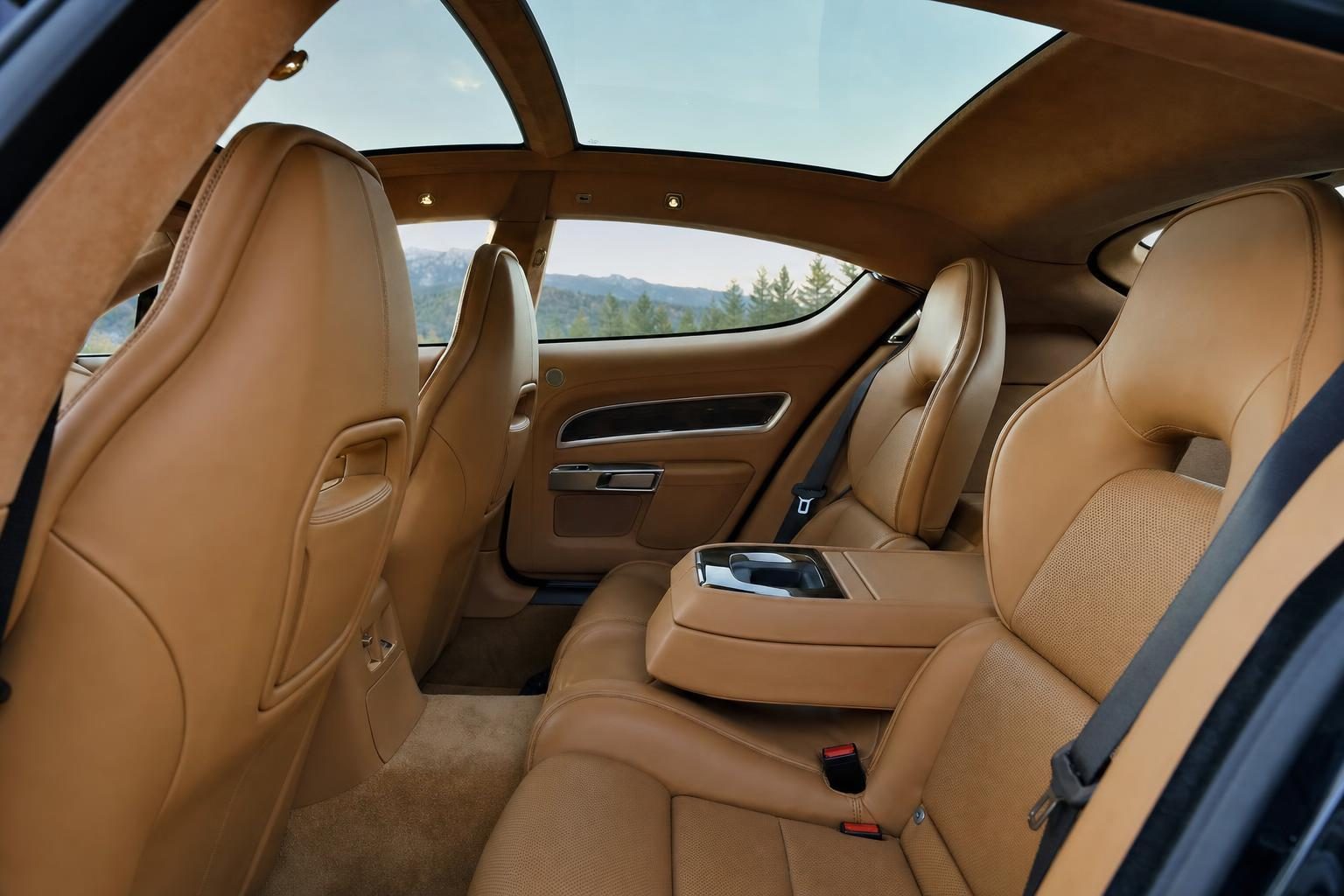
The VH base, common to DB9 and DBS, allowed a low, taut profile despite the four doors. Inside, you find a true 2+2 conceived for travel, where the rear isn’t a mere occasional bench. Here, the sport saloon reads first as an elongated coupé, faithful to Gaydon elegance.
This architectural choice illustrates the Rapide S’s calling: not a traditional English limousine, not an ostentatious fastback, but a four‑door GT built to devour distances. A way of standing apart, in both form and function.
Rapide S versus Panamera Turbo and Maserati Quattroporte: a hard segment to defend
Up against the go‑to references – Porsche Panamera Turbo, Maserati Quattroporte – the Rapide S plays a different score. It doesn’t stack technologies to beat the clock; it asserts a grand touring proposition centred on a naturally aspirated V12, aluminium construction and a silhouette that prizes momentum.
Compared with these rivals, the Aston Martin saloon sets out another scale of values: an old‑school engine (in the best sense), a platform shared with the in‑house coupés, and a design that seeks purity rather than maximum functionality. On paper that can look like a weakness; on the road, it’s character.
Indeed, the Rapide S occupies a territory where coherence trumps one‑upmanship. It speaks to those who want a four‑door Aston, not a generic sports saloon. The market sometimes looked puzzled; enthusiasts saw a welcome rarity.
Production ended in 2020: why the saloon line had no successor
Rapide S production ended in 2020, with no direct four‑door successor announced. In the meantime, diversification happened elsewhere: the DBX, launched in 2019, opened Aston Martin to a broader SUV market, with the commercial appetite we now know.
This shift reflects a strategic priority. The Rapide S was a statement of style and engineering – N/A V12, aluminium VH, elegant four doors – while the DBX answers robust global demand. On one side, the singular piece; on the other, the range’s foundation. The decision is clear without denying what the saloon represented.
Still, history will recall the first four‑door Aston Martin since the 1930s, reinterpreted in the 21st century. An important milestone in the marque’s official timeline, and a parenthesis that deserved to exist in full.
Current market and collecting prospects for the Rapide S
In the landscape of prestige youngtimers, the Rapide S advances non‑negotiable strengths: a naturally aspirated V12, aluminium architecture shared with the marque’s GTs, and production ending in 2020. As turbocharging and electrification redraw the offer, this profile grows more desirable.
Demand is coalescing around clear criteria: the mechanical configuration and the authenticity of the Aston Martin experience. The lack of a direct successor bolsters the appeal of a model with no strict equivalent in today’s range.
For anyone seeking a different grand touring saloon, the Rapide S is a credible entry point into the Aston universe, with that extra soul only a V12 brings. Connoisseurs know it: some cars gain in use‑value before they gain in value, full stop.
Conclusion: why the Rapide S remains a lasting exception
From 2010 to 2013, the story pivoted on a simple, decisive adjustment: 552 PS and a confidently naturally aspirated V12. To that, the Rapide S added the elegance of four doors and the rigour of the VH platform, to sign a singular GT. Faced with more demonstrative alternatives, it chose measure and fidelity to Aston Martin’s DNA. That is precisely what makes it unique today, and likely desirable tomorrow.